Saturday, 8 June 2013

The 4 Minute Shower

Water is a precious commodity in Australia. For all of the years we have been  living in Europe, most of the country has been in the grip of severe drought. The highest level of water restrictions applied for years where my sister lives, so you have designated times when you can water your garden (unless you use grey water, in which case you need to post a notice out the front of your house that you are recycling water, or your neighbours will dob you in to the authorities for watering outside the alloted hours). You are not allowed to wash your car or top up swimming pools.


People are encouraged to take timed showers, limiting themselves to 3-4 minutes. Kids are educated in waterwise ways and recruited to monitor their family's showers. Local authorities will hand out shower timers such as this one in a friend's bathroom so it's easy to know how long you've been running the water.


Personally I find a 4 minute shower easy to achieve, unless I'm washing my hair (then I need 6 minutes).

Friday, 7 June 2013

Frost Free and Fancy

This has been a particularly spectacular year for orchids, and the peak season still has more than a month to go. All the wild orchids have appreciated the cool moist conditions, flowering generously in response to the first really consistently wet spring for a decade.

Two species in particular have benefitted, not just from the rain, but from the relatively high minimum temperatures over the last 6 months. It has been a miserable winter and spring from the point of view of many rainy days and not much sun, but it has been the maximum temperatures which have been low, not the minimums. There has been remarkably few frosts, and for the frost tender species who have had to struggle through the unusual periods of snow and frost of the previous few years, this is as much a relief as the rain.

As a consequence, this year the Greater Butterfly Platanthera chlorantha and the Monkey Orchis simia Orchids are both putting on better shows than we have seen for about 5 or 6 years. These are both common roadside orchids that have been notable by their relative absence for a few years, and are making a very welcome return this year. In a good year, the colonies of Monkey Orchids are very noticeable as crowds of pink flower spikes in the grass. The Greater Butterflies are more discreet, but groups of their starry spires are easy to spot on grassy banks once you know what to look for.

Thursday, 6 June 2013

Steve Drags His Heels

Long time readers of this blog will be familiar with Steve, Son of Steve and the Pseudo-Steves. For those now completely mystified, they are Siberian Irises.

Just now they are putting on a lovely show in both the front courtyard and the back garden. Well, all of them, and their Bearded Iris mates, except Steve. He is obviously saving himself for a big finale to the iris flowering season, and is going to flower after everyone else. So tant pis, he misses out once again on being on the blog. His place is taken by one of the Pseudo-Steves, looking magnificent.

One of Steve's beardy mates.
************************************************************
Nature Update: Yesterday was haymaking central in the Val de la Claise Tourangelle. Everywhere I went for my butterfly survey there were men out on tractors making or carting newly made hay. Somewhat worryingly, I saw more orchids than butterflies on my survey, both in terms of species and total numbers. A fuller report with photos will follow next week if I get time.
*************************************************************
Steve Update: Steve obviously felt I was maligning him, and came out very early this morning. As a result I photographed him at about 7.30 am and can now present him (sadly, not in his true colour, which is more like the dark veins in his throat markings, but the camera doesn't cope with the colour of his petals -- he is a shade or two darker than the Pseuds in reality).


Wednesday, 5 June 2013

Stinking Orchids

The locals, even my French botanist friends, do not regard Lizard Orchids with much fondness. When we go on orchid outings, Lizards are rarely recorded. In fact they are common here, but they are dismissed as nasty stinking things by virtually everyone.

Lizard Orchid in our neighbour's orchard.
Their French name translates as 'billy goat orchid'. It's rather a shame, because while they certainly can smell off-putting (like unwashed bottoms I always think) it varies considerably from plant to plant, and on the temperature. Mostly they are not very scented at all, but local people dislike them and don't find them attractive. This means they are frequently mowed off in their prime.

Personally, I love them. They are tall and a most unusual colour - a sort of silvery purple, with festive twisting streamers. I wonder what can be done to make the French love their Lizards? After all, in some places this is a rare orchid, cherished and protected.

If you want to learn more about Lizard Orchids, please go the species account on Loire Valley Nature.
**********************************************
Botany Club Outing: There is a general botany outing on Sunday 9 June to look at cornfield plants on Dominique Tessier's organic farm La Morellière at Saint Laurent de Lin. Contact me if you want directions -- it is north of Langeais. Meet at Dominique's house at 10 am, or 2.30 pm if you only want to attend for half the day. Bring a picnic.
****************************************************
All Safe on the Mammarian Front: I went for my follow up check yesterday in Loches, after my mammogram in March found a small spot in my left breast. I am happy to report that the spot has disappeared and the diagnosis is that it was probably a cyst (pronounced 'kist' in French). The doctor I saw was of the kindly, reassuring, grey haired variety and explained to me, when I asked, that the dozen or so bright white 2-5mm diameter dots that show up on my x-rays are calcium deposits, and entirely normal for my age. They are the remains of previous cysts that have dried up. A cyst is a capsule of fluid that appears on the x-ray more like a pale blob.
****************************************************
Film Suggestion: If you like to practice your French by watching a film now and then, you could do worse than I Love Périgord. Despite the English language name, this is a French film made by French film makers. Occasionally the dialogue switches to English, as some of the characters are English, but then it is subtitled in French. It is the French poking fun at the English and the French in equal measure. It's not the slickest rom-com around, but Bernard Le Coq as Adémar (the father) is very good. It's nice, fun, quite silly light entertainment.
****************************************************
Orchard Update: The nectarines are coming along nicely, as are the pears and apples. The cherries, which will be the first to pick from the trees are still green marbles, but in reasonably good numbers. No plums or peaches to speak of.

To my surprise, the whole potager is fragrant. I couldn't see anything flowering that I thought could be responsible, so in the end I decided it must be the strawberries. I picked about a kilo of strawberries yesterday. The strawberries are the most maintenance free plants ever. I don't even bother to weed them and never water them. This year I am pleased to note that there is at least one bumble bee nest hidden in a hole amongst the strawberry leaves. I'm worried about the grape vines though. The leaves don't look totally healthy -- I suspect mites. 

The Bee Orchids are everywhere and flowering like mad. The most exciting orchid news is that I discovered a new Pyramidal Orchid, completely at the opposite end of the orchard to the other little group. This is a protected species, so it's a particular thrill to have it coming of its own accord. Unfortunately, I only noticed it after I had stood on it. That was a downer, as it was just about to flower.

I spent a couple of hours yesterday hacking weeds off in their prime. I don't have time to pull them out, so I'm hoping cutting them off before they can seed will help. The vegetables I've planted out all appear to be thriving (potatoes, tomatoes, aubergine, zucchini, peppers, chilli, celeriac, celery and leeks).

Tuesday, 4 June 2013

Lansyer's Loches

Emmanuel Lansyer 1835-1893 was considered the second best landscape painter of his generation (after Corot), but he is hardly a household name today. He began his career as an architect, working for Viollet-le-Duc. Later he studied painting under Courbet and then Harpignies. When he was 29 he switched careers to become a landscape painter, and by the end of his life was widely recognised as talented painter of some merit.

La Tour Saint Antoine from the terrace of the sous-préfecture (that is to say, from the terrace below the Agnès Sorel tower of the Logis Royal, which used to be the sub-prefectural office). I think you could just about get this view without having to step into fresh air, but I think you might have to lean to the right quite a lot, and the terrace is nowhere near as extensive as the painting shows.

The Tour Saint Antoine taken from the artist's garden ie from the other side of the citadel, but looking in the same direction.
His family home in Loches was gifted to the town and is run as a museum dedicated to his memory and works. The house and garden are charming, and very thoughtfully presented. The staff clearly love the place and are delighted when foreign tourists take the time to visit. The museum is free and the views from the garden spectacular as the house is on the citadel, right next to the medieval gateway (known as the Porte Royale) .

The Porte des Cordeliers with the Logis in the background, from Les Cordeliers.

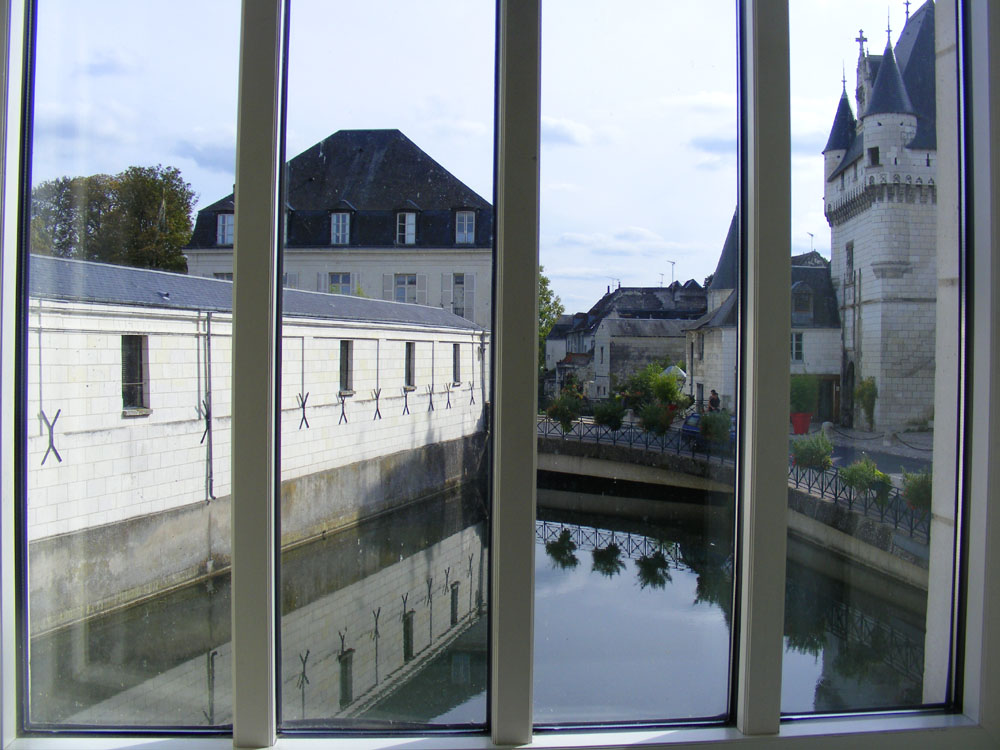
A photo through a window in Le Moulin des Cordeliers (now holiday apartments) with the Porte des Cordeliers on the right.
I was going to post Simon's photos of some of Lansyer's works and then search out the modern view in our photo collection. However, I very soon realised that Lansyer adjusts the view to suit his composition. In most cases it would be impossible to stand where the artist purports to be doing so. Hence, I have chosen to show three of his works and three similar views taken by us in the last few years.

The Chateau of Chenonceau. I doubt if you could get this view even if you were on the river. It is supposedly from the river bank.

The Chateau of Chenonceau.
We liked his paintings a lot. They weren't the cutting edge of creativity, but they were extremely competant, and his architectural background is very evident and used effectively. Perhaps a bit much sienna brown in the palette for my taste, but you can say that about almost any landscape painter.

Monday, 3 June 2013

Wildlife Watching in the Touraine du Sud in June

Wispy lavender blue Bellflowers Campanula spp and deep blue Meadow Clary will be in abundance on roadsides. Meadow Clary is easily as garden worthy in appearance as its fashionable South American Salvia cultivar cousins, but its strict requirement for very chalky soil means that it doesn't transfer well to the garden.

Nettle-leaved Bellflower C. trachelium, one of the less wispy and more robust species.
Drifts of shocking pink Perennial Pea appear in the grass and spires of Foxgloves on the edges of woodland.

Somewhere in between the two, rich purple vetches rise up roadside banks and tumble down ditches.

By early June the scarlet coloured Field Poppies will really be getting underway. It seems to me no wonder that these flowers have been associated with remembrance and rebirth since at least Egyptian times. Their enthusiastic return year after year cheers everyone up.

The average maximum temperature in June is 23C. It is the driest month, at only 46mm average rainfall, delivered on just 7 days of the month. We should get more than 200 hours of sunshine. Here's hoping!

Sunday, 2 June 2013

Big Egos

One of the product ranges I miss from Australia is Ego skincare. What I like about them is that they come in big reasonably priced pump action dispensers, which just don't seem to exist in France. The largest size pump action skin lotion I've found is a 400ml Nivea product, and I've never come across a sunscreen in this style of pump action. The Ego skin lotion is in a 1 litre bottle and the sunscreen in a 500ml bottle.

Saturday, 1 June 2013

Australian Old Growth Forests

While we were in Australia the Tasmanian Forest Peace Deal was signed. Activists hoped that it would be an end to a long fight to protect the old growth forests from unacceptable exploitation. This fight has been going on for all of my life, and still the logging companies and the hydro-electric companies are allowed in to wilderness areas to destroy everything. The Tasmanian government seems wilfully unaware that there are other ways of managing forests and other ways for local people to earn a living besides working for largescale unsustainable forestry employers whose approach is to clearfell natural forest to produce large volume low quality products.

It appears that it is not the end though. The Tasmanian government has still not adequately protected some areas and species, and may still choose not to submit a request for the World Heritage Status to be extended over the forests to the east.

Wet old growth eucalypt and tree fern forest in New South Wales.

There is a fine small scale specialist timber industry in Tasmania which is desperate to see the situation improved, but as one of the artisan furniture makers said, it's now too late for a couple of the really high quality furniture timber tree species -- they've been cut down along with all the others and made into plywood (and until recently, pulp!!).

The focus on Tasmania may mean that old growth natural forests in Western Australia, Queensland and New South Wales are quietly being destroyed too, while they are out of the public eye. The whole situation is one of the saddest conservation struggles I know. Old growth natural eucalypt forest, particularly the wet forests such as in Tasmania and New South Wales are amongst the most inspiring and special places on Earth (see my 2009 post on visiting a valley full of tree ferns, and Ian Fraser's post on Monga NP). It is perfectly possible to manage them sensitively for the benefit of people and the environment. Unfortunately, I think the compromises made by both sides of the Forest Peace may result in aspects of the agreement not being met. Once that happens it will unravel very quickly and we will be back with the vitriole and the destruction as a modus operandi.
*****************************************
Weather Update:  No wonder we are all feeling miserable and complaining about the weather. Following a particularly sun free March and April, May has turned out to have had the lowest levels of sunshine on record. We had 142 hours, when the average hours of sunshine is 210 and two years ago we had 311! Normally I would be picking grape leaves to make dolmades, and thinning flower buds on the vine. With the cold dull weather, the leaves aren't big enough, and there is no sign of flower buds.

Friday, 31 May 2013

Turbulent Times in Azay-le-Rideau

I've delayed posting these photos of the Indre river at Azay-le-Rideau because we wanted to show the spring 2011 counterpoint photos. A week ago the water was swirling and raging through Azay-le-Rideau, churning over the weir by the bridge.

This time two years ago, you could easily have walked across the weir without getting you feet wet, but you will have to trust me on that. I cannot find the photos, even after several hours of increasingly frustrated searching.

It seems to us that the water is exceptionally high, but in fact the levels are coming nowhere near the flood markers from past years. If you are in Azay-le-Rideau, stand on the bridge and check out the flood markers on the boathouse steps. The water has been at least a metre higher in the past, and significantly higher that it is now on at least half a dozen occasions.

Update: Colin has sent me a link to his blog with a photo of the weir completely exposed.

Thursday, 30 May 2013

Saché's 'Secret'

Saché is a picturesque village known for being the country retreat of 19th century French writer Balzac. Much of the tourist focus is on the chateau he stayed in and the sites in the surrounding Indre valley that he made the setting for scenes in his novels.

But Saché has another famous past resident, and a souvenir of his time here is in set in plain view in the middle of the mairie carpark. Recently we stopped here with some art loving American clients. They were astounded to see that it is safe to erect a work by Alexander Calder as a piece of public art in such an out of the way place. The standing mobile is not defaced by grafitti, shot up by rednecks or stolen by scrap metal merchants.
One of the truly wonderful things about France is the abundance of art that you can get right up close to. It is presumed that members of the public will respect the works, and the authorities see it as their responsibility to encourage the arts at all levels. French curators are not keen on ropes and barriers, and there is an expectation that the general public are interested and educated when it comes to viewing art.

American artist Alexander Calder loved Saché and his estate endows a foundation which allows artists to live in his house here and spend three months working whilst supported by the foundation. He had spent the late 1920s and early 1930s in Paris, and later, after he was married, bought a house in Saché. His wife was Louisa James (related to the writer Henry James, who also loved France). By the 1960s he was internationally famous and living in the Touraine full time. During this time he constructed a studio and then a house overlooking the Indre valley. Between them the couple made many of the household objects -- she hooked rugs to his designs and he forged pans and cutlery for the kitchen. He died in 1976, and she 20 years later.

Wednesday, 29 May 2013

Glory in Glass

Not much really old stained glass survives in the Touraine (and very little in situ). This area has been a battleground for too much of its history. The Protestant iconoclasts in the 16th century Wars of Religion did much of the damage, but the Revolution in the late 18th century, the Prussian War in the 19th century and the Second World War in the 20th can all take their share of the blame. Almost all of the stained glass you will see now is 19th century, and some of the surviving older glass has been moved from its original surrounds.
The church in the lovely village of Montrésor is one of only half a dozen that I know of which retains some of its medieval or renaissance glass. It was commissioned by Imbert de Bastarnay (grandfather of Diane de Poitiers) and built between 1519 and 1541 in the gothic style. The window over the altar is a rare survival from that time, and depicts the Passion and the Crucifixion. At the other end of the church the gable above the entrance was opened up in the 19th century to take some very beautiful renaissance era windows that were formerly part of the choir screen (not shown here). The colours in both sets of windows are rich, intense and jewel like, far less flat than their 19th century counterparts. They are truly striking windows, and doubly so because of their rarity.
Considered a very fine example of a Renaissance building, the church is open every day.
Our medieval historian friends Niall and Antoinette have written more fully and more knowledgeably about the church here.

Tuesday, 28 May 2013

Black Farm Chickens

Preuilly is blessed with an excellent butcher, who I use regularly. A few weeks ago I bought two chicken legs from him for our dinner. I asked for deux pattes de poulet, just as I had heard an old lady doing a week earlier. Just as he had done with the old lady, the butcher repeated the request as deux cuisses de poulet. Whole chicken legs are usually referred to as cuisses, even though the word actually means thigh. Pattes de poulet makes more sense (chicken legs) except that pattes is frequently used to just mean feet. In fact, when I overheard the old lady, I was intrigued, because I assumed she was buying chicken feet. The butcher got out a new waxed cardboard box and opened it up to get her order -- deux cuisses de poulet.

Whether they are pattes or cuisses, they are a top notch product. They are Label Rouge, a trusted French quality accreditation system, and are black farm raised chickens from the Loire Valley. Not the famous Dame Noire or Géline de Touraine breed, but I think very like. The meat is as dark as duck and the drumsticks have vestiges of the black feathers. On the label it tells you that the chicken has been raised on the farm in the open air and killed at a minimum of 81 days old. Its origins are traceable up to the point of sale, and each piece is numbered. Two legs weighed 570 g and cost me €5.42 (at €9.50 / kg). They did two meals for two.

And in case you are wondering how I cooked them, they were marinated in soy sauce, pineapple juice, ginger and garlic then slow cooked in the oven over a bed of vegetables, with the marinade forming the pot liquor. I served them with buckwheat noodles.
***********************************************
Orchard Update: Yesterday I planted tomato, aubergine, pepper, chilli, celeriac, celery and leek seedlings in the potager. We had two warm sunny days in a row and it seemed like my last opportunity for a while. The bees of all species have been going crazy the last two days. The paulownia was seriously buzzing, as were the gardens of Chenonceau and Cheverny the day before. They obviously think it is their last chance for a while too. I roughly dug part of a new bed, maybe for green beans, and I picked the first few strawberries. It looks like this year will be the strawbs swan song, so I need to be thinking about creating a new bed for new strawberry plants. With the damp weather at the moment I am losing more fruit on them than is ripening enough to pick. The Early Spider and Lady Orchids are coming to an end, starting to look faded and past it. The Bee Orchids are spectacular -- they seem to be a particularly deep pink this year. Still to come, and budding up nicely are the Pyramidal and the Lizards.

Apparently it is the wettest spring since 2008 and the coldest since 1987.

Monday, 27 May 2013

We Won't be Going That Way!

Last Thursday we had intended to go from Chinon to Azay-le-Rideau along the river. On the day we were foiled by flooding as shown above, so we turned onto the route that takes you through the army tank training base in the forest. No go here either, as the army were out and shooting. We took the deviation as directed, skirting around the edges of the base. A perfectly pleasant drive, so our clients were not disappointed and we were all amused by the sentries in their camouflage gear topped by hi-viz vests.

Sunday, 26 May 2013

Freddo Frogs

Freddo Frogs and Caramello Koalas -- classic Australian kid bait (or as I see Cadbury refers to them, 'pre-teens confectionary').

They need to be consumed fridge cold in my opinion. They aren't proper chocolate of course (being about 30% sugar and only 23% cocoa solids), so chilling them doesn't cause any more distress to food snobs than simply eating them in the first place. I am pleased to see though that when Cadbury switched a proportion of the product's cocoa butter to palm oil, sales suffered and they switched back in 2009.

When Sarah Turnbull, author of Almost French, married a Frenchman called Frédéric, he was (perhaps inevitably) quickly dubbed Freddo by her Australian family.

Friday, 24 May 2013

Where the Wisteria Grows

Wisteria trained across a tuffeau building always makes a picturesque scene. They flower here in May - June and are just beautiful. This one is in Montrésor and the building is a troglo under the chateau.

Susan

Thursday, 23 May 2013

Philippe Lesbahy's Bedchamber

Like her counterpart Katherine Briçonnet over at Chenonceau a few years earlier, Philippe Lesbahy spent several years supervising the building of one of the jewels of the French Renaissance. Both women were married to financiers who worked for the king and so were often away, leaving their wives in charge of building their beautiful new riparian status symbols in the early 16th century.

Philippe Lesbahy's bedchamber, with newly recreated canopied bed and rush wall treatment.
Sadly for Philippe, her husband and his family turned out to be wrong-uns, caught embezzling state funds, and despite her pleading, she was forced to abandon the Chateau of Azay le Rideau before it was finished.

Now owned by the State and one of the historic properties expertly run by the Centre des Monuments Nationaux, it is perhaps the least well known of the big name chateaux in the Loire Valley. That's a shame, because the curatorial staff there do an excellent job and every year the presentation of the chateau features something new and exciting. They manage to be serious and scholarly perfectly combined with charming and fascinating.

The new rush matting in the Oratoire.
Their previous big project was to restore and open the roof spaces. This year they have recreated a Renaissance bedchamber, carefully based on historical sources, which they explain through the use of information panels, original paintings and a video. I knew the project was underway and involved creating new hangings for the bed, but it is much more than that, so it was a magnificent surprise to see the finished rooms when we took our first clients there in March.

Taking their cue from a well known portrait of a royal mistress in the bath, the curators have commissioned hand made rush matting from an English artisan who is one of the few remaining professional rushworkers in Western Europe. The painting shows the walls of the room the woman sits in as lined with rush matting. The chateau sadly does not have the original painting on display -- that's in Washington -- but it does have a 19th century version that you can get extremely close to and scrutinise for details.The actual braiding pattern for the matting is based on a fragment found at Hampton Court Palace.

Detail of the rush matting.
The matting is made from true bulrush Scirpus lacustris (not reedmace Typha spp, which is commonly called bulrush), which in Philippe's day would have been harvested from any of the local rivers or wetlands and worked by a local artisan. It is plaited into long strips then sewn together to form a mat. Its lifespan isn't all that great on the floor, and it would have been treated as sacrificial -- strewn with aromatic herbs to keep it fresh smelling, but removed and burnt once too dirty, worn through or the population of fleas it harboured got unbearable. Because it was 'modular', clean unworn strips from the edges of rooms could be salvaged and combined with new strips when the floor covering was replaced.

Detail of the scalloped hangings echoing the decorative wooden bed frame.
Rush matting was a relatively cheap and easily available alternative to expensive carpets and tapestries. The purpose of all of these soft furnishings was to prevent cold radiating from the stone walls and to deaden sound in large echoing rooms. Housekeeping was easy -- dirt mostly just falls through, but it is a good idea to periodically mist with water to keep the rush in good condition and pleasantly aromatic.

The luxurious bed, with all details based on historical examples.
In addition to the rush matting, the curators have taken a 19th century Renaissance revival style carved bed and dressed it in recreated Renaissance hangings and soft furnishings. It is lush! Rich purple silk velvet has been trimmed with braid. Bolsters and cushions based on various historical references have been created and trimmed with gorgeous passementerie. Everyone concerned has done such a good job with this room. It will be a real attraction for the chateau, and I hope they are all immensely proud of it.

Wednesday, 22 May 2013

Vachement Fleurs !

The name of this shop in Sainte Maure de Touraine made me laugh. That is because to me, vachement is a word I use in French when if I was speaking English I would use 'bloody'. It's an emphasiser, so if you are translating vachement less vulgarly, you can say it means 'really'. Its literal translation is vache = cow, and the ment ending in French is the equivalent of 'ly' on an English word. So vachement is 'cowly' in English – not a real word, and anyway cows just don't evoke the same connotation in English.

C'est vachement bien !  That's bloody good!
Vachement chouette ! F'ing cool! (literally 'cowly owl'!!...)
La vache !  Holy Cow!

Reverso has some more examples of how you might use vachement in French here.
****************************************
Botany Club Outing: There is a general botany outing to the area around the hamlet of Vaux near Sainte Maure de Touraine on Sunday 26 May. Meet at 2.30 pm in the Passerelles carpark in Sainte Maure (the former parking des 4 routes).
***********************************************
Loire Valley Nature Updates: The Grizzled Skipper Pyrgus malvae entry has been updated to include links to Roger Gibbons' Pyrgus spp identification pages and illustrated keys.

Tuesday, 21 May 2013

Botany in the Rain

L'Association de Botanique et de Mycologie de Sainte-Maure-de-Touraine went on an outing to the forest on the privately owned estate of the Chateau des Ormes in Vienne on Saturday afternoon. It started to rain just before lunch and by the time I left home to drive up to Les Ormes the roads were awash with sheets of water flowing across in many places. It rained more or less heavily for the entire afternoon in Les Ormes and we were all soaked to the skin by the end of the outing.

We were met in the carpark near the mairie by Catherine, a member of a 'Friends of the Chateau des Ormes' type of group, who directed us around the park and gave us a background history of the place. The chateau (which we barely glimpsed) sits in an estate of 800 ha, divided into 4 farms. The perimeter wall is vast, and runs for several kilometres along the D910 just outside Les Ormes. It belonged to the Marquises d'Argenson, but when the last Marquis died in 1975, the family broke up the estate and sold it.*

The chateau is now owned by a gynecologist from Paris and his wife, who have apparently done a wonderful job of restoring it, and you can hire rooms for receptions or conferences. The farms were bought by the tenants and other local people bought small parcels of land.

Much of the layout and look of the estate dates from the 18th century, when Count of Argenson, Marc-Pierre de Voyer de Paulmy, purchased the estate. Although highly placed at court, he had made an enemy of the King's mistress Mme de Pompadour and was told in no uncertain terms to restrict his activities to improving his country estate and not to appear at Louis XV's court. He entered into the work with vigour and wide ranging interests, as befitted a true disciple of the Enlightenment. 

His son, the Marquis d'Argenson, continued in the same vein and many of the trees in the forest are the descendents of trees he introduced. In the 1770s, he was one of the first to plant London Planes and Lombardy Poplars in France. He also built a vast horse training facility and the first veterinary school in France. For an idea of the scale of building works, see our previous post on the Poste aux Chevaux at Les Ormes. When the Duke of Choiseul was banished from court and began a similar programme of ambitious construction and improvement on his estate near Amboise the two men developed a friendly rivalry. (The last two paragraphs are a distinctly potted history, but the intrigues of the 18th century French court are way too complicated to go into here.)

This forest is the only place in France I have been to which has a really impressive display of Bluebells covering the forest floor. Bluebell woods are one of the great glories of the English countryside, but they are much rarer in France (probably because they don't really like the poor shallow chalky soil of the Parisian Basin). These Bluebells were coming to the end of their flowering season, but looked as if they could be 'the real thing' ie Hyacinthoides non-scripta to me. However, given the cursory attention paid to them by Jean and François, I think they must be naturalised hybrids. In England, and I assume in France, 'true' Bluebell woods are under threat because of introduced Spanish Bluebells H. hispanica. The Spanish species is the commercially available type, widely planted in gardens. It escapes into the wild and hybridises readily with the native Bluebell to produce H. x massartiana. Scientists estimate that genuine native Bluebells will be extinct in Britain in the next few years, as almost all plants turn out to be hybrids now. This is a shame, because the native species is a deeper, more impressive blue, with more elegant, scented flowers. The hybrid plants lose colour and scent. Distinguishing the hybrids and the species is considered rather difficult. The flowers themselves and the flowers spikes have a slightly different habit, but I find checking the anther colour is one of the most important characters to check. If the pollen on the anthers is white you could have 'true' Bluebells, if it is blue you definately have hybrids or Spanish Bluebells. You can also check if the flowers are only on one side of the stem, and if the petals curl back tightly -- if not you don't have the 'real thing'. We are on the southern edge of the 'true' Bluebell's natural range here and the species is protected.
Walking through the forest was as wet as it could be. Much of the vegetation was bowed down with the weight of water and everything, including us, was dripping.
A lot of the grass had a fungus called Epichloe typhina. It may be particularly prevalent this year because of the cool start to the year, as it prefers such temperatures. It is known as choke disease and will ultimately weaken the grass' productivity by preventing it from flowering. This particular species is not host specific, so will infect many types of grass.
We came across several species of elm. Les Ormes means 'the Elms', so I was pleased to see actual elms in the forest. They are now very rare due to a disease which swept Europe in the 1970s and 80s. However, Catherine informed us that Les Ormes is actually a corruption of Les Hommes, and the name of the town is a reference to it having been a busy crossroads, a gathering place for men (particularly men at arms or soldiers). Nevertheless, seeing elms is a treat, and André did his best to capture a good photo of a White Elm Ulmus laevis. In the wet with low light it was pas terrible though.
On the way back to the cars we encountered a female Agile Frog Rana dalmatina, no doubt enjoying the weather more than we were. Apart from the ubiquitious Green Frog group, found in every ditch and pond, these are our most common frog, and found in damp woods and grassland rather than near water. I tried to photograph a number of insects glumly hanging from the abundant Rough Chervil Chaerophyllum temulum while they waited for the rain and cold to stop. For once I had (enforced) co-operation from my subjects, but the light level was so low I still didn't get a single good photo.

Catherine took us to see one of the farms, a great square of buildings surrounding the basse-cour (farmyard) and housing the farmer and his family, poultry and machinery. It was situated next to an ancient ford across the river Vienne. A walled ramp led down to the river and the riverbed is apparently paved, but it certainly wasn't shallow enough to get across now. The river is running high and fast, and gets very deep just beyond the ford. I wonder how they managed in the old days in years like this, where the river cannot have been traversable for about 6 months? Eventually, in the 19th century, the townspeople raised a public subscription and had a bridge built in the town further upstream, but up to then I suppose you were stuck, as I don't think crossing by boat would have been practical either. There was a fee to cross at the ford, which varied depending on whether you were walking, riding or on a cart and whether the cart was loaded or empty. A ford is un gué in French, pronounced like 'gay' but keeping the vowel sound short and sharp.
*I was interested to hear the verb demorceler used by several people to describe the breaking up of the estate. The online Larousse dictionary doesn't list it as a word and a Google search directs you to the page for morceler, which Larousse defines as 'to divide something into several parts eg morceler un héritage'. However, if you simply search for the word demorceler you get clues that it is an old word, synonymous with morceler, and still used from time to time by historians and (surprisingly) on an IT forum.

Monday, 20 May 2013

A Bit of a Stink

Don't be surprised if you encounter what appear to be flying iridescent black marbles in the woods at this time of year. If you see one, you are likely to see several, if not dozens, all heading in the same direction in a crazy out of control sort of way.

A crowd of Dor Beetles and other coprophagous
insects working on dung in the Brenne.
These are Dor Beetles Geotrupes sp, Europe's largest earth-boring scarab, and they are speeding to the latest bovine deposit, irrestistibly attracted by the smell wafting through the air. Once they've arrived at the source of the aroma, usually a nice fresh cowpat on the edge of the forest, they set to work digging and burying the precious manure. Ever noticed that cowpats are pitted with small holes? Well that is the work of these beetles, taking down pieces of dung into the ground. Both the adult beetles and their larvae eat dung.

They will lay their eggs in the middle of a lump of dung 20-60 cm underground. In time the larvae will hatch into the midst of a ready meal. What they don't eat and what they excrete goes on to be further broken down by fungi and bacteria and fertilizes the surrounding vegetation. Without these marvellous beetles we would be knee deep in excrement in no time flat.

Sadly, their numbers are declining, as almost all cattle are treated with ivermectin, a chemical administered to control worms in the guts of domestic grazing animals. Unfortunately, the still active ivermectin is subsequently expelled along with all the incompletely digested grass and hay. Unknowingly, the adult Dor Beetles are poisoning their young by providing them with contaminated dung.*[see update]

A close up of the action.
Along with Cockchafers, also in decline because of modern agricultural pesticides, the Dor Beetles are a major prey species for Greater Horseshoe Bats, and the decline in the beetles is leading to a decline in the bat population.

Although Dor Beetles are Geotrupidae, rather than Scarabaeinae like true dung beetles, their role in the landscape is very similar. As Alex Wild points out on his fantastic blog Myrmecos, 'there are as many species of dung beetle as mammals. Think about that!' And if you need a bit of laugh (don't read while eating your lunch, btw) Bug Girl wants to know if that stool is taken. I can remember my father receiving little boxes of dung beetles for distribution around our cattle paddocks in Victoria in the 60s, and for a more serious look at the introduction of non-native dung beetles (including 2 French species) to Australia to deal with the non-native cattle dung, check out 'What to do with too much poo' in Cosmos.

*Update: my father has emailed me to point out that I have been somewhat cavalier in my condemnation of ivermectin. For a start, I should have referred to avermectin, which is the active ingredient in question. Ivermectin is the brand name of the most well known product containing avermectin. Secondly, the jury is still out regarding how much of a problem avermectin is in the field. It seems to be complicated, with different toxicities at different times for different species in different places. Here are some links to scholarly papers on the subject: Field Effects of Ivermectin Residues on Dung Beetles (Lumaret et al, 1993); Dung Beetles (Coleoptera: Scarabaeidae and Geotrupidae) in North Carolina Pasture Ecosystem (Lastro, 2006); Dung Beetles (Coleoptera: Scarabaeidae and Geotrupidae) in North Carolina Cattle Pastures and their Implications for Pasture Improvement (Berthone, 2004).