Saturday, 5 October 2019

Catching the train from Spain.

A month ago Susan and I travelled from Donastia - San Sebastian in Spain to Saint Jean de Luz in France. There are a number of ways of doing this, but I decided we should do it the way a local would - by catching the metro to Hendaye, and the bus from there.

The Donastia Metro is run by Euskotren, the Basque railway. The trains are new, and run on narrow gauge lines across the Basque region - and that includes across the border into France. The fare from Donastia to Hendaye is 2€65 for a 40 minute ride and the scenery is spectacular - where you can see it. Because the mountains meet the sea much of the line runs through tunnels, and you just get tantilizing glimpses of mountains on one side and the sea on the other.


The goods yard at Hendaye, looking into Spain

The Euskotren station in Hendaye is at one end of the SNCF mainline station, a one minute walk away even with luggage.

The bus is a local service run by Chronoplus, and runs from the SNCF station in Hendaye all the way to Biarritz for 2€ a ticket. There's not much to say about the bus - except it's a bus...  We were interested that the bus was pulled over by the Douanes (the French customs and border police) and everyone's ID was checked. We used our Cartes des Sejours for ID, and they were very, very closely inspected. Maybe because they are almost brand new, or maybe because neither of our photos look like us. (Quite frankly, most CDS photos I have seen could be stock photos tagged "criminal, generic")

The route is here.

Friday, 4 October 2019

Salamander Weather


Walkers fully kitted out for the rain at the start.
Photographed by Susan Walter. Tour the Loire Valley with a classic car and a private guide.

It's been warm and damp lately -- perfect weather for salamanders. Not that I've seen one recently, but I've been keeping an eye out, even though they are mainly nocturnal. The thought occurred to me that I should be looking for them on our walking club's annual autumn hike. It made me realise how much of what you see on the ground at this time of year is either black or yellow, making salamanders very difficult to spot, even if they are ambling across the forest path.

One end of the Chateau du Grand Pressigny.
Photographed by Susan Walter. Tour the Loire Valley with a classic car and a private guide.

The wet and windy weather reduced the numbers on the walk to about 40 people. Last year it was 109. But the homemade cakes and range of drinks mid walk and at the end were very much appreciated by those who did walk.

Walking through the grounds of the Museum of Prehistory (Chateau du Grand Pressigny).
Photographed by Susan Walter. Tour the Loire Valley with a classic car and a private guide.

I got to wear my new waterproof trousers, purchased for €4 in Noz, and I am delighted with them. They were very comfortable and did the job nicely.

The view over the village of Le Grand Pressigny from the chateau terrace.
Photographed by Susan Walter. Tour the Loire Valley with a classic car and a private guide.

For part of the walk I was alone in the forest, with no one visible in front or behind. It was very peaceful but I didn't see any wildlife. I was not worried about losing my way once I realised that Dominique had zoomed around on his dirt bike in the morning and marked the route carefully with spray paint.

The forest is criss-crossed with tracks, but Dominque's arrows showed the way.
Photographed by Susan Walter. Tour the Loire Valley with a classic car and a private guide.

Once back at the salle des associations I scoffed several pieces of cake and glasses of cider along with other walkers. Some of them had come from as far away as Tours because our walks are well known as taking in some lovely scenery, and our refreshments are very good. I was the only anglophone present.

Walkers enjoying a chat and refreshments at the end of their 11 or 15 km circuit.
Photographed by Susan Walter. Tour the Loire Valley with a classic car and a private guide.

I made spiced pumpkin mini muffins as my contribution to the cake.
Photographed by Susan Walter. Tour the Loire Valley with a classic car and a private guide.


************************************************

For details of our private guided tours of chateaux, gardens, wineries, markets and more please visit the Loire Valley Time Travel website. We would be delighted to design a tour for you.

We are also on Instagram, so check us out to see a regularly updated selection of our very best photos. 

Thursday, 3 October 2019

La Peau Dure


Film director Sylvain Desclous has made another film in Preuilly. The first was Vendeur, a feature film. The current one is a documentary, and as with Vendeur, he chose to present it first in Preuilly, with all the film making team present and available to answer questions after the screening. He revealed to the audience that he was worried about two things -- that no one would come, and that we would not like the film. He need not have worried about either thing -- the salle des fêtes was full to bursting, and we all loved the film, with everyone agreeing the cinematography was beautiful. Three hundred and fifty people attended, with another hundred and fifty turned away!

The director and a representative from Ciclic answer questions from the audience.
Photographed by Susan Walter. Tour the Loire Valley with a classic car and a private guide.

Preuilly is used as a proxy for all small rural towns, and the main subject, 75 year old Gérard Saumonneau, is followed by the film makers as he pootles around on his moped, drinks endless glasses of cheap room temperature rosé and smokes rollups. He hangs out with his dog Zorro and his friend Jacky and together they talk about the past, restaurants that are no more than reminiscences now, loves long gone. Sometimes they watch television together. He claims not to care about death, but did admit that he would hate anything to happen to Zorro. None of it is set up, the film makers visited when they could and turned the camera on when Gérard was relaxed and left again when he'd had enough.

The filming took a couple of years. Sylvain knew Gérard from when he was a kid staying with his grandparents, who lived close by, but the idea for the film came after Sylvain ran into Gérard again a couple of years ago. He spent some time getting to know Gérard before filming even started. Gérard himself set the schedule -- sometimes the crew would knock on his door and he wasn't in the mood and they'd have to go away. Other times they were allowed in and the camera rolled on whatever was happening in his life at the time.

Gérard attended the pre-launch screening and received a big round of applause as he and Jacky walked across the hall to the front. They appeared completely unphased by all the fuss. I'm sure everyone in town knows him, at least to say 'bonjour' to, and knows where he lives. They also know that he is an alcoholic, but he is not in the least threatening, never violent, always rather a gentle person. As the film shows though, he does have a mouth on him in private conversation. He doesn't give a damn what other people think, but he was remarkably cagey about any real personal details of his past, and what was unsaid had an important place in the narrative.

The director's aunt, Claudette, is one of our walking companions and she tells me that there will be a second screening of the film sometime in October, so if you missed it, look out for notices advertising it. She is going to send me the details and I will forward that to my contacts and post on Facebook. If you are not on my contact list and would like to be, please email me (use the link to my profile on the side bar). 

La Peau Dure was made in part with funding from Ciclic, the Touraine film archive.

In the local newspaper.

Another article in the local newspaper. 

And another one!


************************************************

For details of our private guided tours of chateaux, gardens, wineries, markets and more please visit the Loire Valley Time Travel website. We would be delighted to design a tour for you.

We are also on Instagram, so check us out to see a regularly updated selection of our very best photos. 

Wednesday, 2 October 2019

Ivy Bee Scrum


What a scrum!
Photographed by Susan Walter. Tour the Loire Valley with a classic car and a private guide.

Yesterday when I went to get bread from Laurence I noticed dozens of Ivy Bees Colletes hederae (Fr. Collète du lierre) buzzing around just above ground level in the little patch of wild thyme rich nature strip beside the library. So after I'd run my errand I returned to the site with my camera. I managed to time it perfectly.
 
Photographed by Susan Walter. Tour the Loire Valley with a classic car and a private guide.

By the time I returned, a few female Ivy Bees had emerged. That's what all the males were waiting for. The smart or the lucky ones had staked out the nest holes in the ground. Some of them restlessly entered the holes briefly and came out again to sit in the entrances. Females were instantly grabbed and mated. The unlucky males don't accept their lack of success and quickly surround any mating pair in what is known as a mating ball or mating cluster.

Photographed by Susan Walter. Tour the Loire Valley with a classic car and a private guide.

The little site by the library is dry and bursting with wild native plants, including four species of orchids. I'm sure the local municipality, who mow it from time to time, have no idea how wonderful it is.
 

There are many, many species of Colletes bees, but the Ivy Bees are distinctive because they are quite large compared to other species, they have bright orangey yellow stripes and they only emerge very late in the season. Females are a bit larger than males and have bare black faces, whereas the males have hirsute tawny faces.

Female middle top.
Photographed by Susan Walter. Tour the Loire Valley with a classic car and a private guide.

They are called Ivy Bees for good reason. Mostly when you see them they will be feeding on ivy nectar and pollen. They will feed on other plants, but only if there is no ivy in the vicinity. They are technically solitary bees, in that they do not live socially like hive bees, but they will very often nest with their individual nest holes in close proximity in large dense groups. These ones that I photographed were so preoccupied and there were so many of them I had to tread very carefully so as not to squish any or stand on nest holes.

Looks like the female is trying to make a break for it.
Photographed by Susan Walter. Tour the Loire Valley with a classic car and a private guide.

The species has been recorded as present in Indre et Loire and Loir et Cher, but curiously, not in Indre, Maine et Loire or Vienne.

 The insignificant looking site, so full of biodiversity.
Photographed by Susan Walter. Tour the Loire Valley with a classic car and a private guide.

I'd never seen Ivy Bees mating before, so it made my day. I took more than 150 photos.


************************************************

For details of our private guided tours of chateaux, gardens, wineries, markets and more please visit the Loire Valley Time Travel website. We would be delighted to design a tour for you.

We are also on Instagram, so check us out to see a regularly updated selection of our very best photos. 

Tuesday, 1 October 2019

What is All That Poplar Used For?


This topic came up in conversation the other day. There certainly is a lot of poplar plantations in the Loire Valley, and we wrote a blog about them way back in November 2008! So I thought I'd refresh and repost.

*********************************************

This is a question that has long bedevilled us. No one seemed to know the answer. It seemed odd that there were so many small groves of these striking trees, made all the more striking by the strict regularity of their grid plan planting. What on earth were they used for?

Poplars on the river side at Bossay-sur-Claise, one village upstream from Preuilly. 
 Like many poplars these are heavily infested with mistletoe, quite noticeable in the winter when the trees have no leaves (this picture was taken in February).
Photographed by Susan Walter. Tour the Loire Valley with a classic car and a private guide.
I knew that poplars had traditionally been used to make matches, but surely, I thought, hardly anybody uses matches any more – they can't all be destined for Bryant and May's.

A stand of poplars near Champigny sur Veude, north of Richelieu.
Photographed by Susan Walter. Tour the Loire Valley with a classic car and a private guide.

I can now reveal to you the answer, thanks to a forum I belong to and a bit of online digging – hurrah for the internet !

Another stand north of Richelieu, this time near Coudray.
Photographed by Susan Walter. Tour the Loire Valley with a classic car and a private guide.

Rather charmingly, French fathers traditionally plant a grove of poplars when their daughters are born. The idea is that they will be mature and ready to fell just when the daughter gets married, and the proceeds from the sale of the poplar wood funds the wedding festivities. You can always tell a family with ugly daughters because their poplars are left to get old and gnarled. 

 This lovely scene is la Corroirie, once a fortified monastic farm, at Liget near Montrésor.
Photographed by Susan Walter. Tour the Loire Valley with a classic car and a private guide.

But what is the wood actually used for, you are still wondering...

Well, apparently it is used for fruit boxes ! And cheese boxes ! No wonder there are so many groves – French cheesemakers would be devastated if the supply ran out. Looks like poplar may be the only wood that is food grade and pliable enough.

Poplar is also widely used to make paper, and there is a long tradition of high quality paper manufacture in France (I notice my pad of Windsor and Newton cartridge paper, which I use for mounting botanical specimens, is made in France). The bigger pieces of the trunk might be used for lumber (the original lintel over our back door was poplar, for example) and the brash from the top of the tree now gathered up to be munched up for pellets or chips and burned in modern heating systems.

The wood has been used for centuries in furniture making as a superior alternative to pine for drawers and other largely hidden elements, inside or painted. As a 'white wood' that is harder than pine and cheaper and easier to work than walnut, oak or maple, it has a certain value to joiners and furniture makers. The trees grow fast and straight too, which is another reason they can be substituted for pine.

Poplars are planted alongside rivers and on low lying land because they are quite happy with 'wet feet'.  They are seen by farmers as one of the few reliable crops for flood prone meadows. In the old days, cattle would have been put to graze the lush grass that grows naturally on such land or it would have been cut for hay in the summer, but many farms have gone out of cattle and now concentrate on growing cereal. Nevertheless, many small plantations end up being abandoned, not harvested until their wood is worthless. The trees are quite shallow rooted and prone to snapping or falling in windy conditions. Our local river techician takes a dim view of them because they damage river banks when uprooted in the wind.

One of the nicest things about poplars is that Golden Orioles like them. They arrive every year from Africa to breed and often choose poplar plantations. Count yourself lucky if you see one though -- for bright yellow and black birds they are remarkably difficult to spot. You will hear them though.


************************************************

For details of our private guided tours of chateaux, gardens, wineries, markets and more please visit the Loire Valley Time Travel website. We would be delighted to design a tour for you.

We are also on Instagram, so check us out to see a regularly updated selection of our very best photos. 

Monday, 30 September 2019

The Mysteries of French Cream Explained


Red tops mean full fat in France.
Photographed by Susan Walter. Tour the Loire Valley with a classic car and a private guide.
Hopefully. It's a tricky subject and even French people seem confused when you put them on the spot.

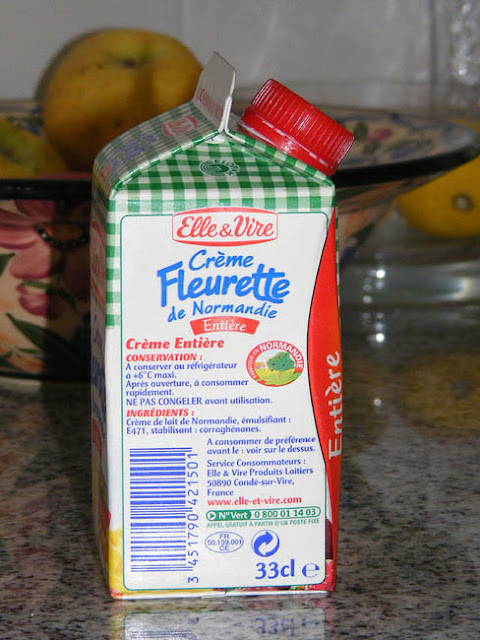
This cream contains a seaweed based stabilising gel.
Photographed by Susan Walter. Tour the Loire Valley with a classic car and a private guide.
As any anglophone expat or immigrant knows, cream is not just cream in France. In Australia there was just cream. When I moved to the UK I graduated to whipping, single and double cream. Easy enough. Whipping cream is for, you guessed it, whipping. Single is for pouring and double is for dolloping. The range of cream on the shelves in France is much bigger again. For anyone who did not grow up with it, it is confusing. More importantly, despite the ubiquity of Chantilly cream in France, French cream is notoriously tricky to whip. For Australians wishing to make pavlova, this causes some angst.

Take no notice of the 'Flavour of 2011' logo. Companies pay
to use this 'certification' on their products.
Photographed by Susan Walter. Tour the Loire Valley with a classic car and a private guide.
And now for some French cream terminology:

Crème: must have a minimum fat content of 30% to be called crème or crème entière. If the fat content is lower a product must use a descriptor such as légère or allegée or not use the word crème at all.

Crème fraîche: always pasturised, and usually has a lactic culture added. This makes it ever so slightly sour tasting, lengthens its shelf life, thickens the cream and means it does not separate when heated. Its fat content is around 40%. Used for dolloping and cooking. Only found in the chiller cabinet. It is not the same as the anglophone sour cream.

Crème crue: always unpasturised, with no lactic culture added. This is what I generally buy, as my local laitière  (dairy farmer) delivers it to the house. Fat content is about 40% and this is the closest to double cream.

Fleurette: originally the cream that rose to the top of the milk, but it has been adopted by the dairy industry to indicate cream that does not have a lactic culture added. There are no rules about its use, so read labels carefully before buying. It can have a fat content as low as 5%. Usually crème fleurette is 30-35% and used for whipping, fleurette is 20% and used for pouring, creme fleurette légère is 5-15%. It often contains stabilising gels.

Liquide: pasturised or UHT cream that has a fat content of at least 30%, and has not had a lactic culture or thickener added. Often used synonymously with crème fleurette by cooks.

Fluide: there are no rules covering this term, but usually means crème fraîche with a lower fat content, around 30%.

Epaisse: 'thick' or 'thickened', usually with a lactic ferment. Often used synonymously with crème fraîche by cooks. Can be found in the chiller cabinet or as a UHT product.

Légère: 'light', products with a fat content of less than 30%, usually somewhere between 15% and 5%.

Fouettée: 'whipped'.

Chantilly: sweetened whipped cream flavoured with vanilla and stabilised with gums. You can buy packets of 'Chantilly mix', which contain the sugar, flavouring and stabilisers to add to your crème liquide / épaisse / fleurette for whipping success.

The astuce gourmande is to take the cream out of
the fridge at the last minute before whipping.
Photographed by Susan Walter. Tour the Loire Valley with a classic car and a private guide. The Golden Rules of Whipping French Cream:

1. Use a big enough bowl because the cream will double in volume.
2. Use a crème liquide with a fat content of 30%. A crème légère does not have enough fat to hold the air bubbles, a richer cream will not make much volume.
3. Everyone agrees the cream must be well chilled and if you are feeling really serious, put the bowl and the whisk in the freezer for 15 minutes before you start.
4. You can use cream with a higher fat content, but add 15% milk to thin it down. That's about 2 tbsp per 250ml pot of cream.
5. If you sweeten with icing sugar you can add it at any time. If you sweeten with granulated or castor sugar, add it at the very beginning to ensure it dissolves completely. Sugar added at the end allows you to add a little less, and results in a less yellowy coloured whipped cream.
6. French chefs habitually add stabilising gums such as a pinch of gum arabic or tragacanth at the end, but the sugar also acts as a stabiliser, as does chilling.

Dairy products (milk, cream and cheese) from my local dairy farm.
Photographed by Susan Walter. Tour the Loire Valley with a classic car and a private guide.

 Pavlova, topped with whipped cream and bottled blueberries.
Photographed by Susan Walter. Tour the Loire Valley with a classic car and a private guide.


Yum

**************************************

For details of our private guided tours of chateaux, wineries, markets and more please visit the Loire Valley Time Travel website. We would be delighted to design a tour for you.

*****************************************

This is a refreshed post from December 2011.

Sunday, 29 September 2019

Rock Art at Mount Moffatt

I can find precious little information about the rock art of Mount Moffatt online. Plenty of photos, not much fact. I'm adding to that problem!

One of the reasons for us going to Mount Moffatt was to see the rock art. It's the only time I have seen Aboriginal rock art in the wild (as it were). Human occupation of the area dates back about 20,000 years, but it seems pretty well accepted that the visible art dates back to no more than 200 years. (I'm willing to be disabused on that one...)


From what I remember (and judging by the ferns in the foreground) the figure in the above painting was child sized. Imagine being able to convince a child to stand still long enough to be able silhouette them with what amounts to dyed spit.


These are the only two photos I took of the rock art. These days I would take many more, but I only had a roll of 36 shots to last 8 days - and this was day 2.

Saturday, 28 September 2019

Sunset on the Seine

About a month ago we spent a couple of days on the Île Saint-Louis in Paris, working.

In the evening after dinner we had some time to ourselves, so we we had a bit of a wander and took the opportunity to do some moody pics, something we promised ourselved we would do when we photographed Notre Dame in 2017.

Tour St Jaques

Picnic on the river bank

Notre Dame on the left

Chatelet

Friday, 27 September 2019

Bouchonne in the Rain

On Sunday we took part in the biennial Bouchonne at Sainte Maure. For the second time running it rained, but there was still 400 cars taking part (according to la Nouvelle Republique).


Thursday, 26 September 2019

The Rise and Fall of the Etang de Ribaloche


The main car park in the Forest of Preuilly is at a small manmade lake called the Etang de Ribaloche. Here is a series of photos showing how much the water level varies with the weather and season.

December 2007.
Photographed by Susan Walter. Tour the Loire Valley with a classic car and a private guide.

February 2008.
Photographed by Susan Walter. Tour the Loire Valley with a classic car and a private guide.

June 2009.
Photographed by Susan Walter. Tour the Loire Valley with a classic car and a private guide.

 June 2011.
Photographed by Susan Walter. Tour the Loire Valley with a classic car and a private guide.

October 2014.
Photographed by Susan Walter. Tour the Loire Valley with a classic car and a private guide.

November 2016.
Photographed by Susan Walter. Tour the Loire Valley with a classic car and a private guide.

September 2017.
Photographed by Susan Walter. Tour the Loire Valley with a classic car and a private guide.

September 2018.
Photographed by Susan Walter. Tour the Loire Valley with a classic car and a private guide.

September 2019.
Photographed by Susan Walter. Tour the Loire Valley with a classic car and a private guide.


************************************************

For details of our private guided tours of chateaux, gardens, wineries, markets and more please visit the Loire Valley Time Travel website. We would be delighted to design a tour for you.

We are also on Instagram, so check us out to see a regularly updated selection of our very best photos. 

Wednesday, 25 September 2019

The Industrial Revolution Starts in the Forest


The source of the Sauvaget, known as la Fontaine Bourbon, 
full of crystal clear water even in the drought.
Photographed by Susan Walter. Tour the Loire Valley with a classic car and a private guide.

The little stream called the Sauvaget starts as a spring, deep in the Forest of Preuilly. It descends rapidly from there, just a few kilometres, to meet the River Claise on the outskirts of Bossay sur Claise. Along the way, this insignificant seeming stream powered the hammers and bellows of an iron smelting complex called the Fourneau de Claise in the 17th century.

The humps and hollows in the topography of the forest tell you man was here.
Photographed by Susan Walter. Tour the Loire Valley with a classic car and a private guide.

Iron ore was extracted from under the ground in the forest. Trees were cut to provide charcoal to feed the Claise furnaces. Mule trains, loaded with ore or sacks of charcoal shuttled materials down to the ore refiners. Slag, the waste product from the foundries, was dumped in the forest on the return journey.

All this section of the forest is full of old mounds and hollows.
Photographed by Susan Walter. Tour the Loire Valley with a classic car and a private guide.

A few more snippets about the industrial activity centred on the Sauvaget are to be found in these previous blog posts:

The Claise and its Mills -- 17th century to the present.

A Walk Along the Sauvaget (Part I).

A Walk Along the Sauvaget (Part II).

A Walk Around Sauvaget.


************************************************

For details of our private guided tours of chateaux, gardens, wineries, markets and more please visit the Loire Valley Time Travel website. We would be delighted to design a tour for you.

We are also on Instagram, so check us out to see a regularly updated selection of our very best photos.