Once the photo is downloaded (or is it uploaded?) to your computer you run it through Photoshop for a bit of post-production. For these photos I used some of the tips outlined by Ted C MacRae in his blog Beetles in the Bush.
Wednesday, 6 March 2013
Scutie in a Box
One of the techniques favoured by really good insect macro-photographers is to set the subject against a white background. It has the advantage of highlighting peripheral details such as hairs, legs, antennae and wing venation unless they are very pale and putting the creature in strong contrast to the plain, uncluttered background. It also has the advantage of being truthful about the fact that it is a studio shot. Plain white backgrounds rarely exist in nature.
Studio shots are very useful for scientific records. They are a relatively benign way of recording details about a species without having to kill it. They are also able to be sent around the world much less problematically than an actual specimen. Of course, there are always instances when only a specimen will do, but more and more scientists are coming to terms with recording or even identifying insects from photos wherever possible.
The plain white studio is achieved by using an open box made of white, slightly shiny card. You can do it indoors with a captured insect, but it is portable enough to do in the field or field lab too. Once the box is in place you set up your lights, flashes and reflectors, put the camera on a tripod and attach a remote trigger cable. The insect, who may have been given a spell in the fridge to slow it down, is brought out and placed in the white box. The photographer snaps away until satisfied and the insect is released back where it came from (or occasionally escapes before the session is finished).
Once the photo is downloaded (or is it uploaded?) to your computer you run it through Photoshop for a bit of post-production. For these photos I used some of the tips outlined by Ted C MacRae in his blog Beetles in the Bush.
Since I don't have a proper SLR camera, only a Fuji Finepix, which is a bridge type camera (more complicated than a compact point and shoot, but without interchangeable lenses or really practical manual controls) I don't often bother with full-on studio shoots. Usually I take hand held shots in the field, with the camera set on auto and hope for the best. I'm used to the camera's foibles and reasonably adept at predicting what the insect is going to do and what the best angle for light is going to be, so I get quite a few photos that are fine for screen viewing, but not jaw-droppingly gorgeous like Piotr Naskrecki, for instance.
Anyway, to cut a long story short, one morning I got up and discovered a scutie (aka House Centipede Scutigera coleoptrata) trapped in the white porcelain laundry trough. Ha! I thought -- I can treat this like a white studio box and take some better photos of this fascinating beast. All my other photos are of scuties lurking in fairly dingy corners, and are very grainy due to low light conditions. The resulting photos are nowhere near like real studio shots, as I just used the ceiling light and the on-camera automatic flash, but they are significantly better than my previous efforts for this species, so I am happy.
No scuties were harmed in the making of these photos, and the specimen was offered a dishcloth draped over the edge as an escape route.
For more discussion on taking insect photos with a point-and-shoot digicam see The Bug Geek and Alex Wild at Myrmecos.
Once the photo is downloaded (or is it uploaded?) to your computer you run it through Photoshop for a bit of post-production. For these photos I used some of the tips outlined by Ted C MacRae in his blog Beetles in the Bush.
Tuesday, 5 March 2013
Crane Central
Yesterday was bee-u-ti-full! Clear blue skies and the car thermometer registered 23°C (although Simon made sure to point out that Accuweather said it was only 14°). I took the opportunity to spend the afternoon down at the orchard.
There were Brimstone butterflies leaping about all over, as well as the occasional Comma and Peacock. I discovered that the Common Winter Damselflies like to warm up on the corrugated iron sheets that are laid on the ground to provide basking places for reptiles and shelter for voles. There was a Red-tailed Bumble Bee queen checking out my French style neatly tied bundles of prunings, although sadly not my extremely artistically arranged bumblebee snugs (made from terracotta pots, small logs and moss). European Wall Lizards scuttled about.
Best of all, several flocks of cranes flew over while I was down there, and more came through after I came home. Simon got some nice photos from our driveway. I estimate that maybe a thousand cranes in all passed over our orchard and house. They navigate by flying up the line of the small stream that runs past Fontbaudry, and between our two properties. Some of the flocks were losing height over Preuilly so they spent some time milling about catching a thermal above the chateau.
This Lizard Orchid leaf rosette in the neighbour's orchard is quite substantial. All the orchids have responded to the wet weather by putting on generous growth.
There were Brimstone butterflies leaping about all over, as well as the occasional Comma and Peacock. I discovered that the Common Winter Damselflies like to warm up on the corrugated iron sheets that are laid on the ground to provide basking places for reptiles and shelter for voles. There was a Red-tailed Bumble Bee queen checking out my French style neatly tied bundles of prunings, although sadly not my extremely artistically arranged bumblebee snugs (made from terracotta pots, small logs and moss). European Wall Lizards scuttled about.
Best of all, several flocks of cranes flew over while I was down there, and more came through after I came home. Simon got some nice photos from our driveway. I estimate that maybe a thousand cranes in all passed over our orchard and house. They navigate by flying up the line of the small stream that runs past Fontbaudry, and between our two properties. Some of the flocks were losing height over Preuilly so they spent some time milling about catching a thermal above the chateau.
Monday, 4 March 2013
Lifesaver or Deadly Poison?
Violet Oil Beetles Meloe violaceus will be out in the ancient woodlands soon, seeking each other out to mate. These lovely irridescent beetles are very visible for a few weeks, often around Wood Anemone Anemone nemorosa, which is flowers at this time of year, and is their favourite food.
Oil Beetles are so called because they are part of a family which protect themselves by synthesising a deadly poison called cantharidin in their bodies. If threatened they ooze orange 'blood' from their joints. A minute amount ingested by a mammal works like viagra (Spanish Fly is in the same family of beetles), but even very small doses can kill, as it is as poisonous as strychnine. The cantharidin laden body fluid most commonly causes blisters (hence their other name of Blister Beetles) when the beetles are touched. Mostly though, predators know to avoid these dangerous creatures.
Female Oil Beetles don't initially have much cantharidin. They receive it as part of the sperm package when they mate, and then coat their eggs with it to protect them. Male beetles are packed with the poison, but the exact process by which they manufacture the cantharidin is not fully understood.
Recently there has been some promising new research, and it seems that cantharidin may be a useful anti-cancer drug. It's early days yet in the research, but mice with cancer have been treated with a compound extracted from meloid beetles, and the results have been remarkably good.
Male oil beetles have 'elbowed' antennae, used for gripping the female.
Oil Beetles are so called because they are part of a family which protect themselves by synthesising a deadly poison called cantharidin in their bodies. If threatened they ooze orange 'blood' from their joints. A minute amount ingested by a mammal works like viagra (Spanish Fly is in the same family of beetles), but even very small doses can kill, as it is as poisonous as strychnine. The cantharidin laden body fluid most commonly causes blisters (hence their other name of Blister Beetles) when the beetles are touched. Mostly though, predators know to avoid these dangerous creatures.
Mating Violet Oil Beetles in the ForĂȘt de Preuilly, the much larger female on the left.
Recently there has been some promising new research, and it seems that cantharidin may be a useful anti-cancer drug. It's early days yet in the research, but mice with cancer have been treated with a compound extracted from meloid beetles, and the results have been remarkably good.
Sunday, 3 March 2013
On This Day in Australia
Hope you weren't expecting something exciting. 1988 was the bicentenary of European settlement in Australia. Every community was expected to have a bicentennial project and there was a lot of money available to facilitate the event. Inevitably, some communities struggled to come up with a truly engaging proposal.
This memorial commemorates the first Governor of New South Wales, Arthur Phillip, and his team pitching tents in the rain. The point of the memorial is that this humdrum event was very early (within the first few weeks) of the colony being established at Port Jackson (aka Sydney Harbour) and Phillip's second in command, John Hunter, would become the second Governor. One of the other ship's officers recorded this event in his diary of an exploratory voyage up the coast and rivers north of Sydney.
Saturday, 2 March 2013
Rasp Fern
I spotted this gorgeous fern at the Australian National Botanic Gardens in November. It is a Rasp Fern Doodia media, native to the north Queensland coast. The attractive pink colouring is flavinoid compounds to protect it from sunburn on young growth. The fern was first described by the great late 18th - early 19th century botanist Robert Brown, who travelled with Matthew Flinders* on his voyage to circumnavigate and chart the entire Australian coast for the first time. Ian Fraser has written a terrific post about Brown and his amazing career over on Talking Naturally if you are interested in learning more about the history of Australian botanical exploration.
*Apart from the scientific opportunities it offered, the purpose of the voyage was to steal the march on the French claiming territory in New Holland, as Australia was then known. The French were nosing around, and they were at war with the British. Curiously, Flinders was travelling on a French passport (see here for a translation of the document, with a link to the original French), as the British Admiralty considered it would be safer! The passport deal was reciprocal, as the simultaneous French expedition to Australia lead by Nicolas Baudin could brandish their British passport.
-----------------------------------------------------------------------------
Friday, 1 March 2013
Wildlife Watching in March in the Touraine du Sud
The big Violet Carpenter Bees Xylocopa violacea will emerge and start looking for nest holes. By of the end of the month we should have rust and black Mason Bees Osmia spp too. They'll be checking out smaller holes in the exterior walls of your house and outbuildings. Neither species does any harm to a building, and Mason Bees in particular are probably more important pollinators of fruit trees than Honey Bees Apis mellifera. Please do all you can to make their lives comfortable and safe -- installing a bee hotel will almost certainly be successful with Osmia spp and the later emerging leaf cutter bees Megachile spp.
Some Common Cranes Grus grus have already made the trip, but many will still be migrating throughout March (yesterday 17 000 birds were counted by a single observer to the south-west of us). While you are looking up you may also see Common Buzzards Buteo buteo, soaring in pairs, establishing pair bonds and making their mewing call (you will recognise it from its similarity to the standard hawk soundtrack in American films and television programmes).
The weather in March is normally cool (average maximum temperature 12°C), and days are often overcast (there is usually less than 150 hours of sunshine for the month).
Violet Carpenter Bee in a friend's garden.
Snakeshead Fritillary on the island in the River Indre at Pont de Ruan.
By end of the month lots of lovely things with be flowering: Cowslips Primula veris, Grape Hyacinth Muscari neglectum, Sweet Violet Viola odorata, wild pansies Viola tricolor, tiny Early forget-me-nots Myosotis ramosissima, blackthorn Prunus spinosa, sallows Salix spp , and most special of all, on water meadows -- Snakeshead fritillaries Fritillaria meleagris. The southern Touraine is home to the largest colonies in the world of this rare and declining plant. If you time it right (late March, early April) and it is a good year you can see hundreds of thousands of them in the wet grassland on certain sites near Chinon (on the Vienne between Savigny and where it joins the Loire at Candes St Martin).
Wild Grape Hyacinth in our orchard last year.
Remember to check yellow butterflies at this time. Brimstones Gonepteryx rhamni are a well known early spring species, but I've noticed that the first generation of Clouded Yellows Colias crocea also appears now too.
Brimstone butterfly.
-------------------------------------------------------------------------
The mairie will be distributing garbage bags at the salle des fetes in Preuilly on Tuesday 5 March. If you live in Preuilly, don't forget to pick up your allocation of yellow recycling bags and black household rubbish bags.
-------------------------------------------------------------
Loire Valley Nature Updates: a photo and information on Clustered Brittlestem Psathyrella multipedata has been added to the Psathyrellaceae Fungi (Inky Caps) entry.
A new Habitat entry, on Rural Tracks (chemins ruraux) has been added.
Thursday, 28 February 2013
Preparing for the Coming Season
Célestine has been for her pre-season checkup. She's in good health, with new oil and the annoying panel on one of her back doors fixed so clients don't all have to pile in from one side only.
Last year we began using a garage in Bossay sur Claise, the next village upstream from Preuilly. The mechanic is 'young Cosson', and the workshop is quite remarkably neat and tidy. He's the youngest scion of the Cosson family, all involved in the family business. He and his mother and one staff member run the mechanical side of the operation on the rive droite, his father and older brother run the panel beating workshop on the rive gauche. His brother Tony is rather a local celebrity, being the French rally car champion for 2012, and having won the title a number of times before I believe. Mme Cosson tells me that young Alexandre, our mechanic, has taken up the sport too, since last year.
At the same time I booked in Célestine for her contrÎle, I booked in the mower for a révision too, at the same garage -- no job too small for them. I knew the mower would need an oil change and the blades sharpening. Alexandre tells me he also fitted a new spark plug and replaced the air filter, but he says it is in good nick and goes well. He also asked me if I ever tipped it over on its side. 'Yes, sometimes, probably...'. 'Hmm, well, make sure you only tip it to the right, OK?' 'OK'. I remember reading something in the instructions about not tipping it over, but never understood why, and couldn't figure out how you dealt with looking at the blades and suchlike if you couldn't tip it over. I'm still not entirely sure why one doesn't tip to the left, but I believe it has something to do with not getting oil on the spark plug.
Alexandre was slightly bemused to be asked if I could take his photo with my mower...
I really like Nadine (Mme Cosson) and her family. For one thing, they always seem to understand what I say, even over the phone, and are very patient when making sure I understand them. It's always really interesting (and relieving) to meet people who have the knack of understanding heavily accented non-fluent French. It's interesting that some people, like the Cosson's, are so intuitive, where others, equally benignly disposed towards me, can't understand a word I say.
-----------------------------------------------------------------
Wednesday, 27 February 2013
New Boots
I bought a pair of new hiking boots on Friday. They cost me €7.50 at MaxPlus, the discount end of line store in Chambray-lĂšs-Tours. They are not a well known brand, but they are leather, with a proper sewn in waterproof tongue. I like the fact they are nice and simple, without multiple cut away layers and kilometres of stitching for water to seep through. I'm slightly dubious that the inner soles will stay put and I will certainly put in an extra insulated inner sole.
This laneway looks lush. What you can't see is that walking it meant going through knee deep water. No wonder the sign tells you not to take farm machinery down it.
My current pair of boots were reasonably expensive (£80 I seem to remember) Salomon lightweights that I bought in Kathmandu (the outdoor and travel gear store in London, not the Himalayan city) just before we moved to France. So, they've lasted nearly 4 years and are still perfectly wearable, but starting to show battlescars. They especially didn't appreciate being waded through floodwater along a farm lane in the Brenne last May. Foolishly, I didn't rinse them when I got home and they've never been quite the same since.
The Salomon boots, and I'm soaked through from the knees down.
The new boots will serve as a fine backup, allowing me to put the old ones into semi-retirement.
Tuesday, 26 February 2013
A Raid on the Paris Store
Last Friday we went up to Tours to check out a couple of hotels and do some shopping. One of our planned destinations was the Paris Store in Tours Nord. Despite it's name, Paris Store is actually a chain of Asian grocers. We stock up there with specialist ingredients from time to time, as they are much cheaper than the supermarkets for the Asian staples like soy sauce, and have many things we just can't get anywhere else.
This is what we bought:
A bunch of green celery (celery is often blanched here, so I buy green when I see it) 74¢
A bunch of coriander 36¢
A 300g box of silken tofu €1.50
A 240g tray of acras antillais (Caribbean fish dumplings) €3.36
A packet of transparent soy noodles in 5 x 50g bundles €1.08
A 450g packet of quick noodles in 50g bundles €1.45
A 1l bottle of sweet chilli sauce €1.99
A 500g packet of fresh bean sprouts €1.20
A 500ml bottle of dark soy sauce €1.35
A 500ml bottle of premium light soy sauce €1.25
A 225g bottle of plum sauce €2.05
A 400g packet of 19cm² rice starch spring roll wrappers €1.65
2 cans of ginger beer 55¢ ea
A 750ml bottle of ginger syrup €3.99
5 packets of instant noodle soups 35¢ ea
A packet of baby pak choy €1.05
A 1kg bag of blanched almonds €10.20
A tray of 6 'spring' rolls (the sort that are deep fried, and known as nems in France) €2.30
A 100g packet of rice snack shapes 85¢
A 500g block of fresh firm tofu €1.42
A 400g bag of coloured tapioca €1.10
A 300g packet of Soba buckwheat noodles 95¢
A 225g packet of Udon noodles 60¢
Grand total €43.29
As regular Paris Store shoppers, we even arrived with our own store branded bag...
This is what we bought:
A bunch of green celery (celery is often blanched here, so I buy green when I see it) 74¢
A bunch of coriander 36¢
A 300g box of silken tofu €1.50
A 240g tray of acras antillais (Caribbean fish dumplings) €3.36
A packet of transparent soy noodles in 5 x 50g bundles €1.08
A 450g packet of quick noodles in 50g bundles €1.45
A 1l bottle of sweet chilli sauce €1.99
A 500g packet of fresh bean sprouts €1.20
A 500ml bottle of dark soy sauce €1.35
A 500ml bottle of premium light soy sauce €1.25
A 225g bottle of plum sauce €2.05
A 400g packet of 19cm² rice starch spring roll wrappers €1.65
2 cans of ginger beer 55¢ ea
A 750ml bottle of ginger syrup €3.99
5 packets of instant noodle soups 35¢ ea
A packet of baby pak choy €1.05
A 1kg bag of blanched almonds €10.20
A tray of 6 'spring' rolls (the sort that are deep fried, and known as nems in France) €2.30
A 100g packet of rice snack shapes 85¢
A 500g block of fresh firm tofu €1.42
A 400g bag of coloured tapioca €1.10
A 300g packet of Soba buckwheat noodles 95¢
A 225g packet of Udon noodles 60¢
Grand total €43.29
The loot unloaded.
Recipe suggestions please...
-----------------------------------------------------------------
Weather Update: On Sunday we had a very light dusting of snow and overnight it built up to a couple of centimetres. It's supposed to come to an end today.
Monday, 25 February 2013
Trams in the Street
On Friday we were in Tours and as we pulled up at some lights we realised that one of the new trams was parked at a station right in front of us. It looked very sleek and shiny. As we went round the corner I snapped a couple of shots through the windscreen, and the tram pulled away from us, going in the other direction.
----------------------------------------------
Loire Valley Nature Updates: The Pyrenean Fragrant Orchid Gymnadenia pyrenaica entry has been updated -- it has been elevated to full species and confirmed as being present in the Touraine.
Sunday, 24 February 2013
Waratah
This lovely New South Wales Waratah Telopea speciosissima, the state flower of New South Wales, was flowering in the Australian National Botanic Gardens when I visited in November. A member of the Proteaceae family, waratahs are native to the eastern seaboard of Australia. They are so spectacular that, although initially they were thought to be difficult to cultivate, they are now a popular garden plant and cut flower. One of the roles of the ANBG is to work with garden worthy native plants and develop an understanding of how to propagate and cultivate them, which can be passed on to commercial growers and the public. Their fact sheet for Waratah is here. In the wild the species relies on periodic bushfires to successfully germinate seeds in the open areas created by the burn. Waratah is an Aboriginal word. The New South Wales Rugby team is called the Waratahs.
-----------------------------------------------------------------
Bakery News: The bakery 'up the hill' has announced their fermeture definitive on 5 March, en cause de manquer clientĂšles et depĂŽt de pain.
Saturday, 23 February 2013
Here be Dragons
A large female absorbs warmth from a rock on the shoreline at Manly.

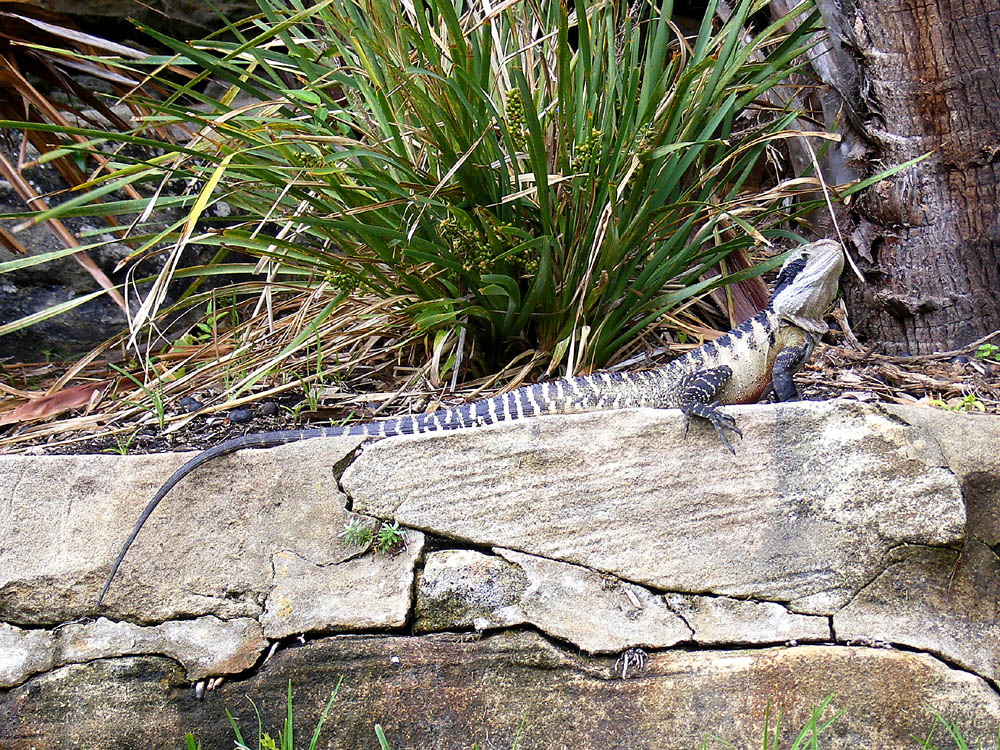
On our recent trip to Australia I encountered Australian Water Dragons Itellagama lesueurii (syn Physignathus lesueurii) in both the Australian National Botanic Gardens and on the coast at Manly in Sydney. This meant I got to see both subspecies -- the Gippsland Water Dragon I. l. howittii in the Botanic Gardens, and the Eastern Water Dragon I. l. lesueurii at Manly.
A female Eastern Water Dragon.

In both places the dragons are considered an attraction and visitors are encouraged to spot them. In Manly in particular, it is clear that the local population has adopted these rather formidable looking lizards. Whenever we stopped to watch and photograph a dragon there, a passing local would step up and tell us about them. Even blokes sitting on park benches with cans of beer knew all about them and were clearly proud of them. We learnt what they ate, where to see them and how to tell male from female, all from random locals who saw we were interested.
A young adult Eastern Water Dragon, showing the pattern on its back.

We were told several times in our discussions that it was not permitted to handle them. With us, they were simply imparting a piece of information along with many other snippets about the creatures, and we were not being suspected of disturbing the dragons. Our friend Stefania, however, who is a qualified eco-guide specialising in marine mammals tours for French and Italian visitors, told us that she had a French client recently who picked one up and was most put out when she very firmly told him to put it down and leave it alone or there would be consequences. The lizards may be on show and familiar with being in close proximity to people, but they are not zoo animals and they are not pets. The cliffs are steep here and they can decide just how close to people they get. Like all reptiles in Australia, they are protected by law and there is a fine for stealing, handling or disturbing them.
A male Eastern Water Dragon, showing the very contrasting light and dark markings that distinguish this subspecies from the Gippsland Water Dragons.

The Water Dragons are the largest species in the Agamidae family of lizards, and can reach a metre long. The holotype (ie the original specimen which was used to write the official description of the species and to which a scientific name was formally assigned) is kept at the Muséum national d'histoire naturelle in Paris, and is named after Charles Alexandre Lesueur, the naturalist aboard Nicolas Baudin's early 19th century French expedition to Australia, who collected the specimen.
A crowd of interested passersby gathers to watch and photograph a dragon at Manly, keeping a respectful distance so as not to disturb it.

Their main predators are snakes, but cats, dogs and foxes can also harm them, and birds like Kookaburras will take young ones. They get run over quite a lot, as they like to bask on warm bitumen, and the Botanic Gardens has recorded at least one instance of one with a broken back after a kid threw a rock at it.
We were told exactly where we would find this magnificent male by a local who stopped to talk to us.

The female digs a hole in the ground and lay eggs in the spring. The eggs are covered with earth and leaf litter to insulate and camouflage them. Depending on the temperature of the nest, she may produce a predominance of males (if the nest is warm) or females (if the nest is hot or cool).
Totally camouflaged -- and that's even after I've upped the contrast a bit in Photoshop.

They are semi-aquatic and always live near water. They will feed on land or in the water, and they often use water as a refuge if disturbed. They eat almost anything (including the tomato from your hamburger, according to our new friend on the park bench with the can of beer).
If you want to know more, the ANBG has produced an FAQ page on their website, and the Australian Museum has an excellent page on them.
A Gippsland Water Dragon, much more uniformly dark grey, in the Australian National Botanical Gardens, Canberra.

These notices appear at intervals along the coastal walk around Manly, and clearly have the support of the locals, who seem to act as self-appointed guardians in a thoroughly heartening way.

This small dragon was not old enough to be digging a nest, but instead we think was hunting for ants and eating them. (That's me and Stefania talking in the background.)
Friday, 22 February 2013
Doing a Salamander
The salamander was the emblem of the French kings and is particularly associated with François I. The salamander's position as royal insignia comes about because of its reputation of being able to survive unscathed from the fire.
The background to this seems to be that salamanders, which are native to the Loire Valley, François' stronghold, live in cool, dark, damp places like firewood piles. Inevitably from time to time they came in on a log and were put on the fire. Naturally they scarpered pretty nippily once in proximity with the flames -- surviving unscathed.
Yesterday we had a bonfire in the orchard to get rid of a pile of prunings. At one stage I noticed a small movement at my feet and to my surprise a longhorn beetle was staggering away from the fire. It didn't look very well, so I think it was suffering from smoke inhalation and general roasting.
I picked it up and sat it on the box of matches to take some photos of it. After I had finished it determinedly chugged off into the undergrowth.
Once I got home I used the photos to identify it. There was no difficulty in that -- it is Cerambyx scopoli, the quite common lookalike little cousin of the rarest and most iconic of the French longhorn beetles C. cerdo, The Great Capricorn (France's biggest beetle at 55mm long).
I was surprised to see an adult longhorn in February, but it seems that some individuals of this species do emerge very early, like this one. Mostly however, the adults are active in May and into June.
This one is a female, with much shorter antennae than a male. I thought that her antennae and legs had a dusting of ash, but in fact, they are covered in grey downy hair. Her body is 'ruggedised' (as manufacturers of field equipment like to say), very textured, and verging on irridescent. She measured about 25mm from mandibles to elytra tips.
She is no threat to timbers in buildings. Like many big longhorns, she requires dead timber in still living trees for her larvae to develop in. The species is not really common enough to be considered a commercial pest, and because dead timber tends to be removed, the population of C. scopoli is almost certainly declining.
Thursday, 21 February 2013
A Fromagerie in Paris
Fromagerie La Ferme de Chloé.

Yet again, we've discovered somewhere we didn't even know existed on a visit to a district of Paris that we thought we knew well. There is a fantastic cheese shop at 2 rue du Rhin in the 19Úme. It's called La Ferme de Chloé and we suddenly noticed it when we stopped over in Paris in December. I have no idea how we have managed to miss it on previous visits.
The window was full of Mont d'Or, a soft cheese that is a seasonal treat at Christmas time.

There are half a dozen French reviews of the shop on Yelp and Keldelice and the like -- they just rave about the place, saying things like:
The choice here is reeeeeeeeeeally large, the welcome always really smiling and the fromager really kind. When you come in without much idea of what you want, she is quick to ask you what you really like in order to advise you what might please you.
The prices are very affordable for the cheese selection (especially for a Parisian cheese shop in an area that is becoming a bit yuppiefied*). *The reviewer used the expression un poil bobo.
There is everything from celebrated Camemberts to little products unknown to the general public. The shop assistant (happily) takes the time to introduce you to numerous artisanal products.
Wednesday, 20 February 2013
Ici un grand arbre est tombé...
The parks and gardens team check the instrument readings being fed to the computer in the back of their van. The news wasn't good.
When we stopped over in Paris on our way home from Australia in December 2012 we went for a walk in the Parc des Buttes-Chaumont as is our usual practice. At one point we encountered barricades and a temporary sign that said (in French):

A big tree has fallen here, its root system having been destroyed by a fungus (honey fungus) despite showing no outward signs of weakness.The barricades and notices didn't seem to be making a blind bit of difference, especially to joggers, who simply ducked under them and continued on their chosen route. I noticed that one American guy got told off when he emerged the other side, into the clutches of the tree surgery and gardening team. We dutifully went around and eventually came across the team working on the trees right next to the dead one.
This fungus can propogate itself from one tree to another. This is why the Council is going ahead with a thorough health check for all the trees situated around and about. While waiting for the results of these tests, the passage of pedestrians under these trees is temporarily halted and a security barrier installed.
Thank you for your understanding.
A cable had been attached to the tree and was being winched tighter and tighter, to measure the tree's 'bendability'.
Meanwhile, a climber prepared to go up the middle tree.
The stump of the fallen tree, a Horse Chestnut Aesculus hippocastarium, or marronier in French, the right hand tree in a group of three.
The parks and gardens team take photographs of their stress metres in place -- they probably write a blog too...
The 'bendability' metres in operation -- you can see exactly what they are supposed to be measuring by the diagram on the side.
The climber fights his way through the twigs.
---------------------------------------------------
Weather and Related News: There was a frost yesterday morning, but it was absolutely clear and sunny the whole day. It got up to 17°C (!!) in the orchard and I had to strip off to shirt sleeves to work. The laneway is now accessible by car and I am thinking of trying a bit of digging -- or at least weeding. My rubber boots have died, developing big splits, so I'm jolly glad my patriotism only extended to €7 worth. At least they lasted through the worst of the wet.
Tongue Orchid Serapias lingua entry updated.
Green-winged Orchid Anacamptis morio entry updated.
Loose-flowered Orchid A. laxiflora entry updated.
Burnt Orchid Neotinea ustulata entry updated.
Monkey x Lady Orchid hybrid Orchis x angusticruris entry updated.
-------------------------------------------------------------------
Loire Valley Nature Notes: a new entry for Corncockle Agrostemma githago added.Tongue Orchid Serapias lingua entry updated.
Green-winged Orchid Anacamptis morio entry updated.
Loose-flowered Orchid A. laxiflora entry updated.
Burnt Orchid Neotinea ustulata entry updated.
Monkey x Lady Orchid hybrid Orchis x angusticruris entry updated.
Tuesday, 19 February 2013
Nestboxes in Paris Parks
We photographed this nestbox in the Parc des Buttes-Chaumont in December. The notice underneath provides an explanation of a project that includes installing nest boxes in all Paris parks. It says:
Why put up a nest box?It's National Nestbox Week over in the UK, and now is certainly the time to be putting new nestboxes up for the coming season, and making sure your existing ones are clean, in good condition and firmly attached. Tim from Aigronne Valley Wildlife has been busy making new nest boxes (when he's not battling The Rat). Don't forget that it's not just birds that will appreciate safe dry nests -- I've been making bee hotels.
The increasing rarity of natural nest sites due to the disappearance of natural grasslands, the culling of hollow trees, hedges and copses, the abandonment of old orchards, the cutting down of old non-commercial trees, and the demolition or renovation of old buildings, constitutes a significant obstacle to the reproduction of nesting birds. As a result, many species are struggling to find suitable places to build their nests.
One simple and effective means of encouraging breeding birds is to put up nests designed to be substitutes for the natural places that have been destroyed. Putting up nest boxes is an act to protect nature that should not be dismissed -- a species can be maintained thanks to this single action. The method offers the advantage of being within reach of everyone, but also to provide the sort of nest spaces that fit the birds' needs, by putting them out of the way of predators and disturbance, and allowing their reproduction to be monitored.
Every gardener, horticulturalist and forester has good reason to protect the birds -- every garden bird, and, all the more so, those inclined to use nest boxes, are insectivores during the breeding season or feed their young on insects, larvae, caterpillars, eggs, etc. A pair of Great Tits can bring up to 6000 caterpillars and other insects to their chicks during the breeding season. Not insignificant help, even if it often goes unnoticed!
This nestbox, for a Common Redstart or a Black Redstart, has been installed on the occasion of the 6th Nature Festival 9 - 13 May 2012, as part of a campaign to get 10000 nest boxes erected throughout France. To learn more, go to www.fetedelanature.com.
----------------------------------------------------------------------------------------
Loire Valley Nature Update: a new entry for Common Knapweed Centaurea jacea has been added. If you are from the UK you may know the British species as Lesser Knapweed C. nigra. It's a taxonomic nightmare and I've tried not to get too complicated with it. Even the most stalwart and intrepid members of l'Association de Botanique et Mycologie de Sainte Maure de Touraine just look at it and mumble 'hmm, some variety of la Centaurée noire...', and don't attempt to take it any further.
A new Habitat entry for Gardens (Compost Heaps) has been added.
Subscribe to:
Posts (Atom)