Showing posts sorted by date for query lyon. Sort by relevance Show all posts

Wednesday, 19 August 2026

What IS That Thing

Yes, it's a steam locomotive, but all is not what it seems


Outside the Cité du Train in Mulhouse, mounted on a plinth beside the car park, it's a survivor from the early days of French railways: a PLM 030 TB steam locomotive. Built for the former Paris-Lyon-Méditerranée (PLM) railway it was intended primarily for freight and shunting work.

The locomotive dates from around 1860, making it a genuine 19th-century machine and a reminder of how compact early steam locomotives were. Its open-sided cab, small driving wheels and exposed mechanical equipment make it look primative compared to the large express locomotives that dominate railway museums.

But here's the "what is": although displayed as PLM 030 TB 2 the locomotive is a confection, reconstructed from components of several early locomotives, rather than a completely original survivor.

Tuesday, 15 July 2025

Low Food Miles Apples

Our ComCom (Communauté de communes Loches Sud Touraine) has joined a network to allow small local producers to distribute within our local area more efficiently. The platform, which originated in Lyon, is called la Charrette ('the cart'). It connects and matches producers, distributors and social canteens (schools, aged care facilities, etc).


Tony at the market in Preuilly with organic apples.

Organic apples at a market in France.

In the Sud Touraine 80% of consumers do most of their food shopping at the supermarket. The supermarkets do sell local produce, 'playing the game'. However, most supermarket shoppers may like the idea of 'local' but are motivated by other concerns when spending. 

There are exceptions within the supermarket franchises, with several managers of local supermarkets convinced of the value of stocking local produce. They've done deals with nearby breweries, dairy co-operatives, orchards and graziers. They acknowlege it takes more time, and the products have to be carefully positioned, but they find it rewarding both personally and financially.


Sandy at the market in Preuilly with organic apples.

Organic apples at a market in France.

Buying 'local' is an act of political and social responsibility. Thus the local authority is keen to encourage and facilitate it.

I buy my organic apples from local orchardists Tony and Sandy, who own Fruit Ô Kalm, just outside of town. They deliver a small part of their production to the primary school canteen in Yzeures sur Creuse. Tony says that when he delivers €50 worth of apples to the school, it's not really financially rewarding, but it's about contributing to the education of the kids, and acting on his and Sandy's personal values. Tony and Sandy's fruit can now also be found at Saveurs Lochoises, thanks to the ComCom's new network. He's happy, but if he could sell enough in Loches he would not bother to go all the way to Tours to sell his produce. Distributing his own produce several times a week is really time consuming, and can be expensive. The new network can help with that, bringing producers together so they can share deliveries. At the moment there are 80 members of the network.


Bus stop advertisement for Centre-Val de Loire produce.

Advertisment for Centre-Val de loire produce, France.

Tony and Sandy are already used to working with similar networks and use the regional network Bio Centre-Val de Loire to get their produce to Paris. It costs them €150 per pallet, but it's worth it when that is transporting €2000 worth of produce.

The schools and other social canteens (Fr. restauration collective) are important drivers of the project, as since the beginning of last year they have to be working with good quality ingredients that are at least 50% from sustainable sources, and 20% organic.


Information from the ComCom newsletter No 12 été 2025.

Saturday, 27 January 2024

Travelling by Train

Last year we had an exciting year of travel, visiting seven countries over a combined four and a half weeks of holiday, and travelling 6,690km in the car whilst doing so.

For both of our holidays I looked at travelling by train, but although we have lived this side of the world for almost 27 years (and in France for 15 of those years) we have travelled remarkably little throughout Europe. That leaves huge swathes of countryside and smaller towns we still haven't visited - and that's only in France.


We have travelled by train for holidays: to Lyon in 2022, Milan in 2015, Spain in 2019 and 2005, and Paris and Brussels a couple of times (from London) at the start of the century. If we're travelling to Paris from Preuilly we always do so by train, because - well, why wouldn't you? Faster, more convenient, and no parking hassle.


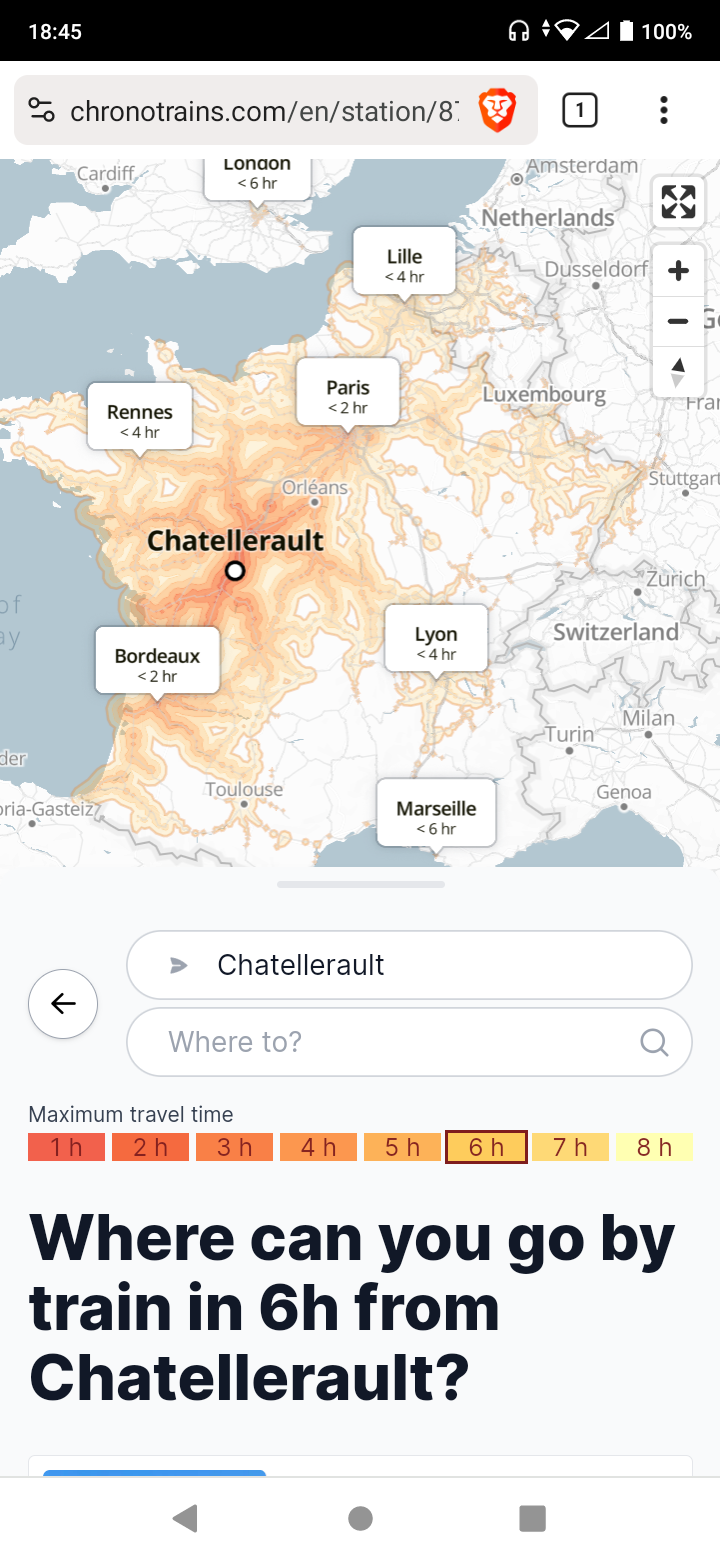
For the near future we will probably continue to drive whilst we are able, but taking the opportunity to take the train when it makes sense. If we can travel by train to a major centre in 6 hours it makes sense to do so - especially if driving would take two days and an overnight hotel.

That's where this website comes in handy. It gives us an idea of how far we can get by train, and how quickly. It will become even more useful if the ban on domestic flights for journeys possible in less than two-and-a-half hours by train is extended. 


Wednesday, 1 March 2023

The Gateway to the Touraine


Snowdrops, Indre et Loire, France. Photo by Loire Valley Time Travel.
Snowdrops in the grounds of the chateau/town hall.

Chateau-Renault is a town north of Tours, built around a castle. There is no evidence of man's occupation of the bluff the chateau sits on prior to a wooden castle on an artificial mound was built in 1140. The town below appeared after this construction, most notably after the Abbey of Saint Julien de Tours established a complex there.

11C keep and municipal police station, Indre et Loire, France. Photo by Loire Valley Time Travel.
11th century keep and modern municipal police station.

In 1160 the Count of Blois built a cylindrical keep when the previous wooden castle burnt down. The castle was protected on three sides by gigantic ditches and on the fourth side by cliffs. In 1560 the assassination of the leading Protestant, Jean du Barry, in the nearby forest, precipitated the Wars of Religion.

Cedar in the grounds of Chateau-Renault town hall, Indre et Loire, France. Photo by Loire Valley Time Travel.
One of several cedar trees in the grounds of the chateau/town hall.

Chateau-Renault's main claim to fame is leather. The place must have stunk, up until the mid-1980s, when the last leather factory closed. As a sort of complement to the leather, there were also 'strong glue' factories, using, I suppose, the bits of the cow that the leather factories didn't want. According to a 19th century commentator, leather was to Chateau-Renault what silk was to Lyon, linen to Lille or wine to Bordeaux. The first tanneries were established in the town in 1543, and by the 19th century leather from here was known worldwide. 

Fire damaged ruin, Indre et Loire, France. Photo by Loire Valley Time Travel.
The remains of the wing which burnt in 1907.

The chateau complex was given to the town in 1948 by the last private owners, with the intention that it become the town hall, although this didn't happen until 1962.

Chateau town hall, Indre et Loire, France. Photo by Loire Valley Time Travel.
The chateau/town hall.

The chateau buildings have been rebuilt and remodelled several times since the 11th century, and much of what you see today is 17th century. In 1907 there was a fire which destroyed part of the principal buildings and only the southern wing was rebuilt.

Gatehouse, Chateau-Renault, Indre et Loire, France. Photo by Loire Valley Time Travel.
Gatehouse.

The gatehouse, the lower part of which dates back to the 12th-13th century, was the main entrance to the castle. The upper part is composed of a room above which is a level fitted with hoardings (a defensive system overhanging the wall). The grooves allowing a portcullis to slide up and down are still visible under the vaulted passage. The bell tower contains a bell dated 1523. After the collapse of part of the building in December 2014, the tower has been fully restored.

Stables, Indre et Loire, France. Photo by Loire Valley Time Travel.
Stables.

Wednesday, 4 January 2023

Last Year

2022 was a strange year for me. If I am honest I still haven't really processed 2020, let alone the two years since. We did a lot of things last year, and visited places we hadn't been to before - namely Lyon and  les Eyzies. Some months we took a lot photos, some months we did a lot of work, and some months it rained. Some months none of the above happened.

gratuitous photo of an icecream cone in Amboise

It doesn't help that half way through October my main office PC died. Generous offers of substitute machines have helped, but I have to admit I haven't yet got everything up and running yet. I don't do computers like I used to, it appears. This means that all my record keepimg stopped when the computer died and I haven't yet caught up.

All this means that instead of being able to say exactly how many photos we took and how many kilometres we drove in doing so, I have to rely on "quite a few".

Let's hope that 2023 is almost normal.

Saturday, 3 September 2022

The Overground Underground

One thing I wanted to see while we were in Lyon in July was the funicular underground railway. The railways were built to carry goods and passengers up the incredibly steep cliffs that suround old Lyon and are very early - the first was built in 1862. They start at ground level and climb a very steep ramp to enter the tunnel. For the people of Lyon that may be normal, but for me...

There were once five funicular lines, but only two exist now, a line climbing the Fourvière hill linking Saint-Jean to Saint-Just with an intermediate station at Minimes, and a line from Saint-Jean to the Basilica. Both lines were modernised in 1986 and 1987. A new station at Saint-Jean was built in 1991 to serve a new line of the Metro and both funicular lines, and the whole complex named Vieux-Lyon. The Fourvière funicular was refurbished at the start of 2018, and the St Just funicular at the start of 2019.

We rode on the line up to the Basilica. It isn't very long, only 404 metres (1,325 ft), but it climbs 116 metres (381 ft). There's only 2 stops, one at each end, and two cars. They balance each other out, so it's actually quite an efficient mode of transport. Each car carries 70 passengers, and the journey takes 2 minutes.

That's the facts, now for the pictures:

The train is at the station

The funicular crosses a bridge to enter the tunnel


The same view from inside


The mechanism that hauls the carriage up the hill

One thing we weren't expecting (so we didn't get any photos) is Roman artifacts in niches in the tunnel.

Tuesday, 23 August 2022

I had no idea

so I had to look it up


Apparently:

The Limousin ostensions are a religious and popular tradition dating back to the end of the 10th century. They take place in twenty communes including Limoges and other localities, fifteen of which are in the Haute-Vienne, but also in Charente, Creuse and Vienne. They are held every seven years, with the last edition in 2016.

The Limousin septennial ostensions are now on UNESCO's Representative List of the Intangible Cultural Heritage of Humanity, after this ritual practice was inscribed on the Inventory of Intangible Cultural Heritage in France.

The legend fixes the origin of this religious festival to the year 994, when Limousin, like a great part of Aquitaine, was in the grips of the "mal des ardents", or ergotism, an epidemic which starts at the end of the harvest. This intoxication is caused by the consumption of rye bread contaminated by a parasitic fungus, the ergot of rye. It causes a sensation of excruciating burning and hallucination (hence the name "ardent", from the Latin ardere, to burn), seizures and painful spasms, diarrhea, paresthesias, itching, headaches, nausea and vomiting. Patients also have hallucinations similar in every way to those triggered by LSD, and psychiatric disorders such as mania or psychosis.

In 994, this disease was seen as a punishment from God. In Limoges, the sick, who had come to implore divine protection, crowded into the churches. Faced with the extent of the tragedy, Bishop Hilduin and his brother Geoffroy, abbot of Saint-Martial, decided to organize a large gathering around the relics of several Limousin saints.

Ambassadors were sent throughout Aquitaine to invite the archbishops of Bordeaux and Bourges, the bishops of Clermont, Le Puy, Saintes, Périgueux, Angoulême and Poitiers, to meet in council in Limoges. On November 12, 994, after three days of prayer and fasting, the body of Saint Martial, the first of the bishops of Limoges and protector of the city, was lifted from his tomb, placed in a golden shrine, and carried in a procession from the Basilica of the Savior (today's Place de la République) to Mount Jovis (montis Gaudii), outside the walls. This hill bears this name which means Mount of Joy since that time. Today, it is located in the city of Limoges, in the Montjovis district.

The procession was led by all the prelates, the monks of the abbey of Saint-Martial, and William IV, Duke of Aquitaine, followed by many pilgrims. A huge crowd crowded along the route, gradually joined by groups of monks carrying relics from Figeac, Chambon, Salagnac, and many other parishes. Arrived on the hill dominating the city, the relics of the Limousin saints are offered to the veneration of the population in distress. This mass event was the very first ostension (a term that originates from the Latin verb ostendere, which means to show, or expose, and which was first used by Bernard Itier, monk librarian of Saint-Martial Abbey, in 1211). On December 4, when the body of Saint Martial was brought back to his tomb, the epidemic had stopped. The chronicles of the time mention more than seven thousand cures.

Nowadays, the Limousin Ostensions are events of patrimonial, social and tourist interest, which, as the interest that the Church continues to carry to it, keep a strong religious dimension. The organization of these events mobilizes the public actors, the associative world and many private individuals. The last septennial ostensions, the 72nd of the name, took place from February to October 2016. The next ones will take place in 2023.

The septennial Ostensions begin in Limoges, with the "ceremony of recognition of the chiefs ". The shrine of Saint Martial is opened jointly by the mayor of the city, the bishop, the parish priest of Saint-Michel-des-Lions and the first bayle of the great brotherhood of Saint Martial. In a second time, the heads of Saint Loup and Saint Aurélien are taken out of their shrine. A torchlight procession then stretches to the cathedral of Saint Stephen.

The following Sunday, the Primate of Gaules and Archbishop of Lyon celebrated an opening mass. The Limousin ostensions are framed by the raising and lowering of the amaranth and white flag at the top of the church of Saint-Michel-des-Lions.

Translates by DeepL from https://fr.wikipedia.org/wiki/Ostensions_limousines

Wednesday, 10 August 2022

Stabilising

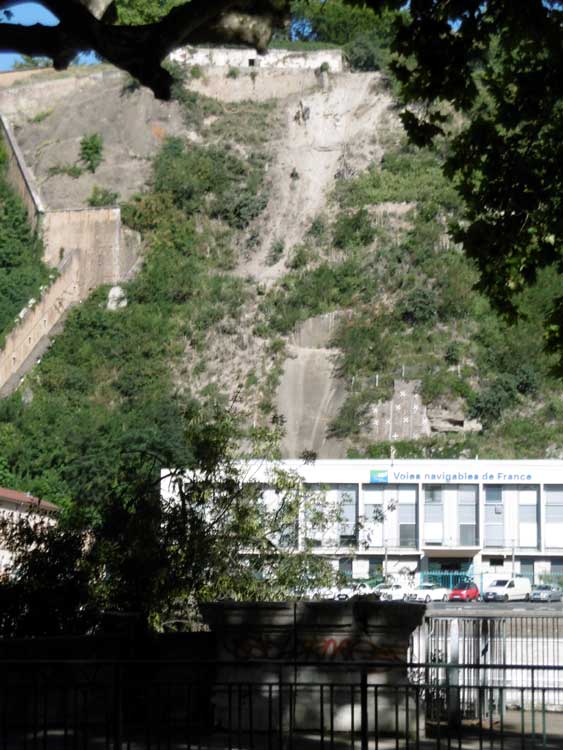
If you had looked really closely at the background of last Thursday's photo (but why would you?) you would have noticed something a little odd. We certainly didn't notice it at the time.

In fact, it wasn't until the next day, as Susan and I were making our way to the station to leave Lyon, that I realised there was a bit of a commotion drifiting across the river. We couldn't quite work out what it was about, but there was what sounded like quite a heated discussion mixed in with machinery of some kind - we couldn't see anything anwhere you would expect to see people discussing things.

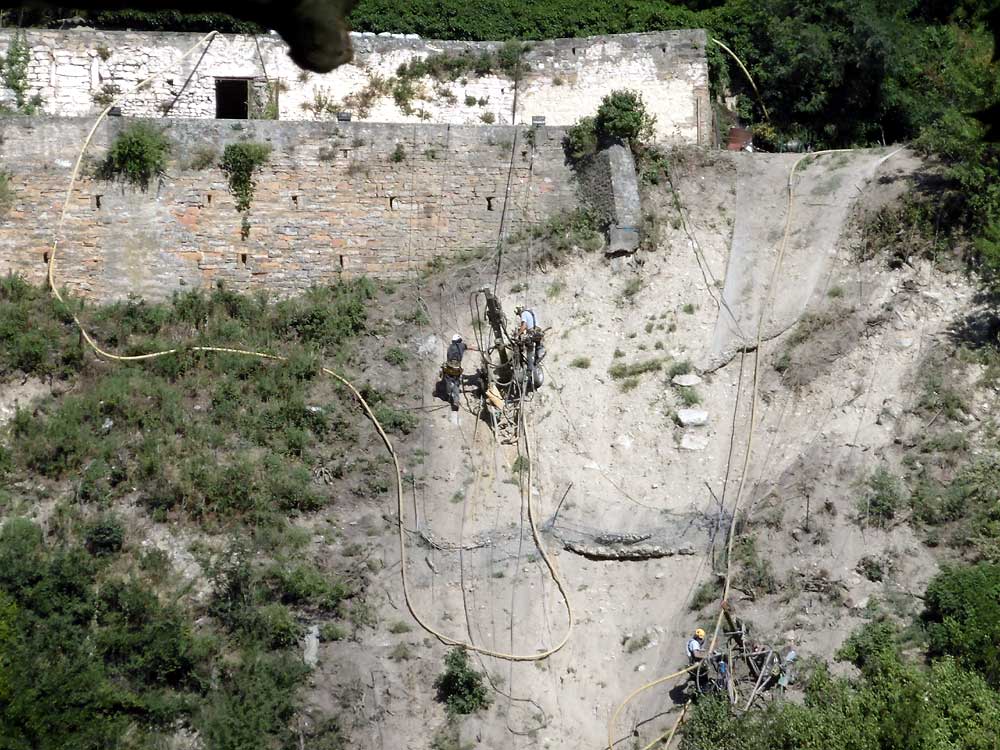
And then we lifted our eyes:


It looks like they are drilling holes in the cliff face to insert some sort of reinforcing, probably steel rods, to stabilise the rocks. The building below is the offices of the canal company. We have seen similar work done in caves, and the results of this sort of activity in rock faces above mountain roads, and we have even seen similar rods being used to hold up the cliffs of the Cité Royale in Loches, but we have never watched it being done in the middle of a big city.

Tuesday, 9 August 2022

Serendipity

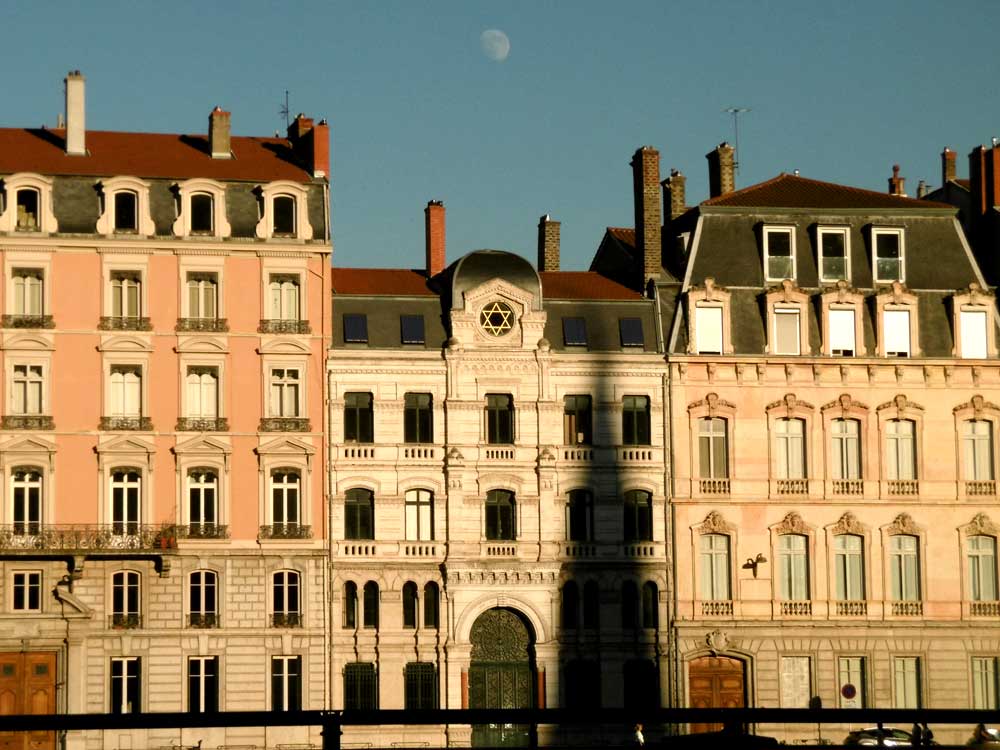
It's just that the moon happened to be in the right place. The photo was taken in Lyon, 4 weeks ago.


It's amazing... In some ways Lyon feels like it was longer ago than 4 weeks, but in others it feels so recent. I suppose it's because we have been so busy and done so much lately that time has felt really random.

Thursday, 4 August 2022

Get your Motor Runnin'


Head out on the highway!
(But wait for the green light first)


Photos taken by Rosy when we were in Lyon. You know how sometimes it's hard not to stare?

Earworm? You're welcome!

Monday, 18 July 2022

Our Trip to Lyon -- an overview

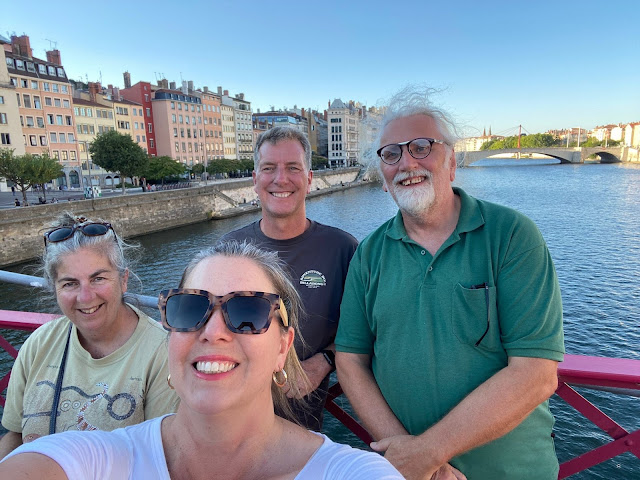
We spent 10-13 July in Lyon with Simon's brother and sister in law and had a great time. It was everybody's first time in the city.
Visiting Lyon, Rhone, France. Photo by Loire Valley Time Travel.
Me, Rosy, Jon, Simon, on the foot bridge over the Saone. Photo courtesy of Rosy.
 

Lyon is France's second (or third, depending on how you measure it) city, situated in the south-east of the country on the confluence of the Saone and the Rhone Rivers. It is divided into several distinct districts -- Vieux Lyon (the old town), the Presqu'ile (the peninsula between the two rivers), the Croix Rousse (where many silk weavers lived), and La Part-Dieu (the new town).  

Looking up the Saone from the Basilica roof, Lyon, Rhone, France. Photo by Loire Valley Time Travel.
Looking up the Saone. Photo courtesy of Rosy, taken from the Basilica roof.
 

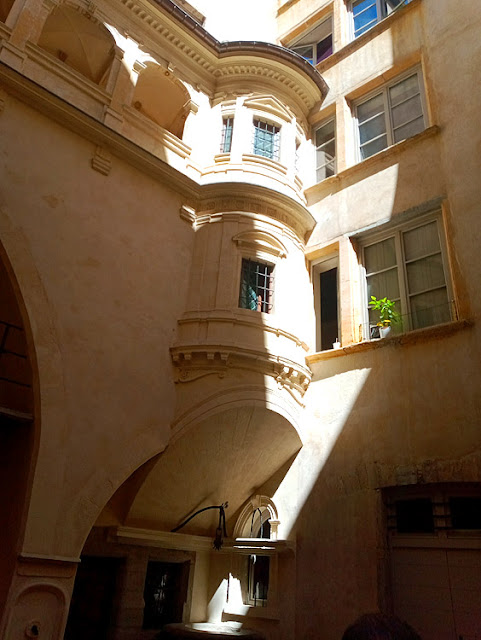
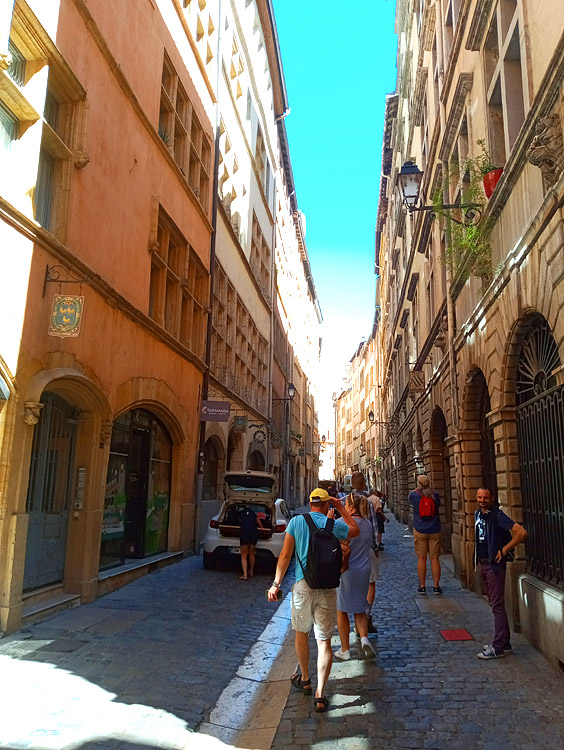
Traboules: These are alleyways which link the three streets in Vieux-Lyon. They are to maximise the use of space in an area that is constricted by cliffs on one side and the river on the other, allowing residences to be built over and around them and include small internal courtyards. They are quite hidden unless you know about them as they have entry doors which in most cases look like private entrances. I recommend hiring a guide to show you the best ones, as they are often architecturally rather brilliant (14C to 17C). Once you are inside you need to be very quiet as sound reverberates in them, and people live and work in the buildings they serve. There are also traboules in La Croix-rousse.
16C traboule designed by Philibert Delorme, Lyon, Rhone, France. Photo by Loire Valley Time Travel.
16th century traboule designed by Philibert Delorme, who also designed the gallery over the river at Chenonceau for Catherine de Medici.
 
Food: Lyon has a reputation for being the great foodie capital of France. It has a remarkable number of Michelin starred restaurants, none of which we tried, although I did chat briefly with one of the chefs. It also has restaurants known as 'bouchons', which were traditionally run by formidible women. There are plenty of good restaurants doing French classic dishes and quite a few places that the locals consider to be tourist traps, especially in Vieux-Lyon. Most of the best bouchons are on the Presqu'ile, not in Vieux-Lyon. The chef Paul Bocuse is (even now he's dead...) a big presence and influence in the city. Probably the most famous dish is quenelles (fish dumplings).

Rue de boeuf, Vieux-Lyon, Rhone, France. Photo by Loire Valley Time Travel.
Rue de boeuf in Vieux-Lyon is full of restaurants.

To be honest, based on what I had read, I expected Lyonnaise food to be stodgy. I was delighted to be proved wrong on that one, although it is generous and hearty. However, despite having a number of excellent meals, I didn't really get what it was about Lyonnaise cuisine that gives it a reputation as a cut above other regional French cuisine. We live in the Touraine, and the food is excellent here too, but somehow the Tourist Office hasn't managed to get the message out internationally in the way Lyon has.
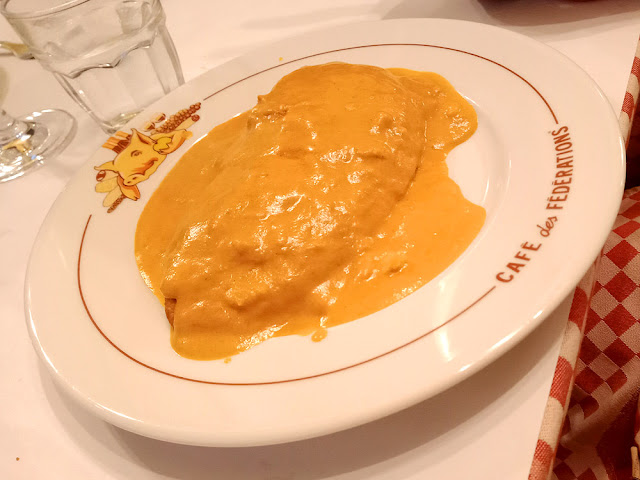
Quenelle, Lyon, Rhone, France. Photo by Loire Valley Time Travel.
Quenelle.

The big difference that was very noticeable was that Lyonnaise restaurant staff are lively and happy to engage, in whatever language you can muster, with diners. Eating in a restaurant in Lyon is a joyous experience, quite loud and boisterous, with lots of smiling and healthy enjoyment of lots of food and drink. 

Aperitif, Lyon, Rhone, France. Photo by Loire Valley Time Travel.
Aperitif on the Fourviere. Photo courtesy of Rosy.
 

Where We Ate:
The Phamily, 7 rue du boeuf, Vieux-Lyon. Vietnamese. Dinner. https://www.thephamily.co/

Les Adrets, 30 rue du boeuf, Vieux-Lyon. French. Lunch. Recommended by our guide. http://les-adrets.com/

Les Adrets restaurant, Lyon, Rhone, France. Photo by Loire Valley Time Travel.
Les Adrets restaurant.
 

Café des Fédérations, 9 rue Major Martin, Presqu'ile. Bouchon. Dinner. Recommended by our guide as one of the authentic bouchons that was not a tourist trap. Nevertheless, by far the majority of diners were American. The restaurant occupies three premises (two adjoining and one across the street). First time diners, including us, struggle to work out how to get in, so don't hesitate to stand in the street and wave madly to attract the barman's attention. He will come and let you in. https://restaurant-cafedesfederations-lyon.fr/

La Salle a manger, 52 cour Charlemagne, Fourvievre (next to the Basilica). This is a restaurant run by a famous institution called the Apprentis d'Auteuil, which takes disadvantaged young people and trains them for various trades and professions. https://www.apprentis-auteuil.org/etablissements/fiche-etablissement/la-salle-a-manger-a-lyon-90944.html

Brasserie l'Espace Carnot, 4 place Carnot. https://espacecarnot.fr/

Note that many restaurants are closed on Mondays.

What We Ate:
Phamily - mixed starters of dumplings and spring rolls; pho, Saigon salad, chicken with satay sauce, coconut milk and chopped vegetables, sauteed beef, boiled rice.  

Les Adrets - Duo of mackerel; confit de canard (slow cooked duck) with polenta; a sort of deconstructed strawberry shortcake.

Café des Fédérations - oeufs meurette (poached egg in red wine, mushroom and shallot sauce); salad Lyonnaise, lentil salad, saucisson aux pistache brioché (pork sausages studded with pistachios and wrapped in brioche); quenelles (pike fish dumplings) with langoustine bisque sauce, civet de joue de porc (slow cooked pork cheeks in red wine sauce), tablier de sapeur (crumbed pork escalope with macaroni cheese); demi Saint Marcelin truffé (half a Saint Marcelin cheese with a layer of truffles and garlic), cervelle des canuts (cottage cheese with garlic); Crème glacée aux raisins, coulis de fruits rouge au marc de Bourgogne (house made vanilla ice cream with red fruit sauce and sultanas soaked in a local spirit).

Saucisson aux pistache brioché (pistachio studded pork sausage in brioche), Lyon, Rhone, France. Photo by Loire Valley Time Travel.
Saucisson aux pistache brioché (pistachio studded pork sausage in brioche).

La Salle a manger - cold carrot soup, lentils with a poached egg, rabbit terrine; pork sausages studded with pistachios; peach tart.

Espace Carnot - rougail (sausages in a spicy tomato sauce) with lentils and rice; pistachio sabayon with a shortbread biscuit.


All our restaurant experiences were good and we noticed that lentils and pistachios featured in nearly every meal.

Silk: We visited Brochier Soieries, 16 rue de boeuf, Vieux-Lyon for a history of the silk industry and the family run Brochier company in particular. They now concentrate on silk screen printing scarves for museum shops. I got to paint some silk and we were shown silk worms in various stages of growth. This was a real highlight. https://brochiersoieries.com/en/
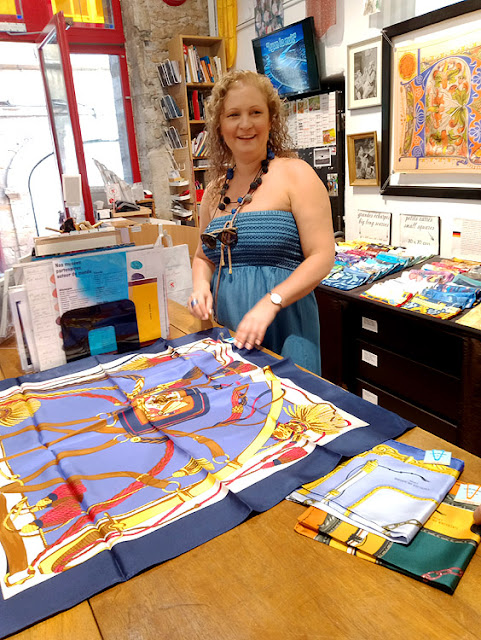
Brochier Soieries, Lyon, Rhone, France. Photo by Loire Valley Time Travel.
Inside Brochier Soieries shop in Vieux-Lyon.
 

Churches: We visited the cathedral, in Vieux-Lyon, which has wonderfully detailed medieval carvings on the front, and a splendid 14th century clock (!!) inside, as well as stained glass from most centuries from the 12th to the 20th.
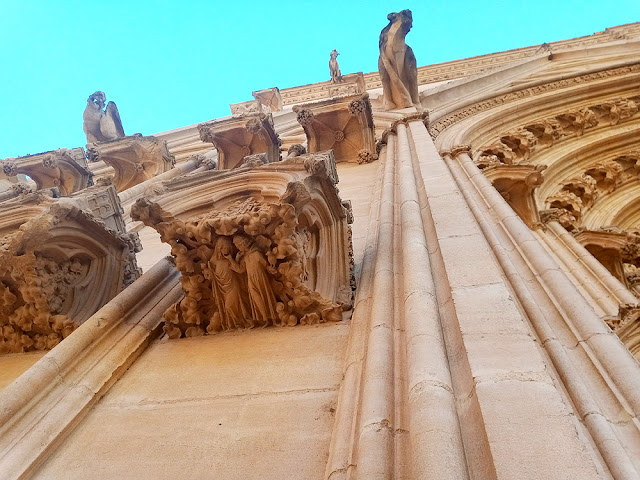
15C Lovers on the front of Lyon Cathedral, Rhone, France. Photo by Loire Valley Time Travel.
The 15th century lovers on the front of the Cathedral.
 

We also visited the Basilica, on the Fourviere hill, which, much to our surprise, turned out to be a tremendous highlight. The exterior and interior is a megafest of 19C high Catholic taste, but by chance we were invited onto a tour of the roof, which was great fun and very informative. Needless to say, there are the best views in Lyon from the roof of the basilica. The tour is only in French, but there were several non-French speakers doing it and they seemed to enjoy it.

Guide: We used New Generation Guide www.newgenerationguide.com who at under 300 euros for a private group of 4 for 3 hours of exploring Vieux-Lyon, including the silk workshop, cathedral and many traboules, was very good value. The guide was extremely knowledgeable and very well networked so we got to see things we would not otherwise have done.

Guided tour in Vieux-Lyon, Rhone, France. Photo by Loire Valley Time Travel.
Our guide Alex, on the right, engaging in that time honoured guiding technique, herding cats.
 

Also recommended to us was www.foodie-lyon.com but we did not actually use them.

Museums: We visited the Musée de Beaux Arts and were impressed by the Egyptian collections, some of the medieval artefacts, and the 17th century paintings. https://www.mba-lyon.fr/fr

What we did not have time for but would have liked to do: The Museum of the Resistance and Deportation https://en.lyon-france.com/discover-lyon/culture-and-museums/museums/resistance-and-deportation-history-centre-chrd, the Institut Lumiere https://www.institut-lumiere.org/ and the Botanical Gardens https://www.lyon.fr/lieu/jardins/jardin-botanique. The Textile Museum https://en.lyon-france.com/discover-lyon/culture-and-museums/museums/textile-museum-closed, which has long been on my list, is closed for renovations. Note that many museums are closed on Mondays and/or Tuesdays.

Where we stayed: A 2 bedroom apartment in rue Johannes Drevet on the Presqu'ile. It was spacious, clean, well equipped except for a few minor niggles and perfectly located for getting to all the places we wanted to see.

What I did not like about Lyon: The noise! There was a lot of street noise, day and night.

How we got there: We caught the Intercity train from Saint Pierre des Corps to Lyon Perrache, a trip of about five and a half hours, and returned the same way. In Lyon we mostly walked, but on one day bought a 24 hour multi-trip public transport pass and used the funicular railway to get up to Fourviere and back.

Friday, 15 July 2022

Off the Tracks

No pictures of the Fete Nationale celebrations this year, we didn't go because we arrived back from Lyon at about 10:30pm and were hot and tired. The celebrations were curtailed this year, having no fireworks because of a request from the Prefecture to try stop wildfires.

So instead an artfully edited photo of the obsolete dockside railway tracks in Lyon.


Thursday, 14 July 2022

The Basilica at night

We arrived home from Lyon at about 22:30 last night. We're too hot and tired to write a blog, so here's a photo of the Basilica of Notre Dame, Lyon, at night.


Wednesday, 13 July 2022

Fom Here to There

...and from there to here. The Lyon edition.

This is the view of Basilique Notre Dame from in front of our apartment. The basilica is the white building atop the hill


This is the view from the top of the basilica to our apartment (just behind the trees near the bridge, behind the tall steeple).


Yesterday we did a tour of the basilica which involved climbing as far as you can go - in this case the top of the right hand tower. The above photo was taken from about the position I have circled in red.


It was about 300 steps up (and down) but well worth the effort and the 14€ ticket.

Tuesday, 12 July 2022

Cathédrale Saint-Jean-Baptiste de Lyon

The Cathédrale Saint-Jean-Baptiste de Lyon is a late medieval church built on a very early medieval site. If you stand in the right place at the right time you can get photos like this.

It's hot in Lyon at the moment, and due to get hotter. Everyone in Lyon is wearing shorts and looking pink, us more than most. A full report will follow in due time, but needless to say we have walked miles and eaten too much.

Monday, 11 July 2022

On The Tracks

Susan and I are in Lyon for a couple of days, spending time with my brother who is over from Australia. He is the first family member we have seen since the pestilance hit.

We left tours at 07:33 and caught the InterCitie train to Lyon Perrache, arriving at about 13:30. The train was modern and air-conditioned and very smooth, if not the fastest. The tickets were inexpensive and the whole thing was less stressful than driving. It's territory we haven't really seen before, so it was a pleasant meander through central France

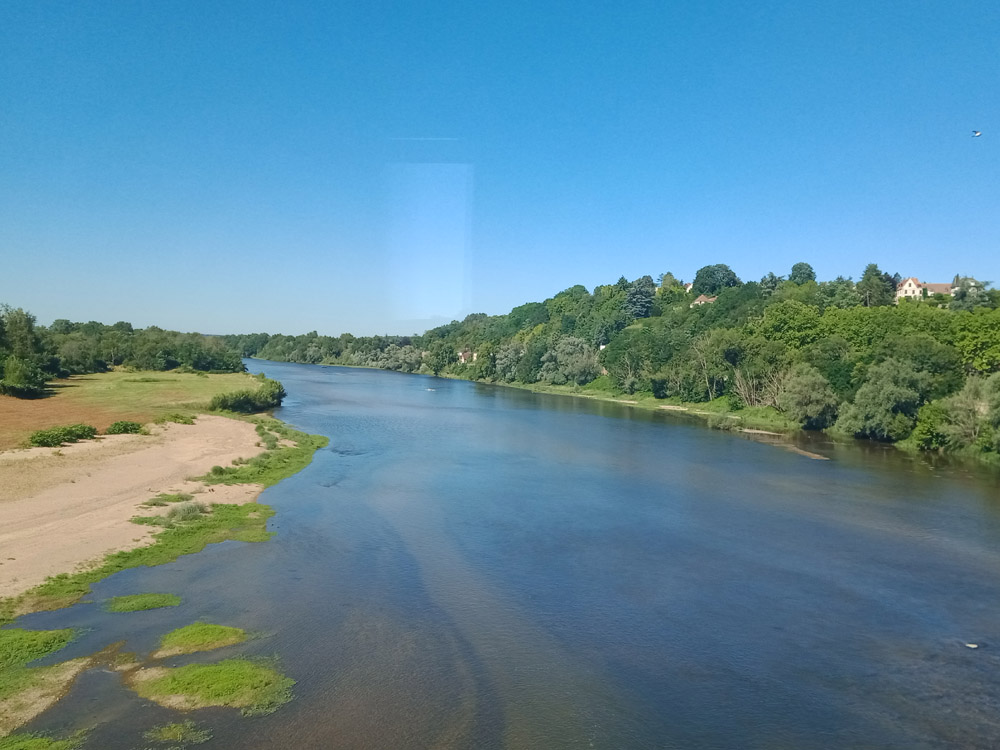
This is the Loire River at Nevers, taken through the train window.


Saturday, 2 April 2022

We're not in Paris

We weren't in Paris last weekend, either.

Usually at about this time of year we visit Paris to go to Retromobile. The past two years it was cancelled due to the plague, and this year it was held a month later than normal. We didn't go, because we were working that weekend, but I am not sure we would have gone even if we hadn't had that excuse.

In fact, it's two and a half years since we were last in Paris. The biggest city we have been to since then is Tours. We have plans to visit Lyon in July, so let's hope we don't get scared by the idea of a big city.

In the meantime a photo of the Elvis Presley inspired gargoyle at the Église Saint-Séverin in Paris' 5th arr.


Sunday, 21 July 2019

Vegemite Delivery


Earlier in the year Marie-France and Gérard (who grew up in our house) called me to say they were going on a world trip and were having trouble with the website for getting Australian visas. I went up and couldn't make it work either and eventually they resorted to using a third party commercial agent to get one, which of course meant they paid a bit extra. Also of course, once they got to Australia, it seemed like no one was interested in their visa! (I suspect it's all electronic these days.)

Marie-France was determined to come home with some Vegemite that she could give me. When in Australia they amused their guide by persisting in asking her if they could stop off at a supermarket to buy Vegemite. The guide (a French woman married to an Australian) didn't take them very seriously and it took several days to achieve the mission.

Photographed by Susan Walter.
Marie-France, Gérard and Simon with a jar of Vegemite.

Once back in France they tried to set up a date with me to deliver the goods. Twice we had a date, and twice it fell through for one reason or another. Then on Friday, they were coming down our way to pick up their daughter in La Roche Posay, so they let me know they would call in that morning. They arrived at 9.10 am, just as I was vaccuuming in preparation. That set Marie-France off into hoots of laughter about being such an important guest, and in fact, it was much nicer outside at that hour, so we sat on the terrace for a cool drink and an account of their trip.

First we discussed the state of the middle garage at the back of our place. It's now owned by Franck from Lyon. He inherited it last year from his uncle, and doesn't really know what to do with it. He's been here twice for a day to try to clean it up and do some emergency repairs. On his last visit we discussed renting it from him to cover the cost of his insurance and property tax. That's a potential win-win while we both work on the finances and a plan for repairing the building.

Anyway, it turns out that Gérard is a model train enthusiast and in his youth, the train set was up in the loft of this garage. I told Marie-France that Simon would love to have a model train and her advice was not to let him start. Once it starts, there is no cure, and no end to the ordering bits online and visiting model shops. We now have an invitation to see Gérard's set up at home. Marie-France says that she is willing to claim they won't be home on the day if I let her know I don't want to take the risk of Simon suffering irreversible train envy.

Finally we got back to their trip. It began very badly indeed, with a problem with Gérard's US visa meaning that he was not allowed on the plane in Paris that would take them to the US. Marie-France had already gone through all the checks. They managed to get Gérard an emergency visa and on the same plane the next day, but it meant that he was chasing the tour for a couple of days before catching them in Las Vegas. They never found out what the problem was and had to pay for extra hotel nights and so on. Their guide didn't seem to care, and blamed them for messing up the visa application in some unspecified way. They are now using their legal action insurance (standard with all home insurance here) to make a claim via the national consumer watchdog organisation.

Luckily after that things improved and went smoothly, but in a couple of places they didn't really find their guide very good. Marie-France commented that she was disappointed with how little Aboriginal culture they were exposed to. They did get told all about Lapérouse though, and how close Australia came to being French. She loved the Opera House, the Bridge and Taronga Park Zoo (although she had hoped to see the Komodo Dragon there, but ran out of time). She also observed that it seemed that Australian pensions weren't very generous and work hours long. I suspect that Rotorua, in New Zealand was the highlight of the tour, despite the fact it rained all the time they were there. She also contrasted how much the Maori culture features in New Zealand compared to the Aboriginals in Australia. Bangkok was very humid, Pape'ete and Tahiti didn't get much of a mention (not so challenging I guess, as they are French speaking).

For an account of another French-Australian interaction with Vegemite, read this post on Papilles et Pupilles

And you can see Simon's beautiful Vegemite sandwiches in this post.


************************************************

For details of our private guided tours of chateaux, gardens, wineries, markets and more please visit the Loire Valley Time Travel website. We would be delighted to design a tour for you.

We are also on Instagram, so check us out to see a regularly updated selection of our very best photos. 

Thursday, 20 June 2019

New Apothecary at Chenonceau


To celebrate the 500 year anniversary of the birth of Catherine de Medici, the Chateau of Chenonceau has recreated the apothecary that once existed in the stable block. The Queen was always surrounded by scientists such as her doctor, Augier Ferrier, and Nostrodamus, her herbalist. The latter was so reknowned that the Queen called him to court in 1555.

A local furniture maker has worked for three years to restore a monumental set of cabinets for the apothecary. It took Fabrice Hulak, who has lived and worked in nearby Azay sur Cher for fifteen years, nearly two years to restore the individual wooden elements before putting the whole thing together, another year's work. He's very aware of how lucky he has been to work on this once in a lifetime project.
Photographed by Susan Walter. Tour the Loire Valley with a classic car and a private guide.

Laure Menier, the curator of Chenonceau, has wanted to reinstate the apothecary for a long time. Then three years ago she had the opportunity to buy the apothecary from a Florentine palace. The nine wooden cabinets, 3.8 metres high and 1.8 metres wide, were delivered with four boxes of bits -- a real jigsaw puzzle.

Hulak, and his old apprentice master Patrice Goulon, from Bléré, took on the task in the autumn of 2016. There were no plans, drawings or instructions. There wasn't even a photograph of the apothecary in situ in Italy. As he worked on the cabinets he discovered that they showed the signs of being altered over the course of their life.

Photographed by Susan Walter. Tour the Loire Valley with a classic car and a private guide.

The apothecary has been reinstated in the stables, where the original one was. The Florentine cabinets have been adapted to fit the space and the beams in the ceiling. Mouldings have been remade, suitable pieces have been found to fit and later modifications reversed so the apothecary is a Renaissance piece of furniture.

Hulak worked at least three days a week on the project, and sometimes two weeks straight. All the while he was engaged in honouring other commissions too.

The longest task was to take the cupboards apart and remove all the old varnish, then replace or reglue the little carved motifs and the broken acanthus leaves. It was very precise and fastidious work. He had to reconstruct the cupboards, remake 400 metres of mouldings and the doors. It took nearly two years to remake all the elements before he could put it all back together.

Everything was done in the workshop, then reconstructed in the room in the stables. All the carcasses of the cupboards are oak, and the facades walnut. The glass for the doors, artisan blown like in the period, were ordered from Lyon.

Hulak has also done all the other items of furniture in the display, including an enormous Renaissance three metre high by three metre wide buffet in rosewood and walnut. That only took him three months!

************************************************

For details of our private guided tours of chateaux, gardens, wineries, markets and more please visit the Loire Valley Time Travel website. We would be delighted to design a tour for you.

We are also on Instagram, so check us out to see a regularly updated selection of our very best photos.