Sunday, 24 September 2017

Ravensbourne Rainforest

Some views of Ravensbourne National Park in south-east Queensland.


Ravensbourne National Park is about 20 kilometres from Toowoomba. It has some remnant old growth trees of great size, palms, gullies with small streams and some species of birds that you don't commonly see, such as Black-breasted Buttonquail, Green Catbird and Noisy Pitta (110 species in total). You might also catch a glimpse of native frogs and lizards. Ravensbourne NP is the best surviving section of the once vast rainforest and wet eucalypt forest that covered this part of the Great Dividing Range until European settlement.


The local Aboriginals used the area as a stage on their journey to the Bunya Mountains, where they would harvest the important food source of Bunya nuts from the Araucaria bidwillii. In the second half of the 19th century most of the big hardwood trees, especially Red Cedar Toona ciliata, were felled.


Nowadays, apart from the remnant giants, the star plants are the palms and the ferns (including elkhorns). The fungi are also notable.


Camping in the National Park is not permitted, but it is a popular picnicking spot with a panoramic lookout. Bushwalkers and birdwatchers also take advantage of how close it is to Toowoomba. Shelter sheds and picnic tables are provided at two areas, as well as pit toilets, water and wood barbecues. The water is not potable so you are advised to bring your own or boil the water on site. Likewise, firewood is not provided, so if you want to barbecue you need to bring your own fuel (collecting wood in the National Park is understandably forbidden). There are no rubbish bins and visitors are expected to take their own rubbish out. Domestic animals are banned from the park.


Some of the tracks have steep drop-offs and can be slippery after rain. Visitors need to be careful of the stinging trees. Mobile phone coverage is patchy so you need to fairly self-reliant.


Saturday, 23 September 2017

Chateau Gaillard, Amboise


The weekend of 16-17 September was the annual Journées du Patrimoine (Heritage Days) in Europe. I was in Amboise working with a group of American gardeners for a week but I had Sunday afternoon off. I chose to visit the newly restored Chateau Gaillard at a reduced entry fee, with my two American colleagues.

The facade of the royal apartments.

Chateau Gaillard is a small royal chateau in Amboise, used by Charles VIII as a retreat when he returned from the First Italian Wars. It is just up the road from Clos Lucé and tucked in under the southern cliff face of the limestone spur that the Chateau-Royal of Amboise sits upon.

This hexagonal staircase tower gives the building away as late medieval rather than wholly renaissance in style.

Construction of the royal apartments which form the main block of the chateau began in 1496. It is the first building in France to be built in the Italian style that the Loire Valley chateaux are famous for. It is also the site of the first renaissance style garden in France, with Italian style parterres that become the iconic French formal style of gardening.

The kennels turned out to currently house a small goat.

In front of the chateau is a generous terrace which looks out onto a 15 hectare park which has been created on boggy land on the banks of the Amasse. The 20 metre cliff behind the chateau means that the valley bowl is protected from the north winds and has its own Mediterannean microclimate.

My American colleagues Deb and Charlie walk up the driveway.

The original garden was created by Dom Pacello da Mercoliano, who returned with Charles VIII after his campaigning in Italy, along with a team of 21 other Italian artisans. The site provided ideal conditions, with plentiful water and shelter, that gave it a big advantage over the main Chateau-Royal.

Looking down into the kitchen garden.

Dom Pacello created the first garden in France with a central axis to enhance perspective, the first formal garden beds, defined by low holly hedges, and the first 'mirror pond', fed by the Amasse and a spring on the side of the hill. He introduced citrus, especially lemon and orange trees, to the garden, the very first to come to France. Heated greenhouses were built to house the northern most peaches in France. The greengage plum (Fr. reine-claude) dates from Dom Pacello's time here and was a selection made in this garden. Another innovation was the growing of melons and tomatoes in enclosures with low walls to act as windbreaks.

Different local wine grape varieties grown on a south-east facing slope, with chunks of limestone mulch. 

Nowadays in the park there are many grand trees (oaks, cedars, yews, tulip trees, elms, ash, robinia, Judas trees), an arched gateway contemporary with the chateau, an 18th century cottage, grottoes in the cliff as well as a magnificent 350 metre double allée of London Plane forming the 'back' driveway, created in 1885 by Jean Théodore Coupier (industrial chemist and engineer, a former owner of the chateau). 

The greenhouse.

In 1505 Louis XII ceded the chateau to Dom Pacello, in return for a rent of 30 sols and a bunch of orange blossom every year. After having been one of  the residences of Charles VIII and Anne of Brittany, then Louis XII and Dom Pacello, Chateau Gaillard saw a succession of notables stay within its walls: René de Savoie (François I's uncle) and Anne Lascaris ; Jean III Cardinal de Lorraine; François II and Mary Queen of Scots (on their honeymoon); Charles de Guise-Lorraine (Jean's nephew and also Cardinal, who remodelled the facade of the royal apartments in 1559); René de Villequier (one of Henri III's favourites); the Della Rovere family (Italian nobility whose family included two Popes and the Dukes of Urbino); and André Malraux (de Gaulle's Minister of Cultural Affairs)  and Louise de Vilmorin (his mistress, a novelist and heiress to the Vilmorin seed company fortune). The estate is currently owned by a private property trust headed by Marc Lelandais.

Espaliered apple trees with chunks of slate used to define the beds and mulch.

In 2009 the chateau was a ruin and it seemed possible that the site would be subdivided. Luckily the mayor of Amboise refused to authorise this and Marc Lelandais was able to purchase the property with a view to restoring it to its former glory. Using private funds only, it took five years, and just as they were about to open fully to the public, in June 2016, they were inundated with flood waters. 

Friday, 22 September 2017

Here starts Autumn

The Equinox is at about 9pm (21h) tonight. That means goodbye to summer (hah!) and hello autumn. In reality it's been feeling like autumn for most of this month so we won't notice the change, except that for the next 6 months we will have more dark than light. Cheery thoughts...

In a month's time we will have this

and in two months this. 

And then suddenly it will be February, we will have a week of sunny warm weather, and everyone will be saying "isn't it amazing, winter's over early".

Thursday, 21 September 2017

Beating the Blue Train

The Calais-Méditerranée Express was a luxury French night express train which carried wealthy passengers between Calais and the French Riviera from 1922 until 1938. It was referred to as "le train bleu" in French and the Blue Train in English because of its dark blue sleeping cars.

In 1930 a very unofficial race was held between a Rover car and the train. Although the car was stopped by heavy fog 5 hours into the run, the team decided to drive on to St Raphael (near Cannes, on the Mediterranean coast) and race the train back. This they were able to do, beating the train into Calais by 20 minutes. After that there were a number of other "races" notably involving Bentleys and Alvis cars.

 Yes please! A 1927 Bentley 4½ litre (the blue car, No2)
behind No3, a 1928 Bentley 4½ litre Blower (supercharged)

These days people who own vintage and classic cars can join the "Blue Train Challenge", a six day event from Deauville to Cannes. This year there was a scheduled stop at Angles sur l'Anglin, so on Sunday I collected Pauline in Célestine and we wandered off to see what was happening.

No23 is a 1937 Bentley Derby Open Tourer and No8 is a 1932 Alvis Speed 20.
The enormous cream coloured car is a 1938 Chevrolet Fangio Coupe

There was lots of cars (and spectators) and although Célestine isn't exactly a vintage GT machine people were just as happy to see us as they were to see the Bentleys, Alvises, Aston Martins, and a bevy of other 1930's, 40's and 50's exotica.

No8 Alvis passes a 1936 Buick Special Convertible (No18) and a 1934 Aston Martin MkII

No48, a 1954 Arnolt Bristol Bolide leads off a 1948  Bentley Le Mans 8

A full list of runners and riders is here.

Wednesday, 20 September 2017

A New Footpath

18 months ago Susan wrote "A Greenway to Replace the Railway". A meeting was held about 12 months ago to discuss the project; specifications, financing and the like, at which number of options were put forwards.

I don't know which option has been taken - either 2 metres wide, pedestrian only, or 3 metres wide pedestrians, bikes horses and skaters, but I do know work has started. I hadn't heard anything further on the project since last October, but I met TimB and Gaynor for a walk last Friday in Chaumussay and was rather surprised.

This is looking from Chaumussay towards le Grand Pressigny

 Looking from Chaumussay to Preuilly
Most of the track has gone from this section 

I will have to keep my eyes open - I hope there will be some sort of announcement about the opening, but you can't take these things for granted.

Tuesday, 19 September 2017

Look Out for Swallowtail Caterpillars


On Wild Carrot Daucus carotta in our vegetable garden October 2016.

On the roadside above the Claise near Chaumussay, on Wild Parsnip Pastinaca sativa, September 2013.

In our garden on Wild Carrot, September 2014.

On French Hog's-fennel Peucedanum gallica, on a forest ride near Luzé, September 2012.

On Wild Carrot in our orchard, September 2015.

Caterpillars of the Eurasian Swallowtail Papilio machaon (Fr. Machaon) can be observed on their food plants in September. They are busy fattening themselves up before winter, which they will spend as chrysalises, having wrapped themselves up before the cold weather hits.

They will leave their food plant and move to a sturdy upright stem where they will attach themselves and make a chrysalis. Depending on the surrounding vegetation the chrysalis could be green or brown, to blend in.

Monday, 18 September 2017

Fun with Célestine

On Thursday Susan and I had dinner in Amboise, and then I drove Célestine home. It's the first time in almost two years I have driven Celestine in the dark, and boy, did she let me know who was boss....

The problem was electricity - with the headlights on she was drinking it like it was going out of style, and she wasn't recharging the battery. This means that by the time I got home 75 minutes later the headlights were little more than glow worms in a tin, and once the motor was off that was it - she wasn't going anywhere. Which was peeving, because I had plans.

Anyway - a day on the charger later (yesterday), Tim and Gaynor arrived to go to the Bouchonne de Ste Maure with us, and this time Celestine behaved impeccably. Yes, it rained, yes there were probably less cars than there could have been, and yes, many people didn't stay to picnic on the road (we did).

And yes, we had a great day. Here are some pics:


So now I have to sort out Célestine's electrics. I have a suspicion the battery isnt good.

Sunday, 17 September 2017

See Yesterday's Post

I know we have posted this photo before, but it still makes me laugh. It is also appropriate given that today I am taking part in a deliberate traffic jam.


Saturday, 16 September 2017

Traffic Alert for Tomorrow

Tomorrow Célestine and I will be at Sainte-Maure-de-Touraine for the biennial bouchonne on the N10 for cars built before 1977. We went two years ago and had a great time. This year, Susan is working, so I will be going with TimB and Gaynor.

This year, once the traffic jam on the main road (10.30 - 12.30) is finished we will be parking wherever we find ourselves stopped, for a picnic on the old Route Nationale N10. It's on occasions like this I wish we had a roof rack and vintage deck chairs.

What to expect...

This means that if you're planning on travelling through Ste Maure you will be diverted all day until about 17.00. But that's just your bad luck - we like heritage traffic jams and this one is part of the European Patrimoine weekend, because automotive history is important here.

Friday, 15 September 2017

More Breezy Times

Last time it was breezy, (March) the front wall of the garage attached to ours was blown in.

Wednesday was a very breezy day too - with winds of about 80kmh (50mph). This time the damaged neighbour's garage wall was blown out - once again the Ford survived because it was parked elsewhere.


I will have to speak to the council, and find out the next step - no-one has heard from the owner since we contacted him about  the Damage in March.

Thursday, 14 September 2017

The Hotel Solar

When we were in Paris last weekend we stayed at the Solar Hotel, a very green establishment in the 14th. Everything is green and bio (organic) and ethical, and it is the headquarters of Sea Shepherd in Paris.


Although it is more expensive than the hotels we normally stay in outside Paris, the prices are very reasonable by Paris standards. It's also in a great part of town, in the 14th near the Catacombs. Not that it's the catacombs that make it a great area: rue Daguerre is just around the corner, an excellently typical pedestrianised Parisian shopping street with plenty of specialist food shops and restaurants of all ethnicity.

It is also very close to the Denfert-Rochereau Metro and RER station, which means direct RERB to Charles de Gaulle Airport, and direct Metro 6 to Montparnasse Station (from where the TGV departs to our neck of the woods). Very convenient.

I am sure Susan will have more to say about the hotel when she has a chance, and we will certainly be posting more about the area. Once again, we have a new favorite area of Paris


Wednesday, 13 September 2017

Take the Slow Train

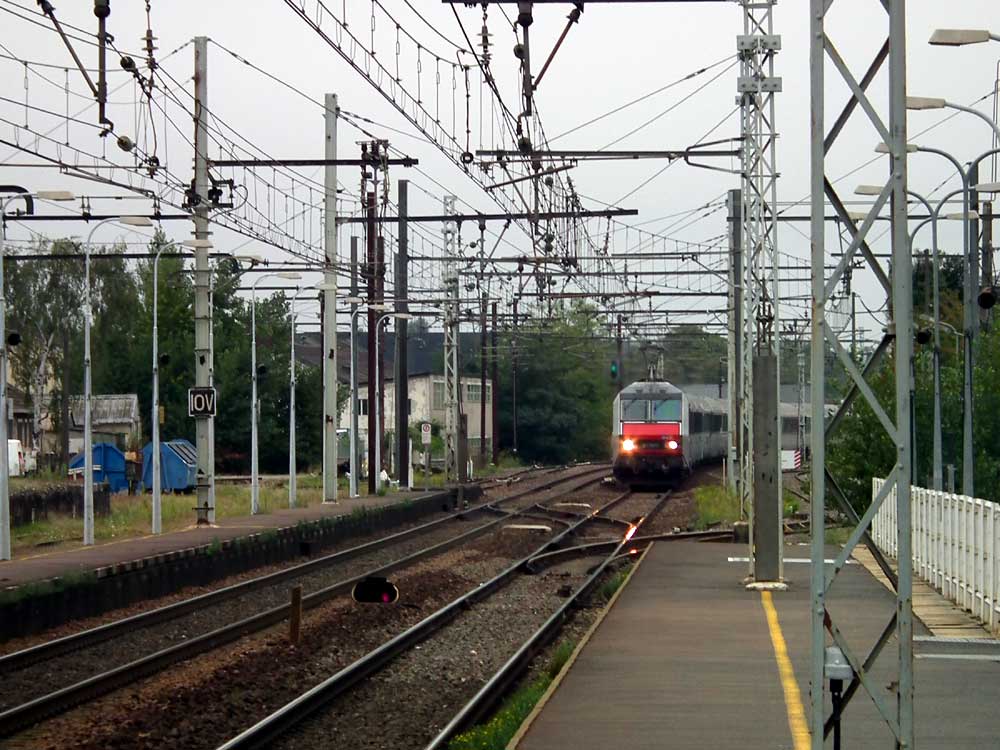
Susan and I spent the past couple of days in Paris. We went up by the "slow" train from Amboise - the ordinary Inter-City Express - rather than the TGV from Saint Pierre des Corps. The trip takes about 40 minutes longer, but is more scenic.

 The InterCity train pulls into Amboise station.

When we found our reserved seats we had a surprise - I had booked tickets in first class rather than cattle class and promptly forgot about it. I am not normally that extravagant, but the first class tickets were 20€ each, only 3€ each more than second. So why not. I know you don't get there any faster, but a little treat is a treat nonetheless.

First class seating - wider, plush seats, more legroom and 2 arm rests each

On the way back I thought I would confirm what we have suspected all along - we should be calling it "the slower train" rather that "the slow train".

200kmh aboard the slow train. The concrete structure you
can see out of the window is the Aérotrain track


Tuesday, 12 September 2017

Złombol

You learn stuff, and after you learn it sometimes you want to do it too...

I was in the new and impressive car park at Villandry on Wednesday, and parked across from me were a pair of decidedly ropey 1970s looking cars, apparently out on a rally (or raid). The crews arrived just as I was leaving, so I gave them a friendly toot and wave and went on my way.


Złombol is a fundraising event for an orphanage in Poland, open to cars built behind the iron curtain before 1989 and bought for less than 1000zloty. That's about 230euros. The rally always starts in Katowice (Poland) and this year was heading to Noja, in the Basque region of Spain. This year there were 530 teams "competing" in what is now reputed to be the biggest event of its kind in the world. The official website is here (in Polish)

The news from Poland (in Polish)

Needless to say, now I know what it is about I am interested...

Monday, 11 September 2017

Shopping at Savebag


For years we have been driving in to Loches via Perrusson and so for years we have been driving past the Savebag factory. We didn't think much about the place. It's a not very prepossessing white building. We assumed they made plastic bags.

It turns out they make luggage! I discovered this when a Facebook friend made a comment about their biennial sale. The company was created in 1963 and is still family owned. They make leather goods, luggage, sports bags, satchels, school and laptop bags. There are 200 employees working at the factory.


In 2014 they were accredited as an entreprise du patrimoine vivant ('a living heritage business'), a label which recognises their knowledge and the excellence of their product. Due to their commitment to passing on the skills and to constant innovation, they are seen as a business that is continuing the tradition of French luxury goods. The products are all designed on the Perrusson premises, but not all manufactured there. The factory workshops tend to focus on the higher end goods. They manufacture bags under their own brand, and for big names like Louis Vuitton.

As well as the big sale the factory has a shop which is open Monday to Friday. Prices are 20 - 50% lower than retail. The staff are very happy to provide advice and after sales service.

We needed a new suitcase and after some research on the internet Simon decided that visiting the shop at Savebag would be worthwhile. I had to go to Loches for a mammogramme on Thursday. My appointment was at 9am and by 9.30am I was out again, with a clean bill of breast health. I went to Intersport to look at sports shoes on special. I didn't like any of them, so didn't purchase. So I had time to pop in to Savebag on the way home.


I parked in the visitor carpark and as requested on the sign on the door, buzzed and entered. I greeted the receptionist and asked about the factory shop. She rang someone called Sylvie upstairs, telling her 'there's someone for the shop'. I was told to go upstairs and wait at the top for Sylvie, who would take me to the shop.

Sylvie turned out to be a lovely and friendly blond woman who was happy to leave me to look around in the shop. I checked out all the suitcases in the size we wanted and chose a yellow rigid case. The price, for a 75 litre capacity, was €31 (retail price €48). When I'd chosen my suitcase Sylvie was nowhere to be seen so I ventured out into the corridor. I encountered a tall, dark and handsome youngish man heading for his office, but entirely prepared to be sidetracked and sell me a suitcase. At that moment Sylvie emerged from the big room at the other end of the corridor so he was saved the trouble, but my impression is that it is an extremely pleasant and friendly place where they care about their customers.


In 1951 Marcel Vignaud was a leatherworker in Tours, designing, making and selling leather goods and luggage. His success was such that he built a factory and registered the business name Savebag in 1962. In 1976 all his hard work really paid off, with a contract to work with the prestigious fashion house YSL. Once the east Asian factories began undercutting his business, Savebag had to regroup and reorganise. They concentrated their production at Perrusson and worked on gaining new markets. Nowadays they export and communicate directly with the public to better position themselves in the domestic market. They now have multiple sites and a total of 485 employees. The management concentrates on maintaining the quality of their manufacture, diversifying their market and ensuring the technical expertise of their staff. They've developed their own brand, built up their proportion of manufacture and distribution under licence and increased their role as sub-contractors.

Sunday, 10 September 2017

Fungi in the Rainforest


Here is a selection of fungi that I photographed in Ravensbourne National Park, south-east Queensland.


Saturday, 9 September 2017

August Aperos


Left to right: Bertrand, Gaynor, Sweetpea, Dauphine, Adrian, Zita (with Brandy the dog), Alice, Géraldine, Tim and Dorothée.

Our monthly apéro party was very kindly hosted by Lisa in Boussay. About 25 people came, and the venue was just about perfect for the event. A big thank you to Lisa (and she will get to host again!)

Sandra playing the harp and singing a medieval song for everyone -- a surprise bonus.

Sadly, due to unforeseen circumstances, the September gathering has been cancelled. But you can all look forward to the October event which will be at Chris's place near Martizay.
Balthazar and Sixtine keeping themselves entertained by playing a board game.

 Clarisse and Zita dancing to Sandra's harp music.