Tuesday, 11 June 2024

Once Upon A Time in Loches -- the Loches Maquis 1944

Poster for an exhibition on the liberation of loches, Indre et loire, France. Photo by loire Valley Time Travel.

" During 1944 the Loches and Sud Touraine maquis set themselves up and prepared for resistance actions against the Germans. The following maquis (armed combattants) were the most active around Loches:

*The Maquis d'Eperon, directed by Commandant Constantini, nicknamed Eperon, in reference to the Governor of the Chateau de Loches in the 16th century. He brought together more than six hundred men, mostly those dodging the draft into the STD (German compulsory labour scheme) and former officers of the 32nd Infantry Regiment. The Maquis d'Eperon was under the command of ORA (Army Resistance Organisation) and its bases were mainly in the Forests of Preuilly and la Celle Guenand.

Memorial to a maquis group, Indre et loire, france. Photo by loire Valley Time Travel.

*The Maquis Césario, also under the command of ORA. Led by sub-Lieutenant Brétegnier, alias Césario, who gathered more than 270 men in the Forests of Manthelan and then Verneuil.


WWII parachute drop site, Indre et loire, france. Photo by loire Valley Time Travel,

*The Groupe Franc-Tireurs et Partisans Francais (FTPF) was first put together in 1943 around the Loches Athletics Club Resistance hub before it was dismantled in July 1943. In 1944 it reformed under the leadership of Engineer Captain Imbert. Composed of about 150 men, it was close to the Communist Party. They operated successively from Perusson, Saint Hippolyte and then the Tivoli camp in Loches.

Remains of a camp kitchen at a maquis site in the forest, Indre et loire, France. Photo by loire Valley Time Travel.

*The Maquis Lecoz is a specific case. It was a group of 155 men led by Captain Lecoz (real name Georges Dubosc). This fake captain and fake doctor founded his own maquis after having been rejected by Eperon. Known mainly for pillaging and summary executions, this 'black maquis' hung out initially in the Forest of Loches."

******************************************

Note: The 32nd Infantry Regiment was traditionally made up of men from the Touraine, so they were locals, who knew the geography and the people.

This poster is part of an exhibition in the Chancellerie on 'Loches in 1944' https://www.ville-loches.fr/expositions-article-3-10-56.html

Monday, 10 June 2024

Urban Bird Watching

Me???

Hang on...

almost there...

Ready!

We were at the guinguette at Monday lunchtime, and this white wagtail (Motacilla alba) was most put out by the fact we were dining near its nest.

Saturday, 8 June 2024

More of My Canberra Story

I've written before about the first house my family lived in when we arrived in Canberra. It was a house tied to my father's employment, and we were there for about three years.

After those three years we had risen to the top of the Government housing list and we were offered a new house in one of the (then) outer suburbs of Belconnen. Mum and Dad didn't want us to change schools yet again, so they agitated for a house that would allow us to stay at the same school.

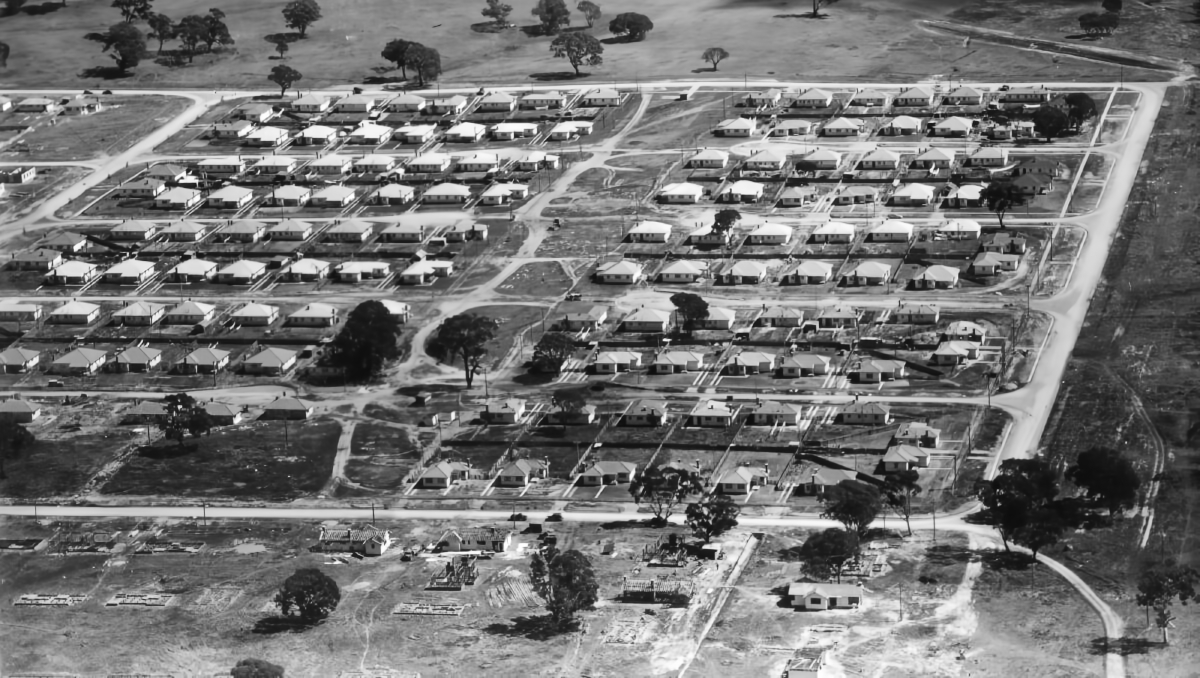
The house we were eventually offered was an ex air force house which had been relocated from the country town of Tocumwal in the late 1940s as a rapid response to a serious housing shortage. About 200 houses had been relocated, many of them to O'Connor.

The Tocumwal Houses in O'Connor 

During World War 2 the American and Australian governments had jointly funded a major aircraft base for the US Army Air Corps at Tocumwal on the New South Wales-Victorian border. Barracks accommodating nearly 4000 personnel were built, designed externally to look like civilian houses to give the appearance from the air of an ordinary township and so avoid detection. 

The huts were made of weatherboard up to window sill height, and had fibro (fibreboard) sheeting between timber windows, and no ceilings or internal linings. The roofs were corrugated iron. After the war they were dismantled and transported by road to Canberra.

When they arrived in Canberra they were refitted as houses with a bathroom and separate indoor toilet, and the walls and ceilings were lined with fibreboard. Our house was a three bedroom house and originally had a cast iron wood burning range in the kitchen, and no other heating apart from a small wood stove in the lounge room. It was on a large block of land (¼ acre was common back then) and had an excellent climbing tree (a silver birch) in the front garden.

I have highlighted 1 Tate Street, our home for about 6 years

They were never the most desirable of houses, and there were objections that the relocated buildings were ‘sub-standard houses’ which would lower the value of houses in the surrounding suburbs. As time went on people put faux brick cladding on the houses, built in the verandahs and generally altered the appearance to make them more acceptable.

Then, in 1985 - nine years after we moved house yet again - the house we had lived in was burnt out, demolished, and replaced with a very large brick house. I doubt if anyone mourned its loss.

The newspaper article about the house burning down

Which makes it ironic that the area - and specifically the houses - were added to the Australian Capital Territory Heritage Register in 1998 and the ACT Heritage Register under the Heritage Act of 2004.

Friday, 7 June 2024

First Through the Doors


Tour group, Amboise, France. Photo by loire Valley Time Travel.

The restoration of the fabulous 15th century Chapelle Saint Hubert, in the grounds of the the Chateau Royal d'Amboise, is finally finished and the building is once more accessible to the public. Although the official reopening won't be until 16 June, the scaffolding is all gone, and the public can go inside. Quite by chance, I was the first independent guide to take a group there, on Saturday 1 June. My tour group, of American men on a cycling holiday, were the lucky recipients of this treat, and happily posed in front Leonardo da Vinci's grave to commemorate their visit.


The chapel dominates the ramparts overlooking Avenue Michel Debré.

Chapelle Saint Hubert, Amboise, Indre et loire, france. Photo by loire Valley Time Travel.

The chapel was erected and sculpted between 1491 and 1496 by Flemish artists in pure Flamboyant Gothic, out of white tuffeau limestone at the orders of Charles VIII. The chapelle initially served as Anne of Brittany's oratory, before becoming the presumed resting place of Leonardo da Vinci, who died at Amboise in 1519.


The magnificent 15th century frieze depicting Saint Hubert meeting the stag, on the front of the chapel.

The magnificent Saint Hubert frieze on the chapel at the Chateau Royal d'Amboise, Indre et loire, France. Photo by loire Valley Time Travel.


The frieze above the front door depicts Saint Hubert's hunt. The stained glass windows, relatively recent, follow episodes in the life of Saint Louis. The tympanum dates from the 19th century and represents Charles VIII and Anne of Brittany.


Detail of the front. I didn't realise until I looked at the photo that I'd photographed right up Saint Hubert's skirt.

Detail of front door, Chapelle Saint Hubert, Amboise, Indre et loire, France. Photo by loire Valley Time Travel.


Since the autumn of 2021, up until just a few days ago, the Chapelle Saint Hubert was the object of a major restoration. Decorative sculptures, carpentry, stained glass windows...in all a dozen trades worked to restore it to its former glory.


The apse.

Chapelle Saint Hubert, Amboise, Indre et loire, France. Photo by loire Valley Time Travel.

Thursday, 6 June 2024

Pouillé

It's quite amazing to a man who grew up in a city designed in 1913 (and whose oldest building dates to 1833) that I am now surrounded by hundreds of buildings built more than 500 years ago. This may also include part of our house.

Because there are so many old buildings we are constantly stopping to investigate and photograph places we catch glimpses of. But also because they are so common they may be relatively undervalued locally as historic structures, and information about them may not be easy to find.

Take, for instance, the farm of Pouillé, near Tournan Saint Pierre. I first saw last year it as I cycled past with TimB, who pointed it out. I was surprised, because I'm pretty certain I had been down that road before but never noticed it. A couple of weeks ago Susan and I drove past, and this time I remembered to stop and take photos.


This is all I have managed to find out. It's from the lieux dits de touraine blog, translated from french.

"The Grand-Pouillé private farm, a former noble residence dating from the 14th and 15th centuries, is built of Brenne sandstone (or grison). It has a massive circular tower housing a stone staircase. The entrance door features a pointed arch and jambs adorned with prismatic mouldings. Inside, in the corridor, we can see a fragment of the mantelpiece of a fireplace that has been cut through by a partition. A very splayed loophole illuminates a vast cellar. The lower part of the gate's pillars is decorated with lozenges. This place was a fief under the barony of Preuilly. Its earliest known owner was Jean de Chauvigny. He was succeeded by the d'Aloigny du Poitou family."


Wednesday, 5 June 2024

Look Out For Cinnabar Caterpillars in the Touraine Loire Valley


There are a couple of orange and black striped caterpillars that you will commonly encounter in the Loire Valley in the summer. The French for caterpillar is chenille.

Cinnabar Moth caterpillars
Tyria jacobaeae
Goutte-de-sang (= 'drop of blood')
The species is found all over France, but is particularly abundant in the north-western quarter of France. Nearly always when you see the caterpillar it will be on ragworts Jacobaea spp (Fr. Seneçons), and you rarely see just one, but usually small groups of them, often near the top of the plant. They have the disconcerting habit of twitching and waving their heads when disturbed. This is presumably a defence mechanism, to remind you that they are toxic, due to the plant toxins they've consumed in eating the host plant. They can be found anywhere there is ragwort -- dry grasslands, scrub, domestic and public urban gardens, roadsides and railway tracks. There are some concerns that the species is declining because its host plant ragwort is commonly destroyed as a toxic weed.

Cinnabar moth Tyria jacobaeae caterpillars on Common Ragwort Jacobaea vulgaris. Indre et Loire. France. Photo by Loire Valley Time Travel.
Cinnabar moth Tyria jacobaeae caterpillars on Common Ragwort Jacobaea vulgaris. Photographed July 2020 in my orchard, Indre et Loire.

Tuesday, 4 June 2024

Once Upon A Time in Loches - the Resistance 1942 - 1943


Poster for exhibition on the liberation of loches, Indre et loire, France. Photo by loire Valley Time Travel.

"On 11 November 1942 the Germans crossed the Demarcation Line and entered the 'Free' Zone, without opposition from the French authorities. From then on, the whole of France was occupied.

Between 14 and 17 November 1942 the 32nd Infantry Regiment was demobilised -- a sign of the cooperation between the Vichy government and the Germans. The weapons and ammunition of the 32nd RI were supposed to be handed over to the Germans, but a portion was hidden and would come to be used by the Resistance.

From the beginning of 1943 opposition against Vichy grew and the Resistance was militarised. It was reinforced in February 1943 with the introduction of the Compulsory Work Service, which drafted young men born between 1920 and 1922 to be sent to Germany to work. Many man deserted and joined the Resistance. 

The Resistance took different forms. Those who wished to take up arms joined the maquis. A hub of the Secret Army was set up in Loches, around Fernand Auclert and Raymond Mallet. Of note too are more personal activities, such as André Renard, who worked for the Town Hall, and specialised in forging documents.

 The Loches Athletics Club, around its gymnastics intructor Emmanuel Marchenoir brought together a stronghold of the Resistance amongst the young sportsmen who were members. Denounced by one of the members, twelve youths and their instructor were arrested by the Gestapo during the nights of 30 June and 1 July 1943. Taken to prison in Tours, four were freed at the end of three months, but eight were deported. Five of them never returned."

***********************************************

Note: The 32nd Infantry Regiment was traditionally made up of men from the Touraine, so they were locals, who knew the geography and the people.

This poster is part of an exhibition in the Chancellerie on 'Loches in 1944' https://www.ville-loches.fr/expositions-article-3-10-56.html

Monday, 3 June 2024

Loire Valley Wines

How much do you know about Loire Valley wines? Chances are, not much, but serious wine lovers appreciate them for their diversity, due to the wide range of soils and microclimates along this great river system that cuts France in half and divides the cool north from the warm south.

Vouvray wines.

Vouvray wines, Indre et Loire, France. Photo by Loire Valley Time Travel.

The history of the Loire Valley wines is intimately linked to the broader history of the valley itself. Wine was first grown in the Loire Valley near Nantes two thousand years ago by the Romans, and from the 5th century in vineyards further inland in the Touraine.

La Cave, a wine boutique in Amboise, madly packing a big order of local wines for export.

A wine boutique packing bottles for export, Indre et Loire, France. Photo by Loire Valley Time Travel.

However, vineyards didn't really develop until the Benedictine and Augustinian monks got involved in the 9th century. They took advantage of the network of Roman roads already established and with an eye to profit started making and selling wine.


 Prize winning Touraine sauvignon blanc wine.

Prize winning Touraine sauvignon blanc wine, Indre et Loire, France. Photo by Loire Valley Time Travel.

The Loire river itself also influenced the development of the wine trade. The river was a major trade route, and much safer and smoother than the badly maintained overland routes which were plagued by bandits. It was the ideal way to distribute wine widely.


A Touraine red wine made from a blend of grape varieties.

A Touraine red blend wine, Indre et Loire, France. Photo by Loire Valley Time Travel.

There are 43 000 hectares of vineyards in the Loire Valley, in 14 départements (counties) stretching from the Vendée in the Atlantic coastal lowlands to the Puy-de-Dôme in the eastern Massif Central uplands. It's the third biggest wine producing area in France and includes over 60 different appellations (designated geographically defined protected names that wines may be sold under).


A red wine from Chinon, made from cabernet franc grapes.

Chinon wine, Indre et Loire, France. Photo by Loire Valley Time Travel.

The wines of the Central Loire (around Orléans) include Sancerre, Pouilly-Fumé, Pouilly-sur-Loire, Menetou-Salon, Quincy, Reuilly, Coteaux du Giennois, Chateaumeillant,  Cotes de la Charité, and Coteaux de Tannay. Sancerre is by far the best known of these appellations, covering an area of 2600 hectares, with soils ranging from flinty or chalky to clay or sandy. The average age of the vines in Sancerre is 25 years, primarily the white sauvignon blanc variety.


 A Touraine winemaker has the quality and character of his wine checked by an oenologist.

A Touraine winemaker having his wine checked by an oenologist, Indre et Loire, France. Photo by Loire Valley Time Travel.

In Loir-et-Cher the appellations include Cheverny and Cour-Cheverny. The latter is a tiny appellation of just 50 hectares, working solely with a rare white grape variety called Romorantin, found nowhere else. I always think the wines of Loir-et-Cher are some of the best kept secrets of France, as not even the French are very familiar with them. They are extremely good value for very good wines as a result.


Old vines in the Chinon appellation.

Old vines in AOC Chinon, Indre et Loire, France. Photo by Loire Valley Time Travel.

In Indre-et-Loire, where we live, we have the wines of the Touraine. The main appellations are Chinon, Bourgueil, Saint-Nicolas-de-Bourgueil, Vouvray, Montlouis-sur-Loire and Touraine. The reds are light and fruity, the whites dry and floral, or fruity with a nice acidic finish, depending on grape variety.


A wine boutique in Loches.

Wine boutique, Indre et Loire, France. Photo by Loire Valley Time Travel.

In the west there are the wines of Anjou and the Loire-Atlantique. Extending around Layon, the Aubance and the Loire, the vineyards of Anjou and Saumur include at least 27 appellations. Primarily they are growing chenin blanc and making dry whites, but there are also sweet wines like the famous Coteaux du Layon, and some lovely dry peachy coloured rosés.


A troglodyte cave cellar in the Vouvray appellation.

A troglodyte cave cellar, Indre et Loire, France. Photo by Loire Valley Time Travel.

Closer to the coast a selection of marvellous muscadets that are ideal for apéritifs is emblematic of the area, perfect for combining with all the seafood. 


 Visitors enjoying a wine tasting at a wine maker's cellars.

A wine tasting at a Vouvray winemaker's cellars, Indre et Loire, France. Photo by Loire Valley Time Travel.

Along the Loire there are about 400 caves touristiques where visitors can taste a range of red, white, rosé and sparkling wines in cellars presenting local wines.


 Some wine boutiques offer tastings delivered by self serve controlled doses.

Wine tasting in a boutique, Indre et Loire, France. Photo by Loire Valley Time Travel.

Saturday, 1 June 2024

A Door in Arles

We were walking down a perfectly ordinary shopping street in Arles last July when we noticed this obviously very old - and very expensively made - door. An information board identified it as the door to the Chapel of the Trinitarians of Arles.


The Trinitarians, formally known as the Order of the Most Holy Trinity and of the Captives is a mendicant order of the Catholic Church for men, founded in Cerfroid, outside Paris, in the late 12th century. Tradition says the founder was John de Matha, who settled in Arles in 1199. The founding intention for the order was the ransom of Christians held captive by Muslims as a result of crusading, and of piracy along the Mediterranean coast of Europe.

The orders rules required "the tertia pars" (setting aside one-third of all income) for the paying of ransoms for Christian captives. Ransoming captives required serious economic resources, and fundraising and economic expertise were important aspects of the order's life.

Among the earliest recruits to the order were some Englishmen, and the first to go on the special mission of the order were two English friars who in 1200 went to Morocco and returned to France with 186 liberated Christian captives.

Starting in 1203 the order built a church, a cloister and a cemetery in Arles. In 1630 the monastery was demolished and totally rebuilt. The new buildings served until the Revolution, when they were sold as national property. Only the chapel, and some elements of the cloister survive, the latter as part of the neighboring shops.

We didn't get a chance to visit the chapel, but the door looks really promising.

Friday, 31 May 2024

A Fish Named Colin

The first time I realised that my restaurant french was really lacking was in 2003. By that time I had done some CD based lessons in the language, and like all these things it had concentrated first on language for tourists: transport, food, and emergencies. Thus I struck out to France for 8 days, 14 year old daughter in tow, confident in my ability to negotiate the perils of international travel in "foreign".

All was going remarkably well, until one damp Sunday evening in Honfleur. Being a harbour town it was obvious that we needed fish and chips. Being a tourist town on a wet Sunday evening in November it soon became obvious that finding fish and chips was not going to be the easy task we first thought. Eventually, however, we found an open restaurant in our price range that had food we (ok - she) recognised and approved of.

The fish on the menu was Colin, something I didn't recognise. "What sort of fish is Colin?" I asked, only to receive a bemused look. "It's... Colin" said the waitress (all done in English, I hasten to add). None the wiser, I ordered it, and since then Colin has been our inexpensive fish of choice.

But what sort of fish is Colin?

Colin

Colin is one of the French names for hake (Merluccius merluccius), the others being merlu and saumon blanc. However the name Colin may also be used for lieu noir (coley/saithe) or lieu jaune (pollack). They are all fish from the wider cod family and it's not easy to tell what species you're being sold, especially once it has been cooked. In a fishmonger's (and probably a supermarket) the common name might have the Latin name as well, but in restaurants it could be whatever sea caught fish with firm white flesh was cheapest in the market that day.

Sometimes Colin

That means that (unwittingly) my question "what sort of fish is Colin" was valid. It just didn't sound clever.


Thursday, 30 May 2024

Looking Good

The Château de La Vallière is a chateau hotel near Reugny, north of Tours. On Tuesday we picked up some visitors to the Loire Valley for one of our tours. We think Claudette looks pretty good driving through the gates.


Wednesday, 29 May 2024

Monday May 29, 2006

On this day 18 years ago we first saw our house.

Writing about it soon after, we mentioned that one of the things that appealed to us was the fact it didn't appear to need too much work we couldn't do ourselves.

Our first photo of the house

So much for facts! (or is that "so much for appearances"?). After 18 years we now have a house we can comfortably live in, in a state where we don't have to apologise for the grime, grot, dust, and ramshackled-ness of it all - but phew. Of course, there is still more to be done: we haven't quite recovered our "spare room" after filling it up with stuff from other rooms, the entry hall (which we never use) is so full of overflow that you enter at you own risk, and I'm struggling with getting curtains up in a very restricted space.

But we're getting there. 


Tuesday, 28 May 2024

Once Upon a Time in Loches -- a 'Free' Town 1940 - 1942


Poster for an exhibition about the liberation of loches, Indre et loire, France. Photo by loire Valley Time travel.

"The town of Loches was not immediately in the 'free' zone. In fact, following an administrative error Loches found itself in the Occupied Zone from 21 June to 11 July 1940. The Germans set themselves up in Rue Picois and in the barracks on Place de Verdun for a month. From 11 July, after the error was rectified, it was the Vichy Army which were installed at both Loches and Perusson.

The daily life of the residents of Loches and the surrounding countryside in the 'Free' Zone had a routine dictated by requisitions and rationning. The ration cards and tickets were distributed by the Town Hall. They covered not only food, like bread, flour or eggs, but also supplies such as petrol, wood or even coal. Because of this, the black market and resourcefulness became the solution for many inhabitants, despite the difficulties and the illegality that it entailed.

Memorial to the Demarcation line, Indre et loire, France. Photo by loire Valley Time Travel.

The Vichy Regime controlled the town at different levels. A new sub-prefet and municipal council were appointed directly by the Government, who placed conviction Pétainists in charge of the town. Numerous streets were renamed, like the Manthelan road, which became Avenue Maréchal du Pétain. The local press was controlled and censored. The Ecole normale, which trained teachers, was closed. To ensure security in the area the 32nd Infantry Regiment, who were under the control of the Vichy Government, were installed in Loches, so it became a garrison town." 

****************************************

Note: The 32nd Infantry Regiment was traditionally made up of men from the Touraine, so they were locals, who knew the geography and the people.

This poster is part of an exhibition in the Chancellerie on 'Loches in 1944' https://www.ville-loches.fr/expositions-article-3-10-56.html

Monday, 27 May 2024

The Massed Steve Show

Regular readers will know the back story to the pseudo-Steves, who are the Siberian Irises in our garden. These photos were taken on Saturday. Last year they were poor and we blame the dry heat, but this year they are close to their best. There are apparently benefits to a wet spring.


Previous year's pseudo-Steve performances:

Saturday, 25 May 2024

Isn't That Strange

It's almost summer - and as soon as I have that thought I think about early morning breakfasts on the road to somewhere new.


That photo was taken in Aigues-Mortes in late June last year. It's my perfect vision of breakfast in a tourist town before the tourists arrive.

Friday, 24 May 2024

The History of China Clay and la Cabane

On Saturday I am leading an outing with ecologist Francois Lefebvre to one of our favourite nature sites, la Cabane, on behalf of the Association de Patrimoine Vivant de la Claise Tourangelle (PVCT), the Association de Prehistoire et d'Archaeology de Bossay (APAB) and the Association de Botanique et de Mycologie de Sainte Maure de Touraine (Botamyco37). As we wanted to focus on both the industrial and the natural history of the site I have prepared a document on the history of the china clay (Fr. kaolin) extraction on the site. Those participating in the outing will get it in French on the day, blog readers will get it here in English.

 *******************************************

Kaolin, or ‘china clay’ as it is commonly called in English, is a rock from which the clay mineral kaolinite is derived. This has been used for many years as the principal ingredient in porcelain tableware. Today its uses range from paper to paints, fiberglass to cosmetics and pharmaceuticals, as well as in sanitary porcelain.

Kaolin is a hydrated aluminum silicate crystalline mineral formed over many millions of years by the hydrothermal decomposition of granite, feldspars, mica and quartz sands. The clay can be modified using high temperatures to create products with different characteristics eg whiter, harder, better electrical conductivity.


Clay storage hangars at Imerys Ceramics, Tournon Saint Martin.

Clay storage hangars at Imerys, Indre et loire, France. Photo by loire Valley Time Travel.

The discovery of kaolin in Saint-Yrieix-la-Perche (Haute Vienne) in the late 1760s was pivotal for the local economy. This high-quality white clay became essential for the porcelain industry, particularly benefitting the famous Limoges porcelain manufacturers. By the 19th century, Indre's kaolin mines, notably in the town of Argenton-sur-Creuse, were thriving. These deposits contributed significantly to the region's economic development, enabling the production of fine porcelain that gained international acclaim. 

However, by the late 20th century, the industry faced decline due to the depletion of easily accessible deposits and competition from kaolin sources worldwide. Despite this downturn, the historical impact of kaolin extraction remains evident. Today the activity continues with Imerys Ceramics, based in Tournon Saint Martin, and one of the largest kaolin producers in the world.


Imerys Ceramics, Tournon Saint Martin.

Imerys Ceramics, Tournon Saint Martin, Indre et loire, France. Photo by loire Valley Time Travel.

At la Cabane, an initial request to quarry was made by Denain-Anzin Mineraux in 1972 but there had been a quarry on the site since 1964 and Denain-Anzin Mineraux had been active in the area since 1959.  The company sold their mining business in Indre, Indre et Loire and Vienne and the equipment associated with it to WBB de France for 35 000 francs in 1978. WBB continued to exploit la Cabane until 1983, when the quarry was abandoned. The equipment at the time of the sale included three trucks, a loader and two diggers, as well as clay drying and processing equipment and two storage hangars at Tournan Saint Martin station. WBB de France was a French branch of a British company based in Devon called Watts, Blake, Bearn and Company Limited. Denain-Anzin Mineraux were bought out by Imerys in 2005 and WBB no longer exists.

The land was owned by a third party and Denain-Anzin only had the mineral extraction rights on 7 hectares at la Cabane and la Touche au lard. The industrial clay was from one to three metres thick, under two to five metres of topsoil, sand and gravel. It was extracted from an open cut mine by hydraulic digger. In the three years prior to September 1971, just over ten thousand tonnes of clay had been extracted, destined for ceramics factories. The site was divided into zones, each of which was dug successively. The top soil was removed, the clay extracted, then the exhausted zone was back filled with the topsoil from the next zone. Denzain-Anzin Mineraux was obliged by the terms of their mining licence to restore the land to a state where it could be cultivated, and all infrastructure was supposed to be removed. The remains of the quarry itself had to be left with clean stable sides, and if there was a risk it would be used as a rubbish dump, Denzain-Anzin Mineraux were obliged to fence it off before they left. 


What the quarry looks like now.

Former china clay quarry, Indre et loire, France. Photo by loire Valley Time Travel.

WBB de France exported 75% of the half a million tonnes annually of clay they excavated globally to their subsidiary in Germany. They operated four quarries near Tournon Saint Martin and in 1977 sold 13 000 tonnes from this production, 30% of it exported. After investment in equipment production was expected to rise to 30 000 tonnes. Their local manager was Monsieur P. Andrei, and everyone I spoke to referenced him as the person I should go to for information, but sadly I understand that he has now died. His boss was an English engineer called Geoffrey Dawes. I had hoped to get an idea of the day to day working of the enterprise, but although I spoke to a relative and others who knew Monsieur Andrei, no one was able to give me any details. Imerys Ceramics did not respond to my email. My understanding is that the clay was loaded on to trucks and transported to the railway station at Tournon Saint Martin, where it was stored for subsequent transportation by rail to Germany. What I have been unable to work out is at what point the clay was dried, but it must have been either on site at la Cabane or at the storage facility in Tournon Saint Martin.

When the business changed hands in 1978 the Prefecture, the sub-prefecture at Loches, the mayor of Bossay sur Claise, the State Service for Industry and Mines, the Directors of the Departmental Equipment, Agriculture, and Antiquities services and the Architect for Batiment de France (historic architecture and monuments) were consulted and had to give their permission. The Departmental Mines Engineer and the Gendarmes were notified.


The gap between the trees is the dam wall dividing the quarry from the drainage ditch.

la Cabane ZNIEFF, Indre et loire, France. Photo by loire Valley Time Travel.


When WBB decided to close the mine in 1981 they notified the Departmental Mines Engineer, advised that previous exploitations had been left levelled, grassed over and ready for cultivation. All of the above authorities were once again advised. Denain-Anzin Mineraux also had to provide a statement that they were no longer involved and provided a photo of how the site had been left. They agreed to the following actions for the existing quarry:

1. the base of the quarry was leveled.
2. the edges were banked at 30° and covered with topsoil so they would revegetate.
3. a dam wall was created between the quarry and the drainage ditch.
4. the storage area was cleaned, leveled and put to grass.
5. the concrete pad was left, to provide a storage space for agricultural material.

So nowadays we may get the impression that la Cabane is a wild untouched site, but in fact it has been greatly impacted by man's actions in the 20th century. But it has now had several decades of 'rewilding' and natural regeneration, and has become a site rich in biodiversity, worthy of being declared a Zone Naturelle d'Interet Ecologique, Faunistique et Floristique (ZNIEFF) in 2022.

********

Many thanks to Jean-Marie Millet, who took it upon himself to act as my 'archive rat', and found several very instructive documents. Thanks also to Simon, who did much of the internet searching and ran what we had through ChatGPT to provide an initial draft. That saved me a lot of time. I then edited it, passed it to Francois for his comments and we whittled it down to under two pages for the handout.  

Thursday, 23 May 2024

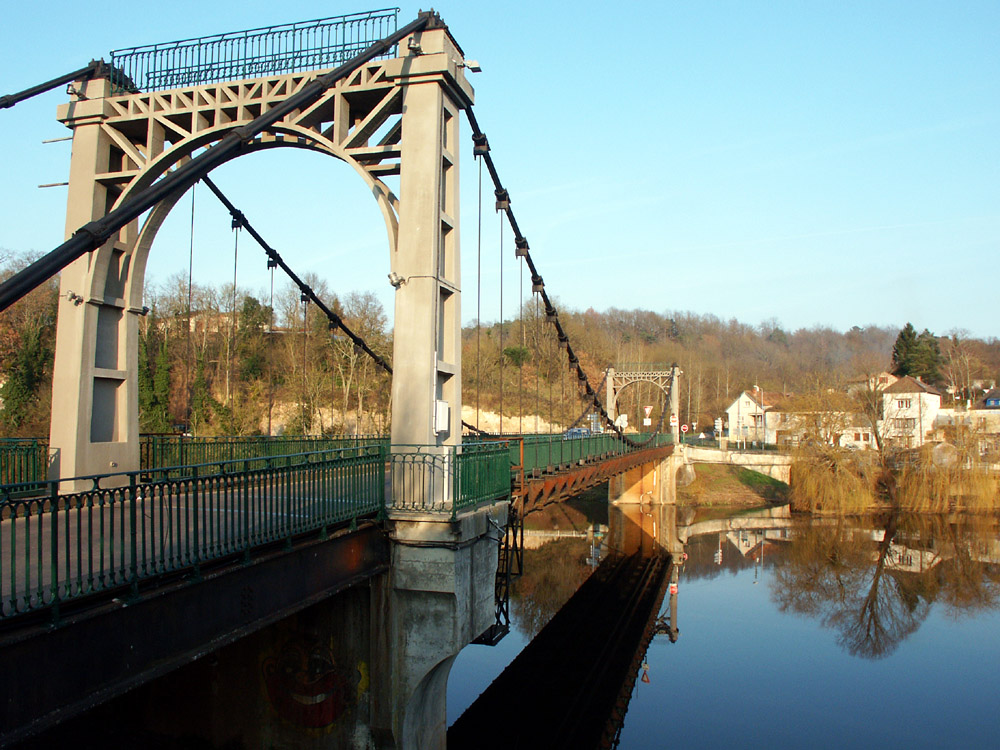
The Pont de Bonneuil-Matours

The Pont de Bonneuil-Matours has done sterling service for over a century but has been closed for the past 4 years.

The original bridge was built in 1846 as a toll bridge. It was initially a wooden structure with a single cart lane and limited to a weight capacity of 5,500 kg. The need for an upgrade arose in the early 20th century due to wear and tear and increased motorized traffic.

The bridge in 2008


In 1931-1932 Etablissements Arnodin Leinekugel Le Coq renovated the bridge, preserving the original foundations but replacing the deck and upper structure to meet modern needs. It's the oldest operational suspension bridge in France with contiguous cable bundles (don't ask me, I'm stumped), a design now seen in larger suspended bridges like Tancarville and Aquitaine. It's the second bridge in France to adopt this technique, following the example of the now replaced Vicq sur Gartempe bridge of 1931.

In 2019 the bridge was closed for a two year refurbishing as part of the "Grand Travaux du Schéma Routier". The real world intervened in events, but it was reopened on the 7th December 2023.

Soon after the reopening we saw the bridge for the first time since the work was done. It wasn't finished (they were doing something with hydraulics) but at least our shortest and quickest route to Poitiers has reopened.

The Bridge in December 2023


We don't often go to Poitiers these days. When we first bought this house we thought we'd be whizzing down to Poitiers at a drop of a hat. But it appears that psychogeography affects even people who are new to a place and don't have inbred opinions. We're in the Touraine, so we go to Tours. The route to to Poitiers is the same distance and leads to the same shops and services but we don't go there. The diversion caused by the bridge being out of commission has hardly affected us.


Wednesday, 22 May 2024

Post-War Rural Reminiscences

On Sunday I spent time with my friends Jean and Ninon. They are in their 90s, she was born here, he arrived soon after the War. The discussion at one point was the length of the grass out the back of their place, which led to the merits and disadvantages of various grazing animals and then a description of how grazing animals were managed in their village in the years just after the War. 
 
Farmers were often women, and they lived in or near the village. They had small herds of perhaps 8 or 9 cows. Twice a day the cows were taken to the river to drink as there were no 'abreuvoirs'* on farm at that time. The cows walked through the village to get to the river, and knew their own way. Too bad if you were growing anything within reach in your front garden -- it was likely to get munched. Pasture was not fenced. The cows were taken out in the morning, along the road to their allocated pasture, and guarded by someone (often a child) then brought back in the evening. Jean says that one of his regrets is never taking a photo of one particular elderly farmer, who always took an enormous black umbrella, about the size and shape of one of those one man pop up tents from his description, when she accompanied the cows. The umbrella was mostly for the sun, but sometimes for rain. Once out at the pasture these women embroidered or similar.
 
Shepherdess by lucien Porcheron, 19C, Indre et loire, France. Photo by loire Valley Time Travel.

The description was *exactly* like a painting by Lucien Porcheron, who was from another nearby village but a couple of generations earlier than Jean and Ninon. The woman in the painting is knitting, and wearing a heavy woollen cloak and sabots (clogs). I've seen such a cloak, owned by someone I know and still occasionally worn on very cold market days. Every village would have had a sabotier in this period (late 19th century or early 20th century). This painting hangs in the the mairie (town hall) in le Grand Pressigny, where Porcheron lived for most of his life. 

Ninon said that none of the local epiceries (grocery stores) sold bottled milk at that time. Everyone bought milk direct from a farm.

*abreuvoir translates as 'trough', and it can be a large trough, but more usually an abreuvoir is a rectangular shallow pond with a ramp for entering and leaving so the stock can walk in and drink, or you can drive a cart in and wash it.

Tuesday, 21 May 2024

Once Upon a Time in Loches - the First Years of the War 1939-1940


Exhibition poster Loches in 1944, Indre et Loire, France.

"War was declared on 3 September 1939, setting in motion the general mobilisation of all eligible men from 20 to 48 years old, as well the requisition of vehicles and horses. The Government was decentralised from Paris to the regions. The Touraine was not at the heart of the combat and became a zone for supply, and for the transit of refugees fleeing the bombing and the advancing Germans in the north of France.

In Loches the town prepared itself simultaneously to go to war and to suffer aerial attacks. Shelters in the troglodyte caves were allocated by neighbourhood and 500 gas masks were bought. Place de Verdun saw a series of barracks erected to house the Ministry of Agriculture. As the months passed the tension and anxiety reduced as they faced the 'phoney war'.

After the defeat of June 1940 France was divided into several zones, separated by a Demarcation Line. To the north of this Line was the zone occupied by the Germans and in the south was the 'Free Zone'. In the county of Indre et Loire, cut in two, Loches was one of the most northerly towns in the 'Free Zone'. As well, the area around Loches was a favoured transit route for refugees."

**************************************

This poster is part of an exhibition in the Chancellerie on 'Loches in 1944' https://www.ville-loches.fr/expositions-article-3-10-56.html

Monday, 20 May 2024

Looking for Archibald Douglas

Underneath this carpet (I think) is buried one of the most notable Scottish warriors of the 14th and 15th century.


Archibald Douglas, 4th Earl of Douglas (1372-1424), played a significant role in the Hundred Years' War, notably supporting France against England. Granted the title Duke of Touraine by Charles VII of France, Douglas fought in several key battles, including the Battle of Baugé in 1421. His military prowess earned him great respect, but he was killed at the Battle of Verneuil in 1424. He was buried in the choir at St Gatien cathedral in Tours.

We've never seen his burial marker, even though we've looked a couple of times. That's why we assume it's under the carpet.

Saturday, 18 May 2024

Mountain Singers

Back in September we mentioned that back in July we had seen a mens' mountain choir in Cauterets.

This is what they sound like. I hope it's worked.

Obviously it didn't. I'm working on fixing that.


Done. Phew. What a palaver.

Friday, 17 May 2024

Three Surgeons

When we were at the Musée des Beaux Arts in Tours the other day we noticed tree surgeons at work on the huge Cedar of Lebanon (planted 1804) that fills the entry courtyard.


You need a lot of strength to be a tree surgeon. Not only do you have to be able to climb a tree, you have to be able to do it whilst carrying what appears to be your own bodyweight in climbing accoutrements.