Friday, 13 December 2019

Every Little Bit Will Help


The next stage of fundraising for more conservation restoration on the Chapelle de Tous les Saints in Preuilly sur Claise has opened on the Fondation du Patrimoine website. We want to embark on the most exciting part of the restoration, that of conserving the rare wall paintings that decorate the interior.


Donations from individual benefactors are important because grants from heritage charities and agencies are often calculated to match the amount.

The work on this second stage has been estimated to cost 160 670 €.

We need to collect a minimum of €8,034 to be eligible for a grant. And beyond that, any euro collected will bring additional support.

The Chapelle de Tous les Saints, Indre et Loire, France. Photographed by Susan Walter. Tour the Loire Valley with a classic car and a private guide.

The Chapelle de Tous-les-Saints is located in Preuilly-sur-Claise in the south of Touraine. The village, which now has a population of 1,000, was once the seat of the first barony of Touraine. This explains its rich heritage of ten monuments protected by the Historic Monuments around its beautiful 12th century abbey church.

The chapel has been on the list of Heritage Monuments since May 13, 1953. This modest sanctuary, dating from the late 15th century, stands to the north of a garden that was once enclosed by the old cemetery on the plan of a perfect rectangle, its walls were built in tuffeau masonry with lime mortar and supported at the corners by four buttresses. The openings illuminate the north, south and east (and it is this Flamboyant style eastern window which allows the whole construction to be dated). To the west you enter through a moulded porch with a broken arch, another door was opened in the 17th century to the south. The building is roofed in tiles and surmounted by a bell tower covered with slates.

Part of a rare danse macabre wall painting showing women, Indre et Loire, France. Photographed by Susan Walter. Tour the Loire Valley with a classic car and a private guide.

Time and the ravages of history have done their work: the religious wars, the Revolution, a brutal restoration in the 19th century, abandonment, and vandalism to the point of losing its facade in the 1950s and almost being left to the wrecking bars of the demolition workers.

The state of disrepair of the chapel had become such that the municipality and the Archaeological Society of Preuilly took the decision to commission a stage of work to save the building housing a remarkable wall painting depicting a danse macabre. The Foundation opened a subscription, the population responded as well as several associative patrons. Thus in 2017/2018, the building was tied with reinforcing rods, its structure and roofing restored, the cracks filled and the vault of painted panelling conserved. It was a success and created an awareness amongst all of us of the interest of this chapel.

Wall paintings conservators working on the vaulted ceiling of a medieval chapel, Indre et Loire, France. Photographed by Susan Walter. Tour the Loire Valley with a classic car and a private guide.

This first phase showed that it was a totally homogeneous work of art, from the building to the painted decorations of the vault and walls. Now it is the turn of the rare wall paintings, held like a jewel in a newly restored case. The fragile paintings themselves and the interior (plasters, floors, carpentry, dismantled altar, missing stained glass windows) remain to be restored.

This chapel will be open to visitors, but will also host exhibitions or small cultural events organized by the nearby library.

************************************************

For details of our private guided tours of chateaux, gardens, wineries, markets and more please visit the Loire Valley Time Travel website. We would be delighted to design a tour for you.

We are also on Instagram, so check us out to see a regularly updated selection of our very best photos. 

Thursday, 12 December 2019

What the Iceman Had in His Pockets


Hoof Fungus Fomes fomentarius (Fr. Amadouvier) is a type of bracket fungus belonging to the Polyporaceae family. It is also known as True Tinder Fungus.

Hoof fungus Fomes fomentarius (aka True Tinder Fungus).  Indre et Loire, France. Photographed by Susan Walter. Tour the Loire Valley with a classic car and a private guide.

Bracket fungi are always found growing on wood, often gaining a foothold on a living tree by entering via a wound caused by bird, insect or weather damage, but some species grow on dead timber, especially newly felled wood. Some attack the heartwood, others sapwood. As they age they become harder and harder. Many are beautifully marked in contrasting bands formed as they grow.

Hoof fungus Fomes fomentarius (aka True Tinder Fungus).  Indre et Loire, France. Photographed by Susan Walter. Tour the Loire Valley with a classic car and a private guide.

Hoof fungus is one of the most common polypores here, found on most types of deciduous trees. Young specimens are velvety, but older ones very hard. The fungus becomes very thick as annual layers of spore tubes develop. It has been used by man from at least 10 000 years ago as tinder. It can also be processed into a leather like material, which could be used on wounds to dry them out, or to make accessories such as pouches.

Don't confuse Hoof Fungus with lookalike  Artists Bracket Fungus Ganoderma lipsiense (Fr. Gandoderme plat). 

Hoof Fungus is not edible (because it would be like chewing wood, not because it's toxic). It can be seen all year round.

Ötzi, the five and a half thousand year old natural mummy discovered in the Tyrolean Alps, was found to have a black substance in the pouch on his belt. When tested it turned out to be Hoof Fungus, with traces of iron pyrites in it. The materials would have been used for firelighting, by striking iron pyrites on a flint, allowing the sparks generated to shower down onto the sawdust like fungus. Carefully nurtured the fungus can be made to smoulder and act as a firelighter.


************************************************

For details of our private guided tours of chateaux, gardens, wineries, markets and more please visit the Loire Valley Time Travel website. We would be delighted to design a tour for you.

We are also on Instagram, so check us out to see a regularly updated selection of our very best photos. 

Wednesday, 11 December 2019

Dr David Barnsby, Pharmacist and Botanist


Son of an English industrialist who supplied the French army, and a mother who was the daughter of a French army officer from a Poitevin family, David Robert Barnsby was born in January 1832 in Blois while his mother was making a journey. Raised in England and France he ultimately chose to train as a pharmacist in France. During the day he worked in the pharmacy, at night he studied. Finally he married the daughter of Professor Mauduit, the head of the School of Pharmacy at the University of Poitiers.

 Flamingoes in the Jardin Botanique de Tours.
Flamingoes in the Jardin Botanique, Tours.  Indre et Loire, France. Photographed by Susan Walter. Tour the Loire Valley with a classic car and a private guide.

He commenced his studies at the School of Medicine in Tours and was an intern at the general hospital during the cholera outbreak of 1849 during which time he worked tirelessly. In 1857 he became the chief pharmacist at Tours General Hospital and applied for the chairs of chemistry and natural history at the University of Tours.

 In the late 19th century Barnsby published three accounts of botanising with his students.
A slide presented during the Rencontres Botaniques 2019 conference, Tours.  Indre et Loire, France. Photographed by Susan Walter. Tour the Loire Valley with a classic car and a private guide.

Nominated as a member of the County Hygiene Council he edited their reports for 25 years. His nomination as the Chair of Botany at the University gave him the directorship of the Botanic Garden (conveniently just across the road from the General Hospital). Very soon afterwards he became the Vice-President of the Botanical Society of France. Finally he was elected to the Academy of Medicine. Along with other men of his background and social status such as brothers-in-law Eugene Pelouze and Daniel Wilson (both associated with the Chateau of Chenonceau, as respectively the husband and brother of 19th century owner Marguerite Wilson Pelouze) he was a long and active member of the Touraine Archaeological Society.

 Statue of Georges-Louis Leclerc, Comte de Buffon, in the Jardin Botanique de Paris.
Statue of Georges-Louis Leclerc, Comte de Buffon in the Jardin Botanique de Paris. France. Photographed by Susan Walter. Tour the Loire Valley with a classic car and a private guide.

In March 1893 he became the Director of the Tours School of Medicine, a post which he retained until 1902. David Barnsby died in November 1916.

 An emu in the Jardin Botanique de Tours.
An emu in the Jardin Botanique de Tours. Indre et Loire, France. Photographed by Susan Walter. Tour the Loire Valley with a classic car and a private guide.

The Botanic Garden was created in 1843, but it was 20 years before any animals were introduced. However, it is the zoological section of the gardens that without doubt attracts the most visitors, especially amongst the young. Anybody over 40 who grew up in Tours can remember going to the gardens to see certain favourite animals, especially Bobby le Phoque (Bobby the Seal, now stuffed and kept on display in the Natural History Museum).

 General Hospital, photographed from the Botanic Garden across the road, Tours.
General Hospital, photographed from the Botanical Gardens across the road, Tours. Indre et Loire, France. Photographed by Susan Walter. Tour the Loire Valley with a classic car and a private guide.

The introduction of animals to the gardens is entirely down to David Barnsby and is an interesting indication of how attitudes have changed.

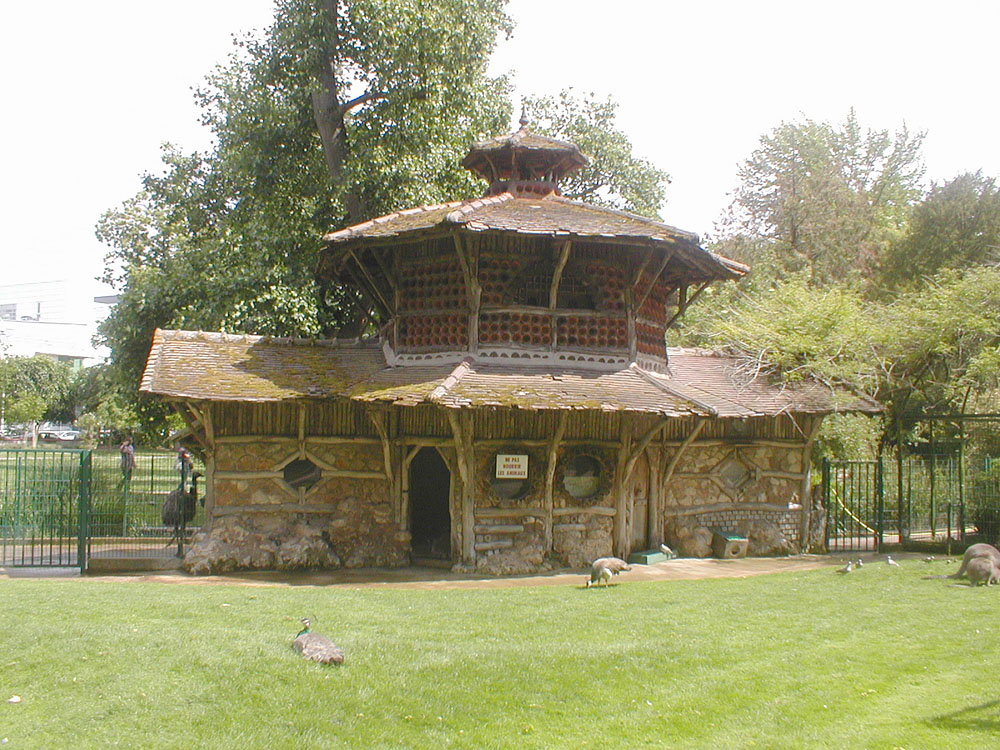
 An exotic looking animal shelter hut in the Jardin Botanique de Tours.
Hut in the Jardin Botanique de Tours. Indre et Loire, France. Photographed by Susan Walter. Tour the Loire Valley with a classic car and a private guide.

He had three reasons for wanting to introduce animals into the Botanic Garden.
  • he thought that the presence of animals would attract the local Tourangeaux on their Sunday walks, and that turned out to indeed be the case.
  • zoology was fashionable, due to Buffon, Cuvier and Lamarck. The 19th century was obsessed by the idea of evolution and Darwin (who published his controversial 'On the Origin of Species' in 1859) and acclimatisation, particularly Etienne Geoffroy Saint-Hilaire and his 'Jardins d'acclimatation'. The discovery of new species of animals opened the door to several questions: the possiblity of domestication and breeding; the possibility of acclimatisation in France of animals native to the colonies; and the potential economic interest for local breeders. (During the 1990s the fashion for ostrich farms in the Touraine fits this line of thinking.) Barnsby's well established reputation in scientific circles meant that he had Parisian contacts and plenty of strong friendships in the scientific world. One of these was Albert Geoffroy Saint-Hilaire, the grandson of Etienne Geoffroy Saint-Hilaire, and the director of the Jardin d'acclimatation de Paris.
  • finally, Barnsby hoped that the animals might have economic benefits for the Botanic Garden by the sale of young animals born there. This however failed to materialise.
Barnsby had two methods of stocking the gardens with animals -- gifts from wealthy donors, and exchanges with the Jardin d'Aclimatation de Paris.

 Wallabies in the Jardin Botanique de Tours. Sadly, about a month after I took this photo in June this year, one of the wallabies was savagely attacked by a mystery assailant and had to be euthanised.
Wallabies in the Jardin Botanique de Tours. Indre et Loire, France. Photographed by Susan Walter. Tour the Loire Valley with a classic car and a private guide.

The first animal to be installed came via a donation, in 1862, and was a magnificent White-tailed Stag, the gift of the Comte de Croÿ. According to Barnsby 'the presence in the gardens of this handsome animal, its hind and fawn, has attracted such a very great number of promenaders that I rejoice in it'.


************************************************

For details of our private guided tours of chateaux, gardens, wineries, markets and more please visit the Loire Valley Time Travel website. We would be delighted to design a tour for you.

We are also on Instagram, so check us out to see a regularly updated selection of our very best photos. 

Tuesday, 10 December 2019

Botanical Encounters


This year, on 30 November, it was time for the bi-annual Rencontres Botaniques ('botanical encounters'), a botany conference organised by several of the local botanical societies and held on the Pharmacy Faculty of the University François Rabelais at Grandmont in Tours.

I went along and felt like a dinosaur. A good many of the presenters were young persons talking about how they were using drones, Lidar, analytical software and data mining to survey and monitor sites, and create standards that will inform biodiversity policy, forestry management and the control of invasive species. Young persons doing whizzy things with technology and making people their parents' age feel inadequate is exactly how it should be.

The Pharmacy Faculty at the University François Rabelais, Grandmont, Tours.
Pharmacy Faculty, University Francois Rabelais, Grandmont, Tours.  Indre et Loire, France. Photographed by Susan Walter. Tour the Loire Valley with a classic car and a private guide.

My friend Marie-Claude did a poster presentation on lichens.
Poster presentation on lichens at the Rencontres Botaniques, University Francois Rabelais.  Indre et Loire, France. Photographed by Susan Walter. Tour the Loire Valley with a classic car and a private guide.

New species recorded for Indre et Loire this year.
Slide from a presentation at the Rencontres Botaniques, Tours.  Indre et Loire, France. Photographed by Susan Walter. Tour the Loire Valley with a classic car and a private guide.

The slide says: There remains much to do...but the future is ours...sometimes skepticism (top left)...sometimes despair (centre right)...but never discouragement (bottom left).
Slide from a presentation at the Rencontres Botaniques, Tours.  Indre et Loire, France. Photographed by Susan Walter. Tour the Loire Valley with a classic car and a private guide.
This was my favourite slide. I totally related to it.

Reduce the number of species of herbivores, and you reduce the number of plant species.
This is why biodiversity matters. The diagram is in English because it comes from an earlier relevant study published in English. No attempt was made to translate it in the presentation. It was clearly assumed that everyone present read English, and in any case, had followed the explanation of the processes being researched in French. One of the techniques in the French study involved sedating Roe Deer and combing their pelt to see how many seeds they were transporting. The previous slide had included some blatant Franglais, being headed 'Pool des Plantes'.

Looking at the display about the historic herbarium.
Botanists at a conference looking at a display about a historic herbarium, Tours.  Indre et Loire, France. Photographed by Susan Walter. Tour the Loire Valley with a classic car and a private guide.

Early career botanists presenting their work.
Early career botanists presenting at a conference in Tours.  Indre et Loire, France. Photographed by Susan Walter. Tour the Loire Valley with a classic car and a private guide.
These two described how they had used analytical software to data mine species lists for some islets in the Loire to automatically generate species assemblage information ie species which you can expect to find growing together. These islets are being very closely monitored for invasive species and natural regeneration as a means of establishing a standard for managing other similar islands and islets in the river. Several of the presentations were about various aspects of this project.

************************************************

For details of our private guided tours of chateaux, gardens, wineries, markets and more please visit the Loire Valley Time Travel website. We would be delighted to design a tour for you.

We are also on Instagram, so check us out to see a regularly updated selection of our very best photos. 

Monday, 9 December 2019

All About the French Christmas Cake


A nice ten minute video about yule logs, with a section featuring Loches. Three quarters of French people will have a slice of bûche de Noël for dessert, before opening their presents. The cakes are supplied by the 33 000 pâtissiers around the country. Picard, the frozen food supermarket, sells 1.4 million yule logs a year.


The Loches section of the video starts at 1.15. The first Loches baker, Mariano, starting at about 1.40 has featured on the blog before. And following him is Laurent, the creator of the Best Chocolate Eclair in the Touraine, at 2.56.

**************************************

For details of our private guided tours of chateaux, gardens, wineries, markets and more please visit the Loire Valley Time Travel website. We would be delighted to design a tour for you.

Sunday, 8 December 2019

Soil Conservation Service


Soil samples in the National Museum of Australia, Canberra. Photographed by Susan Walter. Tour the Loire Valley with a classic car and a private guide.

Unsurprisingly the logo of the New South Wales Soil Conservation Services no longer includes a bulldozer. This display was photographed at the National Museum of Australia in Canberra.

************************************************

For details of our private guided tours of chateaux, gardens, wineries, markets and more please visit the Loire Valley Time Travel website. We would be delighted to design a tour for you.

We are also on Instagram, so check us out to see a regularly updated selection of our very best photos. 

Saturday, 7 December 2019

The Star Redoute


The Basque country was the front line at one point in the Napoleonic Wars. First the senior French generals and then Wellington were based in Saint-Jean-de-Luz and in response the French and their allies ressurected a series of small forts called redoutes across the mountain tops.

 L'Ermitage Redoute on La Rhune.
L'Ermitage Redoute on La Rhune. Pyrenees-Atlantiques, France. Photographed by Susan Walter. Tour the Loire Valley with a classic car and a private guide.

These forts were constructed in 1793-94, when mid-Revolution, the French found themselves fending off Spanish Royalists. Later, early in the 19th century, they were hastily refurbished to keep Wellington and his allies at bay. Some of them were little more than ditches and trenches. The one you can see from the summit of La Rhune was built on the site of an old hermitage and is a fairly rough assemblage of dry stone walls formed into a star shape.

In October 1813 Wellington launched 20 000 troops at La Rhune. By day two of the attack the Hermitage fort was over-run by Wellington's forces, who then used the steep slopes of La Rhune, and the French artillery positioned there to bombard one of the other lower redoutes. Within a fortnight the conflict was over and a sort of peace descended for about a month. Finally Wellington threw 40 000 troops at La Rhune and ultimately managed to split the French army in half at Bayonne to bring the campaign to an end.

(I should note that after having read a very detailed account of this campaign in French I lost the will to live. There may well be inaccuracies and misunderstandings in the above potted account. I can't believe the number of generals required to defend a line of poxy little forts.)

************************************************

For details of our private guided tours of chateaux, gardens, wineries, markets and more please visit the Loire Valley Time Travel website. We would be delighted to design a tour for you.

We are also on Instagram, so check us out to see a regularly updated selection of our very best photos. 

Friday, 6 December 2019

Beneath the Beaux Arts


The Musée des Beaux Arts (fine arts museum) in Tours has started offering tours of its nether regions once a month. Unlike a lot of modern museums this is not an invitation to come and see the basement storerooms, packed full of art legacies that rarely see the light of day. In the case of the Musée des Beaux Arts in Tours, their 17 000 works in reserve are mostly stored off site these days.

 Thibault begins his tour. We will go through the door to his right.
Guided tour at the Musee des Beaux Arts, Tours.  Indre et Loire, France. Photographed by Susan Walter. Tour the Loire Valley with a classic car and a private guide.

So instead, Thibault Salais, a young historian and student at the Beaux Arts will greet you at the main entrance and direct you through a large but non-descript door, tucked in beside the main entrance, hidden in plain sight. Down a stone staircase and you are in an underground tunnel which once linked the museum building (formerly the Bishop's Palace) with the neighbouring Cathedral. The site brings together the history of the old Roman capital of Gaul, known as Caesarodunum, and the location of the very first Christian Bishops of Tours. Wisely, the Bishops chose to settle within the protection of the Roman walled city, right next to the Cathedral.

 Reused carved stones in the foundations.
Reused carved stones in the foundations of the Bishops Palace, Tours.  Indre et Loire, France. Photographed by Susan Walter. Tour the Loire Valley with a classic car and a private guide.

Tours as a city didn't exist before the Romans. The chief town of the area up till their arrival was Amboise.

These massive stones, stacked on top of one another without mortar, are the Roman foundations of the city wall. The white patches are monitoring cracks.
Massive stones forming the foundations of the Roman wall of Tours.  Indre et Loire, France. Photographed by Susan Walter. Tour the Loire Valley with a classic car and a private guide.

The tunnel runs under the foundations of the old 4th century ramparts and the first Bishop's Palace was built right up against them, using stone salvaged from around and about. In these original foundations you can see parts of Roman columns and pediments from temples. The wall that rises up seems put together out of the most randomly placed chunks of stone, but it has stood for 15 centuries (despite some cracks). The stones you can see are part of the original foundations to the wall, set about 5 metres below the Roman ground level.

  Looking back towards the entrance -- a mixture of natural rock and stone reused from a Roman temple.
Looking back at the entrance to the underground tunnel at the Musee des Beaux Arts, Tours.  Indre et Loire, France. Photographed by Susan Walter. Tour the Loire Valley with a classic car and a private guide.

At ground level at the end of the tunnel are two reused pediment stones with an inscription which reads 'Civitas Turonorum libera' (Free City of the Turoniens).

Roman inscription on two reused stones.
Reused stone with a Roman inscription in the foundations of the Tours city wall.  Indre et Loire, France. Photographed by Susan Walter. Tour the Loire Valley with a classic car and a private guide.

It's quite tricky piecing together the history of the tunnel. The episcopal archives were burnt on the Cathedral forecourt during the Revolution, and then anything that survived was subsequently bombed in the Second World War. The occupying Germans installed their central telephone exchange in the tunnel.

 This section of the tunnel was constructed in 1854.
The 1854 tunnel linking the Bishops Palace and the Cathedral in Tours.  Indre et Loire, France. Photographed by Susan Walter. Tour the Loire Valley with a classic car and a private guide.

Book online if you want to see for yourself.

************************************************

For details of our private guided tours of chateaux, gardens, wineries, markets and more please visit the Loire Valley Time Travel website. We would be delighted to design a tour for you.

We are also on Instagram, so check us out to see a regularly updated selection of our very best photos. 

Thursday, 5 December 2019

Fungi Foray in the Forest of Preuilly, November 2019, Part II


Part I can be read here.

Amanita spp, with three Death Cap A. phalloides (Fr. Amanite phalloïdes).
Amanita spp, including Death Cap A. phalloides (centre).  Indre et Loire, France. Photographed by Susan Walter. Tour the Loire Valley with a classic car and a private guide.
White gilled mushrooms and Death Caps in particular are responsible for more poisonings and deaths than any other mushrooms. Death Caps are certainly very toxic, but they are responsible for so many deaths compared to another equally toxic group of mushrooms simply because they are more abundant and bigger, so look more appealing to cook. Galerina spp are just as toxic, but much less common and being small and brown, much less appetising looking, so people are rarely poisoned by them.

Good to see these two taking it seriously and consulting their field guides.
Two amateur mycologists consulting their field guides.  Indre et Loire, France. Photographed by Susan Walter. Tour the Loire Valley with a classic car and a private guide.
Behind them a basket containing Blusher Amanita rubescens (Fr. Amanite rougissante) which they were clearly intending to eat. You need to be really confident of your identification skills if you are going to eat this species, because of it's close resemblance to the toxic Panther Cap A. pantherina (Fr. Amanite panthère).

False Chanterelle Hygrophorpsis aurantiaca (Fr. Fausse chanterelle).
False Chanterelle Hygrophoropsis aurantiaca.  Indre et Loire, France. Photographed by Susan Walter. Tour the Loire Valley with a classic car and a private guide.
The vernacular name of this species simply indicates they are not the highly prized chanterelles, but an unrelated species. Nevertheless they are edible. They differ from true chanterelles by having gills, rather than gill like pleats or ridges. Both tend to be found under pine trees.

Sulphur Knight Tricholoma sulphureum (Fr. Tricholome soufré).
Sulphur Knight Tricholoma sulphureum.  Indre et Loire, France. Photographed by Susan Walter. Tour the Loire Valley with a classic car and a private guide.
These mushrooms really stink! The smell is likened to coal gas.

Death Cap and lookalikes.
Death Cap lookalikes. Amanita phalloides (left), Tricholoma sulphureum (front right), Tricholoma saponaceum (rear right).  Indre et Loire, France. Photographed by Susan Walter. Tour the Loire Valley with a classic car and a private guide.
Could you tell these mushrooms apart and identify the species? It probably doesn't matter if you can't because they are all toxic. That's all you need to know -- except perhaps that the one on the left, the actual Death Cap, is deadly. The other two are Soapy Knight Tricholoma saponaceum (Fr. Tricholome à odeur de savon) rear right, and Sulphur Knight T. sulphureum (Fr. Tricholome soufré), in case you wanted to know.

Amethyst Deceiver Laccaria amethystina (Fr. Laque améthyste) and 
Deceiver Laccaria laccata (Fr. Clitocybe laqué). 
Amythest Deceiver Laccaria amythestina and Deceiver L. laccata.  Indre et Loire, France. Photographed by Susan Walter. Tour the Loire Valley with a classic car and a private guide.
Holding the mushrooms, Loches pharmacist and expert mycologist Didier Raas. The lovely smiling face belongs to our friend Marie-Hélène (who is our insurance agent). 

Charcoal Burner Russula cyanoxantha (Fr. Charbonnière).
Charcoal Burner Russula cyanoxantha.  Indre et Loire, France. Photographed by Susan Walter. Tour the Loire Valley with a classic car and a private guide.
Unusually for a member of the brittlegill family, this species has rather rubbery gills, which simply bounce back if you run your finger across them. Other related species have gills that would shatter if you did this. This one is being born off in triumph by its finder, my friend Corinne. It is edible. Not all Russula species are edible. If their stem stains red when you scrape it then don't eat it.

Webcap Cortinarius sp.
Webcap Cortinarius sp.  Indre et Loire, France. Photographed by Susan Walter. Tour the Loire Valley with a classic car and a private guide.
These old webcap Cortinarius sp are no longer showing any sign of their signature 'spiderweb' but you can recognise them nonetheless because of their rusty colour. All webcaps have rust coloured spores and they eventually colour the gills and often the stem as they fall.

Suede Bolete Xerocomus subtomentosus (Fr. Bolet subtomenteux).
There are four species of 'true' Cep -- Summer Cep Boletus reticulatus (Fr. Cèpe d'été); Edible Cep B. edulis (Fr. Cèpe de Bordeaux); Pine Cep B. pinophilus (Fr. Cèpe des pins); and Dark Cep B. aureus (Fr. Tête de nègre). These are the most prized of all the wild mushrooms, part of the Boletaceae family. Then you get the dry capped boletes, Xerocomus spp, which feel like saddle leather. Finding a Bay-brown Bolete X. badius (Fr. Bolet bai) is nearly as good as finding a cep. The Suede Bolete (above) is not so highly regarded, but adds good bulk to a collection of mixed boletes. It can be distinguished from the Bay-brown by its brighter yellow, bigger pores. Then there are the sticky or slimey capped boletes and related mushrooms, which are more variable in their palatibility, depending on species, and finally, the Orange Oak Bolete Leccinum aurantiacum (Fr. Bolet orangé), which forms a separate category again. Although it discolours badly, it is abundant and most people happily add it to a mixture of other boletes for bulk.

Scarletina Bolete Neoboletus luridiformis syn Boletus erythropus (Fr. Bolet à pied rouge).
Scarletina Bolete Neoboletus luridiformis syn Boletus erythropus.  Indre et Loire, France. Photographed by Susan Walter. Tour the Loire Valley with a classic car and a private guide.
This is an edible mushroom in the Boletaceae family. Unfortunately, it resembles one of the few toxic species in this family, and so most people avoid it unless they are experienced and confident fungi foragers.


************************************************

For details of our private guided tours of chateaux, gardens, wineries, markets and more please visit the Loire Valley Time Travel website. We would be delighted to design a tour for you.

We are also on Instagram, so check us out to see a regularly updated selection of our very best photos. 

Wednesday, 4 December 2019

Hospital Tests


Over the last six months or so I've been experiencing some minor health difficulties. It's coinciding with being about to turn 60 in a most dispiriting way. First I developed heel spurs and had to visit the podiatrist for a special insert for my shoes. After some months of wearing the insert, my heel spurs no longer bother me much, but I've developed tendonitis in my right knee. I've had to give up joining the walking club for their regular Thursday ten kilometre hike and driving myself any distance is agonising.

Pôle Santé Léonard de Vinci (hospital) nuclear medicine imaging section, Chambray lès Tours.
Pole Sante Leonard de Vinci (hospital), Chambray les Tours. Indre et Loire, France. Photographed by Susan Walter. Tour the Loire Valley with a classic car and a private guide.

On top of all that I've been having episodes of breathlessness and a sensation like my heart is being squeezed. Off to the cardiologist for that one, since I'd had a couple of instances where I'd nearly passed out. The cardiologist did ultrasound and made me wear a Holter for 24 hours, but couldn't find anything. So she booked me in to the hospital pronto for the big scary scans in the machine like a tunnel that they slide you in and out of, plus a couple of other tests she couldn't do in the surgery.

The hospital with the imaging gear required is called Pôle Santé Léonard de Vinci and is at Chambray lès Tours. It takes us about an hour to get there. Luckily my appointment was for 9:50am, so not too early. I got very clear instructions about which entry and carpark to go to, and we got a space just outside the relevant entrance. I checked in with the reception, handing over my Carte Vitale (State health care card) and confirming my details. As instructed I had not taken any of my medication nor had a banana, coffee or chocolate for breakfast.

After a short wait I was called through and asked to strip off my upper body so they could apply electrodes (I assume that's what you call them). I was injected with something radioactive and given a stress test where I was asked to cycle at a set rhythm for quite some time. The doctor mumbled, so I had to ask him to repeat everything! A couple of times I thought he was saying I could stop now, when actually he was asking me to redouble my efforts.

Anyway, after that I got laid out on the big scanner bed, first with a camera angled over me for about 10 or 15 minutes, and then actually slid into the tube. Inside there is a ring with a green light that whirs around. That only went on for a few minutes, then I was free to get dressed and go off for lunch. The technician left all the electrode buttons on because I had to return a couple of hours later for a second round of the same tests, but without having to do the cycling beforehand.

On departing for lunch I was asked to pay about €80, by cheque or in cash, which was the doctor's fee. I was given the paperwork to claim some reimbursement from the State health insurance scheme, and I imagine I will get about half of it back. When I finally left after the second round of tests I was asked to pay another small amount (under €10), which was the top-up insurance equivalent for the hospital fee.

After all that, none of the tests have thrown up anything to worry about. My heart rate is within normal bounds (just), I have very little sclerotization of arteries, and no congenital heart defects that they could see. It was this last one that I was a bit concerned about, based on some family history, but it seems I needn't have worried. However, it still remains to be seen why I keep having these strange episodes. I'll be discussing it with my GP and the cardiologist to see what they reckon.


************************************************

For details of our private guided tours of chateaux, gardens, wineries, markets and more please visit the Loire Valley Time Travel website. We would be delighted to design a tour for you.

We are also on Instagram, so check us out to see a regularly updated selection of our very best photos. 
Tuesday, 3 December 2019

Fungi Foray in the Forest of Preuilly, November 2019, Part I


Didier Raas, pharmacist and expert mycologist from Loches, lead one of his public education and outreach sessions in the Forest of Preuilly on Tuesday 12 November. It had been very wet, so many mushrooms were not in the best condition, and many were hidden under dead leaves that were stuck together with the wet. In the end though, after a couple of hours of forcing our way through the bracken and brambles deep in the forest we ended up with quite a good haul. Here are some pictures from the morning.

We set out.
Setting out on a fungi foray with an expert mycologist.  Indre et Loire, France. Photographed by Susan Walter. Tour the Loire Valley with a classic car and a private guide.

Caesars Mushroom Amanita caesarea (Fr. Amanite des césars).
Caesars Mushroom Amanita caesarea.  Indre et Loire, France. Photographed by Susan Walter. Tour the Loire Valley with a classic car and a private guide.
Caesars Mushroom is an uncommon and prized edible species. It is normally eaten as young as possible, when it has a rather egg like appearance. Many white gilled Amanita species are very toxic, but Caesars Mushroom is the only yellow gilled Amanita, making it easy to confidently identify. The only possible confusion is with the infamous Fly Agaric Amanita muscari (Fr. Amanite tue-mouches), which is redder (less orange). But beware -- in rainy weather like this, the white flakes could wash off the cap of the Fly Agaric, making it look much more like the smooth shiny red cap of Caesars Mushroom. It is so important to check gill colour, and beginners should never eat a white gilled mushroom if they have not had it checked by someone like Didier.

 Crowded Brittlegill Russula densifolia (Fr. Russule à lames serrées).
Crowded Russula Russula densifolia.  Indre et Loire, France. Photographed by Susan Walter. Tour the Loire Valley with a classic car and a private guide.

Shaggy Parasol Chlorophyllum rhacodes syn Macrolepiota rhachodes (Fr. Lépiote déguenillée). Shaggy Parasol Chlorophyllum rhacodes syn Macrolepiota rhachodes.  Indre et Loire, France. Photographed by Susan Walter. Tour the Loire Valley with a classic car and a private guide.
This is not an edible species, but mushrooms like this from the Lepiote group poison a lot of people. There is only one edible species of Lepiote, and it seems many foragers are just not careful enough or clued up enough to check for the snakeskin patterned stem that only the edible Common Parasol has. The other thing you should look for when intending to eat a white gilled mushroom that you think is a parasol is that the stem ring will slide up and down intact when gently pushed. If it doesn't then you were planning to eat a toxic Amanita sp.

Brown Roll Rim Mushroom Paxillus involutus (Fr. Paxille enroulé).
Brown Roll Rim Mushroom Paxillus involutus.  Indre et Loire, France. Photographed by Susan Walter. Tour the Loire Valley with a classic car and a private guide.
This is one of the highly toxic mushrooms. It can kill, and causes an autoimmune response that damages the vascular system and internal organs. Treatment is months long, involves heavy duty drugs and the condition it causes is excruciatingly painful. The species can be identified by the very rolled edge of the cap and the way the gills scrape off very easily.

Brittlegill Russula sp (Fr. Russule).
Brittlegill Russula sp. Indre et Loire, France. Photographed by Susan Walter. Tour the Loire Valley with a classic car and a private guide.
These purple and red capped brittlecaps are very difficult to identify to species level. The colour of this one would be described in a French field guide as vineuse.

This bolete has been infected with another fungus.
A bolete infected with another fungus.  Indre et Loire, France. Photographed by Susan Walter. Tour the Loire Valley with a classic car and a private guide.
A mushroom in this condition is not good to eat. The mould that has attacked it will have bad flavours and maybe even make you sick.

Crown-tipped Coral Artomyces pyxidatus (Fr. Clavaire couronnée).
Crown-tipped Coral Artomyces pyxidatus.  Indre et Loire, France. Photographed by Susan Walter. Tour the Loire Valley with a classic car and a private guide.

Butter Cap Rhodocollybia butyracea syn Collybia butyracea (Fr. Collybie beurée).
Butter Cap Rhodocollybia butyracea syn. Collybia butyracea.  Indre et Loire, France. Photographed by Susan Walter. Tour the Loire Valley with a classic car and a private guide.
This species feels greasy which is why it is known as 'buttery'. The stem is always curved into a hook shape.

Sorting the mushrooms into family groups prior to identifying everything to species level.
Participants on a fungi foray laying out the specimens collected to be identified.  Indre et Loire, France. Photographed by Susan Walter. Tour the Loire Valley with a classic car and a private guide.

Part II will follow.

************************************************

For details of our private guided tours of chateaux, gardens, wineries, markets and more please visit the Loire Valley Time Travel website. We would be delighted to design a tour for you.

We are also on Instagram, so check us out to see a regularly updated selection of our very best photos. 

Monday, 2 December 2019

How to Choose the Best Foie Gras


The term foie gras is subject to a number of strict rules. Labelling on foie gras products must clearly distinguish between something that is 100% foie gras and something that has other ingredients as well as foie gras. The latter is not allowed to be called foie gras, although the label may state the percentage of foie gras present. These other products may be labelled as paté, mousse or galantine, for example.

Seventy percent of French people will eat foie gras during the Christmas period. Foie gras can be either duck or goose liver.

Top quality foie gras with truffles.

There are different grades of foie gras even when they are 100% foie gras. The term 'foie gras entier' must be composed only of entire lobes of foie gras and some seasoning. The term 'foie gras' refers to pieces of foie gras, not entire lobes, pressed together and seasoned. The term 'bloc de foie gras' means reconstituted foie gras. If it contains a minimum 30% of pieces it can be termed 'bloc avec morceaux', which is a higher quality than just 'bloc'.

Then there are the products that contain foie gras plus other ingredients. Preparations with more than 50% foie gras can be called 'parfaits de foie d'oie ou de canard' (at least 75% foie gras plus liver sourced from ducks or geese not raised using the force feeding technique to produce 'fat liver'); 'medaillons ou pâté de foie d'oie ou de canard' (at least 50% foie gras or bloc de foie gras, formed into a core wrapped in a liver paste); and 'galantine de foie d'oie ou de canard' (at least 50% foie gras or bloc de foie gras mixed to a paste and seasoned).

 The dizzying array of foie gras products on display in a small town 
French supermarket just before Christmas.

Mousses have to be 50% foie gras, mixed to a paste and seasoned. Preparations containing at least 20% foie gras can be labelled 'pâté au foie d'oie ou au canard'. Note the subtle difference in terminology -- products with at least 50% foie gras are 'of foie gras', products with less (but at least 20%) are 'with foie gras'.

Since 2000 there has been an Indication géographique protegée (IGP or Certified Geographical Protection) for Foie Gras Ducks of the South-West. Since 1996 duck foie gras in France has come exclusively from male ducks. Since 1995 a foie gras must weigh more than 300 g.

Of course, we avoid all of these complexities by making our own from scratch every year.

**************************************

For details of our private guided tours of chateaux, gardens, wineries, markets and more please visit the Loire Valley Time Travel website. We would be delighted to design a tour for you.

Sunday, 1 December 2019

Chris the Sheep


Chris the sheep was an escaped Merino wether living in the bush near Canberra. He managed to dodge being shorn for several years and as a consequence, when he was captured his fleece weighed a record breaking 41 kilos and had strands 42 cm long. A regular fleece would weigh about 5 kilos and have strands about 6 cm long.

When he was rescued by an observant RSPCA officer who spotted him in a paddock he was barely able to move because of the weight of his wool. He was starving and heat stressed. Although he had stock markings, no one was able to match them to an owner and it remains a mystery how he got to be in the situation he was found. After being sedated for shearing he was adopted by a farm refuge and lived out the remainder of his days there.

 Record breaking fleece of Chris the sheep on display in the National Museum of Australia, Canberra.
Record breaking fleece of Chris the sheep on display in the National Museum of Australia. Canberra. Photographed by Susan Walter. Tour the Loire Valley with a classic car and a private guide.

The fleece was acquired by the National Museum of Australia and put on display, which is where I saw and photographed it. The fleece was infested with parasites and had to be stored in a freezer to kill all the residents off before it could go on display.  Chris the sheep died of natural causes at the age of 9 just a few weeks ago.


************************************************

For details of our private guided tours of chateaux, gardens, wineries, markets and more please visit the Loire Valley Time Travel website. We would be delighted to design a tour for you.

We are also on Instagram, so check us out to see a regularly updated selection of our very best photos.