Friday, 7 April 2017

Livr'Libre


The Livr'Libre box in Chédigny.
The Livr'Libre scheme has been going for a year in the Touraine and there are a couple of dozen book lending boxes dotted about in various villages. The idea is that if you have a book that you have read and now want to pass on you can put a Livr'Libre sticker on it and pop it in the lending box. Then someone else can come along and take your book to read. Probably they will put it back in the box in due course, or swap it for another of their own.

Livr'Libre means 'free book', in the sense of 'liberated', but I would be willing to bet there is a play on the alternative English meaning of 'free' (ie no cost) even though that sense doesn't exist in French for 'libre'. 'Free' in the sense of 'no cost' is 'gratuit' in French, but it would be terribly trendy to indicate you understood the English connotation too.

Thursday, 6 April 2017

The Mean Streets of Saint-Epain


On 1 April the Association de botanique et de mycologie de Sainte Maure de Touraine had an outing to the small town of Saint Epain. The aim was to survey the plants growing in the streets so mostly we were looking at 'weeds'. Here is a selection:

Common Fumitory.
There was a lovely patch of Common Fumitory Fumaria officinalis (Fr. Fumeterre officinale) along a lane. Fumitories are notoriously difficult to identify to species level so there was a lengthy discussion about what it was and how one separated the species. The 'officinale' part of its name tells you that it must once have been a medicinal plant. In fact it is now known to contain alkaloids that could be dangerous, but it was once used for eye and skin conditions. The 'fumitory' part of the name refers to the idea that the flowers look like wisps of smoke rising from the earth. You wouldn't guess it to look at it, but the fumitories are related to poppies.

Even the experts have to consult the book when identifying fumitories.

Ivy-leaved Toadflax.
Ivy-leaved Toadflax Cymbalaria muralis (Fr. Cymbalaire des murs) is a common presence on walls and pavements. It's pretty enough that most people don't consider it a weed. In fact it is not really native to the Touraine, but naturalised here after being introduced from the Mediterranean (probably a thousand years ago). It has the peculiar habit of sending new shoots out into the light, but when it has seeds, the new shoots head for crevices where the seeds will be deposited to germinate.

Saxifraga tridactylites.

We found tiny little Rue-leaved Saxifrage Saxifraga tridactylites (Fr. Saxifrage à trois doigts) growing on the exterior of the church. 

Looking at pavement plants.

Purple Toothwort.

The star plant for the day was Purple Toothwort Lathraea clandestina (Fr. Lathrée clandestine). Along the banks of the little Manse River that flows through town is the largest colony in Indre et Loire of this rare parasitic plant. It is one of those many plants that are locally common here but rare over much of their range, and in decline. We stopped to exchange a few words with some locals whose garden backed on to the river. There was a small group of men enjoying a roast chicken lunch and obviously quite a few beers. To my considerable surprise they were interested in what we were doing and in the toothwort on their doorstep. After teasing Jean about his resemblance to Father Christmas (see photo above) they then volunteered that they had also seen Snakeshead Fritillaries along the river bank. They were anglers, so quite familiar with the riverside vegetation, including knowing that the frits are a protected species.

Wild lettuces.
Everywhere in the village were wild lettuces. These two plants above show the two species which are the ancestors of our cultivated lettuces, both batavia and escarole types. The wild plants are bitter, prickly and full of latex-y sap that burns the throat. Obviously gardeners over the centuries have worked quite hard on lettuce to select something edible. 

Wednesday, 5 April 2017

Red Carpet


A couple of weeks ago we were in Chédigny and the salle des fêtes (village hall) was decked out like this. We thought maybe they were expecting Angela Merkel...

Tuesday, 4 April 2017

Rambling Through the Countryside


Lungwort flowering on the side of a farm track.

Rambling (British English) or bushwalking (Australian English) is randonnée in French. We've decided to join our local group, who meet weekly on Thursday afternoons in Le Grand Pressigny. Here are some photos from our first walk, in the countryside around Preuilly.

Walking up an old farm track lined with trees.
 We enjoyed ourselves and the company was good. We walked 10.7 km and it took about two and a half hours.

A field of winter wheat (Fr. blé).
The most exciting thing that occurred was at about the half-way mark. As we passed a farm yard a Rottweiler cross dog came roaring out and went straight for one of our group's English Setter bitch. The Rottie grabbed a mouthful of hair before the setter's owner was able to land a kick on it and make it back off. The owner of the Rottie came out, shouting 'Don't kick my dog!'. One of our group pointed out that it had bitten the setter. 'How dare you accuse my dog of biting. My dog doesn't bite!' (This despite the fact that the dog had a chunk of pale hair dangling from its chops.) Our feisty setter defender (not the owner) was outraged -- 'How can you claim your dog doesn't bite!! You are obviously a person of bad character!' To which the response was 'Well you should remember you are at my place! Hurry up and pass by!'

It was a highly entertaining exchange, although not much fun for the setter and her owner. Legally I think the Rottweiler should have been wearing a muzzle, or not have been allowed loose on a public track. However, the farm is in a fairly isolated place and I'm not surprised the farmer didn't expect a group of people to come strolling down the track, with or without a couple of dogs of their own. Happily no dogs or humans seem to have been injured in the incident.


Canola (Fr. colza) in flower.

Monday, 3 April 2017

Ramsons Cream


April is the time new plants start emerging in numbers and it's a great time for wild foragers. One of the plants they will seek out is wild garlic, known as Ramsons in English and Ail des ours ('Bears garlic') in French. It grows in damp woodland places, often beside streams. Where it grows it tends to grow abundantly so there is no danger of over harvesting if you are just picking for personal use. And bears are extinct in France so you are not depriving them now.

 Ramsons growing on the banks of the Courtineau.

Usually you find it by noticing the strong garlic scent in the air. It really pongs, but in fact the taste is much milder, more like chives. You can chiffonade it and use it in omelettes or you can make a creamy sauce for steak, chicken or fish. The sauce freezes well, and is easier to make in a reasonably generous quantity.

 Sweating the ramsons leaves with onion.

Ingredients:
50 g butter
1 onion, sliced or chopped
1 clove garlic, crushed
A generous handful of ramsons, washed, leaves only
100 - 200 ml cream
Other herbs eg chervil, tarragon, chopped (optional)
200 g mushrooms, chopped or sliced (optional)
Pinch of salt

Method:
  1. Melt the butter in a medium sized saucepan.
  2. Sweat the onion and garlic.
  3. Add the mushrooms if using and cook until they release their liquid. You may want to tip some of the liquid out.
  4. Add the ramsons and herbs (if using) and sweat them until thoroughly wilted.
  5. Transfer to a blender and add the cream and salt.
  6. Blend until reasonably smooth.
  7. Warm gently to serve (this recipe makes at least 6 servings and if you've used mushrooms, twice that amount).
Sauce for the freezer.


Sunday, 2 April 2017

Dolphins


A pod of dolphins cruises past my position on a New South Wales headland. Trust me, there are at least ten dolphins in this photo. These are Common Bottle-nosed Dolphin Tursiops truncatus and there were about 30 individuals in the pod, heading north. A few days later I spotted a Humpback Whale heading south.

Common Bottle-nosed Dolphins are the most well-known dolphin species and the largest of the beaked dolphins. You can see them in warm and temperate oceans all over the world, as well as, unfortunately, in captivity.

Saturday, 1 April 2017

Rare Spring Beauties


Early spring is when some of our rarest and most beautiful wild flowers come out. Their season is brief, so catch them when you can.

Snakeshead Fritillary Fritillaria meleagris.

These can be seen in the Véron (the triangle of land west of Chinon, formed by the confluence of the Loire and the Vienne Rivers), the valley of the Aigronne River between Charnizay and Le Grand Pressigny, along the Claise between Le Grand Pressigny and Abilly and on the island in the Indre River at Pont de Ruan. All these sites are public access or the flowers are easily visible from the roadside.


Pasqueflower Pulsatilla vulgaris.

These can be seen on the Puy Besnard, a nature reserve near Chinon.


Wild Tulip Tulipa sylvestris.

These can be found in certain vineyards in Vouvray (all private access, so seek permission from the landowner). Chateau Gaudrelle and Domaine Huet would no doubt be happy to let you see the tulips on their land. Be sure to raise a glass of their fine Vouvray wine in honour of their admirable custodianship of the tulips.


For more about the wild flowers of the Touraine Loire Valley go to our other blog Loire Valley Nature.

Friday, 31 March 2017

The Universal Spider


Louis XI looms large in the history of the Touraine. He was the son of Charles VII and in his father's lifetime spent much of his energies on plotting to force his father to abdicate. He's also quite likely responsible for the death of his father's mistress, the lovely Agnès Sorel, whose tomb can be seen in Loches. He was present in 1429 when Joan of Arc came to Loches to see Charles VII after the lifting of the seige of Orléans, a major turning point in the Hundred Years War with the English.

A statue of Louis XI in Amboise, looking like he's waiting to catch a bus.

Louis was born in Bourges in 1423, but had to wait until he was 38 to get his backside on the throne. His mother was Marie, the daughter of the formidable Duchess of Anjou, Yolande of Aragon. During his youth he engaged in an uprising against his father and openly disrepected his father's mistress. As a thirteen year old he was married off to the eleven year old Margaret Stewart of Scotland. She died nine years later and when he married the eight year old Charlotte of Savoy against his father's wishes he thought it prudent to flee to his father's longtime enemy, the Duke of Burgundy, to escape the parental wrath. He never saw his father again.

A 19 century bronze statue of Louis XI in Bourges, making him look every inch the Universal Spider.

His endless intrigue and diplomatic manoeuvring gained him the nickname of 'the universal spider', the man spinning a web of spies, plots and deals throughout the kingdom and beyond. The nickname came about because of his creation of a network of postal roads and relays crisscrossing the country. Once king he enabled many reforms and freedoms which benefitted the rise of the bourgeoisie, and talent over birthright. As king he was famously miserly and fiscally prudent. When the Duke of Burgundy died, Louis seized much of his territory, including Burgundy itself and Picardie, effectively stealing Mary of Burgundy's inheritance. He meddled in English politics during the Wars of the Roses, aiding his relative Margaret of Anjou, the English queen, to form an alliance of convenience with the Earl of Warwick in order to restore the Lancastrian Henry VI to the English throne and remove the Yorkist Edward IV. The Hundred Years War ended when he paid the English to leave and France entered a period of peace and prosperity. He died in 1483, a recluse in his chateau of Plessis-lez-Tours, leaving his thirteen year old son Charles VIII to inherit a strong, stable kingdom. 

Thursday, 30 March 2017

Dauphin Again

I was thinking the other day that it feels like ages since we last posted a downpipe photo - and I was right. So to correct that, here's a stylish copper one from Chambord.

Wednesday, 29 March 2017

Looking For Loose-flowered Orchids


The other day I got an email from Jean-Pierre Amardeilh, who runs the orchid atlas project for Indre et Loire. He'd been contacted two years ago by Rolland Paillat, the scientific study officer for the Conservatoire d'espaces naturels de la région Centre, who wanted help with his work to compensate for the damage caused by the new high speed train line between Tours and Bordeaux. Apparently the line has meant the destruction of a colony of about 50 plants of Loose-flowered Orchid Anacamptis laxiflora (Fr. Orchis à fleurs lâches), a protected species, near Sainte-Maure-de-Touraine.

The Conservatoire wanted to find another colony along the trajectory of the train line, no further than 10 km in distance away from the line. The construction company would be obliged to purchase the land on which the orchids grow, and the idea was that for the 50 orchids lost, a new colony of 150 plants must be found and purchased. Rolland was wondering if any such colony exists and figures that if anyone knows it will be Jean-Pierre. He comments that whilst it is true that these big public works fragment habitat, cut through valleys and destroy species, it also means that we get a chance to save other orchid sites which are at risk from modern land drainage, plantations, agriculture, scrub regrowth and so on -- he tries to look on the bright side.

Loose-flowered Orchid.

Rolland had heard that there was a nice site near Saint-Branchs and Jean-Pierre confirmed this, saying that the Loose-flowereds grow with Western Marsh Orchid Dactylorhiza majalis (Fr. Dactylorhize à larges feuilles) and Snakeshead Fritillary Fritillaria meleagris (Fr. Fritillaire pintade) there and the site deserves to be protected. Rolland indicated that he would be shortly visiting the site to see if it was suitable for his purpose. He duly put his observations on Orchisauvage.fr, but we heard nothing more, so Jean-Pierre decided to email him the other day to find out where the compensatory protection was at.

Rolland responded immediately to Jean-Pierre's email. He says that the official purchase process is due to start this year. He liked the site he'd seen, but it is technically too far from the train line. He wondered if anyone knew of other sites in the communes of Bossée, Bournan, la Celle-Saint-Avant, la Chapelle-Blanche-st-Martin, Civray-sur-Esves, Cussay, Descartes, Draché, Ligueuil, Maillé, Marcé-sur-Esves, Neuil, Noûatre, Noyant-de-Touraine, Pouzay, Saché, Saint-Epain, Sainte-Catherine-de-Fierbois, Ste-Maure-de-Touraine, Sepmes, Thilouze, Trognes, Villaines-les-Rochers, Villeperdue and Vou. The other problem with the site Jean-Pierre suggested is that it is in the agricultural area near Saint-Branchs known as the Champeigne, whereas the destroyed site is in the agricultural area around Sainte-Maure-de-Touraine. What he means is that the soil type and land use is different enough on the two sites for it to not be a like for like choice.
Loose-flowered Orchids growing on Rosnay Common in the Brenne.

Jean-Pierre's response was that he didn't know of any colonies of Loose-flowered Orchids in the communes listed, so he has emailed everyone in the Association de botanique et de mycologie de Sainte-Maure-de-Touraine because we are the people most familiar with the flora of the area concerned, and may know of a site which is not yet recorded on the atlas.

So far, no luck with coming up with an alternative site, so if you happen to know of a colony that might prove suitable for protection, please let me know.

French Orchid Recording: If you are interested in wild orchids please consider contributing to Orchisauvage.fr, the French Orchid Atlas. It is available in French, English, Dutch and German.You don't need to live in France to contribute your records of orchids in France.

Tuesday, 28 March 2017

Marching for Europe


On Friday 24 March we packed up the car with sleeping bags, pillows, picnic set, folding stools, esky (coolbox) full of food, overnight bags, laptop and GPS. We were headed for London for the march against Brexit that was to be held in Westminster on Saturday. Much of what was in the car (like the sleeping bags) was just precautionary. 

Taking the national and departmental roads rather than the autoroute we made our way up towards Rouen then on to Calais. Lunch was a picnic by a church in a small village. At Calais we were booked in for the night at the Ibis Budget (along with dozens of members of the border control police force and at least one other couple who were going on the march). We'd arranged to meet this other couple, Marcel and Penny, who live in Brussels and we enjoyed a beer with them before heading for dinner.

The next morning at 7am we left the hotel for the channel tunnel. Unfortunately the GPS took us on some weird route that was clearly wrong. This caused stress and panic but we made it to the train boarding port just in time. Simon was travelling on his new Australian passport with a photocopy of his recently expired British passport, which earned him a dry comment about the change in his appearance between the two.

Looking down Park Lane towards Piccadilly, just before the start of the march.

The tunnel service is excellent and soon we were driving on the left on the M20 motorway through Kent. We were aiming for Swanley train station, which we figured would be a good place to park the car and take the train in to Victoria in central London. I had to pay for the parking using my mobile phone and to my considerable astonishment it worked easily! We bought travel cards for the day just in case we needed to use public transport in London, and arrived in London to have breakfast with Simon's nephew Kippa.

Then we met up with Tim and Gaynor (slight miscommunication there about whether it was to be Starbucks or Pret a Manger, and either way, which one, since there are two of both at Victoria, but we found each other without too much trouble). Other marchers were gathering at the front of Victoria station and apparently Pret was handing out free coffee. Damn -- we'd gone over the road to the pub for our breakfast.

Everyone moved off towards Hyde Park and then started trying to cross over Park Lane to get to the front of the Hilton Hotel, the designated start of the march. We were directed into the underpass, and luckily it didn't take us too long to emerge the other side, although it was slow enough. Some people must have got trapped inside the tunnel of doom for about an hour. My old friend Emile was by then trying to join us, but he had got trapped on the Hyde Park side of Park Lane, but luckily not in the tunnel. The march attracted thousands more people than the police were expected and they delayed the start for an hour and a half while they sorted out the traffic gridlock that was developing. Emile finally made it as arranged to the red phone box in front of the Hilton and we set off. We were about in the middle of the crowd.

One of the best of the placards. Pithy, restrained, self-deprecating, multi-layered wit -- what being British is really all about.
It was a beautiful day and people were good humoured and enjoying themselves. Many bounced around photographing their favourite banners and placards. Lots of us got into conversations with fellow marchers as we went along. Occasionally marchers would dive off to buy takeaway food or coffee along the route. Emile and I enjoyed ourselves catching up (it's about 10 years since we've seen one another) and remarking on all the familiar landmarks. The march went down Piccadilly, St James and Whitehall and we used to work in the area. 

Once at Parliament Square we settled down to listen to the speakers and eat our picnic lunch. Many people had brought flowers and went to deposit them at the front of the square in memory of those killed in the vehicle/knife attack that had occurred just a few days before. I noticed later when we watched video footage of the march that many people had brought daffodils which they were handing out to slightly bemused police as well, as a gesture of respect. It was an extremely well behaved event and I think most of the police enjoyed a nice day out just like we did.

By the time we got to Parliament Square the minutes silence for the dead had already happened and we missed at least the first two speakers. I thought David Lammy, the member of parliament for Tottenham came across well, as he always does. So did a nurse who came from Spain 20 years ago and has worked in the National Health Service, married an English woman and considers England his home. Like us, he is worried that Britain's withdrawal from Europe will mean he is no longer able to work or live where he has put down roots. It's probably not a great risk for white professional tax paying long stayers, but the uncertainty and the lack of any credible reassurances is a big reason why people like he and us have got involved in the Remain in Europe campaign.

Looking up Park Lane with Hyde Park in the background. The red phone booth in front of the Hilton on the right.
We stayed right until the end, then walked back to Victoria station to catch the train back to where the car was parked. We drove from Swanley to Uckfield in East Sussex to stay the night with Simon's cousin Linda, her husband and one of their sons. In the dark, in a left hand drive car, with the GPS wanting to send us the wrong way down a one way street, this proved somewhat more challenging that it needed to be. But by 10.30 pm we were enjoying cheese, biscuits and saucisson together. We didn't get to bed until 2 am and had to leave by 10 am to catch our channel tunnel train but it was lovely to see them.

In the end we were early to the channel tunnel port and got an earlier train. This was great for us because it meant that by driving down to Preuilly on the autoroutes, we got home just before dark after a door to door journey of 10 hours (with a power nap at Alençon). 

We are very glad we went on the march. The police estimate the marchers numbers at 120 000. We don't suppose Brexit will have been stopped by the demonstration, but we feel it was important to personally be there. I was quite struck by how much it felt like individuals counted, just by being there. The bloody minded pursuit of Brexit by the British government following a referendum that in other circumstances would have been too close to call remains a shocking and unjustifiable misuse of power as far as we are concerned. We cannot understand what the government thinks it will gain by withdrawing from Europe, and unfortunately we can see all to clearly what they will lose. We are Europeans by accident and good fortune, and we believe very strongly in a united Europe. It seems unlikely to us that isolating your country is a sensible way of governing or doing the best for your citizens. Some good will come of it though -- many more people are engaged by politics and willing to make their voice heard, rather than blindly ceding power to an unscrupulous cabal whose motives are extremely suspect. Unfortunately, I think the fight will need to continue for years, and us woolly liberals will need to toughen up.

Simon's album of photos from the march can be viewed on his Facebook page.

Finally, I would like to point readers to Arun Kapil's blog, and his recent review of the documentary movie Democracy. His summing up:

Two thoughts. First, Democracy is an excellent antidote to the half-baked, ill-informed Euroscepticism that presently pervades public opinion in the EU’s member states. Second, it makes Brexit that much more incomprehensible. Honestly, why would the Brits want to be left out of the legislative process one sees in the film, which will necessarily affect them whether they remain in the EU or leave? It makes no sense.

Monday, 27 March 2017

A Long Weekend

A quick update on last weekend:

We drove to Calais (via the D roads) on Friday, then on to London on Saturday morning. We met up with Kippa (my nephew) for breakfast, then Gaynor and TimB for the anti-brexit march (and Emile, after he took an hour crossing Park Lane due to the size of the crowds). After the speeches (we stayed to the end) Susan and I drove to my cousin Linda's place for an evening of cheese, cheese, cheese, and laughs, then drove home yesterday.

Here we are with Tim before the march (Gaynor's photo)


We covered 1526km, which should have been slightly less but the mad women in a box kept on trying to make us drive the wrong way up a one way street. And she doesn't cope with motorway junctions. And sometimes she seems to confuse left and right.

In the end what we did may not make a difference, but you do have to make sure your voice is heard amongst all the lies.

Sunday, 26 March 2017

Pacific Gull


Pacific Gull Larus pacificus.
This immature (< 4 years old) Pacific Gull Larus pacificus cruises past my position on a New South Wales coastal headland. The water is a beautiful blue but I don't suppose the scavenging gull cares. The species is fairly common, and much larger than the better known Silver Gulls. This behaviour of patrolling the seashore alone is typical.

Saturday, 25 March 2017

Meals On Wheels in Preuilly

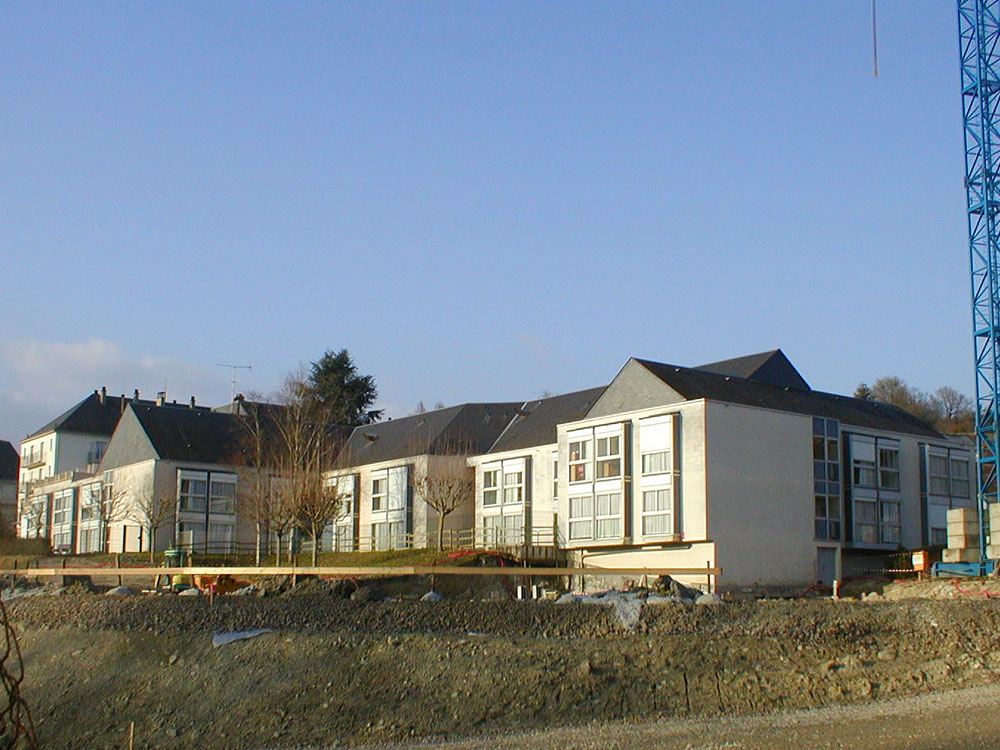
The Aged Care Facility (EHPAD Maison de retraite) runs the meals on wheels service for the elderly in Preuilly and surrounding villages.

Residential wing of the Maison de retraite, Preuilly-sur-Claise.
Three times a week a panel van driven by Flora does a circuit around the district, delivering a full meal of soup, starter, main course of meat and vegetables, cheese and dessert to elderly people. Flora drives 120 kilometres each time and delivers 33 meals.

The meals are made by the cooks at the Aged Care Facility in collaboration with the dietician. Special diets are catered for and replacement dishes can be provided if the service is asked for them in advance. The meals are delivered cold and reheated in the home. Monthly bills are sent by the Treasury in Ligueil  and the meals cost €8.90 each (subsidies can sometimes be obtained from the Aged Persons Association).

New wing of the Maison de retraite under construction in 2008.
The service covers the communities of Preuilly, Bossay-sur-Claise, Boussay, Chambon, Chaumussay, Charnizay, Petit-Pressigny, Saint-Flovier, Tournon-Saint-Pierre and Yzeures-sur-Creuse.

Friday, 24 March 2017

Budget for the Restoration of the Chapelle de Tous-les-Saints


At the last meeting of our town council the budget for the restoration of the Chapelle de Tous-les-Saints was discussed. Quotes from tradesmen are in and the work will start this year with a spend of €169 829. That will allow the building to be made watertight and the wall paintings to be protected.

Sabine de Freitas, the wall paintings conservator, checking the condition of the chapel's danse macabre.

The work envisaged is as follows:
  • roof €20 594
  • carpentry €38 421
  • masonry €45 720
  • protection of the wall paintings (and some other decorative work) €21 254
which is a total of €125 990.

The current state of the carpentry.

It will be funded as follows:
  •  Ministry of Culture €56 000
  • La sauvegarde de l'art français €21 000
  • La Fondation du Patrimoine and the subscription they administer €25 600 (to which the public can still make donations big and small)
  • two parliamentary reserves €11 500
  • L'Association des vieilles maisons de France (the Old Houses Association of France) €5000
  • Credit Agricole bank €5000
  • La Société Archaeologique de Preuilly (SAP) €5000
The town council has already agreed a grant of €11 840 and will advance €22 519 (which they will get back when the sales tax is reimbursed).


The council agreed and passed this budget with 13 votes of assent and one abstention (Guy Buret).

According to Bernard de la Motte, president of the SAP, at this point there is a shortfall of about €15 000 before we can complete the project. (We don't need to find the full €43 839 as the Ministry of Culture will grant 40%.)

Other budgetary issues discussed at this meeting were
  • a bypass for the town centre
  • finishing the 'Heart of the Village' improvements
  • work on the old girls school, the front of the abbey and the sports ground
  • roadworks on certain streets and parking at the champ de foire

Thursday, 23 March 2017

La Maison d'Adam

La Maison d'Adam is one of the unmissable sights in Angers. It is one of the outstanding architectural testiments to a medieval heritage which are scattered about the city today. The 'House of Adam' (also known as 'the House of Adam and Eve' or 'the House of the Tree of Life') was constructed towards the end of the 15th century. It was acquired in 1900 by the local artisans association and is sometimes referred to now as the Maison des Artisans.


Situated in the Place Sainte Croix, by the apse of the cathedral and on the crossing of the two major commercial streets in the city, the 'House of Adam' is the most exceptional of around 40 extant timber framed buildings in Angers. Its dimensions are imposing, its structure complex and its decoration enigmatic. It is truly one of the most remarkable works of carpentry from the French Middle Ages.

Samson slaying a lion.

It owes its name to the statues of Adam and Eve which once stood either side of the Tree of Life on the ground level corner of the building, and it seems to have been known as la Maison d'Adam since at least the 17th century. Recent dating evidence puts its construction at 1491, and the original builders and subsequent owners were apothecaries.

Mary menaced by a dragon.

Today set back from the square, originally it sat right on a major crossroads, flanked by tall thin merchants houses. Its ideal location permitted the double fronted facade that was twice the normal length in both directions, and six storeys high instead of the normal four storeys.
.

The multiple gables, the decorative lozenge shaped fills, the deeply moulded horizontal string courses and corbels supported by thick carved posts illustrate in magnificent fashion the skill of the carpenters at the height of their powers. The corner tower houses tiny offices known as écritoires or comptoirs.


It is the richness of the sculpture that above all marks this building out. The decorative themes range from the naturalistic, like the knots in a tree, to the stylised twisted flutes on the posts. There are numerous carved scenes and each post has a character figure or an animal. The themes are either religious or mythical on the one hand or vulgar and profane on the other.

The shawm player (left) and the bagpipes player (right).

The religious subjects include the Virgin Mary and the Angel of the Annunciation, the Pelican (symbol of the Resurrection) and Saint Michael or Saint George slaying the dragon. Then you have the lovers, the flute players and a selection of fantastical creatures. All of this was once painted in bright lifelike colours, but any remaining original paintwork disappeared with a major remodelling in 1814.

The Tree of Life.

Wednesday, 22 March 2017

Out Hunting in the Forest


The other day we were driving through the Forest of Amboise, between Chenonceau and Amboise, and a large black and tan hound came lolloping down the road towards us. He was on his own and as cars spotted him they slowed down. He came right up to the car going in the opposite direction to us, and then right up to us. He seemed to be checking the occupants and hoping to see someone he knew. We drove slowly and reluctantly past him (we couldn't have fitted him in the car even if we'd wanted to pick him up). 


A bit further down the road we came across a group of chaps with cameras and binoculars. We drove past them, thinking they were birdwatchers on an outing, but soon we encountered a group of mounted hunters. That was who we were looking for, as we realised they must own the dog (and in fact, the chaps with cameras must have been hunt followers). 

We pulled up and I jumped out to tell them about the dog. They thanked me and said they would send someone to fetch the errant beast, who had obviously got separated from the rest of the pack.

Then I asked them if I could take a photo and they agreed. The jocularity I captured was because there was some banter about whether I wanted to photograph the young and handsome members of the group or the old experienced hands.

The horses have all been clipped because they get too hot otherwise in their fuzzy winter coats. Riders generally like to clip horses if they are going to be working because if they get sweaty it takes them a long time to dry off so they can end up first too hot and then cold and wet. Also at this time of year they will pick up quite a lot of mud and if their hair is long it will get matted and be more work to groom.

Tuesday, 21 March 2017

The Eleventh Annual Cowslip

It is a tradition of ours to post a photo of a coucou (cowslip) every year as soon as possible after they flower.

Last week I commented to Susan that the coucou were late (6 weeks or so later than last year), and then almost immediately we saw our first. They are not as numerous as they have been in past years, either - many councils have mown the roadside verges already.

Here are some that have just about survived the carnage.


*****************************************

Brexit March: We will be in London for the march against Brexit on the weekend. We are planning to meet friends and family at Victoria station, then the group calling themselves RIFT (Remain in France Together) in front of Buckingham Palace, before moving on to the start of the march at the Hilton Hotel. I'm hoping to catch up with my friend and former colleague Emile there too (he has the 'reverse' issue to us, being an EU national living and working in Britain). If you are planning to be there too, get in touch and maybe we can co-ordinate something.
Susan