Thursday, 12 January 2017

Meringues


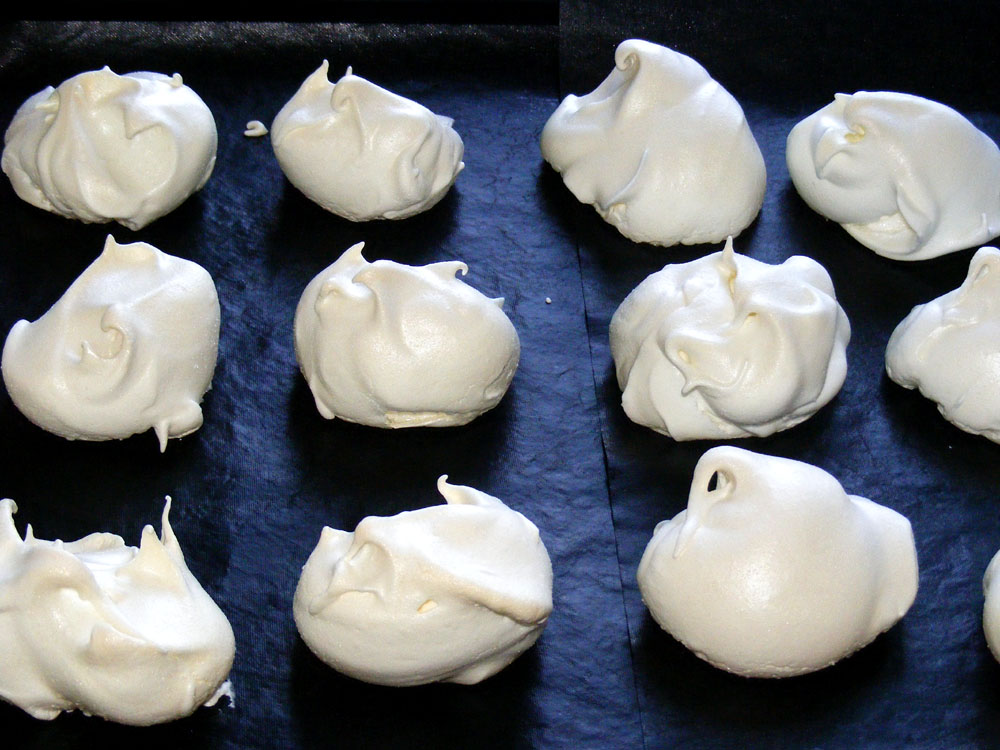
I am frequently left with four egg whites in a jar, after I've made a pint of custard, which uses four egg yolks. Meringues are the quickest and simplest thing I know to use up egg whites. 

Turn on your oven to 100°C and line oven trays with silicone sheets. For each egg white you need 50 g sugar. Whip the egg whites until stiff then slowly pour in the sugar whilst still beating. The whole process should take 2-3 minutes. Using spoons, place dollops of meringue on the oven trays, pulling them up so they form attractive peaks. Put the meringues in the oven for 40 minutes. Check after 20-30 minutes and if they are starting to brown open the oven door for a minute to cool it down. At the end of the cooking time turn the oven off, but leave the meringues in there until the oven is cold (many people leave meringues in overnight, which works well). 

Four egg whites will make about 30 meringues.


Wednesday, 11 January 2017

Architectural Details of Preuilly VII


A slightly odd house with a different surround to each door and window.

An old shop in the main street, now just a private home.

Another former shop in the main street.

Tuesday, 10 January 2017

Farming in France Today


I was watching the news the other day and there was an article about the state of the farming sector in France. Over the last three decades farming has changed dramatically. From a situation where the percentage of big farms was in single figures, they now outnumber small family owned farms. Mind you, big is relative and to qualify a farm just has to be more than 100ha. The number of farmers has halved, their average age is 55+ and the amount of land under agriculture has reduced by a third (mainly due to the reduction in the use of forage crops). Farm incomes have fallen in real terms and 80% of farm income is from subsidies. Despite this France is the biggest poultry and beef producer in the EU, and the third biggest producer of pork and lamb.

Crop spraying in spring. Photo courtesy of my father.


There is a perception that farming is a powerful political lobby in France, but I don't think the reality of the situation backs that up. They are a tiny percentage of the voting population, and despite being remarkably vocal and prone to dramatic public protests, farmers are not wooed in the run up to elections. The subsidies they receive are mostly associated with the EU Common Agricultural Policy (CAP). The main aim of the subsidies is to stablise farmers incomes (which it appears to be failing dismally at), ensure food security and reward non-revenue generating environmental activities. There are also grants available to young farmers (under 40 years old) to encourage generational change and recruit new blood.

Dairy cows in a shed. Photo courtesy of my father.


Farmers here had a particularly hard year last year. Rain in the first half of the year, with its concurrent lack of sunshine, meant that wheat did not thrive, but weeds and pests did. The weather conditions resulted in the worst wheat harvest in 30 years in France, whilst rival producer Ukraine experienced a bumper crop, causing prices to plummet. The quality of the French grain was very poor this year too, with the damp causing grain to germinate in storage, ruining it entirely, or at best reducing it to animal feed. The centre of France, here in the Loire Valley, to the east in Berry and to the north in the Beauce are the big wheat growing areas. Many farmers rely on wheat as their main activity, and France's bakers rely on them too.

The suicide rate amongst farmers is three times that of the general population. Farmers are talking about not being able to service loans or equipment. The evidence is that many farmers are working harder and harder every year -- longer hours in the fields and a lot more paperwork. They can get to a stage where they are physically burnt out and feeling hopeless. It doesn't help that many farmers spend seven days a week working on their own, with no social contact other than with family at meal times.

Harvesting wheat in July.


Milk quotas came to an end this year too. This was not an unexpected event or natural disaster such as the wheat farmers have had to deal with. Also the government stepped in to offer an aid package to dairy farmers who were struggling financially. For the cereal farmers there have been tax breaks announced, but nothing like the pot of money offered to dairy farmers.

Bringing in hay in May. Photo courtesy of my father.


Last September the French agriculture minister Stéphan le Foll called a meeting of his EU peers and they gathered at Chambord (closing it to the public for the day). On the agenda was primarily how to deal with Brexit, but also market fluctuations and the financial struggles of farmers. One of the solutions is to produce less to force prices up, but it's a tricky thing to manage, especially when you are also trying to encourage young farmers to enter the sector.

Certain natural habitats may benefit. For example, cereal farmers may be enticed to establish wild margins. Other sectors, such as forestry are currently trying to stop the trend of short-term opportunism offered by the sale of wood chips for so-called renewable energy. Another beneficiary of France reducing production could be the developing nations. The WTO has long criticised the CAP because it favours EU produce at the expense of developing nations for whom the trade in agricultural products could be the key to pulling themselves out of poverty.

Machinery shed on a local farm. Photo courtesy of my father.

France is self-sufficient in food, and anything which disrupted that would cause considerable disquiet. People have to be fed, and they have to be able to afford food. Farmers have to eat too, and they need a return for all their labour. They are also the guardians of a huge swathe of the natural environment. They need to be supported to maintain their local ecology and engage in nature conservation. Anyone who thinks that farmers are bludgers living off tax payer funded subsidies needs to think about how much maintaining the countryside costs and what the real cost of food is.

Ploughing up weeds at Clos Roussely, an organic vineyard in the Cher valley.

Unfortunately, at the moment the subsidies don't always encourage best practice or provide the safety net farmers need. Farmers are spending so much time trying to earn a crust that they are amongst the least well informed about new agri-chemicals (fertilizers, pesticides) and farming techniques that are better for the environment. They don't have time to read trade magazines and attend conferences to learn new things, nor can they afford the risk of experimenting with new ideas. They often depend uncritically on advice from middlemen (who I, as an Australian would call stock and station agents, but in general terms are farm supply merchants).

Farmers are key to the future of humanity, but they are being ignored politically. Farming is causing the single greatest impact on the environment now that the problems of heavy industrial pollutants have been addressed. But farmers are also feeding the world. They are not an easy group to deal with in times of change, being naturally conservative, and their attachment to their land and lifestyle needs to be handled with care. They are proud of their product and suspicious of attempts to interfere by government.

Harvesting wheat in the background, with sunflowers in the foreground (July).


French Farming in (2014) Figures:
  • French agriculture represents 19% of total EU production, in front of Germany at 15% and Italy at 10%.
  • 40% of the land in France are natural sites (forests, heaths, rocks).
  • Woodland and forest covers nearly 31% of the land (17 million hectares).
  • 54% of land is under agriculture.
  • The main crops of cereals, oilseeds, pulses and sugarbeet represent 40% of agricultural land area.
  • 16.5% of this land is under cereals.
  • 53% of the cereal grown is wheat. France is the 5th largest producer of wheat in the world, after China, India, Russia and the USA.
  • Livestock farming comprises 36% dairy, 22% beef, 14% poultry, 13% pork, 6% veal, 4% eggs, sheep and goats 3%, others 2%.
  • France has the largest cattle herd in the EU (19 million head, of which 3.7 million are dairy cows).
  • Drinks, wine and alcohol is the largest export category.
  • 5.6% of world exports of agrifood products are French.
  • France has 474 000 farms.
  • 922 000 people live and work on French farms. 63% are farmers (23% fewer than in 2001).
  • A quarter of farmers or farm managers are women.
  • Women represent 32% of fulltime agricultural activity.
  • With 9.1 billion euros in 2014 agrifood is the third biggest market sector in France, behind aeronautics and pharmaceuticals.

Monday, 9 January 2017

Architectural Details of Preuilly VI


The butcher's shop.

I love this galvanised hopper on the downpipe of this building. I would guess it dates from the first half of the 20th century. It is on the back of a building which faces a street both back and front.

I don't know what the original function of this house was, but the architectural detail is striking (if a bit clunky).

Sunday, 8 January 2017

Swimming in the Sea


My sister and I swimming in a small bay on the New South Wales coast.

Our posts on Sundays have an Australian theme. To read more click here.

Saturday, 7 January 2017

Lack of Architectural Detail in Preuilly


The market place in Preuilly Thursday morning at 10 am. It was market day, but you'd be hard pressed to tell, partly because you can't see much and partly because half the stallholders were on holiday.

Friday, 6 January 2017

The Mayor's New Year Wishes


This evening we will be attending the annual New Year ceremony hosted by the mayor. He will give a speech outlining the council's achievements during the old year and what they plan to do in the new. After the speechifying and award giving the citizens will gather for a celebratory drink in the salle des fêtes.

Thursday, 5 January 2017

The Nature of Touraine in 2016


Today's post is a series of photos, one taken in each month of 2016, to show some highlights month by month of the natural world in the Touraine in 2016.

January: A European Mistletoe Viscum album (Fr. Gui), on False Acacia Robinia pseudoacacia (Fr. Acacia) and covered in berries, in Amboise.

February: Cowslip Primula veris (Fr. Coucou) in a lawn, including a red flowering mutation, near Charnizay.

March: Wild Tulip Tulipa sylvestris (Fr. Tulipe des bois) flowering on the edge of a vineyard in Vouvray.

April: Ramsons Allium ursinum ( Fr. Ail des ours) on the banks of a stream, smelling strongly of garlic, near Sainte Maure de Touraine.

May: Bee Orchid Ophrys apifera (Fr. Ophrys abeille) in our vegetable garden in Preuilly sur Claise.
June: The biggest flood on record swept through the Claise Valley, photographed here at Chaumussay.

July: Small Spreadwing Lestes virens (Fr. Leste verdoyant) resting in the grass near Chaumussay.

August: A mud dauber wasp Sceliphron curvatum (Fr. Pélopée courbée), in our attic bathroom and flying too and fro to build a mud nest in a crack in a beam.

September: A male Orange Swift Triodia sylvina (Fr. Sylvine) resting on the green beans in our vegetable garden.

October: A Eurasian Swallowtail Papilio machaon (Fr. Machaon) caterpillar on Wild Carrot Daucus carota in our vegetable garden.

November: Grooved Bonnet Mycena polygramma (Fr. Mycène à pied strié) growing in the Forest of Preuilly.

December: The larva of a longhorn beetle Cerambycidae in our oak firewood. I'm told it is likely to be Leptura sp or Clytus sp, or a closely related genus. Based on that and the size of the larva, I think it could be either Plagionotus arcuatus (Fr. Clyte arqué) or Spotted Longicorn Chlorophorus glabromaculatus (Fr. Clyte poilu).
The beetle larva in the photo was identified for me when I posted some photos on the Facebook group Insects of Britain and Northern Europe. Entomology groups like this are one of the reasons I recently succumbed to the blandishments of FB. If you are interested in sending me a friend request, please do so, I'd be delighted. I use my real name on FB, but my profile image won't necessarily be me, and I will 'friend' you if I recognise your name or you send me a message explaining who you are if you are a lurker or use a pseudonym.

Wednesday, 4 January 2017

Squeeze Right


'Keep Right'.
This sign has always amused me. In this context it just means 'keep right', and probably has the nuance that there is a sharp right hand turn coming up plus it's a tight squeeze if there are two cars travelling in opposite directions.

There is good reason for the sign. When driving you approach this spot on the wrong side of the road because there is always a row of cars parked on the right and the street is not wide enough for three cars across. If there are two cars travelling in opposite directions, one of them has to give way. The sign reminds you to get over into your own lane as soon as possible. The chances of meeting the bus, a tractor, a truck or just some inattentive car driver straddling the white line and coming the other way around the corner are fairly high. 

The reason I am amused, in a sort of silly adolescent way, is that the verb 'serrer' has many meanings, depending on context. It could be 'to grip', 'to hold tight', 'to hug', 'to shake' ('serrer la main de qn' - 'to shake the hand of sb'), 'to squeeze', 'to clench' ('serrer les dents' - 'to clench one's teeth'), 'to tighten', 'to be tight' ('ce pantalon me serre trop' - 'these trousers are too tight for me'), 'to close up' ('serrer les rangs' - 'to close ranks').

Tuesday, 3 January 2017

The Heart of the Village


The Post Office in 2006.
For the past four months the centre of Preuilly has been in upheaval. The parking in front of the post office and the town hall has been completely dug up and redesigned. The new look is definitely an improvement and more practical, and includes a couple more parking spaces than we had previously.

The Town Hall in 2006.

The aim has been to beautify the area in front of the town hall to reflect its past as a grand town house. The idea is to create an agreable space for residents and somewhere that will be enticing to visitors. Around the beautified public space will be the doctors, dentist, pharmacist, post office and shops. 

One of the main thoroughfares in the town became an obstacle course. I was amazed that no elderly folk were accidentally squashed while work progressed, as there was no practical alternative to walking through the midst of the works if you live our side of town and wanted to go to the butcher, baker, bank or charcutier.

The council has bought the post office sorting office and it is being converted into a surgery for two health professionals. Although the mature linden trees from the parking space in front of the post office have gone, the area has been terraced and the curb dropped so access is easier. New trees have been planted. More parking has been created around the back of the former sorting office, new surgeries.

The main intersection in town gets a new curb.

The parking in front of the town hall has been dug up and will be converted to lawn planted with roses and shrubs. Two parking spaces remain, one for people with a disability, one with a charging station for electric vehicles. There is also a bench, bike racks and a new digital town notice board.

The works were the subject of considerable local interest and conversation. Residents were almost always to be encountered standing amongst the works and discussing it. I was by no means the only person who regularly photographed the progress.

Down the side of the town hall the one way system has been reversed, to encourage people to park in the existing spaces behind the building.


Initially most of the residents and quite a few councillors were skeptical about this project, but now that it is finished, the reactions are generally positive.

The intersection at rue des douves has been narrowed in rue des douves itself plus in front of the Episervice and pharmacy, to slow traffic down and stop people parking right in front of these two shops. A blue parking space and pedestrian crossing has been provided for the pharmacy nearby.


The mayor, in black on the left, inspecting the work. Two old women stopping to chat, in the road and right in front of the works.
A typical traffic jam, exacerbated by the works. Pedestrians are requested to cross to the other side, but there was no point, since there was works on both sides and no footpath on either.

Rolling the new pavement and grouting the newly laid setts that lead up to the steps of the town hall.


The new parking in front of the post office.

Charging station for electric vehicles. It is mandatory for villages above a certain size to have one. Preuilly is one of the last villages in the area to install one.

Monday, 2 January 2017

Salting the Earth


Now that the ice has arrived, with hoar frosts around New Year, the roads are beginning to be salted and gritted as a precaution. The main street of Preuilly has salt lying in the gutters. It's a priority because it is reasonably steep and usually crowded. You don't want motorists slip sliding around there.

Spreading a mixture of salt and sand in the street in 2010. Health and safety? Pah!

Salt for the roads is an enormous expense for the département and the communes here. We've had some hard winters in the last decade and some years there were fears that stocks would run out. The département could literally slither to a halt if that happened. The salt comes from mines in Spain and in addition to its economic impact there is an ecological impact.

Salt in the gutters of Preuilly's Grande rue on New Year's Eve 2016.

Some authorities are looking at alternatives to at least lessen the salination of roadsides. Sugar was trialled in some places a couple of years ago, but I have not heard of any plans to do that here.

Sunday, 1 January 2017

Happy New Year


Happy New Year
to all our readers.

Let's hope we can maintain our faith in the future and enjoy the year to come.
 

Saturday, 31 December 2016

Croquants au chevre et aux noix


We anglophones tend to think of biscotti as an Italian classic, but actually these hard crisp biscuits exist in other European culinary traditions too. In France they are called croquets or croquants by people in conversation and by artisan bakers, although in the supermarket they will often be labelled 'biscotti'. A friend made some to hand round after a botany outing. She was bemused by me apparently suddenly switching from French to Italian, and told me the biscuits were called croquants.

The recipe below is my savoury take on the subject, using local tourangeaux ingredients.

Savoury Goats Cheese and Walnut Biscotti (Croquants au chèvre et aux noix)

Ingredients
125 g walnuts
2¼ cups flour
60 g mature dry goats cheese
¼ cups maize meal
1 tbsp sugar
1½ tsp baking powder
½ tsp baking soda
1½ tsp salt
¼ piment d'Espelette
2 eggs
150 ml buttermilk
1 tbsp fresh thyme leaves

Method
  1. Turn the oven on to 180°C.
  2. Roast the nuts in the oven for about 8 minutes.
  3. Grate, crumble or chop the cheese, depending on its consistency.
  4. Remove the nuts from the oven and allow to cool. Leave the oven on.
  5. Mix together the flour, cheese, maize meal, sugar, baking powder, baking soda, salt and piment d'Espelette.
  6. Roughly chop the walnuts and add to the dry ingredient mix.
  7. In a separate bowl beat the eggs with the buttermilk and thyme. 
  8. Pour the wet mixture into a well in the dry mixture and work it with a fork and then your hands until it forms a fairly stiff dough.
  9. Divide into 4.
  10. Roll each quarter into a sausage about 25 cm long and put on an oven tray lined with a silicone sheet or baking paper. If it is a bit sticky, sprinkle the work surface with a little flour. Space the logs about 10 cm apart and use two trays.
  11. Bake for 20  minutes, then remove and cool for a couple of minutes.
  12. Turn the oven down to 100°C.
  13. Using a bread knife, cut the logs into slices. Angle the knife diagonally to get long oval slices.
  14. Put the slices back on the lined oven trays and put back in the oven for 30-40 minutes.

Substitutions and Notes
  • You could replace the walnuts with pine nuts. 
  • Any cheese will work so long as it doesn't have too high a moisture content. 
  • Maize meal is a flour made from ground maize (corn) that you might use to make tortillas. It is sold under a variety of names but it is not 'cornflour' (aka cornstarch) or polenta. If you can't get it, just use extra wheat flour. 
  • Piment d'Espelette is a mild chilli powder from the Pyrenees. It's expensive and not available everywhere, so use hot paprika instead if you want.  
  • If buttermilk (lait ribot or lait fermenté in France) isn't available where you are, use plain yoghurt. 
  • The eagle-eyed amongst you will have noticed that it is rosemary in the photo, not thyme. That is because I don't have a thyme plant at the house and getting some for the photo would have involved going down to the orchard to cut some thyme. Rosemary is very nice in this recipe as well.
  • The biscotti (as us anglophones would call them) will not be as brittle as the classic sweet version, because of the cheese. They are very savoury and moreish though.