Friday, 9 October 2015

Mostly Toxic

On Sunday 4 October I went on a fungi foray organised by the Association de botanique et de mycologie de Sainte Maure de Touraine in the Forêt de Preuilly. It was very well attended, as these outings tend to be. Lots of locals like to gather wild mushrooms in the autumn and if you live in the area you will recognise a number of people in the photo above. The outing was an opportunity to learn more and be safe and confident in your choice of mushrooms for the table as well as showing people just how diverse the fungi in the forest is. One man I know admitted to me that he had gathered mushrooms in the wild for many years, but had never been on an outing like this. He had, however, managed to put himself in hospital with hallucinations once after mis-identifying a mushroom that he ate.

Below, a mushroom which is very commonly associated with poisoning episodes. Jean Bouton has told me the story more than once of the chef in a restaurant near Chinon who served this mushroom up to diners and had everyone in hospital. Its name is the Livid Pinkgill Entoloma sinuatum (Fr. Entolome livide). It closely resembles two highly sought after edible species, the Saint George's Mushroom Calocybe gambosa (Fr. Tricholome de la Saint-Georges) and the Miller Clitopilus prunulus (Fr. le Meunier). They often grow together and all have a characteristic odour of flour. The Livid Pinkgill is rarely deadly but induces severe gastro-intestinal symptoms followed sometimes by delirium and depression.
Another related mushroom that often grows with the trio above is this Soap-scented Toadstool Tricholoma saponaceum (Fr. Tricholome à odeur de savon) below. It is also probably mildly toxic.
There was a lot of focus on the fact I am Australian, probably because the Wallabies had beaten the English in the Rugby World Cup the day before the outing. I'm not sure the various French people who mentioned it to me were so much pleased the Australians had won but more that the English had lost. (Simon tells me the French referee made some controversial decisions during the match, but unsurprisingly no one on the outing mentioned this.)

Jean-Pierre made sure to let me know that one of his sons is currently in Australia. His son is a geologist in the oil business and apparently would move out there in a shot, except that he doesn't want to uproot his wife and children.

Finally, Jean, Paul and Jean-Pierre all made sure I knew that the stinky red fungus below was an Australian invader. It is called Devils Fingers Clathrus archeri (Fr. Anthurus d'Archer) and is considered toxic enough by these three experts to be worth avoiding handling directly. They all poked it with a stick rather than touch it. According to Paul it arrived in France at the end of the 19th or beginning of the 20th century when wool imported from Australia to the Vosges region of France contained the spores of the fungus.
In the photo below Jean is testing a wax cap Hygrophorus sp with ammonia while Jean-Pierre looks on. They were waiting to see if a change of colour on the stem was produced, which would be indicative of which species it was. Jean commented that nowadays young professional mycologists would never attempt to identify a notoriously difficult group like Hygrophorus in the field. They'd take a specimen to the lab and test it at a molecular level.
Jean is relating the story (below), in quite graphic detail, of how a mushroom of the species he is holding caused him to have a most unpleasant night. It involved passing out and frequent trips to the toilet. The mushroom, Agaricus impudiens (Fr. Agaric variable), is marked in all the books as edible.
Finally, something we can all happily and comfortably pick and eat (so long as they are carefully kept from contact with toxic species). Despite the fact that these mushrooms are called Trompettes de la mort ('trumpets of the dead') in French these little blackish tubes are delicious, safe and widely sought after. They are called Horns of Plenty in English and their scientific name is Craterellus cornucopioides.
To read about previous fungi forays in the Forêt de Preuilly, see my 2013 post and 2012 post. For more photos of the outing on 4 October see my friend and fellow member of the Association de botanique et de mycologie de Sainte Maure de Touraine André Jousset's website Picturon. You will catch the occasional glimpse of me in some of the photos (hint: I'm wearing an orange gilet).

Thursday, 8 October 2015

Boulangerie les pains de Laurence

We have a new bakery in Preuilly sur Claise. It's owned and run by Laurence. She is already well known locally for her organic naturally leavened bread baked in a wood-fired oven. She used to work from her farmhouse in Boussay, but the business has outgrown the space.

Inside the shop.
She doesn't do pâtisseries, only breads and viennoiseries. Pâtisseries are fancy concoctions of cake, cream, fruit, pastry and mousses. Viennoiseries are yeast based baked goods such as croissants, pains au chocolat, brioches and chaussons aux pommes (apple turnovers, made with apples from Les Jardins Vergers, the organic market garden and orchard on the edge of town). For the moment she is not making pizzas. She says she needs to grow the core of the business first and then it is certainly in her mind to do pizzas again, but she doesn't know when.

The oven, right behind the counter.
The water in the bottle is tipped into the black receptacle on the wall, enters the oven and creates steam. The oven door opens inwards as Laurence pushes it with the pelle.
I really like Laurence and her bread. I don't know her well, rarely encountering her other than when she has been selling her wares at the market, but she comes across as hard working, modest and charming. I'm very happy to support this new enterprise by purchasing a few things every week. I like the ethos behind the business and good multigrain sourdough bread.

Baguettes aux grains, priced at €1.30 each, and what I usually purchase.
The bakery isn't well situated in terms of passing trade. The street it is located in isn't on the way to anywhere. But the locals have long been in the habit of going to wherever Laurence is selling her bread. Her products have quite a reputation in the area and people will make an effort to obtain them. 

Laurence doesn't like having her photo taken and tried to dodge the camera.
The bakery is open Tuesdays, Wednesdays and Thursdays from 7.30 am to 1.00 pm and 4.00 pm to 8.00 pm, then on Sundays from 7.30 am to 8.00 pm. She is closed on Mondays, Fridays and Saturdays. The address is 21 rue de la croix, Preuilly sur Claise (opposite the College Gaston Defferre). You can simply visit the shop during opening hours or if you want something in particular you can place an order by phoning 02 47 92 99 98 or emailing lespainsdelaurence @ hotmail.fr (take out the spaces when emailing). Everything is certified organic.
To see an earlier post about Laurence and her bread click here: The Beautiful Baker.

Wednesday, 7 October 2015

Making the New Vintage in Vouvray

Last week Vouvray wine producers, like all the others in the Touraine Loire Valley, were hard at work bringing in the grape harvest. The warm dry weather over the summer initially resulted in small sweet grapes (potentially too sweet for sparkling wines). Then the heavens opened and there were several deluges. The grapes swelled up, thus reducing their overall sugar content. Happily, the rain stopped again for the actual harvest, which took place earlier than normal, but not as early as had been predicted. Now most of the grapes are in, with those who hope to produce sweet wines as part of their range, like Chateau Gaudrelle, waiting for the recent sunny weather with a dry continental wind to do its job on selected parcels. They'll be picked when they are shrivelled like sultanas. You don't get much juice from these grapes but they are sweet.

The new member of staff at Chateau Gaudrelle backs a trailer full of freshly harvested Chenin Blanc grapes into the winery to be pressed (below). He comes from a background in IT support but has decided to re-invent himself in the wine industry. I think I put him off by snapping away with the camera. There was certainly a lot of backing and filling required anyway.

This is what he was aiming for (below). Guillaume, the vineyard master, makes sure the conveyor is correctly positioned to receive the grapes and carry them up to the press.

The grapes are given a helping hand to exit out the 
bottom of the trailer and on to the conveyor.

Alexandre Monmousseau, the owner and winemaker, watches like a hawk, ready to pluck out any substandard grapes or vegetative material (leaves, stalks) before they can make it to the press (below). Cyril, the cellar master is on top of the pneumatic press making sure everything is as it should be as the grapes drop in.

And here's some they made earlier. The chalk notes on the old 500 litre barrel below tell you that it was filled with fresh juice on 28 September. The fermentation is using just the naturally occuring yeasts that live on the grape skins (known as indigenous yeasts). The grapes come from vines in a parcel known as Montgouverne, which were not trimmed in the summer but their tendrils wound around each other and the top support wire (tressées = 'plaited'). This parcel is a test of this technique, which allows the vines to use their tendrils as antennae, sensing the conditions around them, responding and growing in a more natural way. The next day when I saw this barrel the fermentation was well underway, with Granny Smith apple tasting foam coming out the bung hole. The barrel will not impart any oaky flavour to the wine, merely allow more of the wine to be in contact with the lees (a sediment of dead yeast and particles of grape) than if it were in a big stainless steel tank. This technique means the wine will develop a fuller more rounded and integrated flavour. It will stay in the barrel for several months, the length of time depending on when the winemaker judges it to be ready to bottle.

Tuesday, 6 October 2015

Archaeology at the Logis Royal, Loches

The annual archaeological dig at the Logis Royal in Loches was underway last week. They are working on the section between the destroyed private chapel and the 15th century addition at the rear of the Logis.
I asked what had been found so far and they shrugged ruefully and said it was complicated. There are just walls going every which way and they haven't had a chance to work out the sequence or stratification yet.
You can read about previous digs here (What's Under the Chapel at the Logis Royal?) and here (Digging a Medieval Chapel in Loches).
*********************************************************
Think on This: The 2015 Nobel Prize for Physiology or Medicine has just been announced. So the next time I want to complain about the use of Avermectin and Ivermectin on cattle, its effect on insects associated with dung and all the knock on effects to bats and other insectivores I must acknowledge that some good has come out of it. William C Campbell and Satoshi Omura, who developed the drugs from soil bacteria, have taken it even further and almost eradicated two horrible human diseases -- River Blindness and Elephantiasis. However, it doesn't mean that graziers should continue with routine calendar based prophylactic dosing of cattle when there are other ways of managing the problem.

Likewise the next time I want to diss Traditional Chinese Medicine (TCM) as science woo I must remember that occasionally it comes up with something really worthwhile. Youyou Tu has developed a drug for malaria from traditional plant sources (Sweet Wormwood Artemisia annua*). Importantly it works on patients who have chloroquine resistant malaria. However, it doesn't mean that TCM shouldn't distance itself emphatically and right now from the trade and belief in rhino horn as having medicinal properties. In fact, practioners of TCM should be actively campaigning to disabuse their clients and potential rhino horn buyers of the possibility of any link between the product and a cure for anything. Ditto lion and tiger bones.

*Sweet Wormwood, known as Armoise annuelle in French, is native to Asia, but has naturalised in the Rhone Basin around Lyon, where it is considered a noxious weed. It also occurs in other areas of France, but not, as far as I know, in the Touraine Loire Valley.

Monday, 5 October 2015

Duomo di Milano

The Duomo (cathedral) sits on one side of the Piazza Duomo, a space created at the expense of demolishing several significant 15th century houses in the 19th century, but thereby gaining a central hub for Milan. On the side of the piazza to the left of the Duomo is the Galleria and to the right is the Palazzo Real (royal palace). Plans for the fourth side of the square were never implemented.

The facade.
The Duomo di Milano is the fifth largest church in the world and the second largest in Italy (after Saint Peter's in the Vatican City, which at more than double the volume, dwarfs the Milanese effort). The current building was begun in 1386 and construction finally ceased in 1965. The core of the building is brick, in common with much of Milan. The cathedral's Gothic elements and marble cladding are the work of the French engineer hired to oversee the initial work and make it an unusual church in Italy, where the Gothic style of Northern Europe does not feature much. The marble comes from a quarry gifted to the cathedral in perpetuity by Gian Galeazzo Visconti.

The side, with the Madonnina statue just visible on the far right.
Over the centuries there has been a complicated programme of additions and alterations to the cathedral. Perhaps its most famous external feature is the gilded statue of the Madonna on the spire over the apse, known as the Madonnina. The spire she sits on is over a hundred metres high and she is so high up that she is frequently obscured by fog. Another spire supports a statue of Napoleon Bonaparte, who was crowned King of Italy here. Most of the spires were added in the 19th century as part of a push to finish the building.

A detail of the facade.
The cathedral exterior was cleaned a few years ago and nowadays people are encouraged to support the work by adopting a gargoyle. For a fee you can get up on the roof, which is apparently spectacular, but it was so hot and the queue so long when we visited that we didn't even contemplate it. We didn't go inside for the same reason. 

The cathedral is not universally admired on aesthetic grounds. Inevitably given the centuries it took to build it is a stylistic mish-mash and the quality of workmanship varies greatly.
****************************************************
A la cuisine hier: A few weeks ago I set a rye sourdough starter to festering. Then a couple of weeks ago I used some of it to make crumpet batter. Unfortunately I didn't have enough wheat flour and subbed partially with buckwheat. The first crumpets were a disappointment, being stodgy and not forming the requisite pores. Now the batter has been in the fridge for over a week and I've learned to use just a third of a cup of batter per crumpet they are working much better.
*********************************************
Think on This: What is the value of wildlife rescue and rehabilitation? Certainly the costs can seem disproportionately high compared to the chance of a successful outcome. Some of the numbers in this article about the cost of wild animal rescue and rehab are jaw-dropping. Is it logical to focus on individuals when their chances are so slim? And we should bear in mind the bias towards the cute and furry (have you ever seen a frog in a wildlife rescue centre?). It's like I always say -- in nature conservation if you are not concentrating on habitat creation and regeneration you are just fiddling at the edges of the problem. Try to bear in mind that a sick or injured animal will provide sustenance for another. That helps your morale a bit when you cannot or should not help the individual. And of course, each case needs to be examined on its own merits. More often than we like to admit, doing nothing is the valid response, but sometimes, just sometimes, the feel good response is entirely justified.
***********************************************
Au jardin hier: More grapes, walnuts and apples harvested. 

I spotted a young Agile Frog in the potager and a Buzzard flew away as I arrived. The Ivy is just started to flower, but no sign of Ivy Bees yet. Only Honey Bees were visiting.

Sunday, 4 October 2015

Pussycat Flats Racecourse

The Pussycat Flats Racecourse hosts the Pine Creek Cup in May. In the centre of the track are some very fine cathedral termite nests. They provide homes for the thousands of termites that built them obviously, but also for the rare Hooded Parrot. I'm sure the racetrack is visited by more birdwatchers than racegoers and Pine Creek is famous as having the most bird species recorded in the Northern Territory. It may be in the middle of nowhere, but birdwatchers can't resist a site like that.

I have no idea how the place got its name.

Saturday, 3 October 2015

The Father of Modern Wine Making

Jean-Antoine Chaptal (1756 - 1832) was a scientist, principally an applied industrial chemist, but also with an interest in agronomy. Chaptal began his career studying medicine and progressed from there to chemistry. His wife's family were textile dyers and some of his early work was done developing mordants and dyestuffs, and on using steam and bleach as whitening agents for textiles.

He set up chemical works for manufacturing acids and sodas and is responsible for coining the word nitrogène as the name for the gas used in making nitric acid. In English we now know that gas as nitrogen of course. 

Looking towards the Forest of Amboise from the Pagoda at Chanteloup.
During the Revolution he was put in charge of the manufacture of saltpetre and gunpowder.

A disciple of the guillotined Lavoisier, he applied Lavoisier's formula on the conversion of sugar to alcohol to the production of wine in the years immediately after the Revolution and can be said to be the father of modern wine making. He was a great populariser of the practical applications of science and chemistry in particular and his methods were widely disseminated and quickly adopted by winemakers, revolutionising the industry. Along with like minded men such as Parmentier, he wrote a treatise on winemaking that covers everything from vineyard management to fermentation and distilling, which is the basis of modern winemaking. Chaptal gives his name to the practice of adding sugar to grape juice in order to increase the alcohol content once fermented. The higher alcohol content is designed to make the wines keep longer in the days when wine was stored not in bottles but in barrels, and with less concern over controlling the temperature consistently. Chaptalisation is mostly banned these days in French AOCs, except under very specific circumstances.

Looking towards the Chateau of Amboise from the Pagoda at Chanteloup, 
grape vines in the foreground.
Napoleon Buonaparte appointed him Minister of the Interior in 1801 and he used his time in office to reform the health system, setting up hospitals and a training school for midwifes. He was also responsible for the network of provincial museums in France and the introduction of the metric system.

In 1802 he became the owner of the Chateau of Chanteloup at Amboise. He used the fields around Chanteloup to develop his ideas on agronomy. He bred merino sheep and grew sugar beet. Along with several other highly regarded scientists of the time, he developed the crop to be more productive and worked on methods of extracting and refining sugar from beets. A sugar extraction plant was set up at Chanteloup. France had lost access to its sugar producing colonies because of the Napoleonic Wars. There was a desperate need for agronomists to develop sugar production on the French mainland and Chaptal was not the only leading scientist of the day to be involved.

Looking towards Amboise from the Pagoda at Chanteloup.
Chanteloup today is right next door to the local agricultural high school where teenagers learn winemaking and vineyard management as the prelude to further studies in an oenological or viticultural career. Curiously, the tourist leaflet for the Pagoda, the only remaining part of the Chanteloup estate, only mentions Chaptal's involvement in the development of sugar beet and not his reforms of the wine industry. To read the leaflet you would think he singlehandedly solved France's sugar crisis too.

Although clearly brilliant, his genius was to develop the theories of others into practical applications rather than making new scientific discoveries himself. He was not universally popular due to his disregard for certain social and political niceties. He arranged for his son to be appointed as mayor in a town where he had a factory in order to stop the previous mayor complaining about the pollution the chemical factory produced. Another parliamentary colleague who was a keen beekeeper had similar concerns with Chaptal's approach to industry and chemical waste. 

Looking out over the Loire Valley and towards where the chateau once stood, 
from the Pagoda at Chanteloup.
In his last great work he published on the subject of soil chemistry, covering composition, air, heat, the role of water, the influence of electricity on vegetation, the role of light and temperature.

In 1823 he had to sell Chanteloup to cover debts incurred by his son, who had made large speculative investments in a huge chemical factory. The chateau and most of the grounds were purchased by a consortium who demolished the buildings and sold everything off as salvage. The pagoda, formal pond and the forest were bought by the future King Louis-Philippe. Chaptal died in poverty in 1832.
************************************
Au jardin hier: Tim came with Betsy to mow. He was hoping to kidnap some more Wasp Spiders to restock his place but my supply isn't as good as last year so he went home with two bottles of Berrichon beer, the seed head of a Lady Orchid and a punnet of black grapes. Betsy does the perfect job for the orchard because she doesn't cut too low and slices through volunteer cherry trees like one thing. I'm deeply grateful to Tim for being prepared to help.

On my pre-mow checking round I encountered a lovely Swallowtail caterpillar sunning itself, then later munching on some Wild Carrot. Also two very large specimens of Warted Amanita and a few Weeping Bolete.

I planted more brassica seedlings, a gift from Pauline -- cabbage, brussels sprouts and cavalo nero.

Friday, 2 October 2015

Shooting the Breeze

Until recently it was assumed that many fungi simply allowed gravity to take effect while they passively dropped their spores. If they were lucky a little gust of wind would intercept the tiny spores and they would waft off to propagate the species more widely. It turns out though that fungi are much more active in the matter. Amazingly they are capable of creating their own microclimate, and they do it to ensure their spores spread far and wide.

Orange Peel Fungus Aleuria arancea, a type of cup fungus, in the Forêt de Preuilly.
Some, like morels and cup fungi, violently eject quantities of their spores all at once and create a jet of air that disperses the spores 30 times further than if they just popped out one at a time.

A Morel Morchella esculenta, in our potager garden.
It's the difference between being dropped and landing a mere 3 mm away compared to hurtling 10 cm away from the parent body. The mechanism is possibly triggered by a drop in air pressure or being hit by raindrops.

A Panther Cap Amanita pantherina.
Mushrooms with caps do it by releasing water vapour ie by allowing themselves to shrivel up.

A Parasol Mushroom Macrolepiota procera, by the side of a track near Yzeures sur Creuse.
This cools the surrounding air and creates a convection current that lifts the spores out and up, away from the parent horizontally and vertically. Denser than warm air, the cold air flows and spreads, creating movement in an environment that is normally protected from breezes and draughts. Down on the forest floor, tucked in under logs the mushrooms are not exposed to much in the way of air circulation, so they engineer their own.

Thursday, 1 October 2015

The Medieval Month of October

This panel depicting the month of October comes from a 12th century series of wall paintings of the months of the year in the church at Lignières en Touraine. The month is characterised by the annual task of gathering walnuts.

Wednesday, 30 September 2015

A Bronze Serpent

This bronze culverin (Fr. couleuvrine, meaning snake like) was made by Andri Brasseux in 1568. It's a type of small cannon which fired solid shot (ie cannonballs), in the days before shot became explosive in its own right. Brasseux may have been a local whitesmith (Fr. potier d'étain) as the culverin is inscribed 'ANDRI BRASSEUX, POTTIER DETEN FETTE SETTE PIESSESY SIMON DUFOUR SOLLICITEUR 1568'. I interpret the inscription as saying 'Andri Brasseux, whitesmith, made this piece, commissioned by Simon Dufour, 1568'. Whitesmiths work with tin and pewter, mostly making domestic vessels and implements. Some of them would have understood the process of making tin alloys such as bronze but normally they worked with metals cold (unlike blacksmiths).

Further inscriptions on the cannon indicate it was modified in 1751 and again in 1774. It also shows the arms of Issoudun, the names of the governors and the arms of Charles de Barbançois, Seigneur de Sarzay.

Charles Barbançois came to Issoudun in 1562 to lift the seige of the town which was occupied by the Protestants.  In recognition of his services the King Charles IX named him lieutenant general and commander of the troops in Berry, then governor of the town and chateau of Issoudun.

The cannon, with its multiple inscriptions is a veritable history of the Wars of Religion in a single object. It comes from the town ramparts of Issoudun.

Tuesday, 29 September 2015

Foresters Sound the Alarm

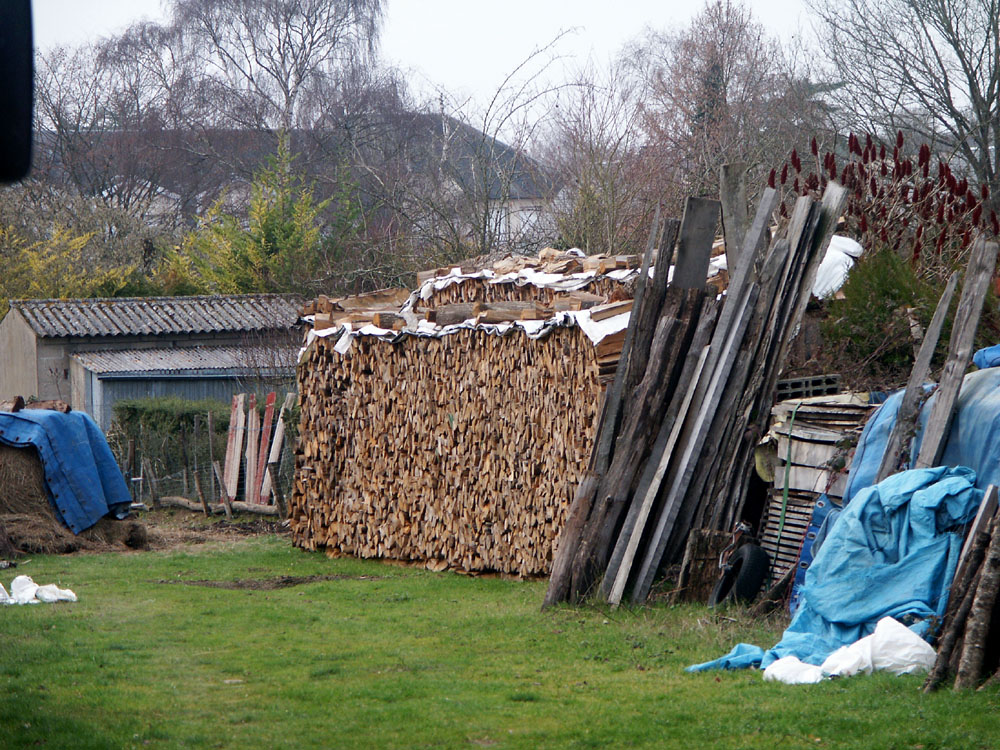
Six million cubic metres of wood are produced in the Centre-Val de Loire region annually.

A private firewood pile.
Whilst the market for lumber has stagnated, with prices not having changed for 30 years, the market for wood as a bio-fuel has really taken off in the last few years.

Firewood in the Forest of Preuilly.
This has led to concerns expressed by the President of the Union of Private Foresters that without a unified management plan the Touraine risks deforestation. He has told his 440 members that if they opportunistically cut their woods for fuel without succession planning, bio-fuel is a mirage. Wood has already been in short supply for several years.

A parcel in the Forest of Preuilly managed for both lumber and firewood.
The development of power plants using wood-chip (Saint-Pierre-des-Corps, Orleans that partially serves the Touraine, and soon Descartes) led some owners to develop coppice which allows a high rotation (the trees are cut every five years). Long term though it exhausts the soil because it consumes a lot of nitrogen. The president of the Private Foresters Union, Antoine Reille, believes that this production is not well managed and wood that is still wet is often being burned. Although he doesn't say so, I suspect that there is also a problem with much smaller diameter wood now having a commercial value and being removed, whereas before it would have been left to rot and replenish the soil.

A parcel of young oak trees in the Forest of Preuilly.
Reille is not ignoring the delicate balancing act required to ensure cash flow in the short, medium and long term. Coppice will make useable firewood in 25 years, a standard oak tree takes 80 years. But he feels that the market is only going to expand and there should be a sensible overarching management plan for the private forests.

A walking trail in the section of the Preuilly Forest put aside for leisure activities.
The Arbocentre Wood Energy Sector Manager is more optimistic. He acknowledges how tempting it is to seize the opportunity offered by bio-fuel. He believes the way forward is to set up a simple management plan and code of forestry practice. Included in this must be plots that are currently being stripped bare with no succession plan and profits must be reinvested in the forests of the future so there is no risk of deforestation.

He also thinks the demand for bio-fuel will slow down. At the moment the three power plants consume 30 000 tonnes of wood and don't have much potential for increasing that. In addition any increase won't be at the sort of rate the foresters have experienced in the recent past. The market took off very rapidly but it's a recent phenomenon of only 5 years. The evolution will be slower. 

Source: La Nouvelle République article.

I should point out that all the photos here were taken by us in the Forest of Preuilly, which is mostly managed by the very professional Office for National Forests and none of the issues discussed above apply. Also probably none of the wood shown above will be destined for wood chip, it will be to supply private households with wood burning stoves. There are private parcels in the forest though and I can't vouch for the management approach to all of them.