
According to Jean-Pierre, we may be in for a very good fungi season. In the autumn following a hard winter or a prolonged period of dry, the mushrooms are often abundant. Since we have had both this year, perhaps we should expect to be overwhelmed by fungal fecundity!

I didn't catch what these are called, but they were so pretty I've included them.

The final haul displayed, with the crowd of foragers contributing and admiring.

Jean Bouton talking to the group about two very poisonous species -- the Death Cap and the Panther Cap. He pointed out that you must check each and every mushroom as it comes out of your basket if you are intending to eat them. Many of the fatalities caused by the Death Cap have been because it is an unremarkable looking mushroom that gets bundled up with comestibles and accidentally eaten along with the edible ones. He also pointed out that many mushrooms accumulate substances like caesium and other hazardous materials, so even non-toxic species must be sourced from unpolluted sites.

Death Cap Amanita phalloides -- eat a single one of these and you have about 3 hours after ingestion to get medical attention before permanent liver damage or death is inevitable according to Jean. They are the most poisonous mushrooms in the forest, and doubly dangerous because the symptoms of poisoning do not manifest themselves until long after it is too late (several days sometimes). In fact, you are not recommended to even touch them in case you subsequently touch your fingers to your lips and ingest a tiny amount of the poisons (yes, they contain more than one...) nor should you carry them in the same basket as mushrooms you intend to eat. Someone asked Jean about the fact that he openly handled this specimen, but unfortunately I didn't hear his response. These mushrooms are not uncommon, and are the reason that some foragers wear latex gloves.
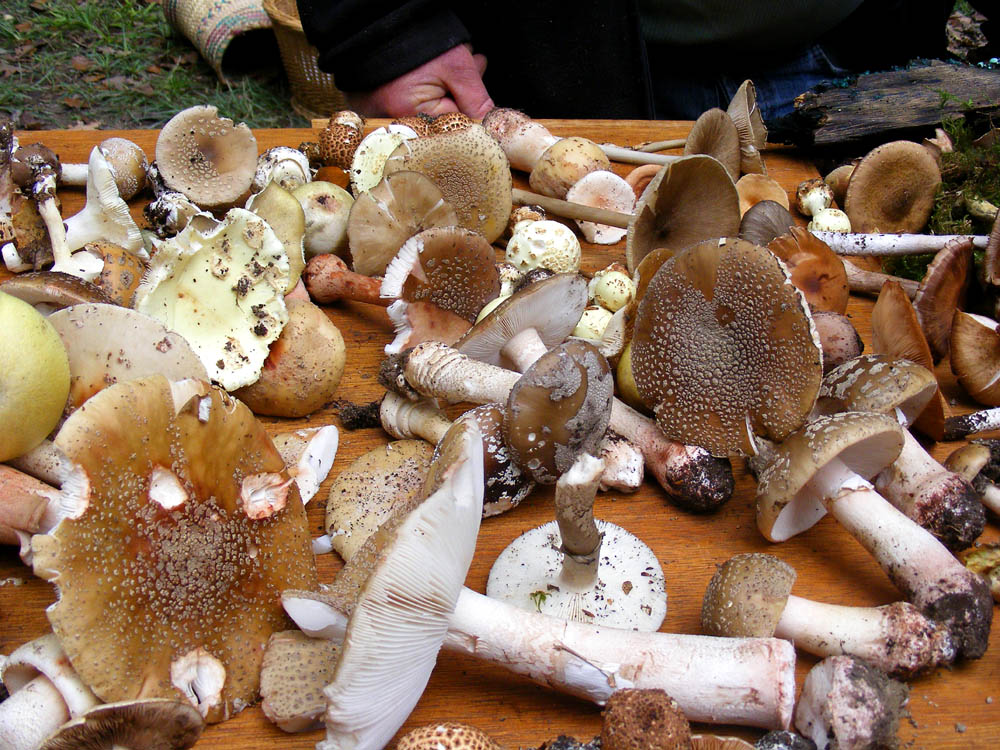
This is a mixture of Blushers A. rubescens and Panther Caps A. pantherina. Blushers are comestible, Panther Caps are one of the most toxic species. Can you tell the difference? I think I can, but I certainly wouldn't be putting my health or life on the line by eating any of these, just in case I was wrong. (Blushers get a pink blush on the stem and cap, especially if bruised or damaged, in case you are wondering what the difference is.) Blushers are very common, but Panther Caps are not uncommon here and they often grow in in proximity to one another.

The deadly Panther Cap.

The Masters at work -- Paul, Jean-Pierre and Jean identifying fungi at the end of an afternoon of foraging.


