Showing posts sorted by relevance for query chapelle de tous les saints. Sort by date Show all posts

Thursday, 5 July 2018

Conserving the Vault of the Chapelle de Tous les Saints


Recently I had the chance to go up on the scaffolding and watch wall paintings conservators Sabine de Freitas and Corinne Tual working on the painted wooden ceiling panels of the Chapelle de Tous les Saints. I happened to be passing the chapel, on my way to the bakers, and noticed they were there, so I asked permission to join them. Sabine, as always, was glad to talk about the work and be photographed. Corinne was less appreciative of me arriving and breaking her concentration, but put up with me with good grace. It was a dull overcast day and the two conservators were really struggling with the lack of light.

The panels were initially removed one by one and dusted thoroughly on both sides to remove years of accumulated grime, feathers and dead insects. When they were put back in place they were numbered from 1 to 90. Due to the restrictions placed on the restoration work by DRAC all of the deformations and misalignments that have occurred over time had to be kept. This meant that panels had to go back to exactly where they had come from and where panels were missing the carpenters had to individually craft each unique shape to fit the gap.

Delicately touching up the decorative painted bands.

Once basic cleaning had been done and the panels back on the ceiling, temporary bands were attached to ensure the panels were not affected by the vibrations of the carpenters and roofers working on the beams, rafters and tiling above. The new oak panels have been treated with bicarbonate of soda so their colour blends in with the old as the tannins in the wood take time to migrate to the surface and darken. The originals would have been coated in limewash to protect the wood from moisture and Sabine has recreated this by mixing a bit of dust with limewash to tone down the whiteness and give a 'dusty' effect.

Sabine is utterly captivated by the chapel. The more she works on it the more she realises how special it is. She thinks it is significant that not only does it contain an important and unusual danse macabre, but that is combined with the dedication to All Saints. She feels that emphasises its function as a funerary chapel, although not everyone agrees with her analysis. 

Corinne mixes up some paint.

However, it is significant that her work has revealed that the chapel was clearly conceived as a whole and built and decorated as a single project sometime around 1500. The reason for her careful analysis is that in order to restore the paintings, she needs to first understand how they were made. Once she knew how the paint was applied and what the pigments were she was able to develop a conservation plan. She has demonstrated that the pigments on walls and vault are the same, and some of the decorative motifs are repeated on both. She has also discovered the residue of paint on some of the carved decorative interior stone, again from the same period, and has realised that the dancers are set in a frieze that is intended as an architectural trompe l'oeil. Once upon a time there must also have been beautiful stained glass windows which continued the theme.

It is very rare that such a complete and original artistic concept for a chapel survives. Usually the roof vault in this style of chapel decoration has been repaired and repainted, even if the wall paintings remain intact.

You can see how wonky the panelling is these days.

Sabine and Corinne's main work consisted of impregnating the painted sections with casein to stablise them. They were careful not to 'over-restore' the vault, as they did not want it making too much of a contrast with the as yet unrestored danse macabre wall paintings. When a decorative painted strip was interrupted due to damage they decided to sketch in a continuation of the red and yellow borders, but not reproduce the decorative pattern between these. It's all about being able to 'read' the design but still allowing the viewer to be clear about what is original and what is restoration.

Sabine very clearly sees her job as not just the technical aspect of wall paintings conservation. She is also a committed educator and communicator about her craft, dealing with architects, artisans and the public. At the onsite meeting on 16 June when benefactors were invited to view the work, she was the presenter who engaged the public the most and who they talked about the most admiringly afterwards.

The conservation work on the ceiling was scheduled to be finished at the end of June but I haven't had a chance to pop down yet to see if the scaffolding has gone and the conservators all packed up.

Previous posts about Sabine and the work to save the Chapelle de Tous les Saints:

Assessing the State of the Chapelle de Tous les Saints

Architects Report on the Chapelle de Tous les Saints

Budget for the Restoration of the Chapelle de Tous les Saints (check out the picture of the ceiling before restoration).

A Visit to the Chapelle de Tous les Saints With the Architect

And another building in the area that Sabine and Corinne have worked on:

Villa Rose, Saint-Aignan

Wednesday, 1 November 2023

La Chapelle de Tous les Saints

The little funerary chapel in the park at the end of our street has been restored. Inside its altar has been reinstated, the windows have glass, the carpentry beams repaired, the painted wooden ceiling and the Danse Macabre painted on the walls carefully conserved.

Conservators working on a medieval danse macabre in a chapel, Indre et Loire, France. Photo by Loire Valley Travel Time.
Conservators working on the danse macabre.

Medieval danse macabre wall painting depicting women, Indre et Loire, France. Photo by Loire Valley Time Travel.
The south wall of the chapel, depicting women characters, before conservation.

Medieval danse macabre wall painting depicting men, Indre et Loire, France. Photo by Loire Valley Time Travel.
The north wall of the chapel depicts male characters in the danse macabre (photo before conservation).

Conservator talking about wall paintings, Indre et Loire, France. Photo by Loire Valley Time Travel.
Corinne Tual, a wall paintings conservator, talking about the project to the public.

Amateur performance of a danse macabre, Indre et Loire, France. Photo by Loire Valley Time Travel.
Amateur theatrical performance interpreting the danse macabre.

Medieval painted wooden vaulted ceiling in a chapel, Indre et Loire, France. Photo by Loire Valley Time Travel.
Detail of the conserved painted oak ceiling vault.

Detail of a danse macabre wall painting before conservation, Indre et Loire, France. Photo by Loire Valley Time Travel.
A panel of the danse macabre wall painting prior to restoration.


Below -- photos of the conserved wall paintings and restored altar.

Chapelle de tous les saints after conservation, Preuilly sur Claise, Indre et Loire, France. Photo by Loire Valley Time Travel.

Chapelle de tous les saints after conservation, Preuilly sur Claise, Indre et Loire, France. Photo by Loire Valley Time Travel.

Chapelle de tous les saints after conservation, Preuilly sur Claise, Indre et Loire, France. Photo by Loire Valley Time Travel.

Tuesday, 13 January 2015

Architect's Report on la Chapelle de Tous les saints

La Chapelle de Tous les Saints.
Regular readers will be aware that we are involved in a campaign to save the Chapelle de Tous les Saints in Preuilly, which has rare and important wall paintings. The Chapel dates from the early 16th century and is in very poor repair. It is owned by the town of Preuilly, who have passed over the responsibility for managing the restoration campaign to the local history society, known as the SAP. We have written about the chapel a number of times before:  La Danse Macabre; A Chapel at Risk; Assessing the State of the Chapelle de Tous les Saints.

On Monday 5 January I attended a meeting of the local council. It was a special meeting, open to the public, so that the architect engaged by the SAP could present his report on the condition of the Chapelle de Tous les saints and propose a programme of works and expenditure. Nine members of council, 3 observers including me and the architect Monsieur Barthel were present. The meeting was not minuted but most people attending took notes.

A video on the Chapel made by our friends Dominique and Dominique Robin.

He began by describing the building as 'a little jewel' with 'hidden treasures' and outlined a programme of works which would restore and maintain the building little by little. He reckons the programme could stretch to as much as 10 years, but might be done in five.

There are serious structural problems which must be addressed first. The three main elements of this are:
  • The arrangement of interlocking masonry at the corners has been altered.
  • The buttresses need repointing.
  • The roof is in a bad state, therefore the carpentry is in a bad state.
These three major problems have knock on effects, leading to further problems:
  • the side door is collapsing.
  • the roof is not sitting on the gable squarely and the gable is disintegrating.
  • the buttresses are dissolving from the inside because water is getting in through the gaps at the top where mortar is missing.
  • passing heavy vehicles are causing vibration damage.
  • cracks in the walls are primarily just a visual problem, but should be filled with liquid mortar to prevent them becoming more serious.
  • the roof can be repaired but it is a big job and can only be done once the carpentry is sorted.
  • once the roof and carpentry are fixed it will allow gutters to be added.
  • the windows need to be glazed.
All of this work is to protect the building from water damage -- as he put it, 'giving the building a hat and coat'. Once that is done we can think about the following problems:

  • the algae visible on the north wall is symptomatic of water trickling down. The raised soil level above the foundations means the water is not escaping and the building is 'floating'.
  • everything about the interior needs restoring -- carpentry, woodwork, walls, floor, and of course the precious paintings.
  • the cement block western gable end needs to be covered with render to disguise it.
  • at the moment rain, wind and snow are all getting in and slowly destroying the paintings.
  • everything is rotting and falling apart.
  • he agrees with Sabine de Freitas' assessment of the paintings and how to conserve them.
  • he proposes rendering the interior where there are no paintings.
  • ideally, we should consolidate but not immediately restore the paintings.
Doing all of the above will make the building more attractive, but also in the process protect it. Both will help when seeking funding grants.

Specifically, he suggests the programme of works should go like this:

Phase 1: Repair carpentry, roof, ceiling vault, exterior masonry as necessary eg gable.
Phase 2: Restore the interior (glazing, masonry, paintings, joinery such as doors) once the building is watertight.
Phase 3: Restore the exterior.

His argument for restoring the interior before the exterior is that once the interior is finished we can start to show the building to people. The most difficult part of the interior will be the painted vault and he has taken the advice of the regional curator regarding this who has proposed a solution that I didn't entirely follow. It sounded like they suggested making a sort of sandwich of the wooden panels in situ rather than dismantling them, cleaning, repairing and reinstating.

You can clearly see that the roof does not sit on the gable squarely.
Phase 1 can be split into three main stages -- carpentry, roof  and vaulted ceiling. His estimate for the carpentry is €34 840, the roof €33 180 and a total including the ceiling of €121 000 (or €179 000 including tax). That figure does not include doors and window glass. The glazing he estimates at €5328 and the total for Phase 2, the restoration of the interior, at €109 000. Phase 3, the facades, would add another €82 232, so we are looking at a €300 000 project over 5 - 10 years.

He suggested ways of using the building once restored, by thinking of it as an extension to the mediatheque across the road. It could act as a complementary space for educational activities and exhibitions. He had gone to the trouble to design a possible interior layout for displays which had visitors entering by the front door and exiting by the side door. He pointed out that one problem with the building is that it will need to be supervised when open. He also suggested making some small improvements to the park to make it more attractive.

The sloping top of the buttress is degraded and the gable is disintegrating.
The big question is how to fund all of this. It is clearly way more than the commune can afford. The Société Archaeologique de Preuilly (SAP) needs to raise 5% of the project money and then apply for grants. Donations are about 60% tax deductible for French taxpayers, so roughly speaking, a donation of €100 has a real cost to the donor of €40. Grant giving organisations would be prepared to fund 20% of the project. One of the grant giving organisations, the Fondation de Patrimoine, can also help manage the fund raising. All grants are a function of the donations received, so the more we can raise ourselves the bigger the grant we would get.

DRAC would also be able to help, especially with the paintings, as would Sauvegarde de l'Art Français. What is needed is a definite programme with possibly conditional phases. It's a real juggling act to manage the fund raising, the grants and the work. It's important to have a dossier that one can present to potential donors and grant givers. Monsieur Barthel observed that in his experience when public aid is difficult to get, private aid goes up.

A detail of the Danse Macabre wall paintings.
Once the meeting was opened to discussion one of the council members asked about the possibility of repairing the building bit by bit using volunteers or trainees. Monsieur Barthel responded that it would indeed be cheaper, but it makes the project longer and harder. The work has to be very well supervised and managed and you still have to have a qualified professional organisation to do that and to sign off the work.

Bernard de la Motte, president of the SAP has already raised €2300 and has pledges which will bring that to €4000. He feels that we need to focus on the rarity of the Danse macabre paintings to encourage funding. He reported that curators and architects from Batiment de France, the Fondation de Patrimoine, la Sauvegarde de l'Art Français, DRAC and the Conseil Général have all been to see the building and all are positive and supportive of the project.

The ugly cement blocks of the rebuilt western wall and the parlous state of the wonderful vaulted ceiling.
He wants to be able to present a dossier to the grant giving bodies as soon as possible, but asked if the meeting felt we should be asking for aid just for Phase 1 or for the entire project. The concensus was to go for the whole project. Some of the council members were visibly shocked by the amount on the bottom line and mentioned what you could get as new build for that amount of money. Others were of the opinion that if that's what it cost, that's what it cost to restore this important little building.

Anyone who wishes to pledge a donation to the project may do so by contacting us or Bernard de la Motte.

The chapel in the snow.
***********************************************
Au jardin hier: More making like a sanglier. And picking up dog poo, which was everywhere. Obviously someone has been regularly walking a large dog up the track to the orchard and it is slipping through the fence to do its business. I'm thoroughly irritated, but there isn't anything I can do about it to stop it.

Once again it was warm enough to have to take my jacket off to work, and there was a honey bee buzzing around.
******************************************
A la cuisine hier: Cheese Crisps, which are super easy and moreish.

Turkey escalopes flashed with lemon, salt, mixed ground peppercorn blend, garlic and thyme, served with grilled tomatoes and steamed spinach.

Soda Bread, dense on the inside and crunchy on the outside.

Tarte fine caramélisée aux pommes, simple and stylish.

Friday, 28 October 2016

Fundraising for the Restoration of the Chapelle de Tous les Saints


Architect Jean-Philippe Barthel talks about the project.

As long term readers may remember we are involved in the efforts to save the Chapelle de Tous les Saints in Preuilly. It is in a parlous state, with a broken main roof beam and leaning stone walls. Inside is a precious remnant of the late Middle Ages or eary Renaissance. The chapel contains a very rare wall painting depicting a danse macabre. It is one of only nine danses macabres surviving in France, and most importantly, one of only two which depict women as well as men.

President of the local history association (SAP) Bernard de la Motte says a few words.

Since we first met with the Fondation du Patrimoine, the wall paintings conservator and tendered for architects, Bernard de la Motte has been beavering away to secure grants to fund the project. In May he finally received notification that DRAC (the Department of Culture and Communication) would give the maximum allowable grant of 40% of the total funds. Charitable grant giving organisations such as La Sauvegarde de l'Art Français are also lined up. SAP members Jill Elton-Wall, Gilberte Blaszczyk and Christine de la Motte have raised around a thousand euros with their efforts sewing and selling small textile pieces (spectacles cases, Christmas decorations, bags, cushions, etc). Dominique Robin has made a video about the chapel and Bernard has written a booklet about the history of the chapel and its importance; Antoinette and Niall translated it into English so the booklet is in both languages. Antoinette and Niall also went off to Troyes in May for the annual conference of the Association des Danses Macabres d'Europe where Antoinette delivered a brief talk about the chapel and brought it to the attention of many interested scholars. While there she was able to network a bit and get more of an idea of where our danse macabre sits in the genre. She also raised €60 with the sale of booklets.

Mayor Gilles Bertucelli and Fondation du Patrimoine representative Jacques Guionnot sign the fundraising agreement.

The final piece of the funding puzzle is to seal the agreement between the Fondation du Patrimoine and the local town council (commune). The Fondation du Patrimoine will promote the project and administer the fund raising. They will then hand the money over to the commune to fullfil the locals part of the bargain, but in order to remain eligible for the DRAC grant we must raise 5% of the total funds. That's about €15 000 we need to raise as our contribution to the €300 000 needed to complete the project.
Drinks and mingling at the end.

It is hoped that work will start sometime next year. Jean-Philippe Barthel is planning to hold occasional site visits for donors to see the progress. He feels it is essential to keep donors in the loop like this. I've briefly discussed doing the visits jointly with him so I can translate for anglophones. When I spoke to him about this he grinned ruefully and said, in heavily accented English, that his English is very bad. He then proceded to tell me a story, in French, about taking a group of American students on a visit to see the stained glass windows of Blois cathedral. It was an experience he doesn't want to have to repeat.

If you would like to contribute to the project you can make a donation via the Fondation du Patrimoine page for the Chapelle de Tous les Saints, Preuilly. Remember that if you submit a French tax return you can offset the donation against income, and the chapel fund benefits from an extra 66¢ from the State for every €1 donated.

Our previous posts about the chapel and its danse macabre are here.

*******************************************

Can anyone remember how Halloween/All Saints Eve was celebrated in France pre-Disneyfication (if at all)? We have asked around, but all we get back is "it's all American these days".
Simon

**************************************************

Computer News: We picked up the office computer from Georges at the Geek Garage yesterday. He was unable to put the new computer's innards into the old case because the motherboards were not compatible. However, he has done some 'panel beating', as he termed it, and straightened up the case and the power pack, as well as sort out the on/off button, which was stuck. Simon got it all up and running, except for our photo archive database. He very much fears he is going to have to re-index every photo.

Monday, 10 September 2012

La Danse Macabre

Just recently I got an email from someone out of the blue. I didn't know them but they were planning to holiday in the area and were researching local sites with wall paintings with a view to visiting them. She had come across a snippet of information about the Chapelle de Tous-les-Saints in Preuilly-sur-Claise and knew that it had wall paintings. She'd seen the photos on the town website, and our blog post on the chapel. Sadly, I had to tell her that the building is in too dangerous a state to let people visit, but it did remind me that I have been meaning to write about the wall paintings for ages. Quite by chance, the same week, I was tipped off that one can see the paintings by peering under the door of the chapel, and so by poking the camera under the door, I've even managed to get some photos. The next step was to spend an afternoon in the library researching the local history articles.

The Danse Macabre of the Women.
The history of the chapel and its wall paintings over the most recent hundred years is a disturbing tale of under resourced high minded altruisim by private individuals on the one hand and shameful inaction (or worse) on the part of the local authorities.

The wall paintings were only rediscovered in 1957, by accident, when the building was on the point of demolition. A visiting architect and his companion idly picked off some render on the interior walls and realised there were significant medieval paintings underneath. The building had been hastily listed as a national monument in 1953 and a local heritage group provided the town council with a modest grant for its maintenance. The grant was not used and the charity asked to be reimbursed - a request which was ignored! Not only that, but the council lobbied to have the building declassified and actively attempted to demolish one gable end!! Finally the architect, Henry Lhéritier de Chézelle, acquired the chapel privately and used his own money to stablise the walls and make it watertight. When his health failed and he could no longer continue the work, his children tried to raise the money necessary to finish the restoration. Although the townsfolk were supportive, and local tradesmen offered their skills for free ('to pay back all the petty vandalism that we did in the chapel when we were kids') the council continued to allow the building to deteriorate after it reverted to their care.

The Orchestra of the Dead.
The significance of this chapel lies in the presence of a danse macabre painted on the interior walls. Its state of preservation is quite poor. The technique used to create it partly explains the fragility of the work - as always with wall paintings, which are done with pigments mixed with glue on a dry wall. It is not a fresco, which are done on fresh damp render. In addition, the faces of the characters portrayed have been systematically hacked away. This act of vandalism probably dates from 1562 when Protestant troops took Preuilly in the Wars of Religion. Their iconoclasm is responsible for the damage to numerous works of art.

Later the paintings were covered by a uniform layer of lime render. To ensure its attachment, the plasterers had to create a key by chipping the walls all over with a pick. This operation had the twofold but contradictory effect of protecting the paintings from light, but damaging them with pick marks. Since their rediscovery the danse macabre has sustained other damage from various acts of ill will, making the reading of the story more and more difficult.

The Danse Macabre of the Men.
Nevertheless it is still possible to determine the general structure. The danse macabre of Preuilly comprises:
  • on the right, as you enter, 9 visible panels of 160 x 50 cm representing the Danse Macabre of the Women. The western gable, with the main entrance, was destroyed then recontructed, so the first few panels have practically disappeared. The female characters are the Queen, the Abbess, the Wife, the Maiden, the Old Woman, the Child, the Shepherdess, the Lover, the Nun, the Widow and the Village Woman.
  • on the left, panels of the same dimensions, representing the Danse Macabre of the Men. The male characters are the Monk, the Archbishop, the Legate, the Lawyer, the Schoolmaster, the Minstrel, the Bailiff, the Emperor, and the Pope.
  • on the left of the former altar is the Orchestra of the Dead, made up of 4 musicians - one holding some bagpipes, another a portable organ, one plays a psaltery (a harplike instrument) and the fourth is a flautist. This Orchestra of the Dead seems to appear as a motif in 1485.
  • on a higher level on each side of the altar one can, with difficulty, distinguish 2 characters. One is perhaps the clergyman who generally accompanies the Danse Macabre.

In the order the characters are represented, Preuilly's Danse Macabre doesn't show any particular differences to an established tradition. In fact, the genre is extremely codified because the design of the danse was widely known due to several very successful publications of the day. The first to have been widely distributed was that made by a Parisian bookseller Guyot Marchant and illustrated by the Rouges brothers, appearing in 1485. It reproduced the fresco from the original Danse Macabre, in the Cemetery of les Innocents in Paris. The following year, when it was republished, Guyot Marchant added a Danse Macabre of the Women, which clearly inspired the one in Preuilly.

Detail showing the Queen and the Abbess, both being approached by Death.
The characters are outlined in black, and painted in yellow and red ochre. (An ochre quarry was found near Saint-Georges-sur-la Prée in Berry.) Each of the panels shows 2 characters - one living and one dead. The dead are here represented in the form of eviscerated cadavers. On the level above the panels is a poem in gothic lettering to accompany each scene.

The poor state of preservation means that no indepth analysis of the style can be made. On the other hand, it is possible to suggest a date of creation, due to several indicators. The most significant comes from the presence of the Danse Macabre of the Women, which excludes a date prior to 1486. The lively costumes evoke the end of the 15th century. Therefore, it seems likely that the wall paintings, along with the building itself, were constructed in the last 2 decades of the 15th century.

La Chapelle de Tous-les-Saints.
The Danse Macabre de la Chapelle de Tous-les-Saints represents the signature of an era. It carries an exceptional testimony of the state of mind, fears, anxieties and religiosity of the populace at the end of the Middle Ages. Death stalked the land in the form of plague, war and famine without respite, and without respect for social class, intellect or personality. This wall painting, despite being very altered by time and man, is precious nonetheless, because of its rarity (there being fewer than a dozen danse macabre extant in France).

The responsibility for the care of the work is today in the hands of the local council. They must take it seriously and ensure the building remains safe (the tie-beam supporting the roof carpentry is broken, for instance, and should be repaired). They should also take steps to acquire the funding to conserve the paintings - it seems it would be available, if only the council would act to prepare an application! Some sections of the Danse Macabre are still sealed under a layer of render. Wouldn't it be great if we could get a professional in to study these unseen sections and maybe know a bit more about something which is an original and precious part of Preuilly, and France's heritage?

At the very least, in the days leading up to the annual Journées du Patrimoine, it seems such a shame that this little treasure is not on the list of buildings open for people to see and appreciate, even if only once a year.

Susan

Source: Reignaud-Bauchet, A-M et Walter, B, La Danse macabre de la Chapelle de Tous-les-Saints a Preuilly, Les Cahiers de la Poterne, 2003.

Friday, 13 December 2019

Every Little Bit Will Help


The next stage of fundraising for more conservation restoration on the Chapelle de Tous les Saints in Preuilly sur Claise has opened on the Fondation du Patrimoine website. We want to embark on the most exciting part of the restoration, that of conserving the rare wall paintings that decorate the interior.


Donations from individual benefactors are important because grants from heritage charities and agencies are often calculated to match the amount.

The work on this second stage has been estimated to cost 160 670 €.

We need to collect a minimum of €8,034 to be eligible for a grant. And beyond that, any euro collected will bring additional support.

The Chapelle de Tous les Saints, Indre et Loire, France. Photographed by Susan Walter. Tour the Loire Valley with a classic car and a private guide.

The Chapelle de Tous-les-Saints is located in Preuilly-sur-Claise in the south of Touraine. The village, which now has a population of 1,000, was once the seat of the first barony of Touraine. This explains its rich heritage of ten monuments protected by the Historic Monuments around its beautiful 12th century abbey church.

The chapel has been on the list of Heritage Monuments since May 13, 1953. This modest sanctuary, dating from the late 15th century, stands to the north of a garden that was once enclosed by the old cemetery on the plan of a perfect rectangle, its walls were built in tuffeau masonry with lime mortar and supported at the corners by four buttresses. The openings illuminate the north, south and east (and it is this Flamboyant style eastern window which allows the whole construction to be dated). To the west you enter through a moulded porch with a broken arch, another door was opened in the 17th century to the south. The building is roofed in tiles and surmounted by a bell tower covered with slates.

Part of a rare danse macabre wall painting showing women, Indre et Loire, France. Photographed by Susan Walter. Tour the Loire Valley with a classic car and a private guide.

Time and the ravages of history have done their work: the religious wars, the Revolution, a brutal restoration in the 19th century, abandonment, and vandalism to the point of losing its facade in the 1950s and almost being left to the wrecking bars of the demolition workers.

The state of disrepair of the chapel had become such that the municipality and the Archaeological Society of Preuilly took the decision to commission a stage of work to save the building housing a remarkable wall painting depicting a danse macabre. The Foundation opened a subscription, the population responded as well as several associative patrons. Thus in 2017/2018, the building was tied with reinforcing rods, its structure and roofing restored, the cracks filled and the vault of painted panelling conserved. It was a success and created an awareness amongst all of us of the interest of this chapel.

Wall paintings conservators working on the vaulted ceiling of a medieval chapel, Indre et Loire, France. Photographed by Susan Walter. Tour the Loire Valley with a classic car and a private guide.

This first phase showed that it was a totally homogeneous work of art, from the building to the painted decorations of the vault and walls. Now it is the turn of the rare wall paintings, held like a jewel in a newly restored case. The fragile paintings themselves and the interior (plasters, floors, carpentry, dismantled altar, missing stained glass windows) remain to be restored.

This chapel will be open to visitors, but will also host exhibitions or small cultural events organized by the nearby library.

************************************************

For details of our private guided tours of chateaux, gardens, wineries, markets and more please visit the Loire Valley Time Travel website. We would be delighted to design a tour for you.

We are also on Instagram, so check us out to see a regularly updated selection of our very best photos. 

Friday, 24 March 2017

Budget for the Restoration of the Chapelle de Tous-les-Saints


At the last meeting of our town council the budget for the restoration of the Chapelle de Tous-les-Saints was discussed. Quotes from tradesmen are in and the work will start this year with a spend of €169 829. That will allow the building to be made watertight and the wall paintings to be protected.

Sabine de Freitas, the wall paintings conservator, checking the condition of the chapel's danse macabre.

The work envisaged is as follows:
  • roof €20 594
  • carpentry €38 421
  • masonry €45 720
  • protection of the wall paintings (and some other decorative work) €21 254
which is a total of €125 990.

The current state of the carpentry.

It will be funded as follows:
  •  Ministry of Culture €56 000
  • La sauvegarde de l'art français €21 000
  • La Fondation du Patrimoine and the subscription they administer €25 600 (to which the public can still make donations big and small)
  • two parliamentary reserves €11 500
  • L'Association des vieilles maisons de France (the Old Houses Association of France) €5000
  • Credit Agricole bank €5000
  • La Société Archaeologique de Preuilly (SAP) €5000
The town council has already agreed a grant of €11 840 and will advance €22 519 (which they will get back when the sales tax is reimbursed).


The council agreed and passed this budget with 13 votes of assent and one abstention (Guy Buret).

According to Bernard de la Motte, president of the SAP, at this point there is a shortfall of about €15 000 before we can complete the project. (We don't need to find the full €43 839 as the Ministry of Culture will grant 40%.)

Other budgetary issues discussed at this meeting were
  • a bypass for the town centre
  • finishing the 'Heart of the Village' improvements
  • work on the old girls school, the front of the abbey and the sports ground
  • roadworks on certain streets and parking at the champ de foire

Monday, 4 February 2013

A Chapel at Risk

 Part of the danse macabre wall paintings in the Chapelle de Tous les saints, Preuilly sur Claise.
The yellow ochre figures are cadavers, come to lead the red ochre shepherdess, lover, nun and widow in the dance of death.

One day in early November last year Marc Dimanche, the secretary of the local archaeological society, came up to me in the street and said 'I hear you would be interested in seeing inside the Chapel of All Saints.' 'Yes, please', I said, 'but we are leaving for Australia in two days time. I'll email you to arrange a visit when we have returned. Oh, and by the way, can I bring my friends Niall and Antoinette? They are historians specialising in the medieval and Niall has a particular interest in memento mori, so I know they would appreciate the chance to see the Chapel.' 'Bien sûr! but don't bring too many people along, as the building is dangerous and we must limit access!'

The simple peg ladder to get up into the roof space and bell tower. This is the inside of the front gable -- rebuilt in concrete blocks after a shameful, and thankfully unsuccessful attempt to pull the building down with a tractor several decades ago (even though it was by then a legally protected historic monument).

So, in January I emailed Marc and we set up a date that suited everyone. I had written about the chapel before, after being tipped off that you can see the inside by peering under the door. For this plain little chapel from the end of the 15th century hides a great rarity inside. The walls and ceiling were once entirely painted, and the theme of the paintings was a very particular medieval motif -- the danse macabre.  I went down there and took some photos of what I could but to be able to see the real thing up close is something really special.

 The tie-beam has fatally cracked under the king post.

I knew the ceiling was painted, but had only ever seen photos of it, and although I had read about the ladder up to the roof, I had no concept of what a Heath Robinson arrangement it was. I expected the paintings to be made up of flakes just waiting to fall off the wall. In fact, where there was still paint on the wall, it appeared to be smooth and well attached, and the paintings were in some ways in better condition than I had feared. Of course, all the figures have been pockmarked as a result of plaster being applied over the top of the paintings, but as is so often the case the plaster and whitewash has protected as well as destroyed.

 The finely carved altar has been broken up and lies scattered around the building. Above the altar platform, a metal tie rod meant to hold the side walls together at the gable has lost contact with the wooden rafter it was originally attached to and that corner of the building looks distinctly wonky.

To read Niall and Antoinette's account of our visit and get some background on the danse macabre you can go to their blog Chez Charnizay. For further details and photos see my earlier post.

A detail of the painted oak vaulted ceiling.

Marc took the opportunity to let us know that the archaeological society is keeping an eye on the chapel. They currently have a project on the go to erect a clock in historic rue de l'Horloge in Preuilly, and they are struggling with developing a new strategy for keeping the museum in the Poterne open under difficult circumstances. On top of this, they would really like to be able to start fundraising to save the chapel, and, just as importantly, convince the mairie (town hall) that they must submit an application for a grant to set the conservation ball rolling. He commented ruefully that the locals just don't seem to be interested, and if it weren't for the incomers in the town, the archaeological society would never raise any money for their projects.
La Chapelle de tous les saints -- from the outside you would never know that the gable has been reconstructed.

He and I have agreed that if any of our readers would like to see the Chapel, they can contact me and I will arrange it. When there is any further news of a public subscription being organised I will naturally post about it on the blog and do everything I can to support the conservation of this special national monument. It won't take very much money to achieve a useful first step, such as installing grills on the unglazed windows, to keep the pigeons out. A thorough job of conserving the paintings and consolidating the building will take a lot of time and a lot of money though, and we will just have to keep agitating.

 The side door of the chapel, which once led to the cemetery. The keystone is dated 1684, so the chapel was already 200 years old when this door was inserted.

 The crude wooden frame which now supports the tie-beam.

Friday, 12 May 2017

A Visit to the Chapelle de Tous les Saints With the Architect


As part of our bid to help save the Chapelle de Tous les Saints in Preuilly I organised a private visit with the architect for a group of interested anglophones. Several of them spoke good French, but I provided translation services for those who weren't so confident of their French and to clarify a couple of points. 

Jean-Philippe Barthel, the architect, talking to the group about the chapel project.

Jean-Philippe Barthel, the architect did a terrific job of explaining the project, both why it is important and how it will be done. (I've written about this here and here.)  I was really grateful to him for coming all the way from Blois to spend time with us. I invited him to lunch as a thank you, but unfortunately he had to get back to Blois. Bernard, who has done all the hard work in terms of obtaining funding and Dominique who made the excellent video about the chapel were also in attendance and able to add their knowledge of the project.

I was also really pleased that all those who attended were as intrigued and charmed by the chapel as we are. It is always a bit worrying showing a building in such a sorry state to others. Some people just see an unimpressive mess. But I needn't have worried. Everyone there understood how important the danse macabre is, and they were particularly taken by the painted ceiling. 

A foliate motif on the ceiling.


Jean-Philippe told us that Sabine de Freitas, the wall paintings conservator who will co-ordinate much of the work, has confirmed that the ceiling and the wall paintings are contemporary. She says that the pigments and the design motifs are carried from one to the other in a way which indicates they were done by the same artists at the same time.


DRAC, the main funding agency, has insisted that the ceiling be conserved in situ, which means that an umbrella style scaffolding (the most expensive sort) will need to be constructed to protect the entire building while work proceeds on the roof. After the roof has been repaired the wall paintings will be cleaned by painting them with a water based gum that is then peeled off. It will take all the dust and surface accretions with it, kind of like a face mask. Then the missing bits of the painting will be filled in using a hatching technique. This allows the eye to make sense of the images whilst still making it clear what is original and what is modern restoration. 

DRAC have also insisted that certain quirks of the building which have developed over time be retained, such as a bow in the wooden beam along the top of the northern wall. Sabine will be directing the work of the roofers and masons because everything revolves around and touches (both literally and figuratively) the wall paintings. She must ensure that the wall paintings and ceiling are protected while the roof is off and while the masons re-render the unpainted sections of wall. 

The same foliate motif used on the walls.

I invited everyone back to lunch afterwards, but unfortunately Jean-Philippe had to get back to Blois, Dominique was off to a meeting with Marisol Touraine, the Health Minister, and Bernard also had other commitments. Most of the rest repared to our place and enjoyed quiche (thanks Tim and Pauline), jerk chicken (made by me) and stewed loganberries (thank you Rose).

I thought it was a very successful outreach exercise and now we have a few more people who know and love the chapel. Jean-Philippe hopes to conduct more visits whilst the work is going on, perhaps in the autumn. We are still about €20 000 short of being able to finish, but the tenders have been put out and artisans chosen to do the initial masonry, carpentry and roofing work.

If you want to donate you can still do so via the Fondation de Patrimoine page. 

Wednesday, 8 July 2020

Wild Flowers in the Park


Hoary Plantain Plantago media (Fr. Plantain moyen) 
visited by Buff-tailed Bumble Bee Bombus terrestris (Fr. Bourdon terrestre).
Greater Plantain Plantago major visited by Buff-tailed Bumble Bee Bombus terrestris. Indre et Loire. France. Photo by Susan Walter.

For the second time this year, due to lack of municipal resources, the little triangular park at the end of our street is looking wonderful. It is full of summer wild flowers that have sprung up and flowered because no one has mowed. The members of the new local council, even the ecologically switched on ones are apologetic, but I think it's fantastic. I photographed some of the most attractive species.

 Meadow Clary Salvia pratensis (Fr. Sauge des prés).
Meadow Clary Salvia pratensis. Indre et Loire. France. Photo by Susan Walter.

Earlier in the year we had a splendid display of Pyramidal and Lizard Orchids, now we have Greater Plantain, Birdsfoot Trefoil, Red Clover, Meadow Clary, Vervain and Hawkbeards. I counted six species of wild bees busily working over their choices.

 Chapelle de tous les saints in one corner of the park, 
with an expanse of wild flower rich grassland in front.
Chapelle de Tous les Saints, Preuilly sur Claise. Indre et Loire. France. Photo by Susan Walter.

I hope the council gets its head around less frequent mowing of this small area. It could be managed with a much lighter touch to benefit all.

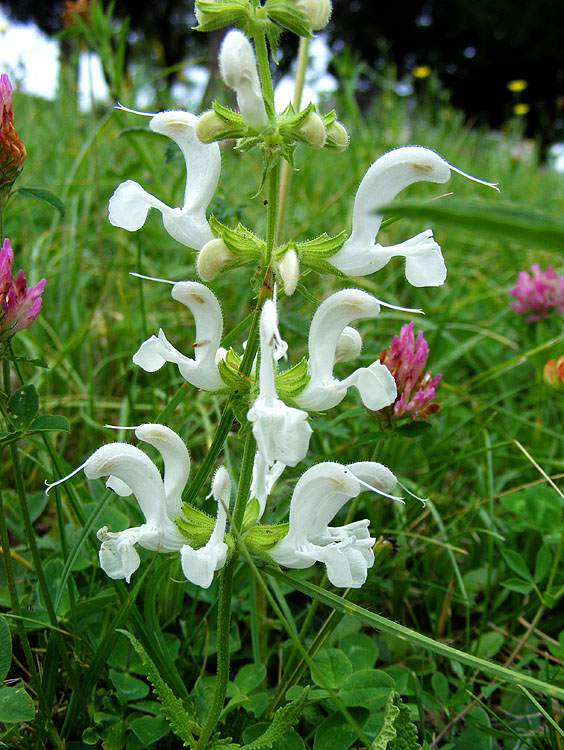
A rare wild white form of Meadow Clary.
An unusual white form of Meadow Clary Salvia pratensis. Indre et Loire. France. Photo by Susan Walter.

Close up of the white Meadow Clary.
Unusual white form of Meadow Clary Salvia pratensis. Indre et Loire. France. Photo by Susan Walter.

French version here: Les Fleurs sauvages du parc.

************************************************

For details of our private guided tours of chateaux, gardens, wineries, markets and more please visit the Loire Valley Time Travel website. We would be delighted to design a tour for you.

We are also on Instagram, so check us out to see a regularly updated selection of our very best photos.