Sunday, 13 December 2020

Fringe Lily

Common Fringe Lily Thysanotus tuberosus. New South Wales. Australia. Photo by Loire Valley Time Travel.

This striking plant is a Common Fringe Lily Thysanotus tuberosus, found growing in the grass in dry sclerophyll woodland and coastal heath in south-east Australia. The three petals are fringed with 'hairs'.


************************************************

For details of our private guided tours of chateaux, gardens, wineries, markets and more please visit the Loire Valley Time Travel website. We would be delighted to design a tour for you.

We are also on Instagram, so check us out to see a regularly updated selection of our very best photos. 

Saturday, 12 December 2020

The Ile d'Oleron Bridge

Ile d'Oleron bridge, Charente-Maritime, France. Photo by Loire Valley Time Travel.

At the time of its construction in 1966 the nearly three kilometre long bridge from the mainland to the Ile d'Oléron was the longest in France (it's now the third longest). Oléron sits just off the Atlantic coast of France, west of Rochefort. It is the second largest island of Metropolitan France (Corsica is the largest). Oléron is 30km long and 8km wide. The island is an extremely popular tourist destination for French people.

Ile d'Oleron bridge, Charente-Maritime, France. Photo by Loire Valley Time Travel.


************************************************

For details of our private guided tours of chateaux, gardens, wineries, markets and more please visit the Loire Valley Time Travel website. We would be delighted to design a tour for you.

We are also on Instagram, so check us out to see a regularly updated selection of our very best photos. 

Friday, 11 December 2020

Chateau des Termelles

The Chateau des Termelles at Abilly is currently owned by a British couple called Ron and Maureen Bates. They run it as holiday accommodation and an events venue [link]. Previously the chateau had been Abilly's aged care home (a new one has been built behind the chateau now).  

Chateau des Termelles, Abilly, Indre et Loire, France. Photo by Loire Valley Time Travel.

These days the chateau overlooks a park of 6 hectares. Outbuildings to the east include an orangerie with the impressive rusting metal frame of a large conservatory or greenhouse built by the Eiffel company at the back. I've seen this from the road but so far not stopped to take a photo.

The chateau was built in 1865 for Joseph Pinet, an agricultural machinery parts manufacturer. The foundry he established in the town in 1820 is still going strong and employs 27 people, making parts for tractors and trailers for 150 clients. The workers skills in metallurgy are no longer supported by the State Education system, so on the job training is really important now. The management is very conscious of the impact a foundry has on a small village, both in a positive sense as an important employer, but also the potential negatives such as pollution. The factory now recycles all its waste and reuses the sand used to make moulds. They have also installed chimney filters and caps to capture particles, and replaced the old furnaces with induction furnaces using clean energy.

Many foundries closed in the 1980s, victims of Chinese competition. The foundry at Abilly survived by diversifying into home decor, making candelabras for the North African market. They also successfully promoted their park benches and rubbish bins to municipalities. They make parts for locks and hydraulic pumps, but rarely the complete product in these sectors. And as the manager points out, there is a more or less insatiable demand for automobile parts.


************************************************

For details of our private guided tours of chateaux, gardens, wineries, markets and more please visit the Loire Valley Time Travel website. We would be delighted to design a tour for you.

We are also on Instagram, so check us out to see a regularly updated selection of our very best photos. 

Thursday, 10 December 2020

Le Cordonnerie du Chateau, Loches

The Cordonnerie du Chateau in Loches is one of those old fashioned shops that I am always very glad to find still exist. A 'cordonnerie' is a cobbler's workshop, and this one sells huntin' shootin' 'n' fishin' gear, but also repairs shoes and bags.

Rue Balzac, Loches, Indre et Loire, France. Photo by Loire Valley Time Travel.
Rue Balzac in Loches. The cordonnerie has a dark wood facade.

Inside the shop is dark and cluttered. You weave your way through racks of hunting jackets and vests to get to midway down the length of the shop where there is an enclosed booth. The cobbler is a nice man who assured me he could reglue my nearly new hiking boots which were separating at the sole, and he could put a new more robust clip on my bumbag strap to replace the one that had snapped. How much would that be? €15, come back in a week. I was very happy.

The cobbler, Claude Lefevre, has been there for 31 years. He's one of the few real shoe repair places still left. The one in Preuilly closed decades ago, the one in Descartes a few years ago. The shop is at 13 rue Balzac, Loches.

The etymology of the word 'cordonnier' is connected to 'cordwainer', the word for someone who makes new shoes, but nowadays cordonniers, like cobblers, are restricted to repairing shoes and leather goods. The words cordonnier and cordwainer also referred to those who worked in Cordovan leather [link]. 


************************************************

For details of our private guided tours of chateaux, gardens, wineries, markets and more please visit the Loire Valley Time Travel website. We would be delighted to design a tour for you.

We are also on Instagram, so check us out to see a regularly updated selection of our very best photos. 

Wednesday, 9 December 2020

Chateau de Prezault

Nothing remains of the original 17th century Chateau de Prézault at Parçay sur Vienne except a couple of towers and some buildings which are now the stables. The estate was seized and sold to the highest bidder during the Revolution. By 1829 it was in the hands of the Vautibault family, who still own it today. The current building was constructed in 1860-65 of brick and dressed stone, with a slate roof.

Chateau de Prézault, Indre et Loire, France. Photo by Loire Valley Time Travel.
 

In the basement are the kitchens, then two storeys and an attic space, connected by a wooden spiral staircase. The small structure on the roadside is a gatehouse.


Chateau de Prézault, Indre et Loire, France. Photo by Loire Valley Time Travel.

  When we passed in October the chateau was clearly undergoing some major renovations.


************************************************

For details of our private guided tours of chateaux, gardens, wineries, markets and more please visit the Loire Valley Time Travel website. We would be delighted to design a tour for you.

We are also on Instagram, so check us out to see a regularly updated selection of our very best photos. 

Tuesday, 8 December 2020

Chateau du Haut-Brizay

The Lordship of Brizay was allied to that of nearby Ile Bouchard and was in existance by at least 1050.  In 1440 Jean de Brizay was authorised by the King to fortify his holdings here, but there is no trace now of this medieval castle and we have no idea what it might have looked like.

Chateau du Haut-Brizay, Indre et Loire, France. Photo by Loire Valley Time Travel.

The southern facade of the existing chateau (the side visible in these photos) dates from the 17th century, but was somewhat remodelled in the 19th century, along with extensive remodelling of the northern facade. Pavillions and a belltower were added in 1895, running water was installed and the park redeveloped. 

The chateau forms an L-shape oriented east-west, with a small conical roofed tower sitting at the junction of the two wings on the southern facade. The main wing has seven bays and a slate roof. The tower is a vestige of an older building.

Chateau du Haut-Brizay, Indre et Loire, France. Photo by Loire Valley Time Travel.

Mining engineer turned agricultural reformer Alfred Goussard de Mayolles turned the estate into an experimental farm in 1865, where he conducted trials of fertilizers. He did not own the property but had a verbal agreement with the widow of the previous owner to develop the property agriculturally, as it had been left fallow for twenty years. His first job was to restore the outbuildings so that he could stock the land with sufficient beasts. He also took the opportunity to create a laboratory in one of the buildings, and started experimenting with the use of chemicals in fruit production. The farm was taken over by the Prussians in 1870 when they invaded and they inadvertently introduced tuberculosis into his herd, resulting in the loss of many animals. After the Prussians had been defeated he began working with horsedrawn mechanical harvesters, rakes and threshers, publishing a number of articles about them, pointing out that less skilled human labour was required. To interest others in these new machines he organised international competitions for harvesters and threshers, held at Chinon in 1873 and Mettray in 1874. Experimental work continued and he started using steam powered machines. Because of the continuing tuberculosis problem he gave up on dairy cattle and concentrated on pigs, goats and sheep. The farm became renowned locally for the quality of its seed wheat, attributed largely to his innovative farming methods.

He purchased extra nearby land, reputed to be infertile, in order to continue his experiments, and began by growing stock feed and bedding. He wanted to introduce the Parthenaise breed of dairy cattle and selectively breed them to develop a beef herd. Initially he concentrated on veal, but the aim was to increase the size of the animals and provide a herd to restock his property. Next, he interested himself in  certain strains of Siberian oats and wheat, resulting in crops which grew remarkably well. Upon the death of the Chateau du Haut-Brizay's owner, Goussard de Mayolles moved on, to manage a business exporting frozen British beef.

His wife, Jeanne Le Clerc, was born and raised in Tours, the daughter of a botanist and medical doctor who taught at the School of Medicine in Tours and became Head Doctor at Tours General Hospital. Her husband worked primarily as a mining engineer prospecting for minerals in Colorado and New Mexico and Jeanne accompanied him on his travels. Later she wrote a book about her experiences called Une Française chez les sauvages. She wasn't overly impressed by many of the things she saw but she provides an interesting contemporary account of Navajo Native American culture. The 'savages' she refers to are not the Native Americans though, they are the white colonialists of the south-west of the United States. Amongst her adventures, she was wounded by a bison, and engaged in a skirmish with Native Americans that involved her firing a gun.

Jeanne's father had been raised by Doctor Pierre Bretonneau (who along with colleagues Doctors Trousseau and Velpeau is a household name in these parts). Her father, who was mostly absent as far as Jeanne was concerned, had himself travelled widely in the south-west of the United States. Eventually he caught Yellow Fever and died in Texas. Bretonneau refers to him in several letters to friends as 'my Texan'. Le Clerc wrote a book about the Texan Revolution of 1835-36, which was translated into English and well regarded.


************************************************

For details of our private guided tours of chateaux, gardens, wineries, markets and more please visit the Loire Valley Time Travel website. We would be delighted to design a tour for you.

We are also on Instagram, so check us out to see a regularly updated selection of our very best photos. 

Monday, 7 December 2020

Les Fours Banaux

Bread has been a staple in France for centuries, and central France is the biggest producer of wheat in Western Europe.
 
Street sign, Indre et Loire, France. Photo by Loire Valley Time Travel.
Street sign.

If you lived in or near a village in feudal times then you were obliged to use the four banal, the communal oven, which was owned by the local lord, who charged a fee for access to the oven. The lord was responsible for the maintenance of the oven, and he had to make sure that bread was baked perfectly, otherwise he was fined. But on top of taking one sixteenth of his peasants’ grain production as a general tax, he took another one sixeenth as a fee for the use of the four banal. In addition, the lord would have owned the mill where everyone had to get their wheat ground into flour. Those who lived close to the oven were disturbed by the endless comings and goings as well as the noise and heat of the oven or ovens. Those who lived further away were annoyed that they could make the most perfect dough, but by the time they had brought it to the oven in summer it had over proved and by the time it arrived to be baked in inter it was too cold. The baker put in charge of the communal oven had to be available day and night in case someone turned up to bake their bread.

Four banal under the chateau, Le Grand Pressigny, Indre et Loire, France. Photo by Loire Valley Time Travel.
Four banal below the chateau in Le Grand Pressigny.

The first four banal appeared in the Middle Ages in Paris near the Tour Saint Jacques [link], and they quickly spread throughout France, in populous communities becoming huge complexes with enormous and multiple ovens. These fours banaux are similar to the smaller private ones in construction and use in the 19th century. Not just bread could be cooked in these ovens, but gratinée style side dishes of vegetables would commonly be placed in the oven to brown and cook in the cooling bread oven after the loaves had been extracted. If you ever see a dish on a modern menu that is something a la boulangere, it will be one of these homely comforting old meals. Old favourite traditional desserts such as clafoutis were also cooked this way.

Four banal (communal oven) in a village in Indre et Loire, France. Photo by Loire Valley Time Travel.
The oven and wood store in the four banal in Le Grand Pressigny.

After feudalism ended in France commercial bakeries started springing up everywhere and the boulangerie, named after the traditional round boule loaf, was born. At first they had big brick ovens and baked all the same breads that everyone had always baked at the fours banaux. They would also take housewives’ gratin dishes and cook them at the end of the baking day, for a small fee, as at this time many village houses did not have ovens at all and were cooking on stoves. 
 
 ************************************************

For details of our private guided tours of chateaux, gardens, wineries, markets and more please visit the Loire Valley Time Travel website. We would be delighted to design a tour for you.

We are also on Instagram, so check us out to see a regularly updated selection of our very best photos. 

Sunday, 6 December 2020

Saw Banksia


Coastal heath with Saw Banksia Banksia serrata, Iluka, New South Wales, Australia. Photo by Loire Valley Time Travel.
Coastal heath with Saw Banksia.

Saw Banksia Banksia serrata is a low growing tree, often contorted and rugged looking. It grows at the coast in the east of Australia, where it can be exposed to some violent weather charging in from the Pacific Ocean. Its thick knobbly bark is fire resistant and underground it has a deep specialised root called a lignotuber, which allows it to access water and regenerate after fires. The cream flowers are large and attractive, the leaves are serrated.

Saw Banksia Banksia serrata, New South Wales, Australia. Photo by Loire Valley Time Travel.


Saw Banksia prefers deep fairly fertile sandy soil and will resist frost, salt and drought as well as fire. It is a long lived tree and often cultivated in Australian gardens as well as occuring naturally on the coastal heath, where these ones were photographed.

Saw Banksia Banksia serrata, New South Wales, Australia. Photo by Loire Valley Time Travel.


It is one of the plants collected by Joseph Banks when the Endeavour landed in Botany Bay in 1770 under Captain Cook. Carl Linnaeus the Younger later took care of the species description and named the genus after Banks.

New growth on Saw Banksia Banksia serrata, New South Wales, Australia. Photo by Loire Valley Time Travel.
New growth.


************************************************

For details of our private guided tours of chateaux, gardens, wineries, markets and more please visit the Loire Valley Time Travel website. We would be delighted to design a tour for you.

We are also on Instagram, so check us out to see a regularly updated selection of our very best photos. 

Saturday, 5 December 2020

Sweat Bee

Globally, with 1700 species, there are more species of sweat bees Lasioglossum sp than in any other bee genus. They are mainly solitary bees, although many species gather together in colonies and nest close to one another. This one that I photographed in a garden in Charente-Maritime in June is a fairly typical looking example of the genus, but they can vary considerably in appearance, just as they do in behaviour.

Lasioglossum sp, Charente-Maritime, France. Photo by Loire Valley Time Travel.

They are valuable pollinators of cultivated and wild plants. This one is on fennel.


Lasioglossum sp, Charente-Maritime, France. Photo by Loire Valley Time Travel.


************************************************

For details of our private guided tours of chateaux, gardens, wineries, markets and more please visit the Loire Valley Time Travel website. We would be delighted to design a tour for you.

We are also on Instagram, so check us out to see a regularly updated selection of our very best photos. 

Friday, 4 December 2020

Les Roches Tranchelion

Up on a hill near the village of Avons les Rochers sit the ruins of Les Roches Tranchelion -- an imposing church and a medieval castle. The church dates from the 1520s and was consecrated as a funerary chapel and parish church, replacing the castle's private chapel. Despite its ruinous state it retains some very fine carvings and the vaulting is more than 12 metres above the ground. The castle is older, 15th century, and all that remain are the lower parts of a square tower and the southern wall, equipped with murder holes and a network of underground casemates, all of which is being taken over by vegetation.

Seraphims on the entrance to the ruined church at Les Roches Tranchelions, Indre et Loire, France. Photo by Loire Valley Time Travel.
Seraphim surmounted by scallop shells on the entrance to the ruined church.

It was in this castle that Charles VII gathered his Great Council in the summer of 1449 before heading out on the last campaign to kick the English out of France and end the Hundred Years War.

The ruined castle of Les Roches Tranchelion, Indre et Loire, France. Photo by Loire Valley Time Travel.
The ruined castle.

At one time it was the property of the Montgomery family. In 1559 the castle became a temporary refuge for Gabriel de Lorges, Count of Montgomery, Captain of the Scots Guard (the King's bodyguards) after he had inadvertently mortally wounded King Henri II in a joust at the end of June of that year. He spent the July here then fled to England in August.

A high-relief sculpture depicting God the Father, Les Roches Tranchelion, Indre et Loire, France. Photo by Loire Valley Time Travel.
A high-relief sculpture of God the Father, delivering a benediction with his right hand and holding a globe in his left.

Even though it is so damaged, the highly carved western end of the church remains one of the best examples of 16th century religious art in the Touraine, along with the church at Montrésor, the chapel at the Chateau of Ussé, and the chapel at Champigny sur Veude. The church itself is a double aisled nave, with a vaulted transept, vaulted crypt under the choir and semi-octagonal apse. It was more or less abandoned in 1600, only being used sporadically until the Revolution, when it was totally abandoned.

Les Roches Tranchelion, Indre et Loire, France. Photo by Loire Valley Time Travel.
Les Roches Tranchelion.

A number of legends are associated with the site, and amazingly, the one about buried treasure turned out to be true. One day in 1966 some young men were working on improving the access to the chapel and they saw right in front of them a large hole opening up. Six or seven metres down they found 214 French and Spanish coins dating from between 1563 and 1618.

Les Roches Tranchelion, Indre et Loire, France. Photo by Loire Valley Time Travel.
Les Roches Tranchelion.

The castle was already destroyed by the 17th century, but the church survived until after the Revolution, when it became the victim of ignorance and vandalism.

Western front of the ruined church at Les Roches Tranchelion, Indre et Loire, France. Photo by Loire Valley Time Travel.
The western front of the church.

Graffiti inside the ruined church of Les Roches Tranchelion, Indre et Loire, France. Photo by Loire Valley Time Travel.
The inside of the church is covered in graffiti from several centuries.

Ruined church of Les Roches Tranchelion, Indre et Loire, France. Photo by Loire Valley Time Travel.
Looking up at the ruined church.

Decorative medallions on the western front of the ruined church of Les Roches Tranchelion.  Photo by Loire Valley Time Travel.
Decorative medallions on the western front of the church, depicting, by the look of it, acanthus foliage, a mercenary soldier and a Greek scolar.

Vaulted transept in the ruined church of Les Roches Tranchelion. Photo by Loire Valley Time Travel.
Vaulting in the transept of the church.


************************************************

For details of our private guided tours of chateaux, gardens, wineries, markets and more please visit the Loire Valley Time Travel website. We would be delighted to design a tour for you.

We are also on Instagram, so check us out to see a regularly updated selection of our very best photos. 

Thursday, 3 December 2020

Crissay sur Manse

Until recently we had never been to Crissay sur Manse. I don't know why. It's only an hour away from home and it's one of the officially 'most beautiful villages in France'. It is also somewhere I was recommended to visit soon after we bought our house in Preuilly. At the time I bought new hiking boots at a sports shop near Tower Hill underground station in London, which was convenient to my workplace. The sales assistant was French, so we got chatting. He said I must visit Crissay, and his winemaking mate there. Well finally, on the most beautiful day in October we made it to Crissay, but not to the winemaker, who would have been closed anyway (and to be honest, I've forgotten his name now, after 14 years).

The Chateau of Crissay sur Manse, Indre et Loire, France. Photo by Loire Valley Time Travel.
The chateau.

Crissay was an absolute delight, and we were by no means the only people there. Everyone was so happy to be out and about between lockdowns, and even though the restaurant was closed, the village is so picturesque we were all just enjoying a Sunday afternoon stroll in the sun.

Cycle/walking/horseriding path through the old fortified gate, Crissay sur Manse, Indre et Loire, France. Photo by Loire ValleyTime Travel.
The official hiking/cycling/horseriding trail goes up the stairs and through the doorway in the village's defensive perimeter wall.

The chateau here was an important stronghold during the Hundred Years Wars, during which it was partially destroyed. There had been a keep here, with underground galleries, since the 13th century. Later, in the 15th century it was rebuilt. A deceptively massive structure, depending on which direction you are looking from, it dominates the valley of the Manse, but not the village.

Entering Crissay sur Manse, from Sainte Catherine de Fierbois, Indre et Loire, France. Photo by Loire Valley Time Travel.
Entering the village from the direction of Sainte Catherine de Fierbois.

There is a remarkable collection of wonderful 15th and 16th century private houses in the village, testimony to the village's grand past. The narrow streets make taking photos quite difficult, and I feel like none of our dozens of photos really do the place justice. Even though clearly popular with flaneurs it was not crowded. It's the sort of place that locals will visit for a day out, like the other 'most beautiful villages' in our area, such as Angles sur l'Anglin, Montrésor and Candes Saint Martin. But these villages are rarely over run by hordes of tourists from further afield.

Logis de la Poterne, Crissay sur Manse, Indre et Loire, France. Photo by Loire Valley Time Travel.
The Logis de la Poterne, once the gatehouse to the chateau, now a private residence. When we passed the owner was proudly giving some friends a tour.

There are very few modern structures in Crissay sur Manse, which gives it immense charm and authenticity. The lovely white tuffeau limestone houses feature carved stone mullioned windows, slate roofs and dormers.

Gun port above the letterbox at the chateau, Crissay sur Manse, Indre et Loire, France. Photo by Loire Valley Time Travel.
Should a gun port above the letterbox be standard everywhere? This is of course at the chateau gate.

Tribute to Samuel Paty on the former school, Crissay sur Manse, Indre et Loire, France. Photo by Loire Valley Time Travel.
Our visit was just a few days after the assassination of teacher Samuel Paty, and the former school, now a private home, had this tribute to his memory hanging from a window.

Houses on the square, Crissay sur Manse, Indre et Loire, France. Photo by Loire Valley Time Travel.

The main street in Crissay sur Manse, Indre et Loire, France. Photo by Loire Valley Time Travel.
The main street. The square staircase tower in the middle belongs to a house from 1523 called the Maison Gaby.


************************************************

For details of our private guided tours of chateaux, gardens, wineries, markets and more please visit the Loire Valley Time Travel website. We would be delighted to design a tour for you.

We are also on Instagram, so check us out to see a regularly updated selection of our very best photos. 

Wednesday, 2 December 2020

Chateau de Montgoger

There has probably been a chateau at Montgoger, near Saint Epain, since about 1150, originally a fortress with a keep. Towards the end of the 15th century a U-shaped building around a courtyard was constructed, with round towers at each corner, one of which contained a chapel. The lateral wings of this chateau were demolished during the Revolution, and the towers reduced.

Chateau de Montgoger, Indre et Loire, France. Photo by Loire Valley Time Travel.

Restorations and improvements were made during the second half of the 19th century but in March 1883 fire ripped through the building, destroying three-quarters of the structure. The remaining part was also destroyed by fire during the German occupation in 1943. 

Gatehouse, Chateau de Montgoger, Indre et Loire, France. Photo by Loire Valley Time Travel.
Gatehouse.

The chateau proper being uninhabitable, the 18th century Orangerie was extended and turned into residental accommodation. You can rent virtually the whole place, which can sleep 30 people and seat 100 people for a reception [link]. There is a 7 hectare park, with lots of centenarian trees and access to the extensive Forest of Montgoger [link]. The 17th century stables also survive, and a restored postern gate to the north. This small tower must have been part of a Renaissance gatehouse and been paired with a second tower with the main entrance to the chateau complex between them. The tower is two storey with decorative machiolations and a staircase turret.

Chateau de Montgoger, Indre et Loire, France. Photo by Loire Valley Time Travel.
The burnt out ruins of the remaining Renaissance wing.

Louis XIII considered Montgoger one of the most beautiful chateaux in his realm. It faces the road between Saint Epain and Crissay sur Manse. It's on the route most likely taken by Joan of Arc when she travelled from Sainte Catherine de Fierbois and Chinon.


************************************************

For details of our private guided tours of chateaux, gardens, wineries, markets and more please visit the Loire Valley Time Travel website. We would be delighted to design a tour for you.

We are also on Instagram, so check us out to see a regularly updated selection of our very best photos. 

Tuesday, 1 December 2020

Joan of Arc and the Church at Sainte Catherine de Fierbois

The church in Sainte Catherine de Fierbois is a 15th century replacement for the original early medieval chapel which burnt down. According to legend Charles Martel left his sword behind the altar as a devotional gift after he defeated the Sarrasins in the Battle of Poitiers in the 8th century. This story is unlikely to be true, because although Saint Catherine of Alexandria is the patron saint of soldiers, she was not a recognised saint in France until after the Crusades, long after Charles Martel's time. Saint Catherine de Fierbois is several days journey away from Poitiers too, which makes it seem an even more unlikely story. Be that as it may, seven centuries later, Joan of Arc's voices, one of whom was Saint Catherine, told her to come and fetch the sword. Charles VII had arranged a suit of armour for her, but she refused his offer of a sword because she knew she would be shortly in possession of Charles Martel's rusty but legendary old sword. Joan had in fact been to the church before, and attended mass there when she was travelling to Chinon to see the young King. Some people find this significant...

Ceiling boss in the church, Sainte Catherine de Fierbois, Indre et Loire, France. Photo by Loire Valley Time Travel.
Ceiling boss in the church, with what I think are Anne of Brittany's arms.

Whilst waiting in Tours for her armour to be made, she sent one of the armourers to Sainte Catherine de Fierbois. Her voices told her the sword was buried but would be recognisable by five crosses on the hilt. She told how the man she sent to dig behind the altar refused to hand over the sword and she had to write to the ecclesiastical authorities to get it sent to her. The priests gave her a red velvet scabbard, the citizens of Tours gave her one made of cloth of gold, and she herself had a robust leather one made. The priests had cleaned the sword and found that the rust fell away with just a light brushing.


Church, Sainte Catherine de Fierbois, Indre et Loire, France. Photo by Loire Valley Time Travel.
The front of the church.

The chapel that Joan knew, which in reality was probably built in 1280 for pilgrims, was burnt down by the English in 1440 and was replaced with the current church in 1450. Charles VII had always intended to agrandise the chapel after Joan's death and plans and funds existed from 1431, but the building wasn't completed until his grandson's generation. For much of its life the association with Joan was played down, but interest grew in the mid-19th century, and became quite a strong movement after the Prussian War of 1870-71.


Internal door in the church, Sainte Catherine de Fierbois, Indre et Loire, France. Photo by Loire Valley Time Travel.
An internal door in the church.


Saint Catherine was a popular saint, especially in the 16th century, and the church is on the pilgrim route to Saint Iago de Compostella in Spain, so the church has always received pilgrims, but not necessarily connected to Joan.
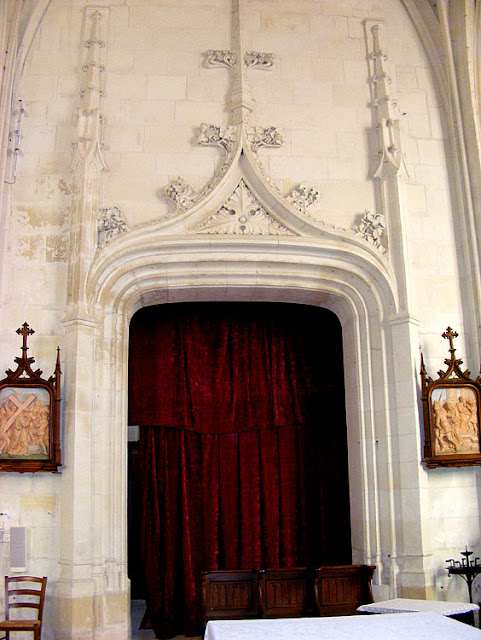
Internal doorway in the church, Sainte Catherine de Fierbois, Indre et Loire, France. Photo by Loire Valley Time Travel.
Internal doorway in the church.


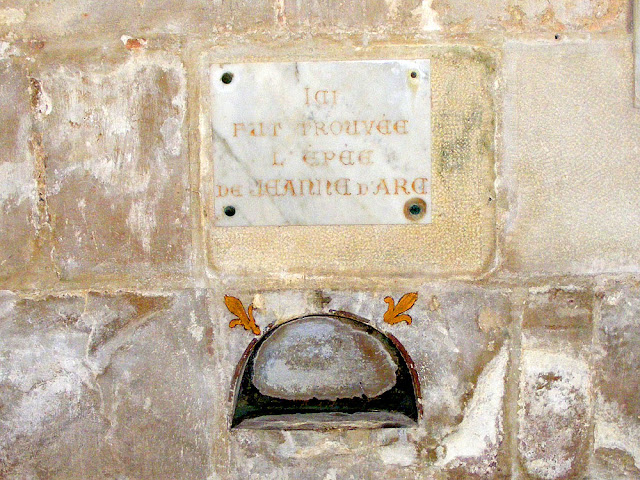
The church was restored in 1859, under the careful eye of the Amboise based architect Sylvain-Philippe Chateigner. It is pure Flamboyant Gothique in style, built in the form of a Latin cross, on the footprint of the former chapel. The place where Joan found the sword is indicated midway down the south wall. Stretching above it all is a 41 metre high bell tower.

View down the aisle of the church, Sainte Catherine de Fierbois, Indre et Loire, France. Photo by Loire Valley Time Travel.
View down the aisle of the church.


Each side of the transept forms a chapel. On one side it is dedicated to Saint Catherine of Alexandria, with a 15th century altar that was retrieved in the 19th century from a nearby mill, after it had been sold during the Revolution. There is also a magnificent 19th century Gothic Revival confessional made by a local cabinetmaker, who also made the main altar. The church has about a dozen 19th century stained glass windows made by the Lobin workshop in Tours. The originals were destroyed in the Revolution. The other chapel is dedicated to the Madonna.

Church in Sainte Catherine de Fierbois, with statue of Joan of Arc. Indre et Loire, France. Photo by Loire Valley Time Travel.
19th century bronze statue of Joan of Arc in front of the church.


Joan's sword mysteriously disappeared before she was captured and she appears unable to explain why she was armed with another completely different sword when she was captured. It was not the sword she offered up at Saint Denis, which she said was another one again. She said she lost the sword from Sainte Catherine de Fierbois.
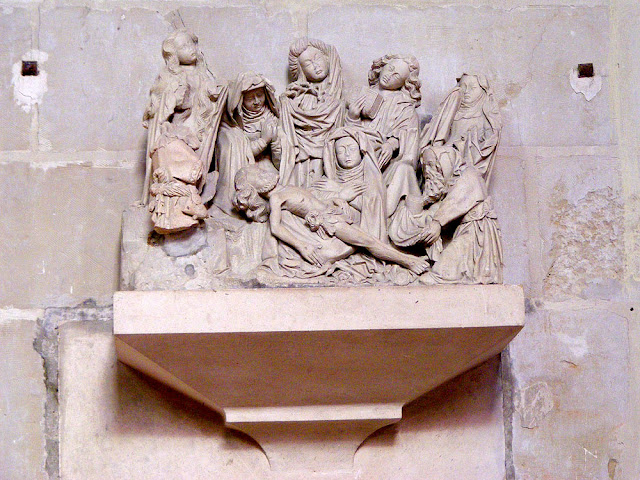
15C sculpture of Christ being interred by followers, in the church of Sainte Catherine de Fierbois. Indre et Loire, France. Photo by Loire Valley Time Travel.
A wonderful small 15th century sculpture depicting Christ being interred by his closest followers.


In a niche to the right of the main altar are some reliquaries, including a handsome silver one with some gilding, containing one of Saint Catherine's finger bones. On a small wall plinth is a sculpture depicting the dead Christ being laid to rest by his closest followers. Both were commissioned by the Maréchal de France, Jean Boucicaut, in the early 15th century, originally for the chapel in the pilgrim hostelry he had built across the road. There is no indication of where these pieces were made.

15C reliquary containing a finger bone of Saint Catherine of Alexandria. Indre et Loire, France. Photo by Loire Valley Time Travel.
Reliquaries in the church.


In front of the church is a bronze statue of Joan, put there in 1895.
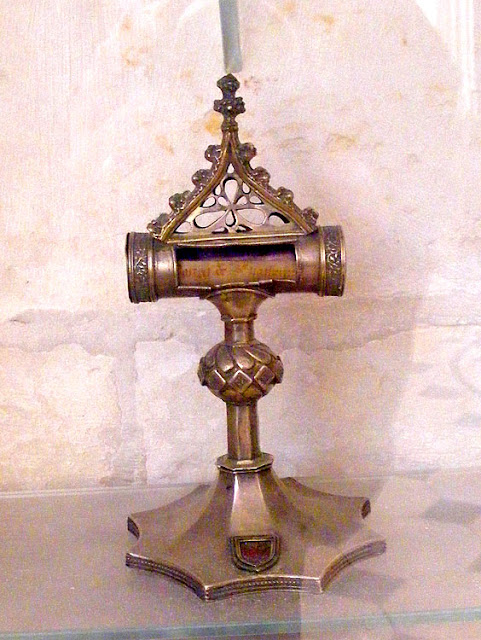
15C reliquary containing a finger bone of Saint Catherine of Alexandria. Indre et Loire, France. Photo by Loire Valley Time Travel.
15th century silver reliquary containing a finger bone of Saint Catherine of Alexandria.

Banner and replica sword of Joan of Arc in the church of Sainte Catherine de Fierbois. Indre et Loire, France. Photo by Loire Valley Time Travel.
Banner and replica sword for Joan of Arc.

Place where Joan of Arc found her sword. Indre et Loire, France. Photo by Loire Valley Time Travel.
The place where Joan's sword was found.


************************************************

For details of our private guided tours of chateaux, gardens, wineries, markets and more please visit the Loire Valley Time Travel website. We would be delighted to design a tour for you.

We are also on Instagram, so check us out to see a regularly updated selection of our very best photos.