Sunday, 18 March 2018

Tiananmen

Yup - we went there too. The Gate of Heavenly Peace was one of the places we visited on our 12hour layover in China in November. It's a big thing, being 66 metres (217 ft) long, 37 metres (121 ft) wide and 32 metres (105 ft) high, and serving as the gateway to the Imperial City, which itself contains the Forbidden City. These days it tends to be used a a saluting podium for offical events - you can see the enormous ranges of seating for the generals either side of the actual gate.

Tiananmen at night (with added tourists)

Of course, Tianenmen is probably more famous for its square, first built in 1651 and enlarged to four times its original size in the 1950s. After another rebuild in 1976 it is now 44.05 hectares (109 acres) in area and is claimed to hold 600,000 people. It's one of the biggest monumental squares in the world, and surround by monumental buildings, including the Great Hall of the People, The Monument to the People's Heroes, the Mausoleum of Mao Zedong, and the National Musem of China.

The Monument to the People's Heroes and the Mausoleum of Mao Zedong

Because it was night, and because we're just not well connected enough to get high above the square to take an overall photo, you will just have to take our word (and everyone else's word too) about just how BIG it is. It's big! Luckily, being a winter's evening it wasn't full so we were able to appreciate the acreage (and having walked one side, the length) but although it felt kind of empty, we weren't the only people there having our photos taken.

Tianenmen Gate


(and some extra, random pics!)


Saturday, 17 March 2018

Pest Control in Namadgi NP


Invasive species are a tremendous problem in Australia. In Namadgi National Park, in the 'high country' (as the mountain terrain is known) around Canberra, non-native canines are some of the species they are trying to keep under control. This is partly to safeguard the native species that might be prey animals (I assume mostly small marsupials and ground nesting birds) but also to placate sheep farmers whose land adjoins the National Park. The National Park is seen as a reservoir of fox and wild dog populations by the local farmers.

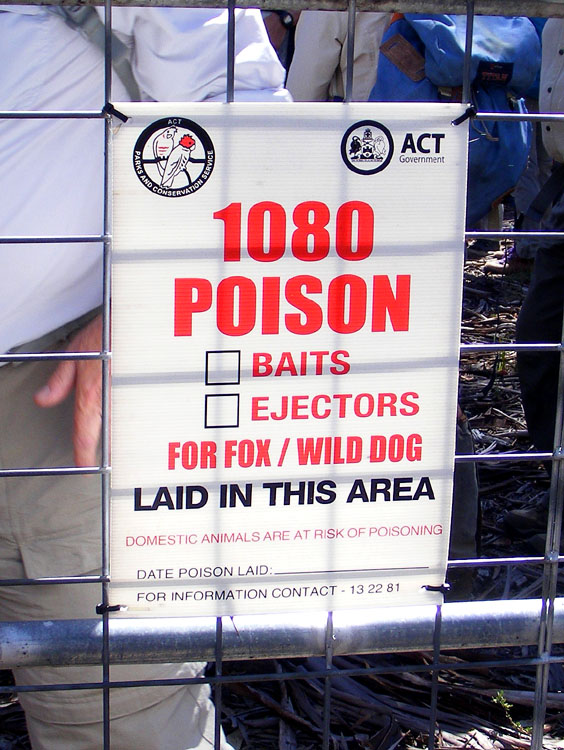
Poison notice in Namadgi National Park.

1080 is a brand name. The chemical compound is sodium fluoroacetate and its use is strictly controlled. Baits are pieces of meat that have been dosed with the poison. They are placed at carefully chosen locations along the access tracks around the edge of the park. Bait sites are chosen by first laying out fresh meat and using trail cameras to record what comes to the meat. Baited meat is then only set out at sites which were uniquely used by foxes or dogs. The meat is usually buried to a depth of 10-15cm. Canines can easily sniff this out. 

Ejectors are a type of bait set in a sort of trigger mechanism. When the animal puts its muzzle around the ejector and pulls with sufficient force the bait is ejected into the dog's mouth. This technique is used to protect other wildlife that might be attracted to meat because only canines have enough strength to trigger the ejector. This method also avoids the risk of animals caching baits that could be found later by non-target species. 

The term 'wild dogs' is a sort of catch all which includes dingoes, feral dogs and their hybrids. In other parts of the park 1080 is used to control feral pigs, using impregnated wheat, and the presence of dingoes is encouraged because they will prey on the piglets. On the edges of the park though, it is considered necessary to protect the neighbouring sheep, and the programme has been very successful at doing so.

A notice informing of biological controls for Vipers Bugloss and Nodding Thistle.

Animals are not the only invaders. There are plenty of plants too. At Brayshaw's Hut I came across a notice informing walkers that the CSIRO were using a biological control on certain plants, Vipers Bugloss Echium vulgare and Nodding Thistle Carduus nutans (aka Musk Thistle). Both these plants grow in natural abundance in the Touraine, but they are invasive aliens in the Australian bush.

Vipers Bugloss in Namadgi NP.

Vipers Bugloss is closely related to one of the most notorious and long established of Australia's invasive alien plants, Patersons Curse E. plantagineum.

I don't know what bio control the scientists are using here, but it's likely to be one of a number of species of weevil which have proved successful on Echium and Carduus species.

The CSIRO is the rather wonderful Commonwealth Scientific and Industrial Research Organisation.

Friday, 16 March 2018

Random Manly Pics

The ferry at Manly Wharf. This is the harbourside beach.
To the right of the photo is the shark-netted swimming area

The safe swimming area at sunset. At this point Susan was still swimming.

The view from JB and Rosy's apartment in Manly.
The light coloured building in the background is Manly Wharf.

The view from Manly Head on a very, very heavy day
(40C, 999% humidity - and no, I haven't missed a decimal point).
You can see the city of Sydney in the background.

In our 8 weeks in Australia over Christmas I spent more time in Manly (10 Days) than I ever remember spending there in the 30 years I lived in Australia. Most of the previous times was for a couple of hours at the beach, or parking in order to catch the ferry. Turns out that it's an interesting place, especially as soon as you get away from people (of which there are a lot!).

Thursday, 15 March 2018

Hedge Trimming and Flowering Forsythia


Alex takes on the privet.

On 9 March gardeners Alex and Nicole came over to trim the hedge at the orchard. This is a tedious job that I am quite happy to pay someone to do and an afternoon's work from them costs a couple of hundred euros. Good value in my book.

Working on the hedge.

 It took longer than it might have because they had to do it all with loppers. The hedge was woody enough due to be left for three years that they couldn't use their petrol motored hedge trimmer.

Common Glow-worm larva.

 While I was clearing Dogwood Cornus sanguinea from the fenceline and the base of the Chasselas grapes I came across a little Common Glow-worm Lampyris noctiluca larva in the leaf litter. It will have spent the winter drawn up on itself but now the weather has warmed up a bit and spring is here it will be ready to ferociously hunt down slugs and snails. They will tackle prey that is much bigger than they are and possess a toxin which they inject to paralyse their meal. So far as I can tell the orchard is just about perfect habitat for glow-worms.

A pile of 3 year old coppiced hazel, cut into firewood kindling lengths by Alex.

Two small Pine Processionary nests in the Scots Pine.

I was less than thrilled to discover two small Pine Processionary Thaumetopoea pityocampa nests in the Scots Pine Pinus sylvestris. They were too high up to lop out even with the long handled extender type loppers so I got Alex to saw off the entire branch. He was really dubious, but I think came round to it as a practical solution that doesn't in fact spoil the look of the tree. Once the branch was down on the ground I clipped off the nests and immersed them in a bucket of water (with a lid, because they float). This is a low tech, inexpensive, environmentally friendly way of dealing with an insect that is actually rather dangerous. Normally I would live and let live (eg paper wasps nesting on the veggie garden gate post). Pine Processionaries are one of the few exceptions and I was careful not to expose myself to their urticating hairs.

Forsythia.

The forsythia by the gate wasn't out when the hedge was trimmed and Nicole was careful to check with me whether she should cut it. When I said yes she suggested I gather the sprigs and take them home. They only took a couple of days to come out in a vase.

Wednesday, 14 March 2018

Hot Chocolate


From what I can gather on the travel forums online, one of the experiences visitors to France want is to have hot chocolate (chocolat chaud) in a café. The most famous is at Angelina's in Paris. They make it from scratch and although I've never had it, I've no doubt it's quite special. Nowadays, all too often, even in France, hot chocolate is just something that comes from a sachet (usually purple) and has boiling water tipped on it.

When I make it at home often I will use Poulain drinking chocolate with milk, cream and a square of dark chocolate melted into it. As a child we had Cadbury's drinking chocolate in the pantry. It was delicious, but these days drinking chocolate tends to have a minimal quantity of actual chocolate, and is padded out with artificial sweeteners and milk solids. This modern 'hot chocolate' is thin and sickly sweet.

Every now and then I like to make the real thing. Break up a block of dark chocolate and add it to a cup of milk in a saucepan with a pinch of salt, a cinnamon stick and a vanilla pod. When it is hot enough that little bubbles are appearing on the surface add 3 more cups of milk and half a cup of cream. Heat until just boiling, whisking in the chocolate. Once smooth and hot add two tablespoons of cocoa powder, whisk some more and serve. No icky squirty cream, no dusting of chocolate powder (shavings acceptable but unnecessary faff in my opinion). Likewise no sugar added. Any leftovers can be stored in the fridge and reheated as required.

Hot chocolate on the stove.

A previous post about Poulain drinking chocolate, which used to be made in Blois.

 A previous post about Choky.


Tuesday, 13 March 2018

Le Carrousel Gourmand, Chambray les Tours


Le Carrousel Gourmand is sort of two restaurants in one. On the left there is La Bricole and on the right there is Mamie Bigoude. Recently we had a big shopping day in Tours and had lunch at Mamie Bigoude, something we'd wanted to do for a while.

The set lunch menus. I had the farmers salad and mini desserts. 
Simon had the Tom Sawyer burger (pictured above) and chocolate mousse.

Mamie Bigoude is a small chain of restaurants with decor that references 1950s rock and roll and American movies. They describe themselves and their approach as simultaneously baroque and quirky. I don't know about baroque, but certainly quirky!

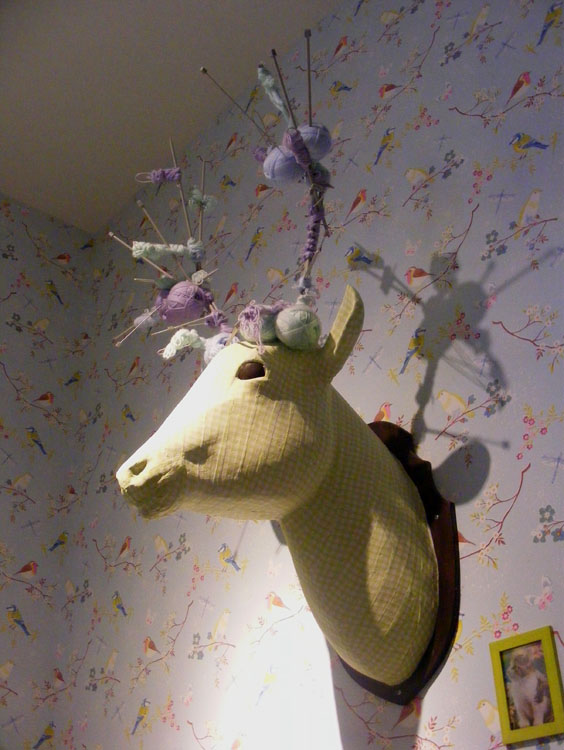
 A red deer taxidermy form wrapped in gingham and given knitting needle antlers.

Tourists often ask on travel forums for recommendations of child friendly restaurants in France. Well, Mamie Bigoude has a kids' play area, with an attendant. While we were there it was school holidays so the attendant had plenty of kids to entertain and she was doing face painting.

 Kids menus.

La Bricole, on the other side, is decorated like a hardware store. We walked through it just to see what it was like.

 The exterior.

Both sections amused us greatly and the food was good value for money. When I came to pay I commented on how extremely pink the desk was. The waitress laughed and said that when they had started painting the old oak furniture in the restaurant older clients were horrified. It just wasn't done to paint old brown furniture. Sacrilege, we joked together.

A general view. Many of the light fittings were fabulous confections of kitchenalia. 
I failed to photograph the most impressive.

Monday, 12 March 2018

The March 1 2018 Snow Event


On Thursday March 1 2018 we awoke to a couple of centimetres of snow. This appeared to catch the nation by surprise and cause a lot of media chatter, despite the fact that it had been forecast by the meteorologists.

The driveway.
 Cat footprints and another animal that puts all its feet in the same print, giving the appearance of having been a one legged creature hopping up the driveway. This was photographed at about 8am, by which time Ghislaine had already cleared the street in front of her house.

 Looking up the street.

 The courtyard.

 A mini snowman on a front window ledge.

 Dotty and her organic veg braving the snow.

Dotty was one of only two market stallholders who turned up. She commented that snow didn't put customers off nearly as much as rain does. However, the real reason I took this photo is that in the background, with the Copra van just passing, is a woman in her pyjamas and a pink dressing gown vigorously sweeping her footpath clear of snow.

The only other stall, with Dotty borrowing their scales because she forgot hers in the excitement.

 Roofs, including ours.

Sunday, 11 March 2018

Australian Sub-alpine Orchids


On a walk in the sub-alpine habitat of Namadgi National Park near Canberra in late November I saw three species of orchid, one of which was a new species for me.

Mountain Caladenia.

 One of the prettiest Australian orchids, Mountain Caladenia Caladenia alpina grows in sub-alpine Snow Gum woodland. We encountered these in a couple of spots along the walk, either single plants or in small colonies. It is endemic to the south-east of Australia.

Mountain Caladenia.

Donkey Orchids Diuris spp are endemic to Australia and the 60 species are spread across the whole of the temperate parts of the country. Their scientific name refers to the hanging sepals (the ribbon tails that peek out from behind the labellum), but their common name refers to the donkey ear like petals. They are almost all yellow with maroon splotches. Studies indicate that they don't produce a nectar reward for insects, but resemble other flowers which do, so they fool the insects into visiting.

Highland Golden Moth Orchid.

Highland Golden Moth Diuris monticola was a new species for me, and by far the most abundant orchid we saw on the day. They were growing in colonies of dozens of plants all through the damp tussock grassland valleys between the dry wooded ridges. I have dozens of photos of them too, almost none of which are any good. They are remarkably difficult to photograph. The species is native to south-eastern Australia, in upland habitats.

Tiger Orchid.

Tiger Orchid Diuris sulphurea is considerably bigger and taller than the previous species, and this one was the only one of its kind I saw on the walk. It was growing on the side of a track on a dry wooded ridge. It's quite a locally abundant orchid in eastern Australia.

Note: This blog post has been edited to reflect a correction made by Ian Fraser, a prominent Canberra naturalist, on the identity of the Caladenia.

Saturday, 10 March 2018

Trentham Trempé


While we were in Australia we stayed a couple of days with friends and fellow bloggers Sue and Leon in their new house at Trentham. Despite a once in 100 year weather event which involved it pouring with rain and blowing a gale we had a great time and really appreciated their generous hospitality.

Trentham is in the Central Highlands of Victoria. The landscape is a mix of pasture, small picturesque towns and forests of magnificent eucalypts growing alongside granite outcrops, including Hanging Rock, which is just down the road. The remains of gold mining are everywhere, and hardwood native timber is still extracted and was once one of the biggest industries in the area. I love this type of landscape.

Shops in Trentham.

The old bank is now a restaurant, with a mural on the exterior.

Breakfast of a croissant, berry jam and coffee in Chaplins at the Muse in Trentham.
 I like the idea of using a baby spinach leaf to stop the jam sliding around.


Trentham Falls.

The falls are the longest single drop in Victoria, situated in the Wombat Forest. The drop is volcanic basalt columns and the Coliban River drops 32 metres onto a bed of quartz.

Grey Kangaroos determinedly out grazing in the rain.

Early Kooka stove.

This enamelled cast iron gas stove was on display in one of the antique / bricabrac stores in town. It is an Early Kooka made by Metters in the 1930s. Stoves like this were greeted with relief in towns that were big enough to have gasworks. They were easier to clean than the previous generation of exposed cast iron wood burning stoves, and gas heated up the house less than a wood fire.
 

Friday, 9 March 2018

Walked off my Feet


A couple of months ago I noticed that because of a peculiarity of the Australian Public Service pension scheme many of the people I went through college with were newly retired and looking for things to do. Erica (who is 3 years younger than me!!) found herself in that situation and joined her mother's walking club. I chirped up that when we were in Australia I'd love to join them for a walk, because sure I could keep up with a pack of 80 year olds for 11 km...

This is the countryside we were lined up to walk

When we arrived in Australia an email from the walking club was waiting for us saying that the walk for the Wednesday we were there was 18km, but "the walk is longish but gentle, with only minor elevation changes." The forecast was for 22C, and the advice was to carry at least 2 litres of water, morning tea, lunch, and warm clothing in case the weather changed. I also had a camera and spare batteries in my backpack.

Waterholes Hut

and its stockyard

It was an excellent walk in sub-alpine country I sort of knew from driving through, but had never properly walked. We had morning tea at a ruined stockman's shelter (Waterholes Hut), and then walked to an abandoned (and now non-existant) farm, Lone Pine Hut for lunch. By then the weather was pretty hot, my feet were sore, and the call to get up and walk back to the starting point was far too early for some.

A very welcome morning tea, and I sample some of Erica's caramel slice

Needless to say... The walk ended up as 22km, the temperature was well over the mid 20's, and there was a total of 1,100metres of altitude change. For for one European who had arrived in the Australian summer from winter only a week previously, 2 litres of water was not enough. I was concentrating on "one foot in front of the other" when I totally blew up, and needed a 30 minute sit down and a handfull of electrolyte tablets about 1km from the end. I have never totally stopped like that before and it was a bit scary - my brain was saying "just walk" but the message was getting lost between there and my legs.

All that is left of Lone Pine Hut

I managed to make the next 500 metres with help from Susan (and one of the the group carrying my backpack) and by that time the rest of the group had reached their cars. Of course, being Australians they were all in four wheel drives, so someone came back to meet us and picked me up.

It was steeper than it looks in the photo - there were many of these short, sharp climbs

Apart from that it was a great day. I saw some country I hadn't really seen before, and caught up with an old friend and learnt some gossip I wish I had known 35 years ago. Human frailty aside, what more could you want?