Breeding activity is in full swing at the largest colony of House Martins (Fr. Hirondelles des fenetres) in Indre et Loire, which is on the Chateau of Chenonceau. There are nests all along the eastern facade of the chateau, and all round the Marques Tower. The action is constant, with birds wheeling about, feeding young in their mud nests and twittering endlessly to one another. The river and woodlands of the estate give them everything they need to thrive, and the sympathetic management of the historic building, which takes them into account, is a significant element of their success.
Wednesday, 7 June 2023
Tuesday, 6 June 2023
Walking From Paulmy
On Thursday 25 May I joined Joel, Denise and Jean-Jacques for a 9 kilometre walk from Paulmy, across the Eperon de Murat and back.
Californian poppies in the street.
The cemetery in Paulmy is proudly pesticide free and pro nature. To achieve this the municipality has mown lawn paths and sown grass between the graves. The perimeter walls have flower beds running all around them. Families maintaining graves are told they can only use savon noir (aka Moroccan black soap, made from olive oil and macerated olives), dishwashing detergent and lots of elbow grease (Fr. huile de coude). Bleach, white vinegar, weedkillers and power washers are banned.
Irises on a garden wall in a hamlet.
![]() |
Monday, 5 June 2023
Peak Poppy
It looks like we are at Peak Poppy at the moment. I photographed these near Bléré on Thursday 1 June. These are wild Field Poppies Papaver rhoeas (Fr. Coquelicot) in a crop of flax. Poppies like these are not the species that provides the poppy seeds for your bread roll, nor are they the source of opium. They are the poppies that appeared in droves on the battlefields of Flanders.
Friday, 2 June 2023
A Café Suggestion
A couple of months ago we were in Amsterdam to visit the Vermeer exhibition. We haven't blogged extensively about it because as soon as we arrived home we were knee deep in renovations and a bit busy.
However, this is one I feel we must pass on:
Before we went in to the exhibition we knew we would be in need of a decent morning tea to tide us over - through the biggest collection of Vermeers ever gathered, and on to a late lunch.
As usual I had done my research and decided on Cobra Cafe, which is in a large tent on Museumplein near the museum entrance. Their specialty is apple pie, so that's what we had.
Someone looks pleased with their life choices
Thursday, 1 June 2023
Sulphur Clover
Sulphur Clover Trifolium ochroleucon (Fr. Trèfle jaunâtre) is a plant with pale yellow flowers in the clover and pea family. If you are in lowland France, as we are, it is unmistakable, but if you are in the mountains it could be confused with T. montanum.
Quite common in southern Europe, but uncommon in the north, including here in the Touraine Loire Valley, it grows up to an altitude of 2000 metres above sea level. It favours poor calcareous clay soils, in full sun. You will mostly encounter it in meadows, and on the side of roads or tracks. In Indre et Loire it is a determinant species for declaring a Zone Naturelle d'Interet Ecologique, Faunistique et Floristique (ZNIEFF).
It is pollinated by insects and the seeds dispersed by grazing animals.
Wednesday, 31 May 2023
Tuesday, 30 May 2023
Three Beautiful Blue Spring Wild Flowers In the Touraine Loire Valley
These lovely and uncommon wild flowers were all photographed on the Eperon du Murat nature reserve near Ferriere-Larcon on 13 May 2023.
![]() |
| Upright Bugle Ajuga genevensis (Fr. Bugle de Geneve). |
Upright Bugle is probably often mistaken for Bugle A. reptans as it resembles it closely, they hybridise readily and A. reptans is much more abundant and well known. If you see a bugle in an open sunny grassy environment with a brighter lighter blue flower that is your clue that you might have Upright Bugle. Check the stems, which like all plants in the mint family, are square in section. If they are hairy on all four sides then you have Upright Bugle. The species likes dry sunny sites with poor calcareous or neutral soil. The flowers produce lots of nectar and are very attractive to Honey Bees Apis mellifera (Fr. Abeilles des ruches).
![]() | |
| Veronica orsiniana (Fr. Véronique d'Orsini). Probably. |
This speedwell is not considered threatened, but it is in decline, and uncommon enough in the Touraine that if it is present on a site it can be declared a Zone Naturel d'Interet Ecologique, Faunistique et Floristique (ZNIEFF). Native to southern Europe, it likes hot dry short grassland and woodland edges on poor calcareous soil.
![]() |
![]() |
| Basil Thyme Clinopodium acinos (Fr. Calament des champs). |
This is an annual or biannual, in the mint family. The leaves are hairy and the flowers are usually pink or mauve but sometimes they are more violet like the ones in the photos, and they often have a white patch on the lower lip.
The species likes uncultivated reasonably warm dry calcareous sites that are mowed annually. You can find it in short grassland, fields and fallow land.
Monday, 29 May 2023
Pruneaux de Tours
This is a repost from May last year, because very few people know about pruneaux de Tours, but may have read how Elizabeth David came to Tours especially to eat the traditional local pork and prunes dish and wondered why Tours should have been so famous for such a dish.
************************************************
Before there were pruneaux d'Agen there were pruneaux de Tours. Pruneaux are prunes ie dried plums. Nowadays the town of Agen in Aquitaine, south-west France, is famous for them, but up until 1970, it was the small oval yellow oven dried whole Saint Catherine plums from around Tours that were the most highly regarded product. Sometimes other small local plum varieties such as Damas de Tours or Rochecorbon (also known as Diaprée rouge) were used. Then in the spring of 1970 there was a tremendous frost which almost entirely wiped out the orchards in the Touraine and production of pruneaux de Tours ceased.
![]() |
| Sainte Catherine plums in our orchard. |
I learnt all this because my friend Christian has a plum drying oven in his troglodyte cave. It is missing the platform on which the plums would have been arranged on racks to dry, and under which a fire would have been lit. The old Tourangeau variety Sainte Catherine plums are still widely grown in domestic orchards in the Touraine. We have two in our orchard, but they are no longer a commercial variety. Supposedly Eleanor of Aquitaine brought damsons back to France from the Holy Land after the Second Crusade in 1149. Both Sainte Catherine and Agen plums were developed from these original plums. Sainte Catherine plums are found only in Touraine and Burgundy, and likewise Agen has its own variety.
Plums used to do very well in this area, but many people, like us, haven't had a decent crop for several years now due to frost and dry. In the days when there was an over supply most years, drying the plums was one of the most practical ways of preserving them. After all, there is only so much jam one can eat, and what else does one do with plums to preserve them in the days before refrigeration?
![]() |
| Interior of Christian's prune drying oven. |
Pruneaux de Tours were eaten with goats cheese (of course!), as something to nibble with an aperitif, used to make tarte aux pruneaux, or combined with pork in a traditional Tourangeau dish.
Sainte Catherine plums are ripe in August, and the production of pruneaux de Tours dates from before the 16th century, when Rabelais writes about it. In the 17th century they were all the rage in Paris, and later shipped up and down the Loire to be exported beyond France. The First World War caused a great decline in their production, due to lack of agricultural labour, the appearance on the market of Agen prunes and Californian imports, and changing agricultural practices. By 1930, the village of Huismes, near Chinon, was the last place producing genuine pruneaux de Tours.
![]() |
| Exterior of Christian's prune drying oven. |
There are some well preserved prune drying ovens at Huismes, and in the early 20th century there was 80 000 tonnes of plums harvested annually in the area around Chinon. A typical orchard was 6 or 7 hectares, with 100 plum trees producing a tonne of dried fruit per year, from 8 ovens.
To process the plums they were first laid in locally made wicker baskets. They were then heated and cooled successively five or six times, over a blackthorn or gorse fire. They were done when the prunes were covered with a fine white powder which was formed by the dessication and deposit of flavour elements in the prunes. It is this bloom, known as 'pruneau fleuri', which made the pruneaux de Tours special.
These days commercial plum orchards are rare in the Loire Valley, but you can still occasionally buy a product labelled 'pruneaux de Tours'. However, the plums have been imported from California, and the product is now specifically a prune filled with almond paste to be eaten as a rather upmarket snack.
Friday, 26 May 2023
Éolienne Bollée
Thursday, 25 May 2023
Three Beetles You Could See in the Touraine Loire Valley in Spring
These beetles all emerge once the days are warm enough and there is enough food for them. In the case of one it needs nice toxic buttercups and wood anemones to be juicy with fresh new spring shoots. In the case of another it needs lots of nutritious pollen on flowers it can burrow into. These were all photographed on the Eperon du Murat nature reserve at Ferriere-Larcon on 13 May 2023.
![]() |
| White Spotted Rose Beetle Oxythyrea funesta (Fr. Cétoine grise) on a Field Scabious Knautia arvensis (Fr. Knautie des champs). |
The White Spotted Rose Beetle is present practically all over Europe. The larvae are about 30mm long and eat decaying matter and plant roots as well as wood. They live underground until emerging as adults in the spring. When they are newly emerged they are covered with a white bloom which quickly wears off, leaving just the small spots you can see in this photo, and revealing the slightly greeny bronzey black base colour. The adults are considered a pest by gardeners and orchardists as they don't just eat pollen, but sometimes whole buds. Their favourite flowers are fruit tree blossom, roses and irises, and they are particularly attracted to pale coloured flowers. They only have one natural predator, the parasitic Hairy Scoliid Wasp Scolia hirta (Fr. Scolie hirsute), a species which is in decline, resulting in White Spotted Rose Beetles being increasingly abundant. Treating them with an insecticide is ineffective, so if they are causing unacceptable damage in your garden, the best way of dealing with them is to pick them off in the early morning, when they are too cold to evade you, and taking advantage of how visible they are on pale flowers.
![]() |
| Violet Oil Beetle Meloe violaceus (Fr. Méloé violet), female, on a buttercup Ranunculus sp (Fr. Renoncule). |
Violet Oil Beetles are parasites of bees and they have quite a complicated life cycle. Females like this one can be recognised by their hugely distended abdomens. The first stage larvae are called triangulins. They are equipped with large flat hooked feet which allow them to scale a flower stem and lie in wait for a bee to latch on to. The second stage larvae look like ground beetle larvae and they live in the bee's nest. During their next stages they look like chafer larvae. At first they eat the food supplied by the bees for their own larvae, then they are more mobile and become carnivorous. For their final two stages they bury themselves in the ground and finally transform into an adult beetle. The adults live in flower rich meadows, on forest tracks and woodland edges. They are very visible in the early spring, on the ground, when they are feeding or digging holes in which to lay their eggs. If the beetle feels in danger it will release a toxic orange liquid from its mouth. Both larvae and adults are toxic, as a result of the adults eating toxic Ranunculus spp. The species is considered to be threatened, and although not protected in France, they are monitored carefully.
![]() |
| Rustic Sailor Beetle Cantharis cf rustica (Fr. Moine) on Dogwood Cornus sanguinea (Fr. Le Cornouiller sanguin). |
The Rustic Sailor Beetle is abundant in Europe, from France to Russia, found in forest clearings, prairies and woodland edges. It is a carnivorous species, visiting flowers, especially umbellifers, to hunt other insects attracted by the flowers. The photo is probably this species, but there are other lookalikes and I can't be sure of the identity from this photo alone.
Wednesday, 24 May 2023
Book Now
This is not an exhortation to book a tour with us (although that would be nice), but a reminder that some attractions in France have timed entry.
This restricts the number of visitors each day: if there is somewhere you really must see and it's somewhere that does timed entry, book as soon as you can.
Last Friday Chenonceau was full. If you arrived hoping to get in and didn't have a ticket you were out of luck.
Tuesday, 23 May 2023
An Outing to the Touraine's Top Orchid Site
On 13 May 2023 the Association de botanique et de mycologie de Sainte Maure de Touraine had an outing to the Eperon du Murat at Ferriere-Larcon, led by orchid expert Marc Fleury. The site is a managed nature reserve in the care of the Conservatoire des Espaces Naturelles de la Val de la Loire. It consists of a limestone ridge with rough grassland grazed by sheep and dominated by juniper and downy oak on the steeper bits. Across one end of the site is a prehistoric defensive wall. The weather was distinctly iffy, and after a couple of hours on the north side of the site we got hailed on and very wet. Nothing daunts a keen naturalist though and off we went to check out the south side of the site. Seventeen species of orchid were recorded, plus three hybrids and two hypochromatic mutations.
![]() |
| Lady Orchid Orchis purpurea (Fr. Orchis pourpre). |
![]() |
| Buckthorn Rhamnus cathartica (Fr. Nerprun purgatif), an uncommon species. |
![]() |
| A hypochromatic Monkey Orchid Orchis simia (Fr. Orchis singe) with a ruby-tailed wasp Chrysidae. |
![]() |
| Marie-Claude photographing a Monkey x Man Orchid hybrid, with lots of Monkey Orchids visible in the grass. |
![]() |
| Burnt-tip Orchid Neotinea ustulata (Fr. Orchis brulé) and Monkey Orchid habitat. |
![]() |
| The very last Small Spider Orchid Ophrys araneola (Fr. Ophrys petite araignée) on the site. They have died out in the past three decades. |
![]() |
| Pyramidal Orchid Anacamptis pyramidalis (Fr. Orchis pyramidal). |
![]() |
| Wood White butterfly Leptidea sinapsis (Fr. Piéride de la moutarde). |
![]() |
| Male Adonis Blue Polyommatus bellargus (Fr. Azuré bleu céleste). |
![]() |
| Marc released this young Western Whip Snake Hierophis viridiflavus (Fr. Couleuvre verte et jaune) that he had captured in his chook shed. |
![]() |
| Since the weather was unreliable, Marc gave his introductory talk in the church. |
Monday, 22 May 2023
French Bars, Cafes and Bistrots
The numbers of cafés in France have tumbled, according to a recent study. In 20 years over a quarter of Parisian cafés have disappeared. A symbol of the French 'art of living', they have gone from 1907 in 2002, to 1410 in 2022. France wide, there were 600 000 bistrots in 1960, and 35 000 in 2016. Similar has happened to the roadside restaurants known as routiers. In 1980 there were 4500, today only 700. These types of cafés which operate as bars and bistrots are one of the most iconic aspects of French life, and if they are on the way out, then so is the morning coffee taken at the comptoir, the demi of draught beer in the late afternoon after work and the aperitif in early evening. In the old days this is where you picked up a 'casse-croute' (snack) such as a jambon beurre (ham in a buttered baguette) if you were pushed for time and needed to eat. Another popular snack was a hard boiled egg, which you took from a rack on the bar and banged against the 'zinc' to shell, until it was deemed unhygienic and the practice ceased. Children might have a boiled egg and a glass of milk with grenadine syrup, or a diabolo menthe (mint with limonade). Adults might have a vin limé (wine and limonade) in the summer, or a café-calva (coffee with calvados) in the winter. (Limonade is a still clear sweet drink and is not lemonade.)
![]() |
| Preuilly was briefly amongst those villages that had lost all its cafés and bars. This is the good old days, at l'Image, with the Chedozeau brothers behind the bar. |
And it is where innumerable conversations on innumerable topics between friends, strangers, and visitors take place. It is where French people would have had their first taste of Coca Cola, in the 1950s. And in the 1960s, televisions appeared, so clientele could watch press conferences with General de Gaulle or the horse races at Longchamp. In the mid-20th century, people would not have had a coffee machine at home and only have consumed Coca Cola at the café, not at home.
![]() |
| This bar, offering casses-croutes, is in the market hall at Saint Jean de Luz. It offers a robust ambiance not for the faint hearted tourist, but beloved by the regulars. |
The 16th arrondissement in Paris is the most affected, with the loss of 68% of its bars and cafés, followed by the 19th (60% loss) and the 8th (58% loss). Only two arrondissements have increasing numbers of bars and cafés. The 2nd has 17% more and the 3rd has 15% more, due to how popular with tourists they are. Concurrently, fast food outlets and coffee shops are multiplying, and it is this which is contributing to the demise of the bar/café. In the 8th arrondissement there is a 90% increase in the number of fast food outlets, and in the 3rd, an 86% increase. Nowadays, the clientele of cafés and bars are not so much workers, who can't afford them any more, but tourists. The bistrots have become brasseries, the cafés have turned into trendy tea rooms.
![]() |
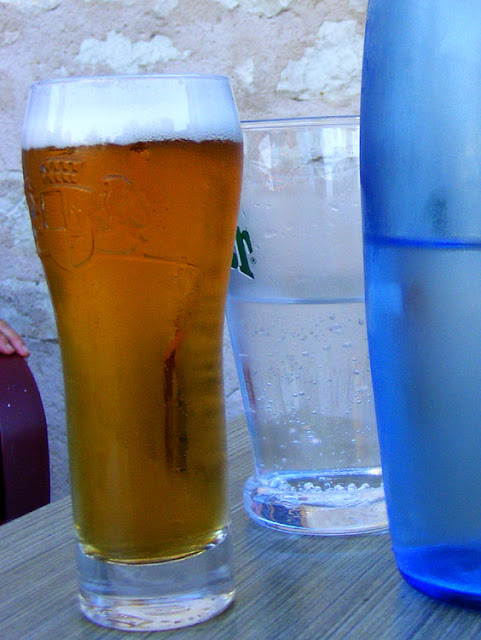
| A galopin (125 ml) of draught beer at a bar restaurant in the Touraine. |
But the rise of fast food outlets is not the only reason bars and cafés are disappearing. French workers are taking less time for lunch, not working in the centre of town, and the pandemic didn't help. Many clients have not returned to their old haunts because they now work from home. Even when bars were allowed to reopen once it was deemed safe, initially customers were not allowed to stand at the bar, and that changed consumption patterns too.
![]() |
| A typical local bar in Preuilly, now also closed. L'Esperance is, or was, opposite the Abbey, and closed in August 2022. |
Ironically, one of the great advantages of the old style bar is the speed of service. Nowadays it is more usual to seat yourself at a table, then wait for the server to come to take your order, and again for them to come with the card machine at the end of your sojourn. Not so good for anyone who just wants a quick drink and has told their wife they are just nipping out to get the daily baguette.
![]() |
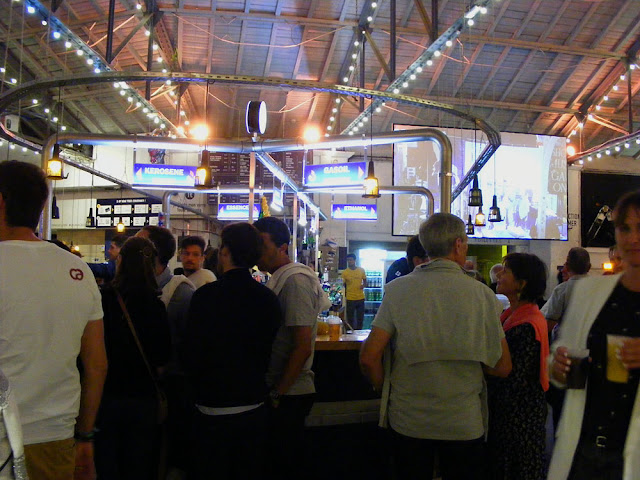
| Le Garage in Saint Jean de Luz, a modern bar which succeeds in being both community oriented and buzzy enough to entice tourists in. |
Sometimes the problem is that bars are in rented premises and the landlord decides to sell the real estate for re-development.
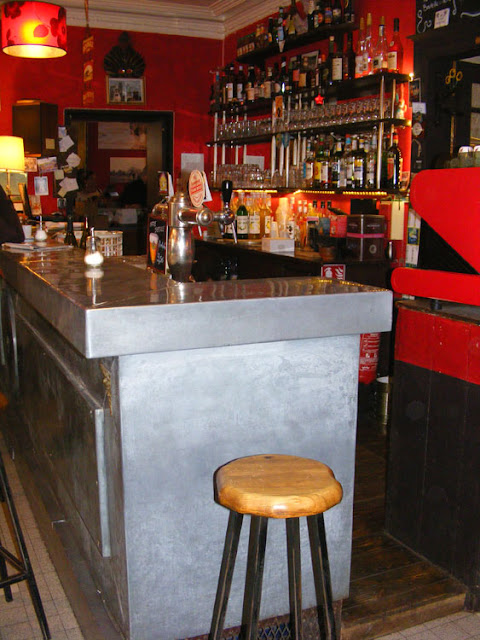
The bar counter is known as a comptoir, often referred to as le zinc. These 'zincs' appeared at the end of the 19th century. They were always set up so they were exactly the right height for a man standing at the bar to lean his elbows on, 110 mm. Even once drunk, men could retain a dignified appearance, propped up by their elbows. Typically the 'zinc' covered bar would be equipped with a beer pump and behind the bar, underneath, there would be refrigerators, with a coffee machine on the other side. Nowadays, many bars are set up in such a way that does not encourage customers to stand propping them up in the old way. Now they are expected to take a table.
![]() |
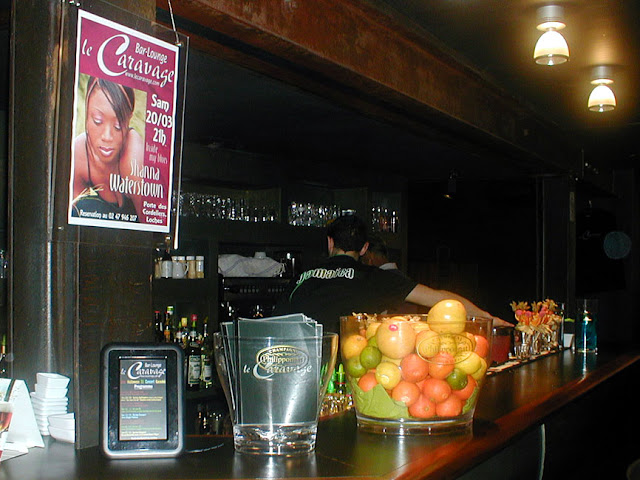
| Le Caravagge in Loches, where they do intimate jazz concerts and great mocktails. |
The 'zinc' of the bar is in fact galvinised (zinc coated) steel. Many old 'zinc' bars didn't survive the German occupation of the Second World War. They were requisitioned by the Germans to melt down for munitions. They made a bit of a comeback in the Trente Glorieuses (the 30 years post-World War Two, when France experienced economic growth) but by then formica was the fashionable work surface treatment. Nowadays the 'zinc' (or brushed stainless steel) is back in fashion and formica out, and the patina and lustre of the metal much admired for its practicality, durability and attractiveness.
![]() |
| A restored zinc bar in Berry. |
In the 1930s there was one bar/café/bistrot for every 85 people. Nowadays it is one for every 1500 people. In the inter-War years these places were where you went for life milestone celebrations (promotions, weddings, birthdays, retirements).
In the early 20th century, absinthe was cheaper than wine. The outlawing of absinthe in 1914 brought a significant reduction to the prosperity of bistrotiers (café owners), as did the outbreak of war and the mobilisation of their clientele (not to mention that so many of them never came back...). It prompted the Pernod brothers to develop the first aniseed flavoured pastis.
Some of the drinks were creatively named (or nicknamed). A 'fond de culotte' is the bitter orange aperitif Suze with cassis (blackcurrant liqueur). It's a sort of French version of Cockney rhyming slang: 'car le fond de culotte ne s'use qu'assis !' (because the seat of the trousers only wears out when sitting, and 's'use qu'assis' is pronounced the same as 'Suze cassis'). A 'soutien gorge' was milk with strawberry syrup, so named because it was the same colour as bras (Fr. soutien gorge) of the time, although sometimes this drink was called a bébé rose (pink baby). A beer is usually a chope (500 ml) or a demi (250 ml), but could be a galopin (125 ml), and can be adulterated with a syrup or cut with limonade like a shandy, in which case it's called a panaché.
Generally speaking, a bistrot is a bar which offers simple dishes, which could be served at the bar. In other words, a pub which offered counter meals.
The etymology of the word 'bistrot' is still disputed. Some people think it is a corruption of a regional word which arrived in Paris in the 19th century. It might come from a Poitevin word 'bistraud', which initially meant a domestic servant, then came to mean a wine merchant. Or it might come from the northern French word 'bistouille' which is a coffee with eau-de-vie added. Or maybe it is from 'bistingo' a slang word for cabaret.
But the popular legend of the word's origin is that it comes from the Russian occupation after the campaign of 1814. The cossacks, stationed in Paris after the fall of Napoleon, would while away their time in the cafés. Fearing discovery by their officers they would cry 'bistro! bistro!', meaning 'quick! quick' when they wanted a drink. The exoticism of the word appealed and many cafés were renamed. The problem with this explanation is that it appears that the first usage of the word only dates from 1884.
And maybe it is 'bistroquet', which is actually a portmanteau word, combining 'bistrot' and 'mastroquet' or 'troquet', a 19th century word from the Flemish for 'cabaret master' or 'bar', and first used in 1926.
Women who remember the good old days of traditional 'zincs' are not always so overcome with nostalgia. They were a haven for alcoholism, and definitely male dominated. And of course, the smoking ban has inevitably altered the atmosphere in these places, with conversations being interrupted whilst the smokers exit for a quick desperate drag (or no longer frequent their local bar at all).


