Tuesday, 20 July 2021

Medical Deserts

Rural France is struggling to ensure that everyone has access to adequate medical services. At the moment Preuilly is doing better than many communities, in that we still have a general practitioner, an ambulance service, a pharmacy and we are within half an hour of at least one hospital. But our GP is due to retire soon and there is no sign of a replacement. 

Banner welcoming a new village doctor, Vienne, France. Photo by Loire Valley Time Travel.
This municipality in the neighbouring county (Fr. département) of Vienne was clearly excited about getting a new doctor. The sign says 'he arrives in June'.

We probably won't have a new doctor set up in town. Preuilly and several adjoining villages are negotiating a solution though. Le Grand Pressigny has had a GP retire too, and so the plan is to set up a multi-discipline medical centre in Le Grand Pressigny that will serve Yzeures-sur-Creuse, Preuilly-sur-Claise and Le Grand-Pressigny. So whilst I won't have to go far to see a doctor, I will have to drive, whereas now I can walk.

Monday, 19 July 2021

Cheesy Beef Empanadas

Homemade cheesy beef empanadas. Photo by Loire Valley Time Travel.

Homemade (including the pastry) cheesy beef empanadas served with salad and fromage blanc battu (the closest thing to sour cream I've come across in France).

Sunday, 18 July 2021

Walking in the Mountains

I mentioned yesterday that we were heading up into the Pyrénées this week.

The intention is to walk in the mountains: there are plenty of trails, and infrastructure is in place so that you only need walk one way. Which is good, because last time we went walking in the mountains it was in Australia, and I "blew up". [link] The weather on the border with Spain is expected to be kinder than the weather in Australia, as well.


Saturday, 17 July 2021

Up the Mountains

This year we will be taking our holidays in the Pyrenees. These photos are from our last visit to the mountains two years ago. Then we were at the western end of the mountain range near Saint Jean de Luz. This year we will be in Cauterets, which is a lot more central, and a lot more mountainous.


I still hope to see vultures.


Friday, 16 July 2021

Lovely Flies in the Orchard

 The other day I photographed some lovely newly minted, straight out of the packet, flies in the orchard.

Male stiletto fly Thereva sp, Indre et Loire, France. Photo by Loire Valley Time Travel.
A male stiletto fly Thereva sp, all golden and fuzzy.

Male bee fly Villa hottentotta, Indre et Loire, France. Photo by Loire Valley Time Travel.
A beautiful male bee fly Villa hottentotta in perfect condition.

Male bee fly Villa hottentotta, Indre et Loire, France. Photo by Loire Valley Time Travel.
Male bee fly Villa hottentotta, so beautifully golden and furry. He can be distinguished from other lookalikes by his gold dusted patagium (the protective flap over his wing joints, which in other similar species is silver).

Tachina magnicornis, Indre et Loire, France. Photo by Loire Valley Time Travel.
The parasitic fly Tachina magnicornis, a known pollinator of Burnt-tip Orchids. It can be distinguished from its close lookalike T. fera by its black femurs and 'string of beads' or series of black lozenge shapes down the abdomen, rather than orangey femurs and a plain tapering black stripe on the abdomen. T. magnicornis is much more abundant in the Touraine Loire Valley than T. fera.

Thursday, 15 July 2021

Monitoring Swift Nests in Preuilly


Monitoring swift nests, Indre et Loire, France. Photo by Loire Valley Time Travel.
Checking the swift nests in Hotel de la Railliere in Preuilly sur Claise. There are at least half a dozen discreetly tucked away up high in this grand historic 17C building.

We don't have very many buildings in town where swifts are nesting, and sadly have lost a few in recent years when people have renovated and blocked up holes. It's really easy to renovate to accommodate existing swift nests, and it is effectively a legal requirement as you are not allowed to destroy or disturb swift nests. Sadly too few property owners, builders and architects are aware of the issues, and most swift nests are destroyed through ignorance, not malice. Swifts calling to one another as they chase each other through the sky is the sound of summer in Europe, but numbers are plummeting in many places like Preuilly, along with swallows and martins for similar reasons. If you are doing building work on your facades or roof, please consult with SOS Martinets [link]. They have plenty of easy to follow advice on how to save our swifts. 
 
Swift Apus apus in entrance to nest, Indre et Loire, France. Photo by Loire Valley Time Travel.
The rear end of a swift resting in the entrance to its nest in a house in rue des Pavillons, Preuilly sur Claise.


There are two key things to know if you are a property owner I think. One is that swifts do not make a mess -- this is in fact part of the problem, as people often do not notice they have swifts nesting in their building. The second is that swifts return to the exact same nest year after year. If the entrances are blocked up they will batter themselves repeatedly against the former nest site trying to get access. It is not a simple matter of them finding another nest site.
 
Une version française de ce message se trouve sur mon blog D'Australie à la Touraine [lien].

Wednesday, 14 July 2021

France in the Second World War – Les Chantiers de la Jeunesse

This memorial to 'Groupement 34 des Chantiers de la Jeunesse' (Group 34 of the Youth Public Works) members who died in the Second World War is fixed to a building in the market place in Mezières-en-Brenne, a small town in central France.

Memorial to the Chantiers jeunesse (youth workers) who died in the Second World War, Indre, France. Photo by Loire Valley Time Travel.

Les Chantiers de la Jeunesse Française (CJF) was a paramilitary organisation which existed between 1940 and 1944. It was intended as a means of training and moulding young French men. The armistice between France and Germany in 1940 ended compulsory French military service and the CJF was quickly set up as a sort of subsitute for those in the Zone Libre and North Africa. The young men joined initially for a voluntary 6 month stint (later for a compulsory 8 months) and lived in camps under quasi-military rules. The officers were serving military or demobilised reserves. They performed community service work, especially forestry.

It is an organisation regarded with some ambivalence. On the one hand, they espoused Revolutionary values. On the other hand, the organisation was complicit in the Service de Travail Obligatoire, which saw thousands of young French men sent to Germany as forced labour, never to return, and the officers did not encourage members to join the Resistance, even in the final stages of the war. Another problematic aspect of the organisation was that it actively promoted a cult of veneration of Marechal Pétain.

After the Armistice came to an end and Germany occupied the whole of France the French armed forces were disbanded, but the Germans chose to keep the CJF going. They did take the precaution of relocating the groups along the borders to other areas however, in case they were in league with the Resistance and the escape route helpers. In fact, several groups did independently 'defect' to the Resistance and got themselves and their gear to North Africa. The Resistance in France prior to the D-Day landings lacked everything and regularly helped themselves to CJF uniforms, tools and stores.

In 1943 the CJF General La Porte du Thiel refused categorically to allow the CJF to assist the Germans in anything that might be of benefit to the occupying nation. The CJF was restricted to performing tasks that were of benefit to the French population. At the same time the General refused the advances of the Resistance to bring the CJF to North Africa. Ultimately he was arrested and put under house arrest in Germany.

When Service de Travail Obligatoire (Compulsory Work Service) was introduced 32 000 young French men born in 1920, 1921 and 1922 were called up. Half of them were sent to the forced labour camps in Germany, often in their CJF groups, and their CJF officers went with them. The officers, who very often were only a couple of years older than their men, tried as far as possible to protect their young charges, and were staunchly anti-Nazi. 

The most famous of these brave young officers is Georges Toupet, who found himself in charge of 2500 young men at the age of 25. His camp was next door to the notorious Auschwitz-Birkenau. As well as fighting against the system of leave passes, the filthy unhygenic conditions, alcoholism and prostitution, he established a rich cultural, sporting and educational life for his men, and maintained a remarkable degree of discipline and order, certainly contributing to the survival of the group. He also established an escape route for prisonners of war and communicated information about the neighbouring death camp. He died in 2007, an honoured hero in France and virtually unknown outside French borders.

A 'Groupement' in the CJF was like a regiment, made up of 6 - 12 groups of 150 - 200 men. Number 34 had its headquarters in Mezières-en-Brenne initially, then later at La Rochelle. They were disbanded in June 1944 and assigned to chantiers bleus de la production industrielle (blue collar industrial production).


************************************************

For details of our private guided tours of chateaux, gardens, wineries, markets and more please visit the Loire Valley Time Travel website. We would be delighted to design a tour for you.

We are also on Instagram, so check us out to see a regularly updated selection of our very best photos. 

Tuesday, 13 July 2021

Big Dark Bat


Serotine Eptesicus serotinus, Indre et Loire, France. Photo by Loire Valley Time Travel.

This big (well, in European terms...) dark bat was flying around our garage the other day. Maybe a Serotine Eptesicus serotinus (Fr. Sérotine) I think.

Monday, 12 July 2021

Charentais Melon


If you live in the Touraine Loire Valley you eat Charentais Melon. They are locally grown and everyone agrees -- they are the best melons in the world! No question! Everyone who tries them agrees. We introduce them to our Australian friends who think they are just rockmelon or cantaloupe -- until they try them.

If you are here in July, August and September, then you must eat Charentais Melon. But they are not served as dessert. That would be weird, and very bad for your digestion, apparently -- according to our French friends. No, no, Charentais Melon is served as a starter -- often on its own, unadorned; sometimes with vin d'épine noire (a local port like drink); occasionally with air dried ham. You are also advised not to eat them out of season -- it simply isn't worth the disappointment.


 Melons marked by the producer in the order we should eat them.
Charentais melons. Indre et Loire. France. Photo by Loire valley Time Travel.

Charentais Melons are small and they don't ship well, so if you want to enjoy their intense meloniness, you will have to come to us in the summer. Accept no substitutes. They smell like essence of melon and have a beautiful salmon coloured flesh. You can eat them straight, as the French do, or make ice cream or sorbet. Otherwise, don't mess with them. Just eat half a melon a day until the season ends.

The modern variety, with its yellow netted skin and green ribs, was developed in the Poitou-Charente area, just to our south-west, in the 1920s, but the original Charentais Melon goes back to the 15th century, brought here by Charles VIII as a prize from his Italian campaign. He had them grown in the Touraine Loire Valley, close to the many chateaux which were now serving as luxury country residences for the King and his courtiers. By the 16th century the court poet, Pierre de Ronsard, is moved to write a hommage to eating melon in the summer by the side of a stream.

The delicious interior.
Charentais melon. Indre et Loire. France. Photo by Loire Valley time travel.

Later it was realised that the Charente had a more suitable sunny climate for growing the sweetest melons, and the coming of the railway in the 19th century meant that melons could be sent to the lucrative Paris markets. Two varieties emerged, one with green skin, one with yellow, with the yellow being considered the more succulent. The green ones are more robust and so appear at the beginning of the season, now imported from Morocco or Spain. Many French consumers spurn them as inferior.

As a crop, their yield isn't very high, they don't keep well once ripe and they have a short season, so that coupled with their fragility in shipping has meant that they remain a localised seasonal treat more or less restricted to France. Our nearest growers are concentrated around Richelieu and one of our early memories of coming to this area is of travelling between Chatellerault and Richelieu on a hot summers day. The air was alternately pungent with melon and dung as we drove along through fields of melons scattered amongst fields that had been harvested of wheat and were now being fertilized.

Melons at the market, being sold direct to the public by the producer.
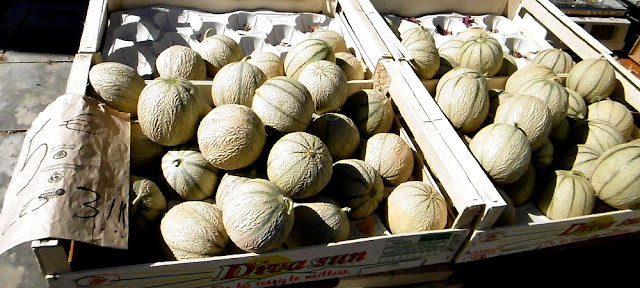
Charentais melon. Indre et Loire. France. Photo by Loire Valley Time Travel.

They are now grown in several suitable areas of France from the south-east to the central west. Melons from the south ripen first and come on to the market in mid-May, and you could still see French produced Charentais Melons in September from the central west. Annually, 250 000 tonnes will be harvested by hand in the cool morning air and sold domestically. Because they are already ripe when picked they need to be eaten as soon as possible after harvest.

The best idea is to buy directly from the producer, either at their farm, from temporary roadside stalls or when they come to a farmers market. Let the producer choose your melons and tell them when you want to eat them -- aujourd'hui, demain, après demain (today, tomorrow, the day after). You will pay around €5 for three melons at the height of the season when they are all ripe at once, or about €2.50 for a single melon in early summer.


************************************************

For details of our private guided tours of chateaux, gardens, wineries, markets and more please visit the Loire Valley Time Travel website. We would be delighted to design a tour for you.

We are also on Instagram, so check us out to see a regularly updated selection of our very best photos. 

Sunday, 11 July 2021

Bondi Icebergs

This is the Bondi Icebergs swimming pool, on Bondi Beach in Sydney, taken a number of years ago. The setting is different to that of Preuilly's swimming pool: we have a view of a chateau and a 1000 year old church as opposed to a beach and the open ocean, but at the moment the main difference is that Preuilly's swimming pool is open (in fact, if you're reading this as it posts, that's where we are) whereas Sydney is in lockdown.


I won't given my opinion on the way that the Australian Government has handled the Covid crisis as bad language often offends.


Saturday, 10 July 2021

A Gateway in Déols

 Déols is now virtually a suburb of Chateauroux, but it was once much more important than its now larger neighbour.

You will notice that the title of this post is "A Gateway in Deols". That's because two gateways of the Benedictine Abbey of Our Lady of Déols (founded in 917) still exist. The abbey church was rebuilt about 1150 with seven towers, of which only one remains, on a floorplan larger than the cathedral of Bourges. The existing tower is impressive, the church must have been a real wonder in its day.


Friday, 9 July 2021

The Mobile Distiller

Mobile distiller, Indre, France. Photo by Loire Valley Time Travel.

While walking down through Ecueillé to find the best site to watch the Tour de France the other day we discovered that a mobile distiller had set up on the river bank so we stopped off to photograph and chat. This spot is on his regular annual rotation. He provides a service to those who want to convert their excess fruit into eau de vie. Local clients arrive with plastic bins full of fermenting plums, grapes, pears or strawberries and he runs each batch through the still. Several days later they return to pick up their clear fruit brandy. Until the late 20th century cherry would have been one of the main fruits used, but hardly anyone makes this now. The mobile distiller is paid a fee for doing the distilling and collects the duty for the authorities. This product is strictly for private consumption only, it is not commercialised. Once everyone around Ecueillé's fermented fruit gloop has gone through the still he will pack it all up and move on to the next town. You can see that the whole distilling rig is mounted on a trailer.

Thursday, 8 July 2021

Oops!

The new bike path (Voie Verte) is almost finished, and almost ofiicially open. So much so that new signage is appearing, directing cyclists towards the path.

Unfortunately, this sign would appear to be in the wrong place. Access to the voie verte is limited to where the old rail line crossed a road. Following this sign, the nearest access (unless you want to drag your bike through a bush) is 3km away. The start of the path is only 300metres away - in the other direction.


Wednesday, 7 July 2021

Joan of Arc in the Loire Valley -- the Chateau of Rivau and the War Stallions

Chateau de Rivau, Indre et Loire, France. Photo by Loire Valley Time Travel.
Chateau de Rivau.

The chateau of Rivau, near Chinon, was built in 1420 so when Joan saw it would have been quite shiny and new. She came here after her meeting with Charles VII, as the Chateau supplied the war stallions she had been granted. The existing stables at the chateau are several centuries later though, so she definitely would not recognise those. Nevertheless, it is a lovely place to visit, with a fairytale 15th century castle in a charming blend of decorative and defensive styles, and an extensive and beautiful garden. 

Chateau de Rivau, Indre et Loire, France. Photo by Loire Valley Time Travel.
Entrance to the Chateau de Rivau.


************************************************

For details of our private guided tours of chateaux, gardens, wineries, markets and more please visit the Loire Valley Time Travel website. We would be delighted to design a tour for you.

We are also on Instagram, so check us out to see a regularly updated selection of our very best photos. 

Tuesday, 6 July 2021

Coypu in the Claise

We have lived in Preuilly for 12 years, and were visiting for 3 years before then. In all that time I don't recall ever having seen a Coypu in the section of the Claise as it flows through town. Last week we were out walking, and crossing the passerelle (foot bridge) across the Claise by the swimming pool we noticed spreading ripples in the water.

The Coypu  entered a patch of water-lilies and stopped - he could see us, but thought he was hidden from view. I pointed the camera in his general direction and started taking pics - the sunlight meant that I couldn't actually see on the camera's screen where the camera was pointing, and the small camera doesn't have a viewfinder.

I moved towards the edge of the bridge to see if I could take some better photos, and  the Coypu dived, surfacing about 30 metres downstream. I took another photo, which shows the ripples.

Coypu Myocastor coypus (Ragondin in French) and Musk Rat Ondatra zibethicus (Rat musqué in French) are vermin and there is an organised campaign in Indre et Loire to eliminate them to protect plantlife. The Coypu were intoduced from South America to France as farmed fur animals in the 19th century (as were American Mink and Musk rats from North America). Following escapes and deliberate releases in the 1930’s when demand for fur fell they have spread to most regions of France.


Monday, 5 July 2021

Driving Through Crissay sur Manse

Yesterday was the first (for us) big car event of the year. Normally we go to Paris for Retromobile in February, and Blois In April for their "use your old car" day, but of course nothing this year has been normal. True, in March we went to a coffee morning with old cars, but that's all we have done for over 18 months,

Yesterday we were again at Sainte Maure, this time for a 60th birthday celebration for the Renault 4L. This involved coffee, a drive in convoy through Crissay sur Manse and St Epain, and lunch. It rained, but not enough to put a total dampener on things. Bob and Alison joined us to make it a social occassion, and although neither Susan nor I took photos, I did remember to turn the video camera on.

Here is some of the footage, taken in and around Crissay sur Manse, officially one of the most beautiful villages in France.


Sunday, 4 July 2021

Roadtrains

A couple of weeks ago I mentioned in a comment that overtaking a roadtrain takes an inordinate amount of road - then I realised that some readers might not know what I was talking about.

Here are some photos of roadtrains. They can be up to 53.5 metres (175 ft 6 in) long, and they travel at close to the speed limit. That means that to overtake them on a normal Australian highway (one lane each way) you would really need over the horizon radar - assuming the road is wide enough to get past, which it rarely is.


The following pic is a roadtrain we later passed (having ourselves stopped for a meal) parked by the side of the road with burning brake blocks.


Saturday, 3 July 2021

Tour de France 2021

On Thursday Susan and I went to Écueillé, just over the border in Indre, to see the Tour de France on its way. We do this whenever the Tour is within reasonable striking distance of home - quite frankly it would feel churlish not to do so.

We arrived in plenty of time (this year without one of the Old Ladies Célestine or Claudette), parked up, and walked to the centre of town. We secured a good position right on a very tight corner in the middle of town and waited for ages - and then some.

Here are some of our photos of the preamble:


I also took a video of the riders and support teams:


Friday, 2 July 2021

Ferns in the Forest with Franck


Western Spectre Boyeria irene, female, Indre et Loire, France. Photo by Loire Valley Time Travel.
Western Spectre dragonfly Boyeria irene (Fr. L'Aeschne paisible), resting in a typical position, under the eaves of a building.

Saturday 26 June saw me heading off to Chambourg sur Indre to meet Franck the Forester and Fern Guy. We were going on an outing to a privately owned parcel of woodland to look at ferns and mosses, joined by Marie-Claude and her husband Patrick, Corinne and Christiane. It was a lovely setting, owned by a young brother and sister who inherited it. There is a small lake and a well built shed with a fireplace and outdoor furniture. It's a proper little retreat.

Common Figwort Scropularia nodosa, Indre et Loire, France. Photo by Loire Valley Time Travel.
Common Figwort Scrophularia nodosa (Fr. Scrophulaire noueuse).


Franck explained that there weren't actually many species of ferns on the site, but ferns hybridise extremely easily, so they are challenging and you need to check every plant to determine their lineage. As a bonus there were some nice butterflies and dragonflies around the lake. There was also a large scat full of big beetle wing cases -- maybe a badger or a fat hedgehog has been feasting on Stag Beetles and Ground Beetles, amongst others. Or maybe it's an owl pellet, which seems more likely given the sheer quantity of beetle bits.

Large Tortoiseshell Nymphalis polychloros, Indre et Loire, France. Photo by Loire Valley Time Travel.
Large Tortoiseshell butterfly Nymphalis polychloros (Fr. La Grande Tortue).


Franck's day job is as a consultant to owners of small private forestry parcels like this. He is concerned about how unbalanced the forest ecology is becoming. Wild Boar numbers are increasing, which means their excrement is causing the soil nitrogen levels to rise. This in turn is leading to an increase in pathogenic fungi which are attacking trees of all sorts. Added to that is the practice of replanting broadleaf forest with pine. Owners are obliged to reforest areas which are felled for timber, but most choose the quick and easy solution of planting pine, rather than the long slow process of allowing the forest to regenerate naturally. Franck would like to see early succession trees like birch and downy oak, with no commercial value, left as long as possible, so that the regeneration is as natural and therefore as resilient as possible to the increasing frequency and intensity of periods of drought. He says many pine trees in the Loire Valley forests died in the drought last year, especially around Orléans.

Owl pellet full of large beetle elytra, Indre et Loire, France. Photo by Loire Valley Time Travel.
What I think is probably an owl pellet, full of beetle wing cases.


There are 150 000 hectares of forest in Indre et Loire, close to a quarter of the total area of the département, of which the vast majority, 130 000 hectares, is privately owned and managed. There are many small non or semi-commercial parcels, but 70 000 hectares are parcels over 25 hectares, managed primarily for timber production. The site we were visiting was 50 hectares.

Etang (small man-made lake), Indre et Loire, France. Photo by Loire Valley Time Travel.
The étang (small man-made lake) on the property.


We have been talking to a local joiner about getting new windows. We had a quote from him which seemed reasonable, but now he has let us know that he will have to recalculate because there is such a shortage of wood in France and he is obliged to put prices up a lot. He said that at the beginning of the pandemic, the US and China basically sucked up the global supply of wood with huge orders for imports. Later I heard on the radio that the problem was that in China it has not been permitted to extract timber from homegrown forests for some decades, so they have to import. They are prepared to pay 15% more than the domestic rate for French oak, and so it is going to China. Tant pis for us and our hope of getting new windows any time soon.

Blue Featherleg Platycnemis pennipes, Indre et Loire, France. Photo by Loire Valley Time Travel.
Blue Featherleg damselfly Platycnemis pennipes (Fr. L'Agrion à large pattes).


On a more positive note, I wore my new waterproof hiking boots, bought for €35 in Noz, a Romanian brand called S-Karp, and they were a tremendous success. Super comfy and not too heavy.

Horned Tree-hopper Centrotus cornutus, Indre et Loire, France. Photo by Loire Valley Time Travel.
Horned Tree-hopper Centrotus cornutus (Fr. Demi-diable) on bracken.

Botanists looking at ferns, Indre et Loire, France. Photo by Loire Valley Time Travel.
Looking at a fern in the forest.

Dryopteris complexa, Indre et Loire, France. Photo by Loire Valley Time Travel.
There was a nice colony of the buckler fern Dryopteris x complexa in one part of the forest. This is one of the dreaded hybrids, but common enough to have its own name. The parents are False Male Fern D. affinis and Male Fern D. filix-mas.

'Cigar' made by Hazel Leaf Roller Apoderus coryli, Indre et Loire, France. Photo by Loire Valley Time Travel.
A 'cigar' made by a Hazel Leaf Roller Apoderus coryli.

Marmalade Hover Fly Episyrphus balteatus on bramble, Indre et Loire, France. Photo by Loire Valley Time Travel.
Marmalade Hover Fly Episyrphus balteatus on a bramble flower (which has changed colour from white to pink because it has been pollinated).

Thursday, 1 July 2021

Visiting an Archaeological Dig

Gallo-roman artefacts from an archaeological dig, Indre et Loire, France. Photo by Loire Valley Time Travel.
Artefacts found on the site.


Many of you will be familiar with the Journées Européenes du Patrimoine (European Heritage Open Days), but like us, you may not have heard of the Journées Européenes de l'Archeologie. I found out about them this year because a friend sent me a link. Apparently they've only been going a few years, and are an initiative of INRAP, the French national archaeology service. 

Gallo-roman 1C archaeological dig site, Indre et Loire, France. Photo by Loire Valley Time Travel.
One end of the dig site, clearly showing the shallow boundry ditch of the 1st century agricultural area.


The European Archaeology Open Days were 18-20 June and in our area INRAP and the départementale (county) archaeology service offered visits to their joint site at the extension to the industrial zone that is being constructed near Sublaines. We've been curious to find out what discoveries have been made there for a while, so I immediately booked our time slot.

Boundary ditch on a gallo-roman archaeological dig, Indre et Loire, France. Photo by Loire Valley Time Travel.
An archaeologist indicates the big boundary ditch around the dwelling and workshop area.


The archaeology team were extremely welcoming and friendly, and very organised. While we waited for our turn to go onto the dig site we got to chat to a couple of them and to look at the artefacts found.

1C gallo-roman cellar on an archaeological dig, Indre et Loire, France. Photo by Loire Valley Time Travel.
Rectangular stone cellar with entry steps being indicated by an archaeologist. Lifting the stone building rubble to see what is underneath was one of the next tasks the archaeologists were planning.


The site is a 1st century gallo-roman farm, with the animal compound and cultivated area surrounded by a shallow ditch, and the dwelling and food storage area surrounded by a deep wide ditch and bank. The archaeologist who took us around explained that the deep ditch and bank were not really for defense or protection, but for prestige. The bigger and more impressive your ditch and bank, the higher the status you were demonstrating.

1C gallo-roman stone cellar on an archaeological dig, Indre et Loire, France. Photo by Loire Valley Time Travel.
Square stone cellar with walls topped by terracotta tiles. This one has no steps so the archaeologists conjecture that it was accessed by a wooden ladder.


The archaeological layer is not deeply buried. The vegetative layer has been removed and immediately the diggers were on to archaeology. The team has three more weeks to finish the work, then construction will start.

Medieval lime kiln on an archaeological dig, Indre et Loire, France. Photo by Loire Valley Time Travel.
An 10-11th century medieval lime kiln shows a later stage of industrial activity after the site shows no signs of human activity for centuries after the 1st century occupation.


When we visited it had rained very heavily during the night and obscured some of the changes in the soil that is often the only sign left of a building. The first thing we looked at were post holes, filled with dark soil in the surrounding pale limestone clay soil, and believed to be the remains of an animal shelter or workshop. We could clearly see the ditches too, but no trace of the house itself has been found. They know it must have been there though, because of the ditches and because of the underground storage spaces. The thought is that the site shows the transition between Gaulish building practices in wood and Roman building practices in stone. The site seems to have been established early in the 1st century, and by the end of that century the buildings were abandoned. However, there is a Roman villa fairly nearby, and the archaeologists think it is not inconceivable that the occupants of the site currently being dug were comfortable enough to have relocated and built somewhere grander. The site indicates the occupants farmed at least a hectare of land. If they had even as little as ten hectares in total they would have been rich, not just comfortable.

1C gallo-roman grain silo on an archaeological dig, Indre et Loire, France. Photo by Loire Valley Time Travel.
Grain silo dug into the limestone. Two of these have been found and there may be others. The openings are narrower than the sides for ease of sealing them hermetically to preserve the grain.

Archaeological dig site, Indre et Loire, France. Photo by Loire Valley Time Travel.
The dig site and the wider landscape. You can clearly see a change in soil type, from dark loam on the left, to pale limestone clay on the right.