Saturday, 21 December 2019

Manech Tete Rousse


The Manech tête rousse is a breed of sheep indigeneous to the French Basque country. Their origins are not fully known, but they have been raised in the western Pyrenees for a very long time, found mostly on the hillsides, and certainly developed in the Pyrenees, not imported from elsewhere during the Moorish invasions, for example. They are dairy sheep, the most productive in the Pyrenees, and their milk is most notably used in the production of the local brebis cheese (AOC Ossau Iraty, which is a type of tomme). They are sheep with hanging fleeces, white with red heads and legs. They are particularly hardy and well adapted to the transhumance and long treks along the steep slopes of the Pyrenees.

Manech tete rousse sheep on the slopes of La Rhune, Pyrenees-Atlantiques, France. Photographed by Susan Walter. Tour the Loire Valley with a classic car and a private guide.

They bear no characteristics whatsoever of Merinos, and are quite different to other local breeds of sheep. Their locks grow to about 25 centimetres long. They are hornless, with long narrow faces, drooping ears and sturdy legs. A ewe will stand about 60 centimetres tall at the shoulder and weigh about 50 kilos.

The ewes are milked for 125 days of the year and in that time will produce 150 litres of fat and protein rich milk. The herds are more or less impervious to bad weather, rain as well as snow, and variations in temperature. They have trouble free births in the spring and lactate all summer. The floral richness of the pasture they eat is reflected in the milk and the end product, cheese.

Manech tete rousse sheep on La Rhune, Pyrenees-Atlantiques, France. Photographed by Susan Walter. Tour the Loire Valley with a classic car and a private guide.

Manechs are raised using a system of a short three to four month transhumance (and sometimes no transhumance at all). Lambing takes place from December to March and they are milked from December to July. It is collected by the industrial producers or processed on the farm. Milking commences when the lambs are weaned at 35 days. Lambs are sold to fat lamb producers in Spain, or raised on the farm and sold as Label Rouge agneau de lait des Pyrénées.
Manech tete rousse sheep in the western Pyrenees, Spanish-French border. Photographed by Susan Walter. Tour the Loire Valley with a classic car and a private guide.

There is a breeding programme, established in 1975, to improve the herd. 56 000 ewes are involved, artificially inseminated with sperm from the best rams. In total the national herd is 200 000 ewes, all located in the Pyrénées-Atlantique, in Basse-Navarre and lower Soule.

************************************************

For details of our private guided tours of chateaux, gardens, wineries, markets and more please visit the Loire Valley Time Travel website. We would be delighted to design a tour for you.

We are also on Instagram, so check us out to see a regularly updated selection of our very best photos. 

Friday, 20 December 2019

The French Coiffure Crisis


I've often seen on expat forums complaints about how difficult it is to get a decent haircut in France. I've always assumed it was just that in France they do things differently and the complaints were probably not justified. After all, Simon and I have no complaints about our hairdresser. She is our next door neighbour and comes to our house to cut our hair once a year. My hair is simple, but Simon has very wavy thick hair, and she clearly understands the tricky nature of hair like his. But it seems that complaints about hairdressers are just as widespread amongst the native population, so something must be up.

In France there is an average of one hairdressing salon for every 720 people, and French people make an average of four to seven visits to the hairdresser a year. Preuilly sur Claise (population 1009) has three salons and a mobile hairdresser (our neighbour), which I've always thought quite remarkable.

Hairdresser.  Loir et Cher, France. Photographed by Susan Walter. Tour the Loire Valley with a classic car and a private guide.

About a million people visit the hairdresser on any given day in France, spending €85 000 a year in a sector worth six billion euros a year overall. But -- the sector is declining and salons are starting to close at a rapid rate. Women are not going to the hairdressers as much, and they are opting for less complicated, lower maintenance styles. Since France is the world's leading producer of hair care products, it's got companies like L'Oréal rattled -- to the point that they have announced the opening of a new academy where students will study for a Bachelor in hairdressing and business. The aim is to reinvigorate a better business approach and improve training.
Hairdressing salon.  Indre et Loire, France. Photographed by Susan Walter. Tour the Loire Valley with a classic car and a private guide.

Since 2011, the sector, employing 90% women, and second only to becoming a baker as a career choice for school leavers who want to do an artisan trade, has been declining. There are 10 000 vacant posts in hairdressers across France. Twenty or thirty years ago there was a swathe of French household name hairdressers setting the trends and making their fortunes but now, good hairdressers are becoming rarer and rarer.

Hairdresser.  Indre et Loire, France. Photographed by Susan Walter. Tour the Loire Valley with a classic car and a private guide.

Technical training for apprentices concentrates on colouring and styling. There is very little on how to cut. Bad haircuts are the result, cleverly disguised with artful blowdrying and use of the curling tongs, only to disintegrate at the first wash. Some women still go to the salon every week for 'le brushing' (a blowdry) to maintain their style, but it is becoming much less common. Most women are just opting for simpler styles, either very short or like me, all one length and long enough to pull back in a simple pony tail.
Hairdressing salon.  Indre et Loire, France. Photographed by Susan Walter. Tour the Loire Valley with a classic car and a private guide.

There are a number of problems in the salons. First of all, what the apprentices are taught, which hasn't changed since the fifties. They learn how to do perms and chemical colours, but what the clients want are organic vegetal tints. They find themselves doing a lot of thankless sweeping up and learning obsolete skills. Some salons focus on selling a lot of product at the expense of the cut itself, so the apprentices have no sense of artistic achievement. L'Oréal says it wants to inject a sense of striving for excellence into the job. These days, many women can do better job on their own hair just using tutorials on the internet rather than a professional hairdresser. In the old days women learnt about new products at the salon, but now hairdressers are no longer the innovative ones. They are seen as old fashioned, dowdy, and expensive. 

************************************************

For details of our private guided tours of chateaux, gardens, wineries, markets and more please visit the Loire Valley Time Travel website. We would be delighted to design a tour for you.

We are also on Instagram, so check us out to see a regularly updated selection of our very best photos. 

Thursday, 19 December 2019

What Are Fungi


Neither vegetable, nor animal, how do they eat, grow and reproduce?

The Symbiotes: Sixty percent of fungi live with trees or grass in a mutually beneficial symbiotic relationship, using mycorhyza as intermediaries for nutrition passing in both directions (ie the tree feeds the mushroom and the mushroom feeds the tree as they are able to process different nutritional elements). This includes boletes, russules (brittlegills), amanites, lactaires (milkcaps) and chanterelles.

Boletes.
Boletes.  Indre et Loire, France. Photographed by Susan Walter. Tour the Loire Valley with a classic car and a private guide.

Brittlegills.
Russules.  Indre et Loire, France. Photographed by Susan Walter. Tour the Loire Valley with a classic car and a private guide.

Amanita.
Amanita.  Indre et Loire, France. Photographed by Susan Walter. Tour the Loire Valley with a classic car and a private guide.

Milkcaps.
Lactarius.  Indre et Loire, France. Photographed by Susan Walter. Tour the Loire Valley with a classic car and a private guide.

Chanterelles.
Craterellus.  Indre et Loire, France. Photographed by Susan Walter. Tour the Loire Valley with a classic car and a private guide.


The Decomposers: Thirty-five percent of fungi digest dead vegetable matter, dead animals and faeces. These species make the leaf litter and humus in the forest and include agarics, coprins (inkcaps), cortinaires (webcaps), lentins (shiitake), pholiotes and pleurotes (oysters).

Agarics.
Agaricus.  Indre et Loire, France. Photographed by Susan Walter. Tour the Loire Valley with a classic car and a private guide.

Inkcap.
Coprinus.  Indre et Loire, France. Photographed by Susan Walter. Tour the Loire Valley with a classic car and a private guide.

Webcaps.
Cortinarius.  Indre et Loire, France. Photographed by Susan Walter. Tour the Loire Valley with a classic car and a private guide.

Shiitakes.
Shiitake.  Indre et Loire, France. Photographed by Susan Walter. Tour the Loire Valley with a classic car and a private guide.

Pholiotes.
Gymnopilus.  Indre et Loire, France. Photographed by Susan Walter. Tour the Loire Valley with a classic car and a private guide.

Oysters.
Pleurotus.  Indre et Loire, France. Photographed by Susan Walter. Tour the Loire Valley with a classic car and a private guide.


The Parasites: Five percent of fungi digest still living vegetation and animals. They include polypores and ganodermes (brackets), collybies, and armillaires (honey fungi). They regulate the forest.

Polypore.
Heterobasidion.  Indre et Loire, France. Photographed by Susan Walter. Tour the Loire Valley with a classic car and a private guide.

 Collybia.
Rhodocollybia.  Indre et Loire, France. Photographed by Susan Walter. Tour the Loire Valley with a classic car and a private guide.

 Ganoderma.
Ganoderma.  Indre et Loire, France. Photographed by Susan Walter. Tour the Loire Valley with a classic car and a private guide.

 Honey fungus.
Armillaria.  Indre et Loire, France. Photographed by Susan Walter. Tour the Loire Valley with a classic car and a private guide.


************************************************

For details of our private guided tours of chateaux, gardens, wineries, markets and more please visit the Loire Valley Time Travel website. We would be delighted to design a tour for you.

We are also on Instagram, so check us out to see a regularly updated selection of our very best photos. 

Wednesday, 18 December 2019

A Sporting Lunch


Our swimming group is a great bunch of people who care about one another and don't just hang out at the pool together. This summer Philippe and Marie-José had their 50th wedding anniversary, so naturally there was a party at their place (on a Thursday of course, when the pool is closed).

I made beetroot and walnut hummus. (Recipe.)
Beetroot hummous. Prepared and photographed by Susan Walter. Tour the Loire Valley with a classic car and a private guide.

I'm not sure what Philippe is up to with this water butt arrangement, but knowing him it's a genius idea.
Water butt. Indre et Loire, France. Photographed by Susan Walter. Tour the Loire Valley with a classic car and a private guide.

Toasting Marie-José and Philippe.
Toasting. Indre et Loire, France. Photographed by Susan Walter. Tour the Loire Valley with a classic car and a private guide.

Presenting Marie-José and Philippe with a bottle of bubbly.
Presenting a bottle of bubbly. Indre et Loire, France. Photographed by Susan Walter. Tour the Loire Valley with a classic car and a private guide.

Left to right: Jean, Paola, Marie-José, Claire, Ingrid, Yohann's daughter, Chantal, Christiane, Yohann, Huub.
Lunch picnic party in a garden. Indre et Loire, France. Photographed by Susan Walter. Tour the Loire Valley with a classic car and a private guide.

I also made a vegetable terrine, from the recipe on Taste of France.
Vegetable terrine. Prepared and photographed by Susan Walter. Tour the Loire Valley with a classic car and a private guide.

Many of the swimming group also cycle.
Fixing a bike tyre puncture. Indre et Loire, France. Photographed by Susan Walter. Tour the Loire Valley with a classic car and a private guide.
The young female owner of this bike with a puncture was visibly unimpressed when the old white guys took over the repair. As she pointed out, if she'd wanted to repair it this way she could have done it herself. I think André ('fifty years of riding bikes in France') forgot he was dealing with a Dutch woman. The metal detector is for trying to locate the metal valve that pinged off somewhere into the pine needle ground litter (never to be found again, even with the aid of metal detecting technology).

************************************************

For details of our private guided tours of chateaux, gardens, wineries, markets and more please visit the Loire Valley Time Travel website. We would be delighted to design a tour for you.

We are also on Instagram, so check us out to see a regularly updated selection of our very best photos. 

Tuesday, 17 December 2019

Chapelle de Plaincourault


Mérigny is in the middle of nowhere in the Brenne, on the border between Poitou and Berry, but once upon a time there was a great medieval castle there, and surviving still, a few hundred metres away, a small but rather wonderful chapel. The chateau estate is in private hands and the castle long ago demolished and replaced with something more modern (still a couple of hundred years old though). After a parlous few centuries the chapel, now on an island between two rural roads not much more than tracks, is now loved and protected, owned and maintained by the Brenne Park Authority.

The apse.
Apse of the Chapelle de Plaincourault, Indre, France. Photographed by Susan Walter. Tour the Loire Valley with a classic car and a private guide.

The chapel building dates from 1110-20 and is a harmonious Romanesque structure of great simplicity sheltering some remarkable wall paintings. Because of its location it is hardly known outside the local area, and its history is a bit mysterious. It is worth a bit of a detour to see the interior and we treated it as a day out with friends in the summer, especially as the resident guide is my friend Sylvain. 

St Eligius shoes a horse in a miraculous way.
Wall painting depicting a scene from the life of St Eligius in the Chapelle de Plaincourault, Indre, France. Photographed by Susan Walter. Tour the Loire Valley with a classic car and a private guide.

The paintings were done between 1170 and the 15th century in several phases. They depict fantastical animals, medieval legends and visitors are invited in to a rich and appealing imaginary world.

Once part of a Commanderie of the Knights Hospitallers of Saint John of Jerusalem (now the Order of Malta) who would have come here every day for mass. Almost by chance it has remained intact, except for the loss of the Poitevin style stone spire on the belltower. Some of the early paintings, such as the Tree of Knowledge, are of exceptional interest, as are the 14th or 15th century animal characters from fables such as Reynard the Fox (the Roman de Renart in French) and legend of Saint  Eligius (Saint Eloi in French).

Floral decorative wall painting.
Floral decorative wall painting in the Chapelle de Plaincourault, Indre, France. Photographed by Susan Walter. Tour the Loire Valley with a classic car and a private guide.

But in 1632 the Hospitallers departed and the chapel was abandoned for three centuries. It got turned into a barn, storing piles of hay and beets, as well as sheltering animals. During the Revolution it was extensively damaged.

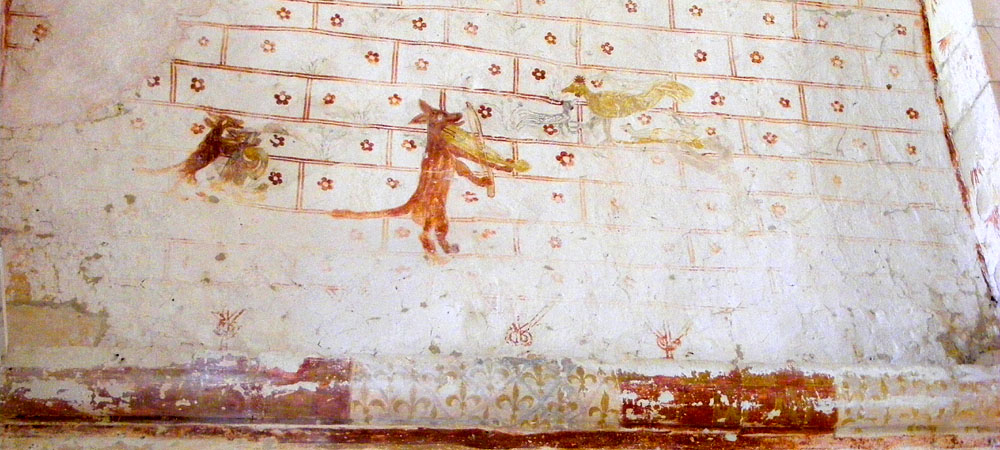
 Detail of wall painting depicting the Roman de Renart.
Detail of wall painting depicting the Roman de Renart in the Chapelle de Plaincourault, Indre, France. Photographed by Susan Walter. Tour the Loire Valley with a classic car and a private guide.

In the 19th century it was bought as part of the chateau estate, but now a road separates the chapel from the rest of the chateau park. The construction of the road meant the chapel started to lean dangerously, as its smooth stones started slipping towards the road. 

A Plantagenet lion.
Wall painting of a Plantagenet lion in the Chapelle de Plaincourault, Indre, France. Photographed by Susan Walter. Tour the Loire Valley with a classic car and a private guide.

Declared a Historic Monument in 1944, and at risk of ruin, the chapel was purchased by the Brenne Park Authority for one franc in the 20th century. They then set about an extensive programme of stabilising, restoring and conserving the building and installing interpretation panels. 

From the outside, we can see an archway with a geometric or vegetal decoration surmounted by an open bay in the triangular gable crowned with an antefix cross. Only the facade and the apse are broken by openings for windows. The rest of the chapel doesn't have direct light, leaving space for large expanses of wall ideal for painting.

Inside there is a single nave with three bays, a narrow choir and then a semi-circular vaulted apse. The bays are separated by paired arches resting on columns with carved capitals.

 The Chapelle de Plaincourault.
The Chapelle de Plaincourault, Indre, France. Photographed by Susan Walter. Tour the Loire Valley with a classic car and a private guide.

The paintings from the 13th century use cobalt and copper oxides to obtain blue and green. Before that they are mostly ochre pigments. The colours are still well preserved.

 The Garden of Eden.
12C wall painting depicting the Garden of Eden in the Chapelle de Plaincourault, Indre, France. Photographed by Susan Walter. Tour the Loire Valley with a classic car and a private guide.

The oldest painting in the chapel depicts the Garden of Eden, with the Tree of Knowledge looking rather like a giant mushroom. The few scolars who knew about the chapel in the 19th century were very taken with the idea that the mushroom tree represents a shamanic reference to Fly Agaric Amanita muscari. Not everyone took this too seriously though, as there are some wry comments about how Eve looks as if she is suffering from colic rather than shame.

Next to the Garden of Eden is the Virgin, seated on a throne with the baby Jesus in her arms and surrounded by a mandorla.

 Crucifixion.
12C crucifixion wall painting in the Chapelle de Plaincourault, Indre, France. Photographed by Susan Walter. Tour the Loire Valley with a classic car and a private guide.

On the other side of the Virgin is a 12th century crucifixion, clearly influenced by earlier 9th and 10th century paintings, with the cross arms ending in 'T's (a style that ceased in the 10th century). The rather unusual representation of Jesus on the cross is also a clue. He is shown with open eyes, still alive, unwounded and his feet are splayed, not superimposed.

This wall painting shows a pentimento.
Wall painting showing pentimento in the Chapelle de Plaincourault, Indre, France. Photographed by Susan Walter. Tour the Loire Valley with a classic car and a private guide.

On the left hand wall we have a scene from the life of Saint Eligius, from the 14th century, showing him miraculously shoeing a reluctant horse, having removed the horse's hoof for convenience. He has a halo, with a hammer in one hand and the hoof in the other. A man holds the leg of the horse whose hindquarters can still be seen. Two men show their amazement behind the saint. Check out the gigantic hands of the characters in relation to their faces: a device used to give an effect of perspective.

We also see traces of a pentimento next to the face of one of the men: pentimento refers to a part of a painting that has been covered, to mask or modify certain details. Most often, pentimenti can only be seen on X-rays because they are hidden under several layers of paint. But in some cases, like this,  you can see it very well.

A depiction of the fable the Roman de Renart.
A wall painting depicting the fable the Roman de Renart in the Chapelle de Plaincourault, Indre, France. Photographed by Susan Walter. Tour the Loire Valley with a classic car and a private guide.

Next to it, we have a scene from the Roman de Renart from the end of the 13th century. Renart plays the violin. Very worn, we see a dog standing on its hind legs (perhaps Roenel the big mastiff), a rooster (Chantecler) followed by a peacock.

On the dome of the apse, we can see Christ surrounded by the animals of the four evangelists.

Mystery coats of arms.
Mystery coats of arms in the Chapelle de Plaincourault, Indre, France. Photographed by Susan Walter. Tour the Loire Valley with a classic car and a private guide.

Not to mention a portion of the wall covered with coats of arms, the study of which in 2013 did not  reveal much, despite modern techniques of lighting and magnification being applied for meticulous examination. The scientists wanted to establish the stages of creation, what techiques were used, how many artists there were and to photograph the work for ease of study.

For details of opening hours for visits and how to get there, see the Berry Province website.

************************************************

For details of our private guided tours of chateaux, gardens, wineries, markets and more please visit the Loire Valley Time Travel website. We would be delighted to design a tour for you.

We are also on Instagram, so check us out to see a regularly updated selection of our very best photos. 

Monday, 16 December 2019

Brined Pork Chops with Italian Greens


Cooked and photographed by Susan from Loire Valley Time Travel. https://tourtheloire.com

Pork is by far the most popular meat in the Touraine. Brining is a great technique for pork chops, especially loin chops, which can dry out in cooking. A brined pork chop is guaranteed to be succulent. The only downside is that you need to be organised the day before, making the brine, allowing it to cool and marinating the chops overnight. What I tend to do is brine several meals worth of chops at a time and freeze those I don't use immediately (take them out of the brine and pat dry to freeze).

Cooked and photographed by Susan from Loire Valley Time Travel. https://tourtheloire.com

Ingredients:

5 cups water
4 tbsp sugar
3 tbsp coarse salt
3 bay leaves, torn into several pieces
1/2 tsp coriander seeds, lightly crushed
A sprig of thyme
4 strips of lemon peel

4 pork chops
2 tbsp olive oil
3 cloves of garlic, smacked with the blade of a chef's knife and peeled
A few fresh sage leaves
4 slices of lemon

8 chard leaves, washed, ribs removed and discarded, leaf roughly shredded

Method:
  1. Combine 1 cup water, the sugar, salt, bay leaves, coriander, thyme and lemon peel and bring to the boil, stirring to make sure everything is dissolved.
  2. Add the rest of the water and put in the fridge to cool completely.
  3. Once the brine is cold, put it in a shallow lidded plastic container and submerge the chops. Return to the fridge.
  4. The next day take the chops out and pat them dry. Discard the brine.
  5. Heat the oil in a frying pan and cook the chops, turning several times over 10 minutes of total cooking time. Be careful not to have the pan too hot, but don't cook them on low either.
  6. Turn the pan off, take the chops out and keep warm.
  7. Add the garlic, lemon and sage to the pan and cook them with the residual heat for a couple of minutes. 
  8. Mash them with a wooden spoon in the pan to release their flavour, then remove the rings of lemon rind.
  9. Turn the heat back on and add the chard to the pan.
  10. Put the lid on to steam the chard for several minutes, stirring a couple of times until they are soft and wilted.
  11. Serve the chops and greens together on warmed plates. Serves 4. 
Cooked and photographed by Susan from Loire Valley Time Travel. https://tourtheloire.com

The pork chops I used came from the butcher in Preuilly. I got forequarter chops rather than loin because I made this dish during a busy holiday period and the butcher had run out of the cut I wanted. He was awaiting a delivery of another pig carcass later that day but rather than go back I figured forequarter chops would be just as good.

Grown by Les Jardins Vergers de la Petite Rabaudiere, Preuilly sur Claise. Cooked and photographed by Susan from Loire Valley Time Travel. https://tourtheloire.com

The chard came from my local organic market garden, Les Jardins Vergers de la Petite Rabaudière, on the outskirts of Preuilly. They sell from the farm every Tuesday evening and from the market in Preuilly every Thursday morning.


Yum

************************************************

For details of our private guided tours of chateaux, gardens, wineries, markets and more please visit the Loire Valley Time Travel website. We would be delighted to design a tour for you.

Sunday, 15 December 2019

Auntie Beryl's View


In early December my Uncle Ric (my father's brother) got an email from the Australian Capital Territory Place Names Officer. It confirmed that my Great Aunt Beryl (one of the sisters of my father and Ric's mother) was to be honoured with having a street named after her in a new development.

 New Taylor development in Canberra, photographed by my sister in June 2019.
New Taylor development, Canberra, Australia. June 2019.

The street will be called Beryl Mann View, named after Beryl Vivienne Mann (1911 - 1982), in recognition of her contribution as an architect, landscape architect and educator. The citation reads:

Beryl Mann graduated in architecture from the Gordon Institute of Technology, Geelong, and in horticulture from the Burnley School of Horticulture, Melbourne (1939). Initially working for Edna Walling as her assistant and subsequently for a number of architectural firms, Mann joined Mockridge, Stahle and Mitchell in 1948. Engaged in both architecture and landscape architecture, she became a Senior Associate of the firm, working there until 1976. While based in Victoria, between 1960 and 1975 Mann was involved in numerous large scale landscaping commissions for Canberra schools. Mockridge, Stahle and Mitchell received the 1964 Royal Australian Institute of Architect’s ACT Chapter Meritorious Architecture Award for her work at Downer Primary School. Other significant Canberra projects include her skilful landscaping of the H.C. Coombs building at the Australian National University and the design and preparation of the Master Plan for the Lake Ginninderra parklands. In addition to her work in professional practice, Mann lectured in landscape design part-time in the Department of Town and Regional Planning, University of Melbourne  (1964-1973). Mann was a founding member of the Australian Institute of Landscape Architects.

Edna Walling, for non-gardening, non-Australians, was one of Australia's most influential landscape designers, pioneering the widespread use of Australian native plants in public and domestic planting schemes. Beryl contributed to the realisation of the vision of Walter and Marion Griffin, who were commissioned to design Australia's purpose built capital city, Canberra. She also worked on several educational institutions, from schools to universities, including Monash University* in Melbourne and the Australian National University in Canberra.

 From left to right: My great grandmother, my Uncle Ric, my younger sister as a baby, my great aunt Beryl Mann, my mother, me. This photo must have been taken in the first half of 1964 I think.
Four generations of the Walter and Mann families, c.1964

I didn't have a photo of Beryl, so I asked my sister what she had. She came up with this amazing multi-generational photo which I don't recall ever having seen before. I do remember visiting great-grannie though. Because my sister lives in Canberra, she was able to provide me with a photo of the new housing development in Taylor that she had taken in June while out birdwatching.

 Courtyard of the H C Coombs Building. Photographed by my sister this week.
Courtyard of H C Coombs Building, Canberra, Australia, designed by Beryl Mann.

 Satellite image of the H C Coombs Building.
H C Coombs Building, Canberra, Australia.

Statue of a kangaroo commissioned by Beryl for Downer Primary School. 
The school was recently demolished and the current whereabouts of the kangaroo are unknown (presumed stolen by someone for safekeeping prior to the redevelopment of the site).
Statue of a kangaroo commissioned by Beryl Mann for Downer Primary School, Canberra, Australia.

Plans for a motel in Victoria. 
(Sourced by my sister via a FB group, from the Mockridge Stahle & Mitchell archive, I think.)
Plans for a motel in Victoria by landscape architech Beryl Mann. Australia.

Ginninderra Parkland, Canberra. (Photo taken by my sister a couple of days ago.)
Ginninderra Parkland, Canberra, Australia.

*That means both sides of my family were involved with designing and installing elements of Monash, as my mother's father won the contract to make the joinery for one of the buildings.


************************************************

For details of our private guided tours of chateaux, gardens, wineries, markets and more please visit the Loire Valley Time Travel website. We would be delighted to design a tour for you.

We are also on Instagram, so check us out to see a regularly updated selection of our very best photos. 

Saturday, 14 December 2019

A Surprise.

Back in early September we posted a photo of Saint Jean de Luz from the top of la Rhune.

It was only when checking all of our photos carefully I realsie that the shot I took a minute later would have been more impressive...

Saint Jean de Luz, with added vulture