Showing posts sorted by date for query descartes. Sort by relevance Show all posts

Wednesday, 11 February 2026

A Descartes Memorial

There's a plaque in Descartes, in a slightly out of the way car park, that we have noticed, but never stopped to read.


In the 1930s, André Goupille was a veterinarian living with his family in La Haye-Descartes (now Descartes). When France was divided during the Second World War, the German demarcation line passed close to their home. Because of his profession, André held a permanent pass allowing him to cross the line. From 1940 onward, he organized a clandestine network to help people cross, involving his wife Jeanne, their four teenage children, and their housekeeper, Odette Metais. Together, they assisted approximately 2,000 individuals, including Jews fleeing persecution, escaped prisoners of war, Allied pilots, and members of the Resistance. They also transported messages and intelligence to London and sometimes sheltered refugees for several days.

Their courage is documented by letters of gratitude from those they helped, including Jewish refugees who had escaped from Drancy. In January 1942, André was arrested for carrying incriminating documents but managed to secure his release by claiming they were linked to black-market activities. He then continued his work from the southern zone, joined later by Jeanne. After the German invasion of the southern zone, their resistance activities expanded to include receiving parachute drops.

In February 1944, the entire group was arrested and deported to Nazi concentration camps. Remarkably, all survived. In 2000, Yad Vashem honored André and Jeanne Goupille, their children, and Odette Metais as Righteous Among the Nations.

Pierre and Denise Renard also lived in La Haye-Descartes during the Second World War. Pierre was involved in the French Resistance and helped escaped prisoners of war and downed Allied airmen cross into the southern zone. His actions expanded when a local hotel owner informed him that the Freudman family, Belgian Jews seeking refuge in France, had been abandoned by smugglers after being robbed of their money.

Pierre rescued the family—two parents and their two-year-old twin daughters—and brought them to his home, where they were temporarily hidden in a small hut in the courtyard. Denise, a schoolteacher, cared for them and ensured they had food and basic necessities. One morning before dawn, she provided the family with supplies and forged identity papers before bidding them farewell. Pierre then guided them by indirect routes across the demarcation line and placed them on a bus bound for Vichy. The following day, he visited them to make sure they were safe.

Pierre Renard sought no reward for his actions, motivated solely by resistance to the occupation and compassion for the persecuted. In 1944, he was arrested by the Gestapo and deported to Dachau. Though he survived the camp, he died shortly after the war due to illness and suffering. In 1969, Yad Vashem recognized Pierre and Denise Renard as Righteous Among the Nations.


Thursday, 9 January 2025

A Resistance Hub

After France was divided into Occupied France and 'Free' France the town of Loches ended up being close to the Demarcation Line, more or less as far north as you could get in the 'Free' zone. As a result the area around Loches became one of the principle crossing places for people wishing to clandestinely get from one zone to the other.

Sympathetic locals emerged from the farming communities that lived along the frontier. They wouldn't accompany the refugees, but they would pass on information about the best routes so as to avoid unpleasant encounters, the timings of patrols, and they might offer a bowl of soup and shelter for the night. Later the frontier became better guarded, and brave souls came forward, offering to drive refugees up to the border, and they became known as 'passeurs'.


Now a Michelin starred restaurant called Abore et Sens, this was until 2019 the Gerbe d'Or.

The former Gerbe d'Or restaurant, loches, France.

Initially they were patriots offering their services for free. But as time went on, the Germans increased their surveillance and the risks became greater. The number of passeurs diminished, and the profile of the passeurs changed to more 'professional', some of whom asked for payment for their services in view of the risks they were running. Little by little a true network developed, with links to the Resistance. The veterinarian Goupille and his family in Descartes were key members of this organisation.

Then several passeurs were denounced. They were deported, and three of them never returned from the concentration camps. 

In Loches the café-restaurant La Gerbe d'Or was a meeting point for those wanting to discretely cross into the Occupied Zone. They would be driven to Dolus le Sec, where it was possible to cross the frontier secretly. They would wait at the Hotel Perrusson then at nightfall, accompanied by their guide, they would slip out. After several hours of walking over ploughed fields and open meadows they would reach the little train station of Cormery, in the Occupied Zone.

Wednesday, 21 August 2024

Le Rafle de Loches

The French word 'rafle' means 'police roundup' in English. Because of its associations with the mass arrests of the Second World War, most famously the Rafle du Vel d'Hiv, it is quite a toxic term.

On 27 July 1944, at dawn, a German task force from Tours, accompanied by Gestapo agents and French members of the collaborationist parties (fascists, anti-semites or anti-Bolsheviks mostly), stormed the sub-prefectural town of Loches. 


Memorial plaque to the clerk of the court, one of the victims of the roundup.

Memorial to a policeman who was deported and died in a WWII concentration camp, Indre et loire, France. Photo by loire Valley Time Travel.

They arrested everyone they encountered in the street, including the sub-prefect, and went to their homes to look for anyone suspected of being more or less active in helping the Resistance.

Among them were civilians such as Marguerite Mallet, wife of Raymond Mallet, one of the leaders of the Secret Army of Loches, Lucienne and René Tocheport, factory owners whose trucks were used by the maquisards, Odette Houlbreque, a nurse who was very close to the maquis leader Lecoze, and Ernestine Denise Charlot, a milliner in rue Quintefol whose nephew had just joined the maquis of Épernon.


Memorial plaque to police officers who died in concentration camps after the roundup.

Memorial plaque to police officers who died in concentration camps in WWII, Indre et loire, France. Photo by loire Valley Time Travel.
 

They also arrested all the members of the police and thirty-six gendarmes present in Loches, who they reprimanded for their lack of diligence in the search for young men who had refused to join the STO (the compulsory labour service which deported those forced to join to Germany to work in the mines and factories). Since 12 June 1944, all the gendarmes of the brigades of the Loches section had, by order of their senior officers, been assembled at the chief town. So that is, in addition to the gendarmes of the brigade of Loches, those of the brigades of Preuilly-sur-Claise, Montrésor, Saint-Flovier, Boussay, Villeloin-Coulangé and Abilly were all gathered in Loches.

All those arrested, maybe as many as three hundred people, were taken to the courtyard of the girls' school for interrogation. 


This war memorial to police officers who lost their lives in the Second World War is in Place des Anciens d'AFN, next to the Agnes Sorel cultural centre in Loches, and the Metropolitan Police Station.

WWII memorial to police officers who died, Indre et loire, France. Photo by loire Valley Time Travel.
 

At the end of the day, 58 men and six women (including Mme Mallet) were sent to the Henri Martin prison in Tours before being deported to Germany.

The gendarmes were first sent to the Neuengamme camp where they arrived on 1 September 1944. Some of them stayed there, the others were sent to the Wilhelmshaven Command where 29 of them died.

Denis Louis BONNAUDET: Born in 1906 in Chatonnay (Vendée), he was the Adjutant at the police station in Preuilly. Having not taken any action against the Resistance in the area he was arrested and taken to prison in Tours. He joined a convoy of prisoners from Rennes and was taken to Belfort then Neuengamme and later Wilhelmshaven. He died in April 1945 at Luneburg.

Ernestine Denise CHARLOT: Born in 1886 at Loches, she was a milliner. She was arrested for having sheltered her nephew, who was in the Resistance, following a denunciation by a woman from Loches. Imprisoned in Tours, she joined the Rennes convoy heading for Belfort. She was deported in September 1944 to Ravensbruck concentration camp, where she was gassed in April 1945.

Noel HAPPE: Born on Christmas Day in 1918 at Hellendoom in the Netherlands, he was a policeman in Preuilly. He was deported via the same route as the others, but only taken as far as Neuengamme. He survived the War and was liberated in the Flensburg Fjord. After the War he wrote a short account of his experience.

Odette HOULBREQUE: Born in 1911 at Fécamp (Seine-Maritime) she was a nurse and close friend of the notorious Resistance leader known as Lecoze (who claimed to be a doctor, but was really just a violent criminal and fraudster on the run). She was sent to Ravensbruck but luckily did not stay there. She was liberated in Hamburg in May 1945.

Marguerite MALLET: Born in 1914 at Lille, she was arrested and sent to Belfort like the others, but after that it is not known what happened to her, and her name is missing from the memorial in Loches. Evidence suggests that she died at Ravensbruck in February 1945. Her husband, a lawyer, was one of the local Resistance leaders and head of the political wing of the Loches based section of the Secret Army.

Lucienne TOUCHEPORT: Born Lucienne Métais in 1907 at Ferriere-sur-Beaulieu, near Loches. She was arrested for having sheltered Resistance members and sent to Ravensbruck by the same route as the others, but then on to another concentration camp and finally Oranienburg, where she was liberated in April 1945.

René TOUCHEPORT: Born in 1906 at Descartes, he was an industrialist, married to Lucienne and living in a charming hamlet just outside of Loches called Les Petites Maisons. He was arrested for sheltering Resistance members and sent to Germany, ending up at Wilhelmshaven and dying there in April 1945.

Paul WATEL: Born in 1914 at Lambersart (Nord), he was a policeman at Preuilly sur Claise. He was deported to Neuengamme, where he died in November 1944.

Thursday, 22 February 2024

Casting for Les Bodin's

Les Bodin's is a comic double act created in 1994 and based at Descartes. Comedians, writers and directors Vincent Dubois and Jean-Christian Fraiscinet have created the characters of Maria Bodin, a cunning and manipulative old widowed farmer in her 80s, and her gormless son Christian.

Casting sign, France.

Every July for the past 19 years they have put on a big outdoor show called 'les Bodin's, Grandeur Nature' on a local farm. It has become a cult and is already sold out for this year.

Casting Les Bodin's, France. Photo LVTT.

The duo perform live as the characters at festivals and charity events around the country, and every so often they make a film or a television show.

Casting Les Bodin's, France. Photo LVTT.

I've never seen them perform, but it is clear they are madly popular in the district (at least with an older crowd -- I don't think the under 40s are so enamoured). My guess is that if you like British comedies like Mrs Brown's Boys, you would like les Bodin's if you were French speaking. I would also observe that the French taste in comedy can be remarkably unsophisticated...

Casting Les Bodin's, France. Photo by LVTT.

Anyway, great excitement in Preuilly when it was announced all over Facebook that les Bodin's would be coming to town and casting 600 extras for their next movie. Hundreds of people duly turned up at the salles des fetes to try out as villagers, cattle herder, goat farmer, receptionists, militant ecologists, police officers, acrobatic dancers, musicians, marching girls, accordionist, tie wearing public servants, little girl and a teenage boy. Our friend Mathieu didn't even have to audition. The production team approached him at work behind the bar of his restaurant, l'Image, and asked if he'd play himself in a bar scene.

So I guess we'll go and see the movie once it's released. There will most probably be a special pre-release showing in the salle des fetes.

Wednesday, 21 December 2022

Foresters Sound the Alarm

This is a reworked version of a post that was originally published in September 2015.

*******************************************************

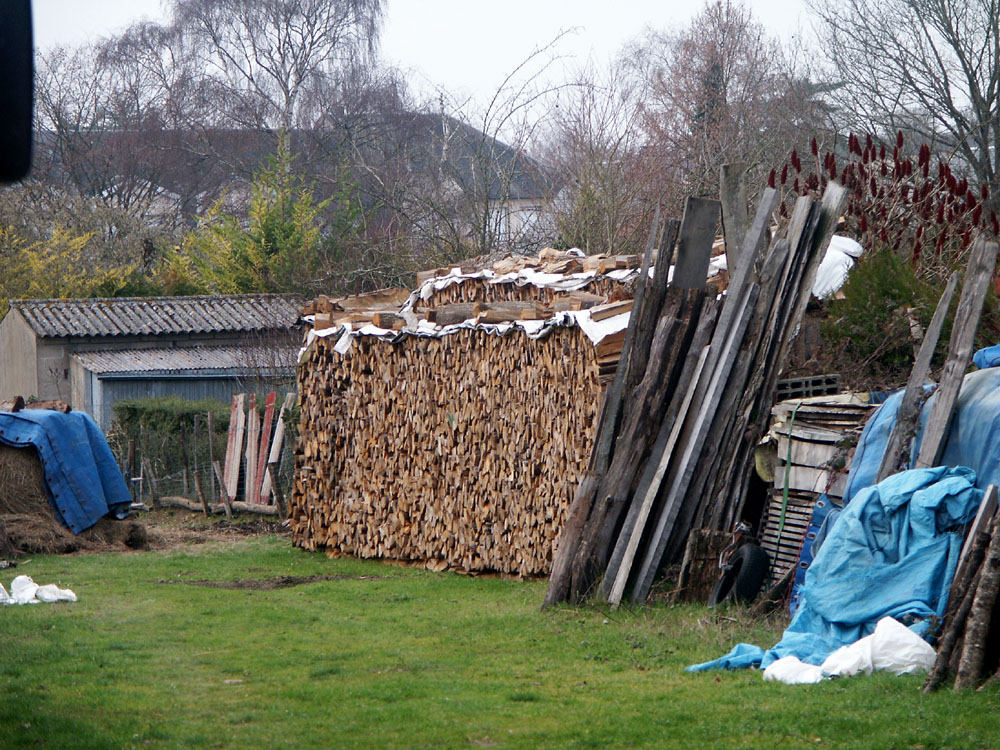
Six million cubic metres of wood are produced in the Centre-Val de Loire region annually.

A private firewood pile.
 
Whilst the market for lumber has stagnated, with prices not having changed for 30 years [I suspect that this is no longer the case, and that prices have increased in recent years], the market for wood as a bio-fuel has really taken off in the last few years [and everything in this post about bio-fuels still applies].

Firewood in the Forest of Preuilly.
 
This has led to concerns expressed by the President of the Union of Private Foresters that without a unified management plan the Touraine risks deforestation. He has told his 440 members that if they opportunistically cut their woods for fuel without succession planning, bio-fuel is a mirage. Wood has already been in short supply for several years.

A parcel in the Forest of Preuilly managed for both lumber and firewood.
 
The development of power plants using wood-chip (Saint-Pierre-des-Corps, Orleans that partially serves the Touraine, and [maybe] soon Descartes) led some owners to develop coppice which allows a short rotation cycle. Long term though it exhausts the soil because it consumes a lot of nitrogen. The president of the Private Foresters Union, Antoine Reille, believes that the supply of wood chip is not well managed and wood that is still wet is often being burned. Although he doesn't say so, I suspect that there is also a problem with much smaller diameter wood now having a commercial value and being removed, whereas before it would have been left to rot and replenish the soil, even on sites that are being clearfelled.

A parcel of young oak trees in the Forest of Preuilly.
 
Reille is not ignoring the delicate balancing act required to ensure cash flow in the short, medium and long term. Coppice will make useable firewood in 25 years, a standard oak tree takes 80 years. But he feels that the market is only going to expand and there should be a sensible overarching management plan for the private forests.

A walking trail in the section of the Preuilly Forest put aside for leisure activities.
 
The Arbocentre Wood Energy Sector Manager is more optimistic. He acknowledges how tempting it is to seize the opportunity offered by bio-fuel. He believes the way forward is to set up a simple management plan and code of forestry practice. Included in this must be plots that are currently being stripped bare with no succession plan and profits must be reinvested in the forests of the future so there is no risk of deforestation.

He also thinks the demand for bio-fuel will slow down. At the moment the two existing power plants consume 30 000 tonnes of wood and don't have much potential for increasing that. In addition any increase won't be at the sort of rate the foresters have experienced in the recent past. The market took off very rapidly but it's a recent phenomenon of only 5 years. The evolution will be slower. 


I should point out that all the photos here were taken by us in the Forest of Preuilly, which is mostly managed by the very professional Office for National Forests and none of the issues discussed above apply. Also probably none of the wood shown above will be destined for wood chip, it will be to supply private households with wood burning stoves. There are private parcels in the forest though and I can't vouch for the management approach to all of them. 

I should also point out that the Descartes bio-fuel power plant that would have consumed more than six times the other two put together as well as waste from the paper mill was due to have opened soon after this post was originally written but seems never to have got off the ground.

Friday, 18 November 2022

Walking Around Descartes

 On Thursday 10 November Joel led a 10 kilometre walk around Descartes.

Park, Descartes, Indre et Loire, France. Photo by Loire Valley Time Travel.
The attractive park on the river in Descartes.

Raised barrage and paper factory, Descartes, Indre et Loire, France. Photo by Loire Valley Time Travel.
The barrage on the Creuse River at the papermill was lowered last year, allowing to river to flow more naturally and completely changing the character of the river. There was considerable public opposition, but from a nature conservation point of view it was the right thing to do.

Big Sheath Mushroom Volvopluteus glioicephalus, Indre et Loire, France. Photo by Loire Valley Time Travel.
Big Sheath Mushroom Volvopluteus glioicephalus (Fr. Volvaire gluante). You can see the volva (like a sheath at the bottom of the stem) that give this species its name.

Scarletina Neoboletus luridiformis, Indre et Loire, France. Photo by Loire Valley Time Travel.
Scarletina Bolete Neoboletus luridiformis (Fr. Bolet à pied rouge), showing the important diagnostic character of no red layer between the flesh of the cap and the tubes.

White Saddle Mushroom Helvella crispa, Indre et Loire, France. Photo by Loire Valley Time Travel.
White Saddle Mushroom Helvella crispa (Fr. Helvelle crépue). This was a new species in its natural habitat for me.

Friday, 14 October 2022

Walking From Neuilly le Brignon

On Monday 10 October we walked 6 kilometres with friends, from Neuilly le Brignon, up the hill and through the woods, through a prehistoric settlement and down to a dolmen, past a medieval moated chateau and back along the ridge on the opposite side of the little River Brignon. Thank you to David for organising. There were some impressive mushrooms along the way. On the way home we took a short detour in order to be able to top the car up with petrol at Descartes during the refinery workers strike, which is causing shortages, and we have to go to Tours.

The Brignon at Neuilly le Brignon, Indre et Loire, France. Photo by Loire Valley Time Travel.
The Brignon at Neuilly le Brignon.

A bracket fungus and Ganoderma lucidum, Indre et Loire, France. Photo by Loire Valley Time Travel.
Blushing Rosette Abortiporus biennis (Fr. Polypore bisannuel) on the left, and Laquered Bracket Ganoderma lucidum (Fr. Ganoderme luisant) on the right.

Laquered Ganoderma Ganoderma lucidum, Indre et Loire, France. Photo by Loire Valley Time Travel.
Laquered Bracket Ganoderma lucidum (Fr. Ganoderme luisant), often confused with a well known  Asian medicinal species known as Reishi or Lingzhi, which it resembles.

Spectacular Rustgill Gymnopilus junonius, Indre et Loire, France. Photo by Loire Valley Time Travel.
Spectacular Rustgill Gymnopilus junonius (Fr. Gymnopile remarquable), a hallucinogenic mushroom that is popularly known as Big Laughing Jim.

Walking, Indre et Loire, France. Photo of Loire Valley Time Travel.
Walking where prehistoric man walked, between a settlement and a dolmen.

The Pierre Chaude dolment, Indre et Loire, France. Photo by Loire Valley Time Travel.
The Pierre Chaude dolmen, a prehistoric tomb.

Back of the Chateau du Chatelier, Indre et Loire, France. Photo by Loire Valley Time Travel.
The back of the Chateau du Chatelier.

A garden on the Brignon at Le Chatelier, Indre et Loire, France. Photo by Loire Valley Time Travel.
A garden on the Brignon at Le Chatelier.

Le Chatelier, Indre et Loire, France. Photo by Loire Valley Time Travel.
Le Chatelier.

Buying petrol during a refinery workers strike, Descartes, Indre et Loire, France. Photo by Loire Valley Time Travel.
Buying petrol during the refinery workers strike.

Thursday, 18 August 2022

From Descartes to Tournon.

Not a philosophy post, a cycling post.

To justify buying The Vicar I have had to use it (him/her, as you wish). We have a fairly level bike path that runs through town, so most of my activity has been restricted to that, and the roads it runs parallel to. This is my cycling record for the past 10 days:


On Sunday I rode from Preuilly towards Paris along the voie verte. The train from Preuilly used to go to Port a Piles, then to Tours and subsequently to Paris, these days the bike path which now uses the trackbed stops at Descartes.

Yesterday I rode in the other direction, to Tournon St Martin. From there the train used to continue on to le Blanc. There is a bike path that goes to le Blanc, but there is a break in the path of about 5km where you have to go back onto the open roads. One day I will do it, but yesterday wasn't the day for it.

So the map of my last two rides looks like this:


And that average speed of 9.9km/h for yesterday? That's because I fogot to turn my watch off while I was at the swimming pool. Otherwise the figure is 20.0 km/h Average Moving Speed

Friday, 21 January 2022

Walking From Descartes

On Monday 17 January we walked a 7 kilometre circuit from Descartes. Here are some photos.

Fancy hens, Indre et Loire, France. Photo by Loire Valley Time Travel.
Fancy chooks.

Walking up a lane, Indre et Loire, France. Photo by Loire Valley Time Travel.
Walking up a lane above Descartes.

Chateau du Bois d'Aix gates, Indre et Loire, France. Photo by Loire Valley Time Travel.
The new gates at the Chateau du Bois d'Aix.

House in a valley, Indre et Loire, France. Photo by Loire Valley Time Travel.
A substantial old house in a valley.

Thursday, 20 January 2022

Jack Frost Pays a Visit

Over the weekend we had freezing fog and hoar frost. The maximum temperature on Saturday was -2C, but by Sunday we got to 1C and the frost on the trees started falling like snow. Here are some photos I took on my travels in the Sud Touraine while it was a winter wonderland.

Frost on clematis seedheads, Indre et Loire, France. Photo by Loire Valley Time Travel.
Clematis seedheads in our garden.

Freezing fog, Sainte Maure de Touraine, Indre et Loire, France. Photo by Loire Valley Time Travel.
View of the church in Sainte Maure de Touraine from the Espace Theuriet. I was there for a botanical association meeting.

Freezing fog on the outskirts of Descartes, Indre et Loire, France. Photo by Loire Valley Time Travel.
On the outskirts of Descartes.

Freezing fog on the outskirts of Abilly, Indre et Loire, France. Photo by Loire Valley Time Travel.
On the outskirts of Abilly.

Freezing fog on the outskirts of Abilly, Indre et Loire, France. Photo by Loire Valley Time Travel.
View from the car park at Archeolab on the edge of Abilly.

Freezing fog on the outskirts of Abilly, Indre et Loire, France. Photo by Loire Valley Time Travel.
On the outskirts of Abilly.

Freezing fog, Indre et Loire, France. Photo by Loire Valley Time Travel.
View from our orchard.

Freezing fog, Chateau de Boussay, Indre et Loire, France. Photo by Loire Valley Time Travel.
Chateau de Boussay.

Freezing fog, Indre et Loire, France. Photo by Loire Valley Time Travel.
Boussay.


Tuesday, 24 August 2021

The Seven Executed by Firing Squad at Ingrandes

 Who were les sept fusillés d'Ingrandes?

They were all members of the Resistance network code named 'Cram', set up by Marc Farineau. Three of them, Jean-Claude Moreau, Robert Chevalick and André Rigaud, were 18 year olds from Montmorillon. René Demousseau was also 18, a blacksmith from Lathus. Pierre Séjot was the oldest, at 25, and came from Brigueil-le-Chantre. Erwin Creutzer, known as Marius, was a malgré-nous ('against our will'), a deserter from being forcibly enlisted into the German army in Moselle. Edouard Kerhir was 20 years old and came from Brittany. He had dodged the draft into the forced labour system set up by the Germans and had joined the Resistance in the Vienne in order to escape the authorities.

Memorial to 7 executed Resistance fighters, Ingrandes, Vienne. France. Photo by Loire Valley Time Travel.
Memorial to Les Sept Fusillés. Sculptor Paulette Richon.

Enlisted in the army in 1937, Marc Farineau was mobilized in 1940, then taken prisoner by the Germans. After three attempts, he managed to escape from the prison camp. Back in the Vienne, in Montmorillon, he created the resistance movement "Cram", his first name spelled backwards. At the beginning of 1944, he received weapons and uniforms via Allied parachute drops. In the summer of 1944, volunteers flocked in. The group trained in the Bois de Flamagne, in the commune of Bourg-Archambault. 

On August 24, 1944, about thirty members of the "Cram" group showed up at the hamlet of Varennes to ask for lunch. In one of the farms, the maquisards sat down in the courtyard, as reckless as they were enthusiastic. Louisette Savatier, now 91 years old, recalls that her  mother-in-law served them rabbit and an omelette.

Around noon, Émile Gaillard, an inhabitant of the village, alerted the resistance fighters at the table that a German patrol had left for Oyré and would no doubt return shortly. Unworried, tired and hungry, the young men ignored the warning. It was already too late. Louisette Savatier recalled that the Germans saw a sack placed at the entrance to the farm, on a large stone. They went in and searched everywhere, under the beds, in the cupboards, in the attic. Some of them escaped, thanks to Emile Gaillard. His daughter Claudette, now 86 years old, remembers that her father took several guys behind the farm and they managed to escape. She remembers that day as if it were yesterday.

But the others were caught. The Germans ordered the maquisards to get into a cart driven by Louisette's fiancé. Her father-in-law intervened and took his son's place. At one point he heard a noise in the cart, and he thought one of them had jumped off, but he couldn't turn around in case it gave it away.

La Mégane, Ingrandes, Vienne, France. Photo by Loire Valley Time Travel.
La Mégane.

The maquisards were brought to the courtyard of  La Mégane, a large bourgeois house in Ingrandes. The mayor attended the interrogation. The seven men were sentenced to death within minutes in a mock trial. They were left with only their trousers on and taken to the banks of the Vienne. The mayor was forced by Captain Schmitt to attend the execution. The mayor's wife brought white sheets to cover the bodies.

The inhabitants feared reprisals, and the Germans talked about burning down the whole village.  Those present recall that the Germans had cans of gasoline. The inhabitants spent a night of terror, many of them not daring to sleep in their homes. A few days later the same unit of the German army would be partly responsible for the Maillé massacre, about 20 kilometers to the north.   

The memorial stands on the spot where they were executed, in a public park.

The sculptor was Paulette Richon, who lived in Preuilly. [Link] She is also the sculptor of the monument to the martyrs of Maillé, Christ the Redeemer overlooking Chinon, the  memorial on the end of the bridge at Descartes to another group of Resistance fighters [link], and the stations of the cross in the church at Ferrière Larçon.


************************************************

For details of our private guided tours of chateaux, gardens, wineries, markets and more please visit the Loire Valley Time Travel website. We would be delighted to design a tour for you.

We are also on Instagram, so check us out to see a regularly updated selection of our very best photos. 

Tuesday, 22 June 2021

A Rare Memorial

You don't see many memorials in France to events that took place early in World War II, but there are a few in the Loire Valley. One such is to a young tank driver who was killed at Descartes. The early days of the War are not talked about much. The French prefer more often to highlight the Resistance and the struggles for liberation which came at the end of the War. The events leading up to the surrender are presented as not very glorious, even humiliating. Soldiers are even sometimes presented as cowards who fled from the enemy. 

Second World War memorial, Descartes, Indre et Loire, France. Photo by Loire Valley Time Travel.
Second World War memorial to Lieutenant René Mennesson at Descartes "fatally hit in his tank" on 22 June 1940.

While Marshal Pétain was in the process of accepting Hitler's armistice conditions, the fighting continued. On the morning of  22 June 1940, at the top of the hill above Descartes, a small Renault tank advanced alone. It was stopped and set on fire by a shell. Its occupant, Lieutenant Mennesson, was burned alive inside the tank. 

World War II memorial, Indre et Loire, France. Photo by Loire Valley Time Travel.
Memorial to Private Anghelos Hajopoulos, on the road between Descartes and Ligueil.

Also at Descartes, a couple of kilometres from the other memorial, is one to a young career soldier, Private First Class Anghelos Hajopoulos, of the Moroccan Division. He was lying in a ditch at a bend in the road and with his single machine gun, put seventeen Germans out of action, including one officer, before being shot down in his turn.


A total of fifteen men died in a few hours between the road to Ligueil and the suburbs of Buxeuil. At least one of them had been rescued earlier in the year off the beaches of Dunkerque, been taken to England, then subsequently returned to France. Civilians were also killed by bombardments or stray bullets. The same day the armistice was signed in Rethondes.    But what drove these soldiers to fight so valiantly when all seemed lost and the highest echelons of the State were negotiating with the Nazis? Militarily, this operation had only a limited value, the goal was quite different. It was necessary to stop the German column coming from Ligueil for twenty-four hours, to allow the gold reserve from the Bank of France to be evacuated from Poitiers. This mission was accomplished since the Germans took thirty-six hours to cover the 13 kms which separate Ligueil from La Haye-Descartes.

************************************************

For details of our private guided tours of chateaux, gardens, wineries, markets and more please visit the Loire Valley Time Travel website. We would be delighted to design a tour for you.

We are also on Instagram, so check us out to see a regularly updated selection of our very best photos. 

Thursday, 29 April 2021

The Church Above Saint Remy sur Creuse


Church, Saint Remy sur Creuse, Vienne, France. Photo by Loire Valley Time Travel.

I love this view. It is the church above the village of Saint Rémy sur Creuse. I've never driven to it, always walked from Buxueil on the River Creuse, along the river to the village of Saint Rémy, then up the steep sides of the valley to the church. This photo was taken from way across the other side of the valley, coming into Descartes.


************************************************

For details of our private guided tours of chateaux, gardens, wineries, markets and more please visit the Loire Valley Time Travel website. We would be delighted to design a tour for you.

We are also on Instagram, so check us out to see a regularly updated selection of our very best photos. You may also like to check out our YouTube channel. 
 
***********************************************
 
UPDATE -- RESPONSES TO COMMENTS:
Pré de la Forge -- were you in a 2CV? Sounds like that's what the road was made for!
chm -- yes, the church has some interesting features.
Jean -- it's one of our favourite walks.

Tuesday, 27 April 2021

Chateau de Bouferre

The Chateau de Bouférré, near Le Grand Pressigny, was badly damaged by fire in May 2016. About 50 firefighters attended, but the building was left a shell. After several hours of wrestling with the blaze they were unable to save the roof, or the interior. They did their best to make sure the facade was at minimum risk by clearing out anything they thought could smoulder and rekindle the fire at the end. 

Chateau de Bouferre, Indre et Loire, France. Photo by Loire Valley Time Travel.
Outbuildings.

The site itself has been named and inhabited for at least a thousand years, with the name being spelt about a dozen different ways, from Bouc-ferré to Buphferret.  The current building is late 18th century to early 19th and the property is run as a B&B (chambres d'hotes), with 46 hectares of woodland including hundred year old trees in the park near the house. Their blurb says that deer are regularly seen in the park 'pointing their antlers at the dwelling'.

Chateau de Bouferre, Indre et Loire, France. Photo by Loire Valley Time Travel.
Outbuildings.

Situated two kilometers from Le Grand-Pressigny, in the valley of the Claise, just off the road to Descartes, it is a country house with a pointy bell tower, a slate roof and a white facade overlooking the Claise Valley (or it would do if there weren't trees in the way). This house, so advantageously situated, is the main house of one of the oldest aristocratic seats of the region. The chateau itself is relatively recent and its outbuildings, including its vast square dovecote are modern.

La Poterie, Indre et Loire, France. Photo by Loire Valley Time Travel.
La Poterie.

Before these recent buildings there was an ancient manoir, now completely gone. Up the hill from them and once part of the estate is La Poterie, now a farm, and below them, near the confluence of the Brignon and the Claise, there was once a fortified mill.


************************************************

For details of our private guided tours of chateaux, gardens, wineries, markets and more please visit the Loire Valley Time Travel website. We would be delighted to design a tour for you.

We are also on Instagram, so check us out to see a regularly updated selection of our very best photos. You may also like to check out our YouTube channel. 
 
********************************************
 
UPDATE -- RESPONSE TO COMENTS: 
Jean -- a fire like that ust be a terrible shock.
Gaynor -- you don't notice the chateau because of all the trees.