Tuesday, 20 February 2024

What's the Rush?

Once upon a time there would have been a rush weaver in nearly every village, and the plant they used would have been abundant on the edges of rivers and étangs (dams) where the water was shallow and still. Now the plant, true bulrush Schoenoplectus lacustris, is sufficiently rare that if you have it growing on a site you can have it declared a Zone Naturelle d'Interet Ecologique, Floristique et Faunistique (ZNIEFF). It is easy to cultivate, but rush products went out of fashion and the skills to process the plant were lost. Nowadays it is making a comeback, but as an aquatic plant used in environments that need stabilising.


True Bulrush at the Etang du Louroux, a great purpose built pisciculture dam, hand dug in the Middle Ages, so this is a scene that has barely changed for eight hundred years.

True Bulrush Schoenoplectus lacustris, Indre et loire, France. Photo by loire Valley Time Travel.

In French bulrush is known as Jonc des chaisiers ('chairmakers' rush') because it was used to weave the seats of chairs. And it was used by coopers to bind barrels before the iron hoops were put on, hence it's alternative French name of Jonc des tonneliers. Up until the 1960s, rush harvesting was a quite lucrative side hustle for farmers with marshy land (particularly in the Marais Poitevin). These days though, 'rush' seats are made from twisted paper fibre or seagrass.


Rush matting on the floor, specially made in the 16th century style for the garderobe of Chateau of Azay le Rideau by an English rush weaver experienced in historical reproductions.

Some years ago curators at the Chateau of Azay le Rideau recreated Philippe Lesbahy's 16th century bedroom and included rush matting.

Taking their cue from a well known portrait of a royal mistress in the bath, hand made rush matting was commissioned from an English artisan who is one of the few remaining professional rushworkers in Western Europe. The painting shows the walls of the room the woman sits in as lined with rush matting. The chateau sadly does not have the original painting on display -- that's in Washington -- but it does have a 19th century version that you can get extremely close to and scrutinise for details.The actual braiding pattern for the matting is based on a fragment found at Hampton Court Palace.

Detail of the rush matting.
The matting is made from true bulrush Schoenoplectus lacustris (not reedmace Typha spp, which is commonly called bulrush), which in Philippe's day would have been harvested from any of the local rivers or wetlands and worked by a local artisan. It is plaited into long strips then sewn together to form a mat. Its lifespan isn't all that great on the floor, and it would have been treated as sacrificial -- strewn with aromatic herbs to keep it fresh smelling, but removed and burnt once too dirty, worn through or the population of fleas it harboured got unbearable. Because it was 'modular', clean unworn strips from the edges of rooms could be salvaged and combined with new strips when the floor covering was replaced.

You can see the rush matting on the walls of the bedroom at the Chateau of Azay le Rideau.

Rush matting was a relatively cheap and easily available alternative to expensive carpets and tapestries. The purpose of all of these soft furnishings was to prevent cold radiating from the stone walls and to deaden sound in large echoing rooms. Housekeeping was easy -- dirt mostly just falls through, but it is a good idea to periodically mist with water to keep the rush in good condition and pleasantly aromatic.


True Bulrush in a ZNIEFF at Chambon.

True Bulrush Schoenoplectus lacustris, Indre et loire, france. Photo by loire Valley Time Travel.


Monday, 19 February 2024

Creating A Stink in Normandy

Normandy is on everyone's social media at the moment, in the lead up to the 80 anniversary of the invasion. So I've had several conversations recently about Normandy and what one can do there. One of the things one can do is seek out Pont l'Eveque cheese. Below is a repost from ten years ago about the stinky Norman cheese.

****************************************

France is famous for its cheese, and quite a few French cheeses are distinctly aromatic. One of the stinkiest comes from the area between Deauville and Lisieux in Lower Normandy. Simon loves to tell people the story of us spending Christmas in the area and taking a block of the local Pont l'Eveque cheese home on Eurostar.

The other day he announced that the fridge smelled, as if there was stinky cheese in there, but he couldn't see the source of the aroma and was mystified. Eventually I remembered that I had bought a Petit Pont l'Eveque some days earlier. It was unopened, and hidden under something else, but after a few days in the fridge had completely stunk it out. We happily unwrapped it and ate it and the fridge problem disappeared. A clear win-win.

There is a very fine line between good stinky and bad stinky with cheese. Once the lactic aromas go over a certain level or develop in a certain way the cheese turns from being a delicious treat to something disgusting that turns the stomach. But the cut-off point between delicious and disgusting is different depending on where you were raised and what foods you have been exposed to.

The French anthropologist Claude Lévi-Strauss had quite a lot to say about this particular aspect of our approach to food and how our attitudes are culturally acquired. He points out that these distinctions are entirely learnt, and not instinctive or innate as one might think. He illustrates his point at one stage by relating how, in the days after D-Day, American troops would occasionally encounter fairly whiffy dairies in the Norman countryside. To the unsophisticated Americans, who had never been exposed to anything more challenging than processed cheddar, they assumed the dairies were full of dead bodies, and burnt them to the ground. They were revolted and wanted to eliminate the smell.

Saturday, 17 February 2024

Beer Tales

When we first moved to London in 1997 we didn't have much time or money to spend exploring Europe. Our focus was very much towards visiting family in Australia, or taking visitors around England.

Once both of us were working we had a little disposable income, the channel tunnel had lost a little of it's novelty, and companies were doing cut price weekend deals to Brussels and Paris. Our first two European adventures were Friday evening to Sunday evening trips to Brussels, and this was followed by a similar trip to Paris.

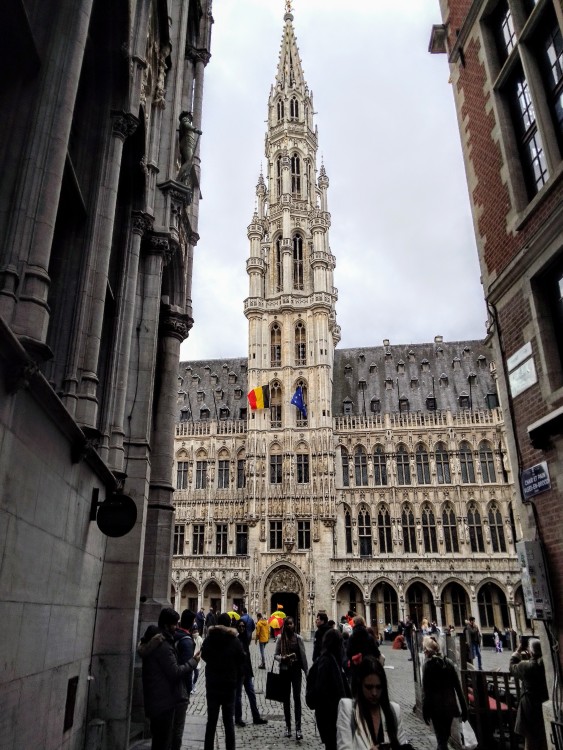
The Stadhuis van Brussel, last year

This means we have an attachment to Brussels. Our first trip we stayed just outside the city centre. The weather was very warm and dry, and we found ourselves in the Grand Place in front of the Stadhuis van Brussel (town hall). The square is lined with bars with inviting umbrellas, and as it was a hot day we decided that a beer at 11am wasn't a decision that needed much thinking about. We ordered, and on receiving Susan's order the waiter said "it's a tripel" in a warning tone of voice. Susan took the attitude that she was an Aussie and beer didn't frighten her and said "yeah yeah", only to discover she had half a pint of beer so strong it made her gums go numb. Before lunch.

Jolly japes.

When we visited Brussels with Lisa last year we had to go back to the Grand Place. It's a pilgrimage to the place where we started to realise they do things different over there.

Friday, 16 February 2024

Walking From Etableau

On Monday 12 February we joined the Phoenix en Claise walking group on a 5.5 kilometre circuit from Etableau, up to the Chateau de la Vienne, across to Courvault then back to Etableau on the voie verte (greenway). It took us an hour and a half.


 The wicker (Fr. osier) weaver's workshop in Etableau.

Wicker weaver's workshop, Indre et loire, France. Photo by loire Valley Time Travel.


The walking group approaching the 19th century Chateau de la Vienne (privately owned and not open to the public).

Walkers approaching the Chateau de la Vienne, Indre et loire, France. Photo by loire Valley Time Travel.


Snowdrops Galanthus sp are out everywhere in the Claise Valley at the moment. It's hard to know if these are native or naturalised.

Snowdrops Galanthus sp, Indre et loire, France. Photo by loire Valley Time Travel.


The gable end of this barn in Courvault is constructed mainly of flint.

Barn built of flint, Indre et loire, France. Photo by loire Valley Time Travel.


The hamlet of Courvault.

Courvault, Indre et loire, France. Photo by loire Valley Time Travel.

Thursday, 15 February 2024

Renovation Update

We've written bits and bobs about the insulation and lining of our salon and bedroom, so it's time to give an overview.

The exterior walls of the rooms are being given 120mm (5 inches) of insulating rockwool, which has heat and acoustic insulating properties. It should keep our bedroom cooler in summer, as well as retaining heat in winter. It's all being hidden behind a plasterboard wall on a metal frame. Of course it will reduce the size of the rooms - quite surprisingly so - but the house should be much more liveable.


The builders arrived on Monday last week and started immediately in the salon. I realised that if we wanted to have a stone wall in the salon I should remove the concrete before work progressed too far. This involved two evenings of bashing my thumb (and occasionally a cold chisel) with a hammer, the tidying away the rubble before the builders arrived next day. It was dirty and dusty work, but the end results should be worth it. It already looks a lot better, but now the stones and the gaps between them need cleaning with a wire brush.


By Friday most of the insulation and much of the plasterboard had been installed so it was time for Stan the electrician to do his first fit. Over the weekend I attacked the fireplace in the bedroom, then worked continued on the remainder of the walls and the ceilings.


By yesterday evening we had reached this stage: the walls and ceiling of the bedroom are 90% insulated and plastered (and the joints done) while the salon only awaits a ceiling. Then the electricity has to be finished, then sanding and painting the walls, sanding and varnishing the floor of the bedroom, scrubbing the tiles in the salon, and doing the pierre apparent - also in the salon.


Wednesday, 14 February 2024

Walking From Maire

On Monday 5 February we joined the Phoenix en Claise walking group for a 6 kilometre circuit from the small pretty village of Mairé, overlooking the Creuse River. This is always a challenging walk, as it includes the most elevation change of any of our local walks. We had to struggle up a further 145 metres from our start point -- nowhere else has this much climbing! And it was very muddy in places. We had to stop twice to lever  mud off our boots with sticks we found at the side of the track. The walk took one and three-quarter hours, including fording streams, climbing hills, taking photographs and shedding mud build ups.


Mairé town hall and war memorial.

Town hall and war memorial, Vienne, France. Photo by loire Valley Time Travel.


The main street of Mairé and looking down into the Creuse Valley.

Maire, Vienne, France. Photo by loire Valley Time Travel.


Palms in a front garden in the village (I assume Windmill Palm Trachycarpus fortunei).

Palms in garden in central France. Photo by loire Valley time Travel.


A view from the heights.

View, central France. Photo by loire Valley Time Travel,


Fording a stream...

Fording a stream, Vienne, France. Photo by loire Valley Time Travel.


...because the foot bridge looks like this...

Broken footbridge, Vienne, France. Photo by loire Valley Time Travel.


Abandoned agricultural machine.

Abandoned agricultural machine, Vienne, France. Photo by loire Valley Time Travel.

Tuesday, 13 February 2024

A Renovation Bonus

(Some photos may not be in full focus. It's the dust in the air confusing the camera)

Back in October 2009 we had the fireplace in our salon replaced with a brand spanking new old recuperated fireplace. We were sad to see the dark red marble fireplace go - but less so when we discovered that it was painted concrete.

In our bedroom, which is currently being insulated, we have a red marble fireplace which we assumed was the same arrangement. When we were clearing the room so the builders could do their thing Gael said "oh! It's stone" and our plan of removing the fireplace was put on hold while we had a brief period of reflection.* We didn't know what stone, or if the whole construction was stone, but chips in the paintwork led to a suspicion on my behalf it was local tuffeau.


On Saturday I stopped thinking and grabbed my  sander to have a proper look see at what the fireplace is made of. I have no idea what the paint was, but I suspect it was lead based, over a black sealant/primer. It was very hard - harder than the stone it was applied to. It made an incredible amount of black dust - followed by even more white dust as I smoothed the stone.

You want dust? We have dust!

Seven hours of work, 29 sanding disks, 1 orbital sander and 3 vacuum cleaner bags later we have a 90 million year old late 19th century fireplace. The finish wouldn't please a stone mason, but I had to get it done before the workmen arrived on Monday.


Pleased? I should co-co!

*We're good at putting things on hold while we have a brief period of reflection. That's how come the house still isn't fully restored after 15 years.

Monday, 12 February 2024

A Meal With Ukrainian Friends

Some weeks ago our friends Antoinette and Niall replaced their television, and asked me if one of 'my' Ukrainians would like their old one, which still worked perfectly as a television but wasn't as modern and connected as a new one. I knew my Ukrainian friend Natacha D had been without a television since she and her family arrived as displaced persons in April 2022 so I offered it to her.

A meal with Ukrainian refugees in France. Photo by loire Valley Time Travel.

Natacha now lives in Tours because her teenaged children will have better opportunities there. Her son M is training with the firefighters (perfect for him as he is very sporty and not at all academic) and her daughter V is attending high school (lycée). We don't have a high school in Preuilly, and most kids board during the week in Tours or Loches.

Ukrainian refugees in France. Photo by loire Valley Time Travel.

I messaged Natacha to say Simon and I would drop by with the television late morning. Natacha promptly messaged back to say 'don't eat too much for breakfast, I'm going to make something!' I thought she meant a cake for morning tea, but it turned out she meant a proper Ukrainian meal, with kotleti (Ukrainian rissoles), potatoes topped with cheese and baked in the oven, chunks of red pepper, cucumber and tomato, blue cheese and olives, plus homemade pizza, washed down with soursop tea. What she didn't realise was that we were due to go to lunch with a colleague after visiting her! So that was two lunches! I tried to stick to mostly salad in both cases...

Ukrainian meal, France. Photo by loire Valley Time Travel.

We talked a bit about how things were going. She's doing an internship in a small neighbourhood shop. V is doing very well at school and all her teachers are impressed. They had just come back from Romania, which is where her parents have fled to. She said it is very hard for her parents as they are in their mid-seventies and there is no State financial support in Romania. So they find themselves working in a paint factory. She also showed us a video from her cousin's wife as she planted a flag to remember him by in Maidan Square in Kyiv. He was killed not so long ago. Her cousin had been a strawberry farmer. By chance his flag was being planted very close to an Australian flag and some International Brigade flags. M and V's father is still in Mykolaiv where they come from. It's a big river port city in the east, on the Dnipro. He has found work as a window fitter. There is a lot of call for new windows because of the shelling, but he is afraid of heights, so it is not his ideal job. He had sent a huge box of Ukrainian lollies (candies, sweets) and Natacha sent us on our way with a big bag of them, and some of the soursop tea leaves. She says she won't return to Ukraine if the Russians take power.

Saturday, 10 February 2024

Cement Tiles

I wrote yesterday about having to remove the plinth in our salon before the builders arrive.

The tiles in the salon are one of the things we really liked about the house when we first looked at it. They are cement tiles, very fashionable in the first half of the 20th century. The pattern layer is about 6mm thick, with a plain cement backing. They are often confused (especially by us, who were convinced) with encaustic tiles which are glazed clay tiles with a deep embedded pattern and fired in a kiln. Cement tiles are much more durable and don't need firing 


The tiles are made by forming a pattern in a metal mold with mineral pigments in Portland cement. A thick layer of ordinary cement and sand is laid over that, and the whole is compressed at very high pressure. Our tiles were made by a company called B&C in Tours. I have managed to find out nothing about them.


We weren't looking forwards to removing the plinth as we had been told the tiles were the very devil to remove because they are laid on a surface with cement. Luckily (or unluckily) our plinth was cemented directly to soft(ish) limestone, so came away easily. What might not be so easy is removing the cement used to mount the tiles from the cement of the tiles themselves.

The red lines show the thickness of the tile - between the yellow lines is the pattern layer and the blue lines the backing cement. The white lines show the cement used to mount the tile, which has to be removed


We managed to remove about 60% of the plinth tiles unbroken, plenty enough for the feature band we want to reinstall. The floor tiles themselves are remaining in place, to be thoroughly cleaned.

Friday, 9 February 2024

Another set of renovations

People who follow us on Facebook will know we are having renovations done on the house. The work started in March last year with the windows.

On Monday the professional crew arrived to insulate our bedroom and the salon, but that was not the start of the current phase. First we had to empty both rooms, remove the plinth (skirting board) and demolish tatty old inbuilt wardrobes in both rooms.

The plinth in the salon. We're hoping to reinstate some of these on the new walls


We were not looking forward to it, and I was apprehensive about having to be both efficient and effective. Luckily, Susan had asked around town, and our friend Gael came over on Friday afternoon to help us move furniture and destroy stuff. We had allowed ourselves 2 days, but with Gael's assistance it was done in 5 hours.

Gael and I shift furniture out through the window. It's bigger than the door

Gael carefully removing the plinth


Because our bedroom had been dismantled we were lacking somewhere to sleep, but lovely Lisa and sensible Simon offered us their house in Boussay for however long it takes. So now we're installed in Boussay with warmth, comfortable beds and a lot less dust than we'd be experiencing at home.

Both rooms empty and awaiting the arrival of the professionals


Work is progressing well, we'll keep you informed!

Thursday, 8 February 2024

A Baby Girl is Born

 In January I posted about the Franco-Ukrainian Christmas party, and happened to mention that one of 'our' Ukrainians was pregnant and in fact due to give birth before the end of the month. I'm pleased to announce that little Arina arrived a fortnight ago and mother and baby are doing well. Mum is supported by her own mother, which is good, since it is her first child. Dad is on the front line.


A beautiful little cardigan and two soft baby blankets arrived in the post.

Hand knitted baby clothes, France. Photo by loire Valley Time Travel.

After I posted a link on Facebook, someone got in touch with me and said she would like to send some hand knitted baby items. I thought initially that she was one of the very many very nice people out there whose heart is going out to the Ukrainians, and who want to make some gesture to help. It turned out she has a very personal reason for wanting to help, which I won't divulge, as it is private. But it did add a whole new layer of significance to the gift.


Proud Dad (who got a few days leave to come and meet his daughter), Grandma and Mum with baby Arina. (Bertrand with camera in the foreground.)

Ukrainian baby in France. photo by loire valley Time Travel.

Wednesday, 7 February 2024

A Longtime Reader Is No More

Regular and longtime readers of the blog will no doubt be familiar with comments from someone calling themselves 'chm'. This is our old friend Charles Henry Michel, resident in the US since the seventies, but French born and raised. I learnt yesterday that he died on Friday. He was 99 years old, and had been bedridden, living in an aged care home (and complaining about the food) for several years.


A gathering of 10 different nationalities of bloggers at our place in June 2012. Charles Henry is fourth from the left, standing in the back row, next to Simon and behind me.

International party in France. Photo by loire Valley Time Travel.

He had been reading the blog, and adding his thoughts, insights, anecdotes and opinions on a frequent basis since 2007, so almost from the start. He found us through his friend Ken's blog Living the Life in Saint-Aignan. Saint-Aignan sur Cher is not that far from us, and it was Ken who introduced us in person when Charles Henry came to visit.

He was a tall, charming, elegant and handsome man, even in his 80s when we first knew him, always dressed in white, with a good head of white hair and a beard. He had grown up in a family of artists and doctors from what I understood from his stories, and every year until his health prevented it he would spend the summer in France.


Charles Henry, centre, with Ken on the left and me with my back to the camera, in Saint Savin in June 2009.

Cafe in Saint Savin, Vienne, France. Photo by loire Valley Time Travel.

I knew I could count on him if I had a question about mid-20th century French life, or the proper way to prepare some delicacy, or for a steer towards extra information about some historical object or place. There wasn't much about French culture he didn't know about or wasn't interested in, and he was always willing to share his knowledge and experience.

Curious and generous minds like his are always a loss, and the blog and our lives are richer for having him involved, and will be poorer having lost him.

Tuesday, 6 February 2024

Long in the Tooth

The other day I went to the dentist for my more or less annual checkup. I'm very lucky to have a dentist. He's a youngish Romanian guy who came to Preuilly several years ago when the previous dentist retired. I signed up immediately and lucky I did. Nowadays it is nigh on impossible to get on to any dentist's books. 

My dental record, with the missing tooth top left in the schema, which is the way the dentist looks at them (top right in real life).

Dental record, France. Photo by loire Valley Time Travel.

The dentist was in a genial and chatty mood, and asked what was up. I responded that there was nothing the matter, so he nodded and said 'good, just a checkup then' (in French, a checkup is 'un contrôle'). After checking my teeth one by one he informed me that I was a very good brusher. 'How old are you now?' On being told I was 64, he said there was no reason I shouldn't go to my grave with all my own teeth. Except for the one he had to remove last year, which I had somehow cracked.

Then he asked me how come my French is so good. As one does when one is a foreigner, we are both operating in our second language. He does speak English, and would do so if I asked, but we get along just fine in French.

Monday, 5 February 2024

Another Local Food Certification

In 2014 Centre Val de Loire Region introduced a new food certification in order to promote quality locally produced food and the Region's gastronomic heritage and terroir. It is called © du Centre. The idea is that it provides the consumer with a guarantee of the quality of the product, backed up by the producer's knowhow and respect for the environment. 


Billboard at the bus stop advertising the © du Centre regional food certification.

Bus stop billboard advertising for Centre Val de loire regional food certification, Indre et loire, France. Photo by loire Valley Time Travel.

The hope is that it will support the local economy, safeguarding jobs and businesses. And hopefully more people will be encouraged to buy local because it's great fresh and healthy food. Products will be easily identifiable because the © du Centre logo will  be prominently displayed on the label. Or that's the theory, anyway. Of the half dozen producers I know and use that have signed up, none seem to use the logo anywhere I've noticed it.


https://www.cducentre.com/adherents/gaec-limouzin/

Sainte Maure de Touraine goats cheese, Indre et Loire, France. Photo by Loire Valley Time Travel.

The producers have the usual strict set of rules to adhere to, especially in terms of their treatment of the environment. The product must be healthy, sustainable and local. The label is a guarantee that the product is grown and made in the Region, with ingredients mainly sourced locally. Products must also carry another certification to ensure their gastronomic quality, such as AOC, IGP, Label Rouge, AB, Viennoiseries 100% maison, Boulanger de France or Ici on fabrique les pâtisseries and not contain any synthetic additives.


https://www.cducentre.com/adherents/laiterie-de-verneuil-627005cede1c8/

Faisselle (like cottage cheese), Indre et Loire, France. Photo by Loire Valley Time Travel.

The certification is the brainchild of the Regional Development Agency DEV'UP. I'm not sure there has been much take up in 10 years and whilst I sympathise with their desire to make a brand that clearly identifies good products from Centre Val de Loire I suspect that it is seen by most people, producers and consumers alike, as being a bit superfluous.

It seems to me that quality certification labels for food are really only useful when food is shipped and sold outside of the area it is produced in. But in these days of short food chains and locavores what is important is having direct access to producers. Consumers can and do verify for themselves that the production methods and quality of the produce is to their satisfaction. Farmers markets and direct sales are a very important part of this process in my opinion.

Further reading (in French): https://www.cducentre.com/

Saturday, 3 February 2024

Unblogged 2023 - Gambrinus

When we were in Belgium we went to Leuven with Lisa. We had lunch at Gambrinus, a bar restaurant in the Grote Markt.

It's very olde worlde, with wood panelling, copper chandeliers, and faded murals. What sets it apart are Bavarian wall paintings and the inscription Bürgerliches Brauhaus München. The original owners were granted exclusive rights to sell Munich beer, which saved the cafe during the destruction of Leuven by the Germans in 1914. In 1932, the owners relocated to the main square, reconstructing the old interior.


Our lunch was stoomp and sausage, a warming and filling meal on a cold winter's day.


Friday, 2 February 2024

The View From the Orchard

This is the view I get from the orchard now, as the project to repurpose the old furniture factory site into a photovoltaic solar energy farm steady progresses, clearing the site and now adding access tracks and fences. For some reason, solar farm projects produce much less angst amongst the French populace than terrestrial wind farm projects.

Work building a photovoltaic solar energy farm, Indre et loire, France. Photo by loire Valley Time Travel.

The Total Quadran project will occupy 8.6 hectares (4.12 hectares of photovoltaic surface) on the Prés du Maine, on the south facing slope just the other side of the stream that runs along the front of our orchard. It is estimated that the panels will produce enough electricity (excluding heating) for 7786 households. So that's well more than the entire municipality covered. 

In other orchard news, Sylviane, who owns the neighbouring field and the Moulin du Chanvre across the road, has got halfway through the mowing. This is good news as it means that the part to repair her slasher has finally been delivered. She and I have an arrangement about the mowing and she does it in return for apples.