Thursday, 16 April 2015

Catching the Train to Saint Jean de Luz

You can tell we're busy - I am writing little blog posts.

And today we are back in the station of Tours, which has a series of 18 painted ceramic panels decorating the walls, their purpose being to beautify the station concourse and entice travellers to the destinations portrayed. At present the panels are being conserved: each panel will cost €8000 to clean, conserve and reattach the tiles to the walls. The fundraising campaign started last year to raise some of this money. In order to publicise the fundraising, last year we started posting photos of the panels.

This is one of the panels which has
been removed for restoration
St Jean de Luz is half way between Biarritz and the spanish border. To get there by train from Tours you catch the shuttle to Saint Pierre des Corps, then a couple of TGV: the first to Bordeaux, and the second to St Jean de Luz.


One day we will travel down this way: for the past couple of years it's been a bit of an ambition to visit la Petit Train de la Rhune, a tramway which take you to the top of the Pyrenees. Last year we would have done so, except stuff happened, and the year before we would have but we didn't (can't remember why, probably stuff happened then, as well).

Maybe this year.  Stuff can't happen every year.

Surely....

Wednesday, 15 April 2015

Lost in Translation

I bet you're glad you asked for the english menu...


*************************************************

Tonight and for the next few days there is a chance of some seriously good International Space Station action if you're in France. Do it, and then ponder on just how amazing science is.

Tuesday, 14 April 2015

Canola Gold

The canola (Fr. colza) is in flower again. I'm not a big fan. It's acid yellow which is hard on the eyes, it stinks of cabbage (to which it is related) and it gives me hayfever. It's widely grown as a crop here to produce oil, biodiesel and a high protein stock feed (which is actually a by-product after the oil is extracted). Only palm and soybean are more important globally as oil producing crops. The EU is the biggest producer, followed by Canada and the US. It is favoured as a source of biodiesel because canola produces more oil per hectare than other oil seed crops and freezes at a lower temperature than other oils.

A typical April sea of canola in the Touraine.
Bees love it and many of the apiarists here will sell a pale creamed or set honey labelled colza. The honey crystalises easily, which is a nuisance for the beekeeper and the crop can cause a boom and bust situation in the hive. It flowers relatively early, but doesn't last very long, so if the bees don't have anything to move on to it can be a disaster for them. On the arable farms where canola is grown crop margins where wild flowers might grow are getting smaller and smaller. These days the bees are in real danger of starving after the canola finishes flowering.

Roe Deer like canola flowers too.
Canola is prone to fungal diseases as a crop and is typically sprayed with fungicide about 8 times between late August when it is planted and early June when it is harvested.

The Chateau of Montpoupon through the canola.

The view from our guest bedroom window every alternate April.
************************************************
A la cuisine hier: ANZAC biscuits, which are notorious for spreading all over the oven tray. I managed to judge the spacing quite well, with only a few joining up at the edges.
***********************************************
Au jardin hier: Onions, garlic and broad beans weeded and watered. Mangetout (snow peas) sown (I figure that if ordinary peas have failed to oblige by not germinating after two sowings I might as well see if mangetout will come up instead). Strawberries planted. Brassicas and lettuce seedlings planted. I've set up a fleece tunnel for them. It's an experiment to protect the lettuce from frost and the brassicas from caterpillars.

Monday, 13 April 2015

Tulips at Cheverny

Last year the 60 000 tulips planted in the grounds of the Chateau of Cheverny came into bloom about a month before they were expected to, somewhat to the chagrin of the management, who erected temporary signs apologising to anyone who inadvertently mistimed their visit and missed the mass of colour.

Luckily, we had clients who booked for early April. She was an professional artist and he a keen amateur photographer, so they were in luck and delighted.

The photos above are a few of the ones we took on 2 April 2014. The one below is one we took when visiting with clients 10 days later.

Still magnificent, but anyone who arrived over the Easter break, a full fortnight after this, would have been disappointed.
 
This year the chateau has planted 100 000 bulbs and again, we've managed to visit with clients at just the right moment. The photo above was taken on the warm sunny morning of Friday 10 April 2015.
************************************************
A la cuisine hier: Lamb ribs in a lemon, coriander and brown sugar glaze. I bought a lamb forequarter just before Easter and this is another of my attempts to make breast of lamb edible. This recipe steams the ribs for an hour and a half before glazing and grilling. The taste and texture is terrific, but it's still fairly greasy. Simon loved it and ate all of his plus most of mine.
***************************************************
Au jardin hier: Simon has done up our window boxes for this year. We are having double red pelargoniums and mixed pansies.

Sunday, 12 April 2015

Insects of the Interior

An antlion.

A moth.

These beetles very quickly buried themselves in the gravel as I approached. They made a very audible and agitated squeaking noise too.
A selection of insects I photographed near a public toilet in the middle of nowhere in central northern Australia. So long as you don't get arrested as a pervert, public toilets are excellent places for observing the local insect fauna. They are attracted to the lights.

*****************************************

A note from Simon: Congratulations to my brother, who finished 9th in the 2015 North Pole Marathon in 7:23.04. I guess we are all a bit mad in our own way.

******************************************
Orchard News: Onions and garlic doing well. Plums, apricot, nectarines, peaches and almond flowering or finishing flowering. The sweet cherries have just started, sour cherries still buds and it's too early for the apples and pears (although one of the pears is showing white petals). 

No sign of orchid flower bud spikes yet, but lots of leaf rosettes (6 species up so far). 

I picked a couple of meals worth of chard (silver beet) and prepared a bed for the strawberry plants Colin and Elizabeth gave me.

Lots of small ground beetles in the potager and best of all, several Glanville Fritillary caterpillars were spotted. They were just mooching around on their own, not in a group, so I would guess pupation is imminent.

Saturday, 11 April 2015

Getting a Buzz

It turns out that bees like a buzz. They are attracted to flowers that give them a bit of caffeine along with the nectar. The flowers of plants such as coffee and citrus have nectar laced with tiny hits of substances like caffeine and nicotine.

 A Honey Bee on Linden (Lime) tree flowers.
For it to be beneficial to the plants they have to give the bees just the right amount -- enough to give them a buzz, but not enough to give them the jitters. The levels are about one thirtieth of the levels in instant coffee. Flowers with this low level of caffeine are significantly more popular with bees than those with none or those with high levels.

 Violet Carpenter Bee on Pigface (Hottentot Fig) flowers.
Experiments show that bees fed a little bit of caffeine learn more quickly and have longer memories, so the caffeine is giving them a foraging advantage. The plants of course benefit by being more attractive to the bees, therefore increasing their chances of pollination.

Café gourmand at La Table d'Ysoa in Monts.

Friday, 10 April 2015

Going Mobile

Claudette and Calder in Saché
While we were in Saché last Monday with clients we were approaced by a local, who first admired the car (natch) and then said (in French, also natch) "So you've come to see the Calder?". Apparently Calder was well known in the village and they were drinking companions. The clients were most impressed with the way riding in a classic car broke the ice, and we were interested to learn more about the famous American artist who chose to live and work in a small French town.


Thursday, 9 April 2015

Blessed are the Cheesemakers

Lots of visitors to the Touraine Loire Valley would like to visit a goat dairy, sample some cheese, pet the goats and see the cheese being made. This can prove more difficult than it sounds if you are not familiar with the area and especially if you don't speak or at least read French. Even when visitors do manage to find and visit a farm, the experience is not always quite what they are expecting. Often farms do not have the resources to show visitors around and many places are unwilling to offer tastes even if they sell cheese from the farm shop.

I thought it might be useful to provide a list of cheese producers who in our recent experience are friendly, approachable and happy to receive visitors who want to do more than just buy cheese. All of these places are working farms or cheese dairies. Some charge a fee to visit, but many do not. In the latter case it is polite to buy some cheese at the end of the visit as an acknowledgement of the time they have generously given over to you.

 Dairy goats at Patrice FrĂ©mont's farm near Charnizay.
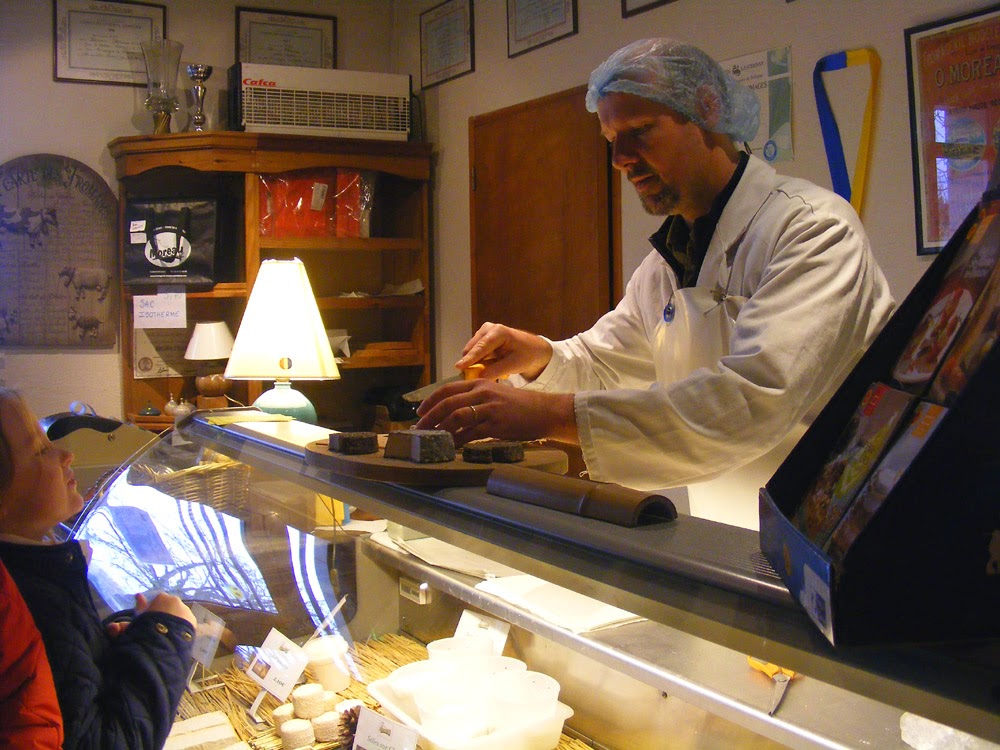
Fromagerie Moreau: Occupying a 19th century farm complex in Pontlevoy, they make AOP Selles sur Cher and AOP Sainte Maure de Touraine goat cheese, as well as a range of non-AOP goat cheese. There is a farm shop stocking local products such as terrines, preserves and wine. Visits can range from just popping in to the shop (which you don't need to book) to watching the cheesemaking and visiting the goats on a nearby farm (which does require booking and is not available on Mondays or at certain times of day). The fromagerie is owned and run by Jean Luc Bilien, who speaks English. I particularly like their Selles sur Cher and wrote about our visit here. Nearest chateau: Cheverny.

Ferme du Cabri au Lait: Situated near Sepmes, this farm makes organic AOP Sainte Maure de Touraine goat cheese. Owners Claire Proust and SĂ©bastien Beaury don't come from a farming background, but the farm is the fullfilment of their dream to live on the land. From the beginning one of their aims has been to teach others about goats and goat cheese, so they run frequent open days, workshops and full guided tours of the farm followed by a tasting session. Their 'discovery' tour lasts about 1.5 hours and is usually on the weekend as they have other commitments during the week. They charge a small fee (€3-€4). Booking is essential. Claire speaks English. Nearest chateau: Azay le Rideau.

Goat cheese on display at the Fromagerie Moreau shop.
Ferme de la Fringale: Making AOP Valencay at Veuil this farm is in the process of transitioning from one generation to the next. Owners Chantal and Alain Chichery are handing over to a new young female cheesemaker, who speaks English. We have their cheese often, as they are friends of our mechanic and he frequently turns up with some. This is my favourite goats cheese. An appointment is advised if you want to visit the farm. Slow to respond to email, so book by phone. Nearest chateau: Valencay.

Limouzin freres: This is our local goat farm and cheese producer, making prizewinning AOP Sainte Maure de Touraine near le Petit Pressigny. They are fairly relaxed about impromptu visits, but I am sure making an appointment will always be appreciated. Slow to respond to emails so book by phone or in person at Preuilly market on Saturdays. One or two members of the family speaks English, but they are not involved with the goats so may not always be available. I wrote about our visit to the farm here and here. Their cheeses are also available in local supermarkets and at La Charrette, the farmers co-operative shop at the agricultural high school in Tours. Nearest chateau: Le Grand Pressigny (the museum of prehistory).

Scooping cheese into moulds at Fromagerie Moreau, photographed from their viewing passage.
Patrice Frémont: An AOP Valencay producer near Charnizay, his cheeses are very delicate in flavour and he is an absolute stickler for hygiene (the only farm we visited with a water purification unit, for example). He used to do a lot of visits, but in the last few years has really scaled it back. He is very friendly but doesn't speak English. Booking by phone is essential. Call at the house next door (that you will have passed on your way to the parking area) on arrival if he is not at the fromagerie.

Ferme du Carroire: The Vandooren family make a range of non-certified goat cheese, very popular in the area. The farm is situated in the Brenne, near Martizay. They are friendly and speak a little English. They have several open days a year, but can be visited outside of those days as well. Appointments preferred but probably not necessary. Nearest chateau: Azay le Ferron.

 Sainte Maure de Touraine goat cheese and 
Chateau Gaudrelle Brut Tendre sparkling wine.
Chateau Gaudrelle: Occupying caves right on the Quai de Loire in Rochecorbon, this boutique Vouvray wine estate offers wine and cheese pairings (€20/person, Selles sur Cher, ComtĂ© and Forme d'Ambert) or wine and local specialities (€8.50/person, Sainte Maure de Touraine and rillettes) tastings. Booking is essential. All staff speak English and one of the owners is also a highly respected cheesemonger. Tasting sessions last about an hour. Nearest chateau: Amboise.

 Goats cheese after a tasting session at Fromages du Moulin (Rodolphe le Meunier).
Loches Market: Twice a week, on Wednesday and Saturday mornings this popular produce and general street market has 4 local goats cheese producers, a cheese truck with cheese from all over France and a specialist mountain cheese seller, as well as sometimes others. The goat cheese producers include at least one whose goats are on pasture, not always indoors, and an organic producer. They are not necessarily AOP certified, but this does not mean the uncertified cheese is lower in quality, just that the producer is small enough not to want the extra expense and admin of certification and sells all his produce locally where his reputation is high. All the stalls are willing to offer samples and are very friendly and approachable, but there is an increasing disgruntlement amongst the stallholders against people who try and don't buy (especially if the taster praises the cheese and still doesn't buy...This is considered to be a very anglo thing to do). Only the mountain cheese seller speaks English. Nearest chateau: Loches.

Les Fromages du Moulin: Occupying an old mill complex in La Croix en Touraine this is not a cheese dairy but a cheese refining facility, where carefully selected cheeses from producers all over France are matured. The business is headed by the highly regarded affineur Rodolphe le Meunier, who speaks English (as do his wife and at least one other member of staff). He offers tours of the maturing cellars and tasting sessions of 6 cheeses plus local wine for a fee of €30 per person (minimum number 4 people). Booking is essential. Usually takes several days to respond to email. Rodolphe's cheeses can be sampled in a select group of local restaurants (eg Domaine de la Tortiniere, Auberge de Launay) as well as internationally (eg Bouley, New York City). He also has a shop in Les Halles (the covered market) in central Tours, run by his sister Caroline and they have a stall at several local markets (eg BlĂ©rĂ©, Amboise, Chinon, Vouvray and Blois). His cheese can also be bought in LeClerc supermarkets. Nearest chateau: Chenonceau.

Wednesday, 8 April 2015

Farms and Pharma, Castles and Cosmetics

Since 15 January this year our region is now officially Centre-Val de Loire. The region has been pushing for this change of name from the anonymous Centre for some time. It was a real disadvantage touristically because many overseas tourists assumed, understandably, that the famous chateau such as Chenonceau and Chambord and the UNESCO World Heritage area were in the region called Pays de la Loire. Centre was dull and touristically meaningless.

The Chateau of Amboise -- not in Pays de la Loire!
The Centre-Val de Loire region is made up of 6 départements (Indre et Loire, Loir et Cher, Eure et Loir, Indre, Loiret and Cher) and includes the old provinces of Touraine and Berry as well as the culturally related 'sub-provinces' of the Perche, the Sologne and the Brenne, which are the names many locals will use to indicate geographic locality.

Barley makes a beautiful crop in Centre-Val de Loire.
The region covers 39 151 km² and is bigger than Belgium (and a bit under half the size of Tasmania). There are 2 560 000 inhabitants with an average density of 65 people per square kilometre (Tasmania has just over half a million population and a density of 7 people per square kilometre). The gross regional product is €65 million (Tasmania's gross state product is around AU$22.5 million, or around €15.5 million).

Centre-Val de Loire is the biggest cereal producer in Europe, the biggest producer of medications in France and the biggest producer of cosmetics in France.

**************************************

For details of our private guided tours of chateaux, wineries, markets and more please visit the Loire Valley Time Travel website. We would be delighted to design a tour for you.

Tuesday, 7 April 2015

Fromagerie Moreau Pontlevoy

The Fromagerie Moreau is conveniently situated in a 19th century farmyard right in the small town of Pontlevoy. For the past 4 years it has been owned and run by Jean Luc Bilien. When the Moreaus wished to retire Jean-Luc purchased the fromagerie part of the business and their farmhand purchased the goats.

Topping up Selles sur Cher moulds. 
All that curd will drain down to about a third of the mould.
Now the goats live on a farm about 4 km away and the farmer supplies Jean-Luc exclusively with milk for the cheese. The fromagerie makes AOP Sainte Maure de Touraine and Selles sur Cher cheeses. They are classed as artisanal, as the cheese is made from milk purchased from the farm ie they are two separate businesses, not all under one roof.

Experiments and special orders tucked away in a corner of the drying room.
Jean Luc originally trained as an agronomist, but when he left university he went to Brazil and ended up working in a cheese factory, training on the job as a cheesemaker. When he and his Brazilian wife and their children returned to France to live he wanted to make cheese in a less industrial fashion and so he bought Fromagerie Moreau.

The fromageries AOP cheeses, 
Sainte Maure de Touraine logs and Selles sur Cher disks.
Almost all of the cheese is sold in Paris, loaded into the fromageries own trucks and delivered to cheese shops and restaurants all over the city on Mondays. Only 4% of the cheese is sold direct from the farm or at the weekly market in Montrichard. Nevertheless, Jean Luc is happy to welcome visitors to the fromagerie.

The non-AOP cheeses, faisselle (fresh curd), pyramids, pavés and crottins.
There is a well stocked shop selling his cheese and other local artisanal products such as wine, onion and fig preserves, honey and terrines. The cheese is not sold by weight but by the piece. Alongside his AOP cheeses he also offers pavé de Pontlevoy, crottins and pyramids.

Jean Luc carefully cutting tasting samples.
If you are interested you can also watch the cheese being put into moulds, and if there is a group of you and you book, you can do a full tour which includes visiting the farm and the goats. Jean Luc has converted part of the longere building to a classroom and produced an excellent video that can be shown in either English or French so visitors learn about the entire process on the farm and in the fromagerie.

Selles sur Cher of different ages, for tasting.
He has a staff of 8 people, none of whom came from a cheesemaking background, and have all learned on the job. He is proud of them and quick to praise them and tell you what a great team they make.

Monday, 6 April 2015

Montrichard

We like Montrichard for many reasons, and these are three of them:

The medieval bridge (much repaired and obviously strengthened)
 The medieval houses (colombage in French, half-timbered in English)
This little summer house right on the corner. I want one.
*********************************** 
Nature News: 'Our' swallows have arrived. Two were observed sitting on the phone wire in front of our garage, nattering to one another. No investigation of the garage as nesting site was observed though. They did however take the opportunity to poo on Claudette when she was parked in the driveway.

Sunday, 5 April 2015

Moon Over the Marbles


My Dad silhouetted in the evening sun and the moon rising over the Devils Marbles in central Australia.

Saturday, 4 April 2015

Following Brock's Trail

On a recent walk around Braslou with Colin and Elizabeth we encountered many signs that badgers are thriving in the area. The hole above went down for nearly a metre in the chalk, then took a sharp right turn.

The landscape is laid out before you on the chalky hill behind Braslou where the badger has dug several individual dens, although there was no indication there was a family with a multi-chambered and exited sett.

The badger has left clear footprints in the muddy clay track that runs up the hill through the fields. You can see how long the claws are and that gives you some idea of how the animal has excavated the sizeable chunks of stone in the first photo.

Down below the hill the soil changes entirely to sand and the moles are obviously working hard. The badger has walked through the area on the path, again leaving clear footprints.

Sadly I've seen lots of badgers in France, but they've all been dead at the side of the road. I've never seen a live badger in the wild in France. In fact, I've only ever seen a live badger once, galloping across the road in the middle of the night in Wales. It looked kind of like this famous image of a badger running.