Wednesday, 7 February 2024

A Longtime Reader Is No More

Regular and longtime readers of the blog will no doubt be familiar with comments from someone calling themselves 'chm'. This is our old friend Charles Henry Michel, resident in the US since the seventies, but French born and raised. I learnt yesterday that he died on Friday. He was 99 years old, and had been bedridden, living in an aged care home (and complaining about the food) for several years.


A gathering of 10 different nationalities of bloggers at our place in June 2012. Charles Henry is fourth from the left, standing in the back row, next to Simon and behind me.

International party in France. Photo by loire Valley Time Travel.

He had been reading the blog, and adding his thoughts, insights, anecdotes and opinions on a frequent basis since 2007, so almost from the start. He found us through his friend Ken's blog Living the Life in Saint-Aignan. Saint-Aignan sur Cher is not that far from us, and it was Ken who introduced us in person when Charles Henry came to visit.

He was a tall, charming, elegant and handsome man, even in his 80s when we first knew him, always dressed in white, with a good head of white hair and a beard. He had grown up in a family of artists and doctors from what I understood from his stories, and every year until his health prevented it he would spend the summer in France.


Charles Henry, centre, with Ken on the left and me with my back to the camera, in Saint Savin in June 2009.

Cafe in Saint Savin, Vienne, France. Photo by loire Valley Time Travel.

I knew I could count on him if I had a question about mid-20th century French life, or the proper way to prepare some delicacy, or for a steer towards extra information about some historical object or place. There wasn't much about French culture he didn't know about or wasn't interested in, and he was always willing to share his knowledge and experience.

Curious and generous minds like his are always a loss, and the blog and our lives are richer for having him involved, and will be poorer having lost him.

Tuesday, 6 February 2024

Long in the Tooth

The other day I went to the dentist for my more or less annual checkup. I'm very lucky to have a dentist. He's a youngish Romanian guy who came to Preuilly several years ago when the previous dentist retired. I signed up immediately and lucky I did. Nowadays it is nigh on impossible to get on to any dentist's books. 

My dental record, with the missing tooth top left in the schema, which is the way the dentist looks at them (top right in real life).

Dental record, France. Photo by loire Valley Time Travel.

The dentist was in a genial and chatty mood, and asked what was up. I responded that there was nothing the matter, so he nodded and said 'good, just a checkup then' (in French, a checkup is 'un contrôle'). After checking my teeth one by one he informed me that I was a very good brusher. 'How old are you now?' On being told I was 64, he said there was no reason I shouldn't go to my grave with all my own teeth. Except for the one he had to remove last year, which I had somehow cracked.

Then he asked me how come my French is so good. As one does when one is a foreigner, we are both operating in our second language. He does speak English, and would do so if I asked, but we get along just fine in French.

Monday, 5 February 2024

Another Local Food Certification

In 2014 Centre Val de Loire Region introduced a new food certification in order to promote quality locally produced food and the Region's gastronomic heritage and terroir. It is called © du Centre. The idea is that it provides the consumer with a guarantee of the quality of the product, backed up by the producer's knowhow and respect for the environment. 


Billboard at the bus stop advertising the © du Centre regional food certification.

Bus stop billboard advertising for Centre Val de loire regional food certification, Indre et loire, France. Photo by loire Valley Time Travel.

The hope is that it will support the local economy, safeguarding jobs and businesses. And hopefully more people will be encouraged to buy local because it's great fresh and healthy food. Products will be easily identifiable because the © du Centre logo will  be prominently displayed on the label. Or that's the theory, anyway. Of the half dozen producers I know and use that have signed up, none seem to use the logo anywhere I've noticed it.


https://www.cducentre.com/adherents/gaec-limouzin/

Sainte Maure de Touraine goats cheese, Indre et Loire, France. Photo by Loire Valley Time Travel.

The producers have the usual strict set of rules to adhere to, especially in terms of their treatment of the environment. The product must be healthy, sustainable and local. The label is a guarantee that the product is grown and made in the Region, with ingredients mainly sourced locally. Products must also carry another certification to ensure their gastronomic quality, such as AOC, IGP, Label Rouge, AB, Viennoiseries 100% maison, Boulanger de France or Ici on fabrique les pâtisseries and not contain any synthetic additives.


https://www.cducentre.com/adherents/laiterie-de-verneuil-627005cede1c8/

Faisselle (like cottage cheese), Indre et Loire, France. Photo by Loire Valley Time Travel.

The certification is the brainchild of the Regional Development Agency DEV'UP. I'm not sure there has been much take up in 10 years and whilst I sympathise with their desire to make a brand that clearly identifies good products from Centre Val de Loire I suspect that it is seen by most people, producers and consumers alike, as being a bit superfluous.

It seems to me that quality certification labels for food are really only useful when food is shipped and sold outside of the area it is produced in. But in these days of short food chains and locavores what is important is having direct access to producers. Consumers can and do verify for themselves that the production methods and quality of the produce is to their satisfaction. Farmers markets and direct sales are a very important part of this process in my opinion.

Further reading (in French): https://www.cducentre.com/

Saturday, 3 February 2024

Unblogged 2023 - Gambrinus

When we were in Belgium we went to Leuven with Lisa. We had lunch at Gambrinus, a bar restaurant in the Grote Markt.

It's very olde worlde, with wood panelling, copper chandeliers, and faded murals. What sets it apart are Bavarian wall paintings and the inscription Bürgerliches Brauhaus München. The original owners were granted exclusive rights to sell Munich beer, which saved the cafe during the destruction of Leuven by the Germans in 1914. In 1932, the owners relocated to the main square, reconstructing the old interior.


Our lunch was stoomp and sausage, a warming and filling meal on a cold winter's day.


Friday, 2 February 2024

The View From the Orchard

This is the view I get from the orchard now, as the project to repurpose the old furniture factory site into a photovoltaic solar energy farm steady progresses, clearing the site and now adding access tracks and fences. For some reason, solar farm projects produce much less angst amongst the French populace than terrestrial wind farm projects.

Work building a photovoltaic solar energy farm, Indre et loire, France. Photo by loire Valley Time Travel.

The Total Quadran project will occupy 8.6 hectares (4.12 hectares of photovoltaic surface) on the Prés du Maine, on the south facing slope just the other side of the stream that runs along the front of our orchard. It is estimated that the panels will produce enough electricity (excluding heating) for 7786 households. So that's well more than the entire municipality covered. 

In other orchard news, Sylviane, who owns the neighbouring field and the Moulin du Chanvre across the road, has got halfway through the mowing. This is good news as it means that the part to repair her slasher has finally been delivered. She and I have an arrangement about the mowing and she does it in return for apples.

Thursday, 1 February 2024

Walking From le Grand Pressigny

On Sunday 21 January I joined the local branch of the French Federation of Hikers (FFR) on a 5.5 kilometre walk around le Grand Pressigny, taking an hour and a half with a few photo stops and a brief rest at the top of a hill. It was cold, wet, windy and foggy. Luckily the walk was followed by galettes des rois, cider and contre peteries (French word games like Spoonerisms) in the Salle des Assos (club room).

After some discussion about the weather and cancelling, we set off.


Walking through the chateau/museum grounds.

Walking through chateau grounds, Indre et loire, France. Photo by loire Valley Time Travel.

Walking past the Museum of Prehistory.

Walking past the Museum of Prehistory, Indre et loire, France. Photo by loire Valley Time Travel.

The old entrance to the Chateau du Grand Pressigny.

Old entrance to the chateau du Grand Pressigny, Indre et loire, France. Photo by loire Valley Time Travel.

Holiday accommodation near the chateau, overlooking the village. It looks nice and gets good reviews. https://www.maisondhotesduchateau.fr/

Holiday accommodation, Indre et loire, France. Photo by loire Valley Time Travel.

Behind all these brambles is a former troglodyte cave.

Hidden former troglodyte cave, Indre et loire, France. Photo by loire Valley Time Travel.

Chateau du Grand Pressigny.

Chateau du Grand Pressigny, Indre et loire, France. Photo by loire Valley Time Travel.


Wednesday, 31 January 2024

The House of Bees

Recently I was invited to a private group visit of the Maison des Abeilles at Champigny sur Veude. It is a community project led by beekeeper Alain Pageard. 

View of the greenway, with crossing keeper cottage on left, the Sainte Chapelle centre and the plan d'eau beyond the vegetable garden on the right.

View of the greenway and Maison des Abeilles site, Champigny sur Veude, Indre et loire, France. Photo by loire valley Time Travel.

The former railway line between Richelieu and Chinon has been turned into a greenway (Fr. voie verte). At Champigny the old station building has been renovated and is now a small exhibition space to inform the public about the local area. The agriculture of the Pays Richelois was featured -- melons, asparagus, saffron, truffles and goat cheese. 


Eric (naturalist), Christian (president Botamyco37), Jean-Paul (maker and nature lover), Eric (nature lover), Jacqueline (artist), Alain (beekeeper), Francoise (beekeeper) and Cyril (naturalist).

Meeting of naturalists, Indre et loire, France. Photo by loire Valley Time Travel.

The goods shed has been taken over by the Maison des Abeilles, and Alain explained how the intention is to have a site which is integrated with the adjoining public spaces or attractions such as the plan d'eau (village pond) and La Sainte Chapelle de Champigny sur Veude. The land around the station is slowly being turned into a pollinator garden, with picnic area. Further down the track is the old crossing keeper's cottage, which may get turned into holiday accommodation. There are plans for a footbridge over the Veude to give better access to the plan d'eau from the Maison des Abeilles. And I was there to provide advice about an insect hotel.


 A bed sown with crops that are nectar rich, including flax (Fr. lin), phacelia, canola (Fr. colza), and field beans (Fr. fèves). Alain commented on how slug munched the canola was and how it showed why farmers treat canola with so many pesticides, which is problematic for beekeepers. Personally, I never buy canola honey.

Nectar plant seedlings, Indre et loire, France. Photo by loire Valley Time Travel.


Inside the Maison des abeilles (House of Bees). The idea is that it represents the inside of a hive. The wax comb is made of paving reinforcing grids for gravel paths. Genius I thought, and Alain was quite pleased with himself for having discovered it in yellow at the hardware store.

Inside the Maison des abeilles, Indre et loire, France. Photo by loire Valley Time Travel.


Old style bee hives. From left, made from cattle manure; wicker; chestnut staves with wicker and mud daub fill; woven rush (I think, but it might be hemp).

Old style bee hives, Indre et loire, France. Photo by loire Valley Time Travel.


Feral bee hives. On the left, in a tree trunk. The forester who cut this tree was very surprised to discover an active bee hive. On the right, two-thirds of a hive that had been living in a chimney for a decade. The wax at the top is black, old and no longer in use. The bees abandon sections of the hive successively as it gets dirty and unhygenic.

Feral bee hives, Indre et loire, France. Photo by loire Valley Time Travel.


Visible bee hive. This glass cabinet is connected to a regular hive outside by a tube and the bees will enter the cabinet and treat it like part of the hive. They'll fill it with wax comb and start storing honey and raising a brood there. Visitors can see the activity, and are invited to put their ear to the special holes to hear the activity.

Visible bee hive, Indre et loire, France. Photo by loire Valley Time Travel.


Beekeepers suits. Alain runs beekeeping workshops here which I'm told are excellent.

Beekeeping suits, Indre et loire, France. Photo by loire Valley Time Travel.


Tuesday, 30 January 2024

The Giant Goat Sculptures of Sainte Maure de Touraine

The good people of Sainte Maure de Touraine are clearly obsessed with goats.  Sainte Maure is the centre of the goat cheese producing world so I suppose there is good reason. One way this obsession manifests itself is in the creation and public display of giant goat sculptures.

Giant goat sculpture at cheese fair, Indre et loire, France. Photo by loire Valley Time Travel.

The first one I encountered was some years ago. It is papier maché and brought out every year for the June cheese festival in the town. It is somewhat animatronic, with teats that squirt 'milk'. I found it slightly disturbing and a bit creepy, but I'm sure one gets used to it.

Resin model of proposed sculpture of a goat, Indre et loire, France. Photo by loire Valley Time Travel.

Then in September I was shown a resin model at the community centre of a proposed statue for the 'heights' overlooking the autoroute exit/entry at Sainte Maure. The artist proposing it is well known for his monumental landmark sculptures. In general I'm not a fan of his work but this project might work quite well.

Giant goat sculpture made of bark, Indre et loire, France. Photo by loire Valley Time Travel.

And the other day I was on my way to something completely different with friends Christian and Jean-Paul. Christian was driving and we were on a backroad out of town when he pulled over. So I could see a giant sculpture of a goat made from bark that was under construction in a barn! It turns out that our companion J-P was responsible for this masterpiece. It's very clever, and I particularly like the hessian sack udder. I didn't quite catch what it was for though.

Giant goat made of bark, Indre et loire, France. Photo by loire Valley Time Travel.

Monday, 29 January 2024

Chenin Blanc

Wines made from the grape variety Chenin Blanc are by far my favourite of the local wines. That means Vouvray or Montlouis AOC primarily.


Chenin blanc maturing in barrels in a troglodyte cave.

Chenin blanc wines maturing, Indre et Loire, France. Photo by Loire Valley Time Travel.

It is the 16th most planted vine variety in France, covering 10 500 hectares, and producing 69 million bottles in the Loire Valley. Chenin blanc can be dry (26% of production in the Loire Valley), sweet (11% of production) or sparkling (63% of production). Worldwide, France produces 28% of the chenin blanc, Australia 2%, South Africa 53%, Argentina 7% and the United States 9%.

Chenin blanc is grown along the Loire River from Blois to Nantes, and also along the Loir west from Vendome. It is a grape variety with quite a long vegetative cycle. Bud burst is early, which exposes them to spring frosts, and at the other end of the season, grape maturity is late, which means that the weather is really influential on the quality and quantity of the harvest. It is a grape that doesn't thrive with too much cold or too much heat, and has a tendency to stay a bit acidic. Luckily the temperate evenness of the Loire Valley climate, suits it perfectly.


South Africans tasting chenin blanc in France.

Tasting chenin blanc wine, Indre et Loire, France. Photo by Loire Valley Time Travel.

Chenin blanc makes complex mineral wines that keep well. The wines have an elegant acid brightness. The aromas are equally complex, and require a bit of time to develop. You could smell Robinia, hawthorn, linden, quince, plum, pear, citrus, tropical fruits, honey or beeswax.

Chenin blanc is a variety which can develop noble rot (botrytis) which the winemakers can use to their advantage. It gives the wine flavours of preserved or roasted fruits, and makes it go an amber colour. It is a sweet wine with the typical acid finish of chenin blanc.


Chenin blanc fermenting in barrels in a troglodyte cave in Rochecorbon.

Chenin blanc wine fermenting, Indre et Loire, France. Photo by Loire Valley Time Travel.

The variety's origines are unclear but its first appearance in the records, as 'plant d'Anjou' comes from a document from Charles the Bald in 845 to the Abbey of Saint Maur de Glanfeuil (west Gennes in Maine et Loire). It has had several names over the centuries and the records can be quite difficult to follow. Nowadays it is found globally, and especially in South Africa. It was brought there by Huguenots in exile after the revocation of the Edict of Nantes in 1685. Some of the Huguenots were winemakers, and their Dutch colonial hosts requested they bring vines. It is known as steen, and makes up 20% of South Africa's vineyards.

Chenin blanc is THE emblematic variety of the Loire Valley and 90% of the grape in France is planted in Anjou-Saumur and Touraine. Its great versatility allows the production of sparkling, dry whites and sweet and dessert wines.


Tasting a range of chenin blanc wines in Vouvray.

Tasting chenin blanc in Vouvray, Indre et Loire, France. Photo by Loire Valley Time Travel.


Further reading: https://www.fandechenin.com/en

Saturday, 27 January 2024

Travelling by Train

Last year we had an exciting year of travel, visiting seven countries over a combined four and a half weeks of holiday, and travelling 6,690km in the car whilst doing so.

For both of our holidays I looked at travelling by train, but although we have lived this side of the world for almost 27 years (and in France for 15 of those years) we have travelled remarkably little throughout Europe. That leaves huge swathes of countryside and smaller towns we still haven't visited - and that's only in France.


We have travelled by train for holidays: to Lyon in 2022, Milan in 2015, Spain in 2019 and 2005, and Paris and Brussels a couple of times (from London) at the start of the century. If we're travelling to Paris from Preuilly we always do so by train, because - well, why wouldn't you? Faster, more convenient, and no parking hassle.


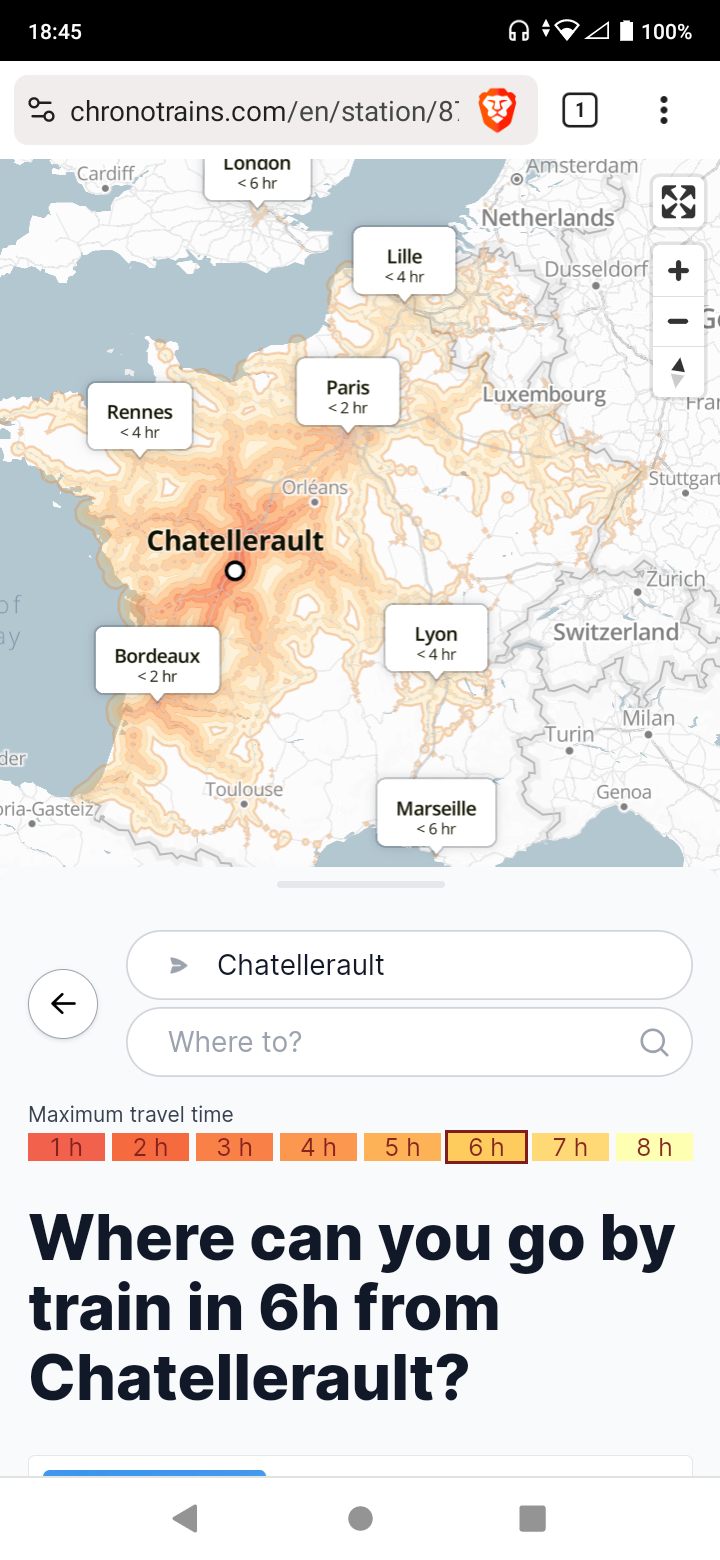
For the near future we will probably continue to drive whilst we are able, but taking the opportunity to take the train when it makes sense. If we can travel by train to a major centre in 6 hours it makes sense to do so - especially if driving would take two days and an overnight hotel.

That's where this website comes in handy. It gives us an idea of how far we can get by train, and how quickly. It will become even more useful if the ban on domestic flights for journeys possible in less than two-and-a-half hours by train is extended. 


Friday, 26 January 2024

Being Balanda

I am Balanda. 

Private guided tour at the Chateau de Chenonceau, Indre et Loire, France. Photo by Loire Valley Time Travel.
Me leading a private guided tour at the Chateau de Chenonceau.

I'm a white Australian and my father's family arrived in Australia from England in 1851. My mother's parents arrived from England in 1928.

Four generations of family, Australia. Photo by Loire Valley Time Travel.
I am the baby in this photo. The other people are my great-grandmother, my uncle, my great aunt, my mother and my aunt.

The term Balanda had only just a few years earlier entered the English lexicon. The explorer Ludwig Leichhardt was the first European to use it, in his journal in 1845, and he got it exactly right, explaining that it was an indigenous Australian term which had come from the Malay word for 'Hollanders'. The Malay word in turn comes from the Portuguese 'Holanda'.

Thursday, 25 January 2024

La Plongeuse


la plongeuse, Indre et loire, France. Photo by loire Valley Time Travel.

This charming scuplture is situated on the terrace of the restaurant Le George in Loches, overhanging the River Indre. It appeared in September 2021, but apart from that I can find no other information about it. I suspect it comes from a local sculptor's workshop, but I am not sure. I could of course ask the staff at Le George, but I keep forgetting to do so. I have no doubt that she is also a reference to the former public swimming pool, which was on the river opposite the restaurant. The sculpture's name means 'The Diver', but there may also be an element of restaurant based humour and wordplay, as a plongeur (or plongeuse if female) is washerupper in a restaurant, an essential but lowly member of most restaurant teams here.

Wednesday, 24 January 2024

Struck by Lightning

In September last year, just after a major restoration of the roof had been completed, the eastern spire of Saint Ours church in Loches was struck by lightning and damaged to the point where the authorities were worried falling masonry would damage neighbouring buildings.

Scaffolding on church after lightning strike, Indre et loire, France. Photo by loire Valley Time Travel.

The adjoining public garden and restaurant, and a couple of private homes were put out of bounds. Due to the awkward position of the apse and tower, on the edge of a cliff, inside a walled citadel with a narrow medieval gate, the scaffolding was helicoptered into the garden, then slowly erected. It has just been completed, and the damage on the spire marked up in yellow, ready for the roofers to come in and do the repairs.


The scaffolders gave me a cheery wave as they squeezed their truck through the 12th century gateway at the entrance to the Royal Citadel and left for lunch.

Scaffolders squeezing through a medieval gateway, Indre et loire, France. Photo by loire Valley Time Travel.


Tuesday, 23 January 2024

Niches for Swifts

The church in Bossay sur Claise has recently undergone a major and extensive restoration, which included the bells, as well as interior and exterior masonry. 


All the black squares are pieces of slate blocking up most of the scaffolding holes, except for a slot at the top. It allows swifts to enter into the cavity behind, but not pigeons.

Swift nest niches in old scaffolding holes, Indre et loire, France. Photo by loire Valley Time Travel.

One of the elements they got right was ensuring spaces remained for the swift colony to continue to breed in the building. So many recent 'conservation' renovations have ignored the existence of swift colonies and their nest hole entries have been blocked up. They like to nest in the small niches formed when the ends of the original wooden scaffolding rots away and leaves a hole in the masonry. Modern masons and architects want to block these off to prevent pigeons occupying them, but they don't understand that they are also banishing the swifts. The solution is simple, and involves the masons closing off the niches with a piece of slate that doesn't go all the way to the top, kind of like a letterbox. The trick is to educate the masons and architects so that this simple solution is applied. In Bossay, SOS Martinets, the local swift conservation association, managed to get through to the right people and save the day. I understand that the swifts have accepted the new arrangement and nested in the church last year.

Swift nest niches in former scaffolding holes, Indre et loire, France. Photo by loire Valley Time Travel.


Further reading: SOS Martinet (in French) https://sosmartinets.com/

Monday, 22 January 2024

French Nutritional Scores

France uses a system called Nutri-Score to rate supermarket foods and indicate to consumers how healthy they are. It was developed at the Sorbonne and is periodically reviewed.


Nutri-score A rated supermarket own brand dried red lentils.

Red lentils in a French supermarket. Photo by Loire Valley Time Travel.

At the beginning of the year food and drinks which were too sweet or too salty were particularly targeted for downrating, as was red meat and anything with artificial sweeteners.


Nutri-score C rated supermarket own brand plain crisps.

Plain crisps in a French supermarket. Photo by Loire Valley Time Travel.

The five letter, five colour system is well embedded in French shopping habits. At a glance consumers can assess the nutritional quality of an item. 


The supermarket own brand root veggie crisps only manage a D on Nutri-Score.

Root veggie crisps in a French supermarket. Photo by Loire Valley Time Travel.

Many ready meals have been downrated, but the sector which took the biggest hit was breakfast cereals, even the ones which have been reformulated in order to score better under the old Nutri-Score rules. Lots of drinks have been reclassified too, for being too fatty, too sweet and too calorific. Drinking yoghurts and flavoured milks were particularly targeted. Plant based milks and bovine milk didn't escape either. Coke Zero got downgraded, as did Lipton's Ice Tea, due to the unacceptable presence of artificial sweeteners.


I was amused that the manufacturers of these Breton buckwheat crisps presumably don't feel the 'traffic light' aesthetic of Nutri-Score fits their brand, and they've chosen to modify it to tasteful blue tones.

Buckwheat crisps in a French supermarket. Photo by Loire Valley Time Travel.

Red meat was downgraded to favour poultry and fish, especially oily fish (so long as they aren't salted or oiled). Wholegrains are favoured over processed carbohydrates, so long as there isn't too much added salt. Oils low in saturated fats, such as olive, canola, walnut and sunflower have been uprated, and other oils have been downgraded.


Bjorg corn thins will not show a Nutri-Score in future.

Corn thins in a French supermarket. Photo by Loire Valley Time Travel.

After months of consultations the new Nutri-Scores could have started appearing on supermarket products in January. But manufacturers have two years to comply with the requirement to use the new Nutri-Score on their labels.


Organic ravioli, with a C rating. Also reduced by 30% because it is close to its use by date and must be sold or given to a food bank. By law it cannot be thrown out in the rubbish.

Organic ravioli, France. Photo by loire Valley Time Travel.

From the outset the project has been a battle with the big industrial food brands. Ferraro, Lactalis, Mondelez and Coca-Cola have been particularly unco-operative and have always refused to use the system. Even the big organic brand Bjorg has withdrawn from the programme as more and more of their products don't meet the criteria.

So if you encounter supermarket products that don't have a Nutri-Score you can be fairly sure they aren't very good for you.

Saturday, 20 January 2024

Unblogged 2024 - Llívia

This falls into the category of "I can't believe we didn't mention it".

Llívia is an Spanish enclave in France. After the Franco-Spanish War (1635–1659), the Treaty of the Pyrenees (1659) assigned all the villages and territories of Roussillon, Conflent, Capcir, Vallespir and northern Cerdanya to France. It established the Pyrenees as the France-Spain border, dividing Northern Catalonia. Which all worked swimmingly well until the Mayor of Llívia pointed out it had town status as the former capital of Cerdanya. Llívia thus remained a Spanish enclave within France, reaffirmed by the 1660 Treaty of Llívia. It's only 1.6km from the Spanish border and can be found here.

We drove through Llívia at the end of June last year. My original plan was to spend a couple of nights there, but a town of 1500 doesn't have much in the way of tourist accommodation. The idea of staying in an enclave excited me, and Llívia has an intriguing history, and some good walks.


Instead we just stopped on our way to Andorra to see the Esteve Pharmacy, located in Llívia's municipal museum. It's a complete 18th-century pharmacy donated to the town by the family who owned it, on condition the contents remain in the town. The pharmacy has a large display of albarelli (a type of ceramic jar used in pharmacies) as well as antique drugs, and one of the most important collections of prescription books in Europe. I can't remember where (or when) I first read about the old pharmacy, but it seemed appropriate to visit and compare to Chenonceau's apothecary.


It's a pity it was in a new and freshly restored room in the museum, but it's interesting how small a village pharmacy was compared to the Chenonceau apothecary, which came from a private villa in Italy.

You can read more about the apothecary here.

Friday, 19 January 2024

It's All Messed Up

Last night, as we were coming home from dinner with friends, we noted how clear the sky is, and how the door handles of the car had a thin layer of ice. We also noticed that their daffodils were obviously not frost tender, because they're blooming beautiful.

It's been cold this winter. Not the brain numbing cold of 12 years ago, but cold enough. We've had days where the temperature hasn't risen above 0°C and the sun has never appeared. The kind of damp, cold and windy day where going outdoors hasn't appealed in any shape, size or form.

It's also been mild this winter - days where the minimum temperature was 8°C and soared to 14°C. The sun has shone and felt warm on the back. The kind of day where you go for a walk and get home hot, bothered, and needing a cool drink.


It's been a messed up year so far. Why else would Dotty's iris have been flowering on the 2nd of January?