Wednesday, 25 January 2023

The Key to a Stress-free Life

Yesterday we posted a photo of Amboise, taken while we were waiting to collect our clients. We used the Cactus, because when the temperature is close to freezing most people like car heaters. But because we were going to be near the garage in Tours I thought I would visit Claudette, start her engine, give her a quick check over.

When I arrived at the garage I discovered that I didn't have the key. Cue swearing. I knew I had picked the key up before leaving home, but it was nowhere in my bag, or any pockets.

So on Sunday I ransacked everywhere inside the house, in my bags, and the car. We only have one key for the garage and are forbidden by the terms of the lease to get a copy made. So I emailed everywhere we went on Saturday: shops, restaurants, town halls, you name it.

Then as Susan was heading out on Sunday afternoon she saw them - on the exterior window sill next to the back door. I know I didn't put them there, so I can only assume it was a passer by found them dropped in the driveway. Probably the factrice (post lady).


I'm glad to have them back, but could have done without the stress

Tuesday, 24 January 2023

It's Oh So Quiet

In May last year we were in Amboise with clients. It was one of the long weekends, and the closest to the chateau that I could park was at the supermarket e.Leclerc on the very edge of town. It took me about 20 minutes to get there because of the people illegally parked on both sides of all the roads. Normally it's a 3 minute drive.

On Saturday we were in Amboise at 8:25, and it was quiet. Nothing - none of the cafes - were open. Even Paul the bakers don't open until 8:30. 


The large fabric covered item in the photo is the Chapel of Saint Hubert, last resting place of Leonardo. It's having a major restoration, and will look like this for at least a couple more months.

Monday, 23 January 2023

A Tonic For Good Health

Once upon a time, back at the beginning of the last century, a large dose of quinine in your drink was trendy and desirable in France. There were now forgotten wine and quinine drinks produced all over the country and they were madly popular. 

Vintage poster advertising Bourin's Quinina Vouvray aperitif, collection of Gallica, Bibliotheque Nationale de France.
Poster from the 1930s, advertising Bourin's Quinina Vouvray and referring to the product as an 'exquisite aperitif'.

Who now has heard of Quinina Vouvray, made with Vouvray wine and quinine by Ernest Bourin in Tours? These days the closest most of us get to a quinine infused drink is Schweppes Indian Tonic.

Quinine bark was first imported to Europe from Peru in the early 17th century by Jesuit monks, who were well aware of its reputation for treating fevers, which they had learnt from the Peruvian indigenous people. It was initially known in Europe as 'Jesuit powder'. Quinine is actually two related chemicals, which were being extracted on an industrial scale by the 1830s. Some time before the Second World War one of the chemicals was synthesised, but it was not fully synthesised until 2001.

Byrrh, Lillet and Jaegermaister on a supermarket shelf, Indre et Loire, France. Photo by Loire Valley Time Travel.
Byrrh and Lillet on the shelf in my local supermarket.

The best known use of quinine medicinally is as a treatment for malaria, a mosquito born disease that was still a problem in many areas of France in the early 20th century. Many World War One troops in the trenches suffered from malaria, and wetlands like the Brenne and certain areas of the Loire Valley and Atlantic coastal areas were partially drained to increase farmland and eradicate malaria.

But quinine was also famously used in tonic drinks. The British used it as an aromatic in fizzy water, but the French opted for adding it to wine. The health benefits of quinine were well known and accepted for centuries, but it was only in the 20th century that real concerns about the consequences of overuse were acted upon. Over consumption of quinine can cause a dangerous reduction of blood platelets, blood clots, heart attacks, deafness (in unborn babies), disruption to the immune system and allergic reactions. The levels of quinine used before the Second World War in tonic drinks were about four times the dose that is considered safe these days.

Vintage Quinina Vouvray poster, Indre et Loire, France.
Poster from 1936 advertising Bourin's Quinina Vouvray, claiming to give you strength and strengthen your appetite. Courtesy of a local collector.

Quinina Vouvray was marketed as an 'exquisite' aperitif and was said to give you a healthy apetite. It was sold in a no nonsense litre bottle, with a label printed in red that was instantly recognisable in its day. Ernest Bourin's factory was in rue Ledru-Rollin in Tours, near the hospital. I don't know if the building still exists. Many of the buildings in this street have been demolished and replaced with modern apartment blocks.

Much was made of the extreme care taken with hygeine in the product's manufacture, and how it was matured in the latest fifteen thousand litre capacity glazed cement vats. An article from the 1930 Revue géographique et industrielle de France describes how bundles of Kalissaya quinine bark of the finest quality were delivered to the factory and mechanically crushed before being macerated in Vouvray wine. The name Kalissaya suggests that the quinine in this case was coming from Bolivia, but I haven't been able to confirm that. The end product is described as topaz coloured.

Quinina Vouvray may be long forgotten, but there are still related drinks with similar histories on the shelves. Byrrh, Dubonnet and Lillet are the best known and most widely available. In the 1930s Byrrh, made in the Pyrenees, was the most popular aperitif in the world. Lillet, which comes from Bordeaux, was a favourite of the Duchess of Windsor, and is a mixture of wine, bitter orange liqueur and quinine. I remember being offered it years ago by Gascon friends that we stayed with near Giverny. I liked it, but it is clearly not a madly popular drink these days as I have never been offered it since. Dubonnet was originally made by a doctor on the site where the Opera Garnier now sits and was intended to be issued to the Foreign Legion for medicinal purposes, until the doctor's wife served it as an aperitif one day to her friends, who loved it. It contains a mixture of strong flavoured herbs and spices to disguise the bitterness of the quinine. All three brands are owned by Pernod Ricard these days.

Friday, 20 January 2023

Working!

As this post is published we will be heading towards Chenonceau. It will probably look something like this, but with added fog, and I imagine I won't be spending much time in the gardens.


Thursday, 19 January 2023

Snow Joking

At 23:53 (11:53pm) on Tuesday night I happened to look out of the back door and was excited to see that the snow which had been lightly falling all afternoon along the Loire River had finally made it south to us. In fact, I was so excited I went out of the back door in my stockinged feet (socks, no shoes - stop sniggering) to take a photo, then woke Susan to show it to her.


Yesterday morning we were both excited to see that the snow had continued into the night, and there was a light cover of snow in everyone's gardens. It was a beautifully sunny day and everything was sparkling.

When we went to the supermarket at 10:00 the temperature hadn't risen above zero, so we drove through the patchily gleaming countryside, remarking that it was the first settled snow we have seen here in a long time. In fact, it hasn't snowed properly here since March 2018.

We went out again after lunch, and although by that time we had reached the heady heights of 6°c, there was still evidence of snow.


Wednesday, 18 January 2023

A Walk from Abilly

On Monday we did our first walk of the year with our Monday walking group. It was the first walking I have done since Thursday's little episode.


We started on the Voie Verte, which being an ex railway line, is flat. That was the last time we weren't either climbing a quite oppressive slope, or descending the other side. Luckily the weather was fine, if somewhat blowy, which was a real window of opportunity.

Neither of us felt any after effects, which is good. We like our Monday walks, which are social affairs where you can bumble along, hands in pockets, and have a chat. Susan is often called upon to share her knowledge of stuff botanical and historical in two languages, and there are a few locals who know the more folkloric and anecdotal stuff.


It's a win/win.

Monday, 16 January 2023

Le George Restaurant, Loches

Menu board, Indre et Loire, France. Photo by Loire Valley Time Travel.
Menu board on the footpath outside the restuarant.

Recently my friend Charlie, from La Ferme des Effes, messaged me to say that the side of lamb I had ordered from him was ready. It was originally to be delivered before Christmas, but he explained that they had left the sheep on the pasture an extra month to gain weight after the drought. In fact, I took delivery of two sides of lamb, one of which was for Rosemary and Jean-Michel. They live in Blois, so we decided to meet in the middle to hand over the goods.

Le George restaurant, Loches, Indre et Loire, France. Photo by Loire Valley Time  Travel.
The server leads us through the bar out onto the verandah.

It seemed like a good idea to eat at Le George in Loches. The hotel has had a makeover since we were last there, and it seems like the sort of place we might decide to take clients.

Le George restaurant, Loches, Indre et Loire, France. Photo by Loire Valley Time  Travel.
The bar.

We had the menu du jour and the vin du jour. The main course and dessert was good, the service friendly and quite efficient.  

Le George restaurant, Loches, Indre et Loire, France. Photo by Loire Valley Time  Travel.
The verandah dining room is a great setting, jutting out over the river Indre. Check out the 'diver'.

Toilets in Le George restaurant, Loches, Indre et Loire, France. Photo by Loire Valley Time  Travel.
I don't normally photograph the toilets (well, unless they are a la turque or something...).

Le George restaurant, Loches, Indre et Loire, France. Photo by Loire Valley Time  Travel.
Foyer.

Le George restaurant, Loches, Indre et Loire, France. Photo by Loire Valley Time  Travel.
Our main, chicken with chanterelles and trompettes de la mort mushrooms on penne.

Friday, 13 January 2023

An Unexpected Turn

Yesterday we went to a clinic in Chatellerault for Simon to have an angiogram and he passed out in front of the machine!

The nurse was just explaining about injecting the dye and he started to sweat excessively and not respond to questions. He sort of glazed over, then started sliding forward and sideways off the stool he was sitting on. What's odd is that he isn't afraid of needles, and has had a number of injections lately. It's not a process he was looking forward to, and was stressed even before we left home. (I blame the literature that was given to us about the dye - Simon.)

Paramedics, Indre et Loire, France. Photo by Loire Valley Time Travel.
The paramedics.

So we got to sit round for ages in the nurses room while he recovered. The doctor called an ambulance. The nurse and a final year student doctor monitored and assessed him until the paramedics came then they took over. By the time they arrived, about an hour after he fainted, he'd fully recovered except for feeling very tired. The paramedics arrived complete with stretcher that they wheeled in, and which unfortunately I didn't get a photo of. They did their thing, then rang the specialist emergency doctor from the SAMU to see if they thought it was worth bringing Simon to hospital for further checks. 

Fortunately he was deemed sufficiently recovered to go home, so long as I drove. So he didn't get his angiogram. We've got a new appointment for a consultation only on 1 March. We have strict instructions to ring 15, the French medical emergency number, day or night, if we have any concerns at all or if anything out of the ordinary happens.

By the way, 'to faint' in French is 'tomber dans les pommes' (literally, 'to fall in the apples'). I have no idea why.

Thursday, 12 January 2023

Inflation

Flour, France. Photo by Loire Valley Time Travel.

A recent consumer report shows that the standard supermarket trolley for a French household has gone up nearly 15% in the last year. It varies a bit depending on where you live, but here in Indre et Loire we are almost exactly average, at 14.3%. According to the report, the three items which have skyrocketed in price are flour, steak haché (beef patties) and toilet paper.

Steak haché, France. Photo by Loire Valley Time Travel.

The most expensive supermarket shopping is in Paris, of course, then Yonne and Seine-Saint Denis around Paris, Yvelines, much of the south-east, and Corsica.

Toilet paper, France. Photo by Loire Valley Time Travel.

Wednesday, 11 January 2023

A Franco-Ukrainian Christmas


Traditional Ukrainian Christmas foods at a party in France. Photo by Loire Valley Time Travel.
A traditional Ukrainian Christmas meal laid out for the performance of 'our' Ukrainian's play.

The Association d'Accueil et d'Accompagnement de Refugiés en Sud Touraine (AARST) organised a Christmas party on 7 January, which is Orthodox Christmas day, and when 'our' Ukrainians would normally have Christmas. They are all from Mykolayiv and Kyiv, in the east of the country, where the traditions are Ukrainian Orthodox.

Decorating a village hall, Indre et Loire, France. Photo by Loire Valley Time Travel.
Vitalina, Marina and Preuilly Olena K put up their decorations.

All the decorations were made by Olena K (Preuilly) and Vitalina. Carlos, the adults French teacher, acted as MC. Christiane and Marina did a bilingual introduction to the proceedings. 

Organising Christmas presents at a Franco-Ukrainian charity event, Indre et Loire, France. Photo by Loire Valley Time Travel.
Fabienne and Christiane sort out presents.

The Ukrainians put together a sketch of how Christmas was celebrated in the old days in Ukraine. It involved two of the littlies and two of the teenagers playing a family at a feast and Tym leading Natasha around while he scattered seed and she was dressed as a goat [link]. Then there was some carolling.

Franco-Ukrainian Christmas party, Indre et Loire, France. Photo by Loire Valley Time Travel.
Carlos takes the mike and gets the proceedings underway.

Then there was a children's magician who Nina translated for. After that we attacked the buffet, loaded with a mixture of homemade Ukrainian and French finger foods, closely followed by the arrival of Pere Noel and gifts being given out. Graine Créative, who manufacture craft kits in Preuilly sur Claise, WDK Groupe Partner (Wonderkids), a games distributor and wholesaler in Tauxigny, and l'Oréal at La Roche Posay all responded positively and generously to requests for donations of products that we could offer as gifts. 

Ukrainian Christmas play, Indre et Loire, France. Photo by Loire Valley Time Travel.
Ukrainians singing carols at the end of their play.

Finally there was galette des rois, a French Epiphany tradition, served with a very nice sparkling wine supplied at cost by Xavier Fortin, our local Michelin starred sommelier, and cider supplied by Thomas from the social housing agency Ficosil, who works closely with most of the Ukrainian families.

Ukrainian children singing French carols with their teacher, Indre et Loire, France. Photo by Loire Valley Time Travel.
Ukrainian children Anastasia, Valeria, Milana and Tym, singing French carols, with their teacher Danielle.

Way too much food was consumed by all. One of the Ukrainians admitted to me that since she has been in France she has gained 7kg! It was a lovely afternoon, with some tears of course, but mostly smiles and hugs and laughter and kids racing around everywhere. Lots of work put in by Preuilly Olena K, Vitalina and Marina especially, as well as Fabienne, Danielle and Christiane. Many others helped too. It is fair to say that having this group of Ukrainians living amongst us has enriched all our lives, but we hope more than anything that these families can be reunited, and live peacefully in Ukraine once more. However...another family arrived the night of the party...

Father Christmas at a Franco-Ukrainian party, Indre et Loire, France. Photo by Loire Valley Time Travel.

Father Christmas at a Franco-Ukrainian party, Indre et Loire, France. Photo by Loire Valley Time Travel.

Childrens magician at a Franco-Ukrainian Christmas party, Indre et Loire, France. Photo by Loire Valley Time Travel.
The magician, Madragore, with 'volunteers' from the crowd Natasha on the left in a fetching blue balloon crown and Arsene standing on a chair. Nina is on the right translating.

Tuesday, 10 January 2023

Last Year's Biodiversity Records

According to the analysis of my biodiversity records for last year by iNaturalist, this is the breakdown of what I saw when I was out on field naturalist outings of one sort or another:

Deathcap Amanita phalloides, Indre et Loire, France. Photo by Loire Valley Time Travel.
Deathcap Amanita phalloides.

57% of my observations are termed 'research grade', which means that they are trustworthy, have been corroborated by other observers and can be used in scientific research. The rest of my observations are awaiting corroboration by other observers.

Hover fly Merodon sp, Indre et Loire, France. Photo by Loire Valley Time Travel.
Hover fly Merodon sp.

42% of my observations were records of plants and 37% were fungi. 16% were insects and the rest were made up of about equal numbers of amphibians, birds, mammals, mollusks and protozoans. The plants I identified most were oaks and orchids, the most frequent fungi I submitted were boletes and flies were my number one category of insects. 

Wild cherry Prunus sp, Indre et Loire, France. Photo by Loire Valley Time Travel.
Wild cherry Prunus sp.

Most of my observations were made in October, with April coming second. The month when I made the fewest observations was June. The previous year the big spikes in observations were June, July and October, all about equal, with January and February having the fewest observations. I made more observations than last year, but saw fewer species.

Rustgill Gymnopilus sp, Indre et Loire, France. Photo by Loire Valley Time Travel.
Common Rustgill Gymnopilus penetrans.

The photos are of the species which other observers commented on or marked as a favourite.


Monday, 9 January 2023

The Pope of Taste

Jacques Puisais, born in 1927 at Poitiers and died in December 2020 in Chinon hospital, was a French biologist and oenologist, author of books on wine and taste phenomena, philosopher and creator of the concept of the "goût juste". This is an idea that is very easy to define in French -- it is the opposite of "malbouffe". But in English it is much more complicated. It's not just a question of good food versus bad food. It's like the concept of "terroir", where a single simple phrase or word encompasses a whole raft of interacting phenomena. So "le goût juste" is about good food, delicious tastes and seductive textures, the right food and wine pairings, slow food, high quality ingredients skillfully and respectfully prepared by artisans, and consumers who are educated enough to appreciate and value all this. "malbouffe" on the other hand is junk food, fast food, cheap poorly prepared industrially processed ingredients and ignorant consumers.

A table set for lunch, France. Photo by Loire Valley Time Travel.

The son of a wine salesman he went on to specialise in analytical chemistry and oenology and obtained a doctorate in science from the University of Poitiers. His first job was with the Poitiers analysis and research laboratory. He moved to Tours in 1959 to take over the management of the Indre-et-Loire Departmental and Regional Laboratory of Analysis and Research, which tests soil, water and food for hazardous contaminants. 
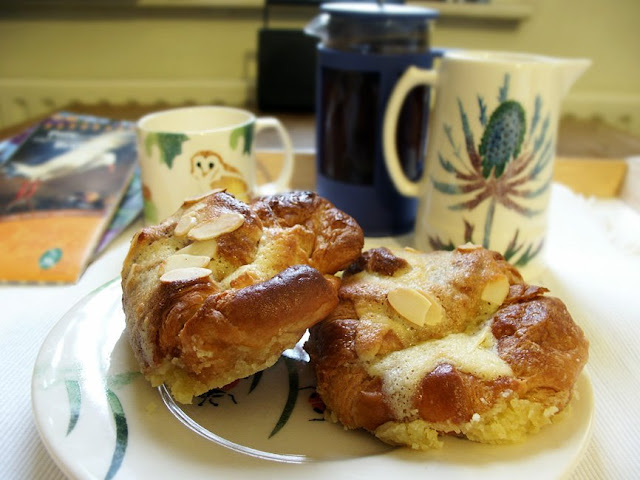
Breakfast, France. Photo by Loire Valley Time Travel.

Keen to encourage children to taste, from a very early age, he developed a method of sensitisation and awareness known as the Sapere method that was widely used in school classes. He started giving taste education classes in 1964. In 1974, he experimented with his first "taste class" in primary schools in the Tours region. In 1976, he founded the French Institute of Taste in Tours and Paris, with the idea of developing multidisciplinary research on taste and food sensitivity. He continued his research and developed a teaching method with teachers. From 1984 onwards, his method was applied on a national scale until 2000. Approximately 100,000 children were thus made aware of taste by teachers trained at the French Institute of Taste. In the past decade or so, if you watch local television, you will see one of his protegées, senior Institute of Taste member, the gastronomic journalist Périco Légasse, on screen frequently.

Homemade tartiflette, France. Photo by Loire Valley Time Travel.

In 1999, Jacque Puisais collaborated in the creation of the Images du goût and the Atelier du goût at the Futuroscope near Poitiers.

Homemade apricot clafoutis, France. Photo by Loire Valley Time Travel.

He was also very interested in food and wine matching, which he helped to popularise. His scientific work on this subject has become an authority and has influenced many famous sommeliers and chefs. He is the author of numerous works devoted to wine, taste and food/wine pairing. 

Cooking class, France. Photo by Loire Valley Time Travel.

He died at the age of 93 of Covid-19, active with a blog and workshops to the end, but not widely known outside an elite group of epicureans. I suspect that like many obsessive experts he made as many people uncomfortable as he influenced to his own point of view. In later life he often complained that when he approached local councils to offer them taste classes in their schools they would tell him they would rather spend the money on 10 metres of new footpath.

Touraine wine, France. Photo by Loire Valley Time Travel.

Although the course he designed is no longer part of the school curriculum in France, there is now La Semaine du Goût, when French children spend a week learning about food, including everything from international cuisines to how climate change affects food supply chains. His ideas about teaching children about how to experience the taste and texture of food are now mainstream, but the chains of fast food outlets and industrial food production continued to proliferate despite him, and the food industry is involved in la Semaine du Goût. He was deeply distressed when in 2019 a survey showed that his beloved Tours, one of France's official centres of gastronomy, was the third worst city in France for "malbouffe" (junk food), using the measure of numbers of fast food outlets per head of population. (The worst two, in case you are interested, are Bordeaux and Metz.)

Further reading: Washington Post article from 2009.

    Jacques Puisais's blog.

Sunday, 8 January 2023

Australian Zebra Finches on the Loose

Australian Zebra Finches are an adorable native Australian finch. They have been a very popular aviary bird for decades and I have seen them in several private aviaries in the Touraine Loire Valley. Apparently they've been introduced in the wild in Portugal, so it wasn't much of a surprise when a nature contact of mine reported them from Ariege in the Pyrenees. 

Australian Zebra Finch in the outback. Photo by Loire Valley Time Travel.

The species adapts to life in captivity remarkably well, and it is well known as Australia's most studied bird species and indeed, globally the most studied captive passerine bird. Pairs mate for life and they are very social birds.

Flock of Australian Zebra Finches in the outback. Photo by Loire Valley Time Travel.

They eat grass seeds and their main predators in the wild are snakes and lizards.

Photos taken by me in the Australian desert more than 15 years ago.

Friday, 6 January 2023

Lunch in Loches

Yesterday we visited Loches to do some shopping and have lunch with Rosemary and J-M. It was quite a warm day, 17°c, which is a lot more acceptable than -17°c, which we experienced here ten years ago.


We dined at the Hotel le George, previously the George Sands, which backs on to the Indre River. We have dined at the George in its previous incarnation, and we even stayed there a couple of times when we were house hunting.

The hotel has had a proper makeover, losing its provincial old fashioned feel, dark interior, and hopefully the collection of old beds that made up its furnishings.

The meal was good, an 18€50 three course menu du jour. We started with goats cheese and  cured meats, followed by chicken with a mushroom garnish, then creme brulee and ice cream. The meal was good, and a step up from the previous restaurant, which had become very tired.


Wednesday, 4 January 2023

Last Year

2022 was a strange year for me. If I am honest I still haven't really processed 2020, let alone the two years since. We did a lot of things last year, and visited places we hadn't been to before - namely Lyon and  les Eyzies. Some months we took a lot photos, some months we did a lot of work, and some months it rained. Some months none of the above happened.

gratuitous photo of an icecream cone in Amboise

It doesn't help that half way through October my main office PC died. Generous offers of substitute machines have helped, but I have to admit I haven't yet got everything up and running yet. I don't do computers like I used to, it appears. This means that all my record keepimg stopped when the computer died and I haven't yet caught up.

All this means that instead of being able to say exactly how many photos we took and how many kilometres we drove in doing so, I have to rely on "quite a few".

Let's hope that 2023 is almost normal.

Tuesday, 3 January 2023

Bottle Munching at Auchan

When we were in Tours last month (that makes it last year already - blimey!) we saw this recycling innovation outside the Auchan centre in Chambray les Tours.


You feed your plastic bottles in to the machine (after having removed the cap and putting it in the "bouchon" hole) one at a time, and in return you get a voucher worth one cent for each bottle.

It's not a lot of money, but if it encourages people to recycle rather than send bottles to landfill it can only be a good thing.

Monday, 2 January 2023

Would You Buy These Apples?

I see the phrase 'only in France' used frequently on social media, and it almost always irritates me -- because it is very rarely true. But in this case, I might just about get away with using it.

Patte de loup apples, Indre et Loire, France. Photo by Loire Valley Time Travel.

I photographed these apples at the market in Preuilly on Christmas Eve. Just as I was doing so my friend Bernadette came up and asked for two kilos of them, as her husband Alain adores them. Whilst it might not be only in France that apples with such obvious scars would be for sale, I certainly can't imagine less than perfect apples like this for sale in Australia. 

Patte de loup apples, Indre et Loire, France. Photo by Loire Valley Time Travel.

I can remember buying the most beautiful shiny red apple in a supermarket once when we were back in Australia visiting family and friends. It tasted of absolutely nothing except bitter skin. What a swizz! Whereas, whilst they are in season and available, I can buy ugly deformed rough skinned Patte de Loup apples and enjoy their delicious appleyness, along with everyone else in the village. In the Loire Valley this is such a legendary variety that even the local supermarkets sell it.

Patte de loup apples, Indre et Loire, France. Photo by Loire Valley Time Travel.

Patte de Loup are an old local variety, grown in this case at the organic orchard on the edge of town. They are €3.20 a kilo. The scarring is a feature of the variety, and is a result of the way the fruit develops. Patte de Loup means 'wolf paw', and the scar is supposed to be the mark left by the wolf swiping the apple with its claws.

Apples at a market, Indre et Loire, France. Photo by Loire Valley Time Travel.

It is a variety that is very resistant to pests and disease. The fruit keeps a long time, with a sweet taste and an acidic finish, sometimes a hint of aniseed. They are medium sized, a bit flattened and have distinctive russet type rough greeny yellow brown skin.