Thursday, 12 April 2018

Likin' the Lichen


I've only entitled this blog post the way I have because if I don't someone will do it in the comments.

Common Orange Lichen.

I went on a most enjoyable lichen outing on Saturday 7 April, organised by my friend Marie-Claude. She's become a real expert on the subject and is busy training up others. I was super impressed by how much work she had put in to make sure we all got to grips with the lichens we were looking at. The site chosen was the Puy de Besnard La Colline near Chinon*. It's a nature reserve on a sandstone topped limestone ridge, full of rare species of plants and no doubt other orders too. I've written about visiting it the Puys de Chinonais before here and here.

Cladonia foliacea.

Marie-Claude had prepared sheets of photographs of each of the possible species and made it all look so easy. She has been greatly supported in her learning about lichens by Jeannine.

Physcia tribacioides.

Jeannine had a marvellous story about how, some years ago, when she first got interested in mosses and lichens, she found some specimens she thought were rare, or at least unrecorded in our area. She made an appointment with the leading lichenologist of the day, who worked out of a fusty dusty back room in one of the big natural history museums.

 Grassy-leaved Buttercup.

When she got there and showed him her specimens he was intrigued. He asked where she had found them. 'Chinon', she said. 'Where's that?' he said. 'In Indre et Loire' she replied. 'Jean! Jean!' 'Claude ! Claude !' he called out to a colleague, 'We've got people from 37 here!'.* Each of the French administrative areas called départements are numbered and Indre et Loire is 37. Apparently to live in 37 is to be unimagineably exotic.

The group gathers around to look at a lichen.

We saw some very common species and some very rare species. Common Orange Lichen Xanthoria parietina (Fr. Parmélie des murailles) is a leafy, bright yellow, abundant and widely distributed lichen. Technically it is a fungi that has been lichenised by algae. It's one of the most familiar lichens due to its high visibility, and because it is one of the most studied. The bright yellow colour is a pigment produced by the lichen to protect itself from sunlight. It will be grey-green where the sun doesn't reach it. It occurs all over the world with the exception of Antarctica, and will grow on many substrates, especially if they are in the sun. It's not fussy, whether it's on trees or buildings, but is especially partial to spots that have plenty of bird poo stuck to them. In France it is very common, occuring everywhere except the high mountains. Recent research has revealed that it has antiviral properties that may be useful against influenza. In the old days it was mixed with urine and used to produce a pink dye for woollen textiles.

Early Spider Orchid.

Cladonia foliacea is one of the so called 'reindeer mosses', which are really lichens, and a largish genus with many species that closely resemble one another. Reindeer themselves mostly only eat one species, C. rangiferina, which we didn't see on the day. The C. foliacea was growing with C. rangiformis (the brown wispy bits bottom right in the photo above) and C. furcata. They are common lichens of sandy or calcareous soil, so right at home on the Puys de Chinonais.

Violet Oil Beetle.

Physcia tribacioides is a real rarity in our area. La Colline is the only recorded site for it in Indre et Loire. It seems to be dying out, as it is associated with older trees and undisturbed sites such as churchyards and old private parks. It is a leafy lichen that is naturally a grey-green colour (some lichens are pruinose, with a powdery surface that gives them a grey-green appearance but hides their real colour, which could be very dark). Petractis clausa is also only recorded on La Colline in 37.

Petractis clausa.

Grassy-leaved Buttercup Ranunculus gramineus (Fr. Renoncule à feuilles de graminée) is a southern warmth loving plant of dry grasslands, on the edge of its range here. It is rare and protected in Centre Val de Loire. Nearby was a colony of the first orchids I've seen in flower for the season (we saw two species flowering), and a male Violet Oil Beetle Meloe violaceus (Fr. Méloé violet) ambling about. I assume he's munching on the rare buttercup and the equally rare Pasqueflower Pulsatilla vulgaris (Fr. Anémone pulsatille) as he will need the poisons they contain to protect himself and his offspring.

Pasqueflower.

Marie-Claude scouring the ground for lichens.

Wrapping up the day with drinks and practicing our identifying skills with close up photos.

* Both Marie-Claude and Jeannine have been in touch with me to point out that we were on La Colline, not Puy Besnard. They are both landscape features known as the Puys de Chinonais. Jeannine also pointed out that the lichen expert in her story was Monsieur Boissière and he called out to his colleague Claude Roux. When I came to write the blog I couldn't remember the names of the people she was talking about, so I opted for a generic version.

Tuesday, 10 April 2018

Revitalising Town Centres


I bet our mayor is spitting chips. The government has just announced a plan to revitalise the centres of more than 200 medium sized provincial towns. They are offering generous funding so the locals don't have to contribute, and have even stolen our mayor's name for his project to improve the centre of Preuilly.

In fact, Preuilly wouldn't have qualified for this new programme. It's for towns with populations between thirty and fifty thousand.  Twenty-three percent of the population live in such towns and twenty-six percent work in them. Many of these towns struggle with social problems and lack of resources to maintain their attractiveness.

Central Chatellerault.

To help these towns a fund of 5 billion euros will be rolled out over 5 years, available for 222 towns.

The mayors of these towns will produce plans in partnership with public and private local enterprises. Known as 'Coeur de ville' ('town heart') the project can take different forms.

The historic centre of Poitiers.

The first is to improve the energy ratings of dwellings in the centre of town. 1.2 billion will be available to adapt the built heritage in these town centres so they are more energy efficient.

Chinon.

The second is to use 1.5 billion euros to build new dwellings in town centres as well as develop education, cultural and transport options to improve quality of life.

Finally, there is support for businesses wishing to establish themselves in the centre of town. This is seen as key to the vitality of these places. One way of doing that is to assist businesses to develop their online presence.  The rules will be relaxed and businesses who wish to set up in town will no longer have to apply for permission from the préfecture (shire offices).

A classic car event in Blois.

Around us the towns who will benefit include Chateauroux, Chinon, Issoudun, Blois, Bourges, Chatellerault, Limoges and Poitiers.

The project is seen as a successor to the previous programme to improve internet access for everyone and eliminate the 'dead zones'. The government has come to an agreement with the telecomms companies to resolve the issue and end patchy internet connections. They recognise that three out of four job seekers use the internet.

Old and new in Bourges.

Monday, 9 April 2018

Walking Near La Roche Posay


On Thursday 29 March the local walking group that I belong to met in a carpark in La Roche Posay and set off for a circuit through the countryside around this small attractive spa town.

A sunken lane.

This sunken lane is a couple of hundred metres from the dentist's surgery that Simon goes to. Lesser Periwinkle Vinca minor, Ivy-leaved Cyclamen Cyclamen hederafolium and Lesser Celandine Ficaria verna grow along the banks.

Snakeshead Fritillary.

A meadow full of Snakeshead Fritillary Fritillaria meleagris in the grounds of the Connétable Thermal Spa Hotel. Along the roadsides here there is Greater Periwinkle V. major.

Rainbow through the trees.

This was the most impressive rainbow I've ever seen. It was very low, through the trees, and made the landscape glow.

La Basse Charpraie.

 The abandoned grain co-operative in La Roche Posay.

 The mill on the Creuse at La Roche Posay.

Studios.

This building, opposite the mill, has a sign saying 'Studios' on it. Studios for what, I wonder?

A street behind the church in La Roche Posay.

Almost every building in La Roche Posay has a sign indicating it is providing accommodation for curistes (people sent here for a cure at one of the spas and often funded by the public health system) and this street is a typical example.

Souvenirs, gifts, games, grave ornaments.

I have never been inside this shop, but I imagine that tasteful isn't part of their buying brief.

An info board, in English, in the market place, in La Roche Posay.

The board is quite worth reading. It tells you the history of the development of the thermals springs in this place, from medieval times to now.

Sunday, 8 April 2018

Nigh on Invisible


An emerald moth.

I photographed this superbly camouflaged emerald moth (Geometridae) in the grounds of the old army base on North Head, Sydney. I don't know what species it is. There are several dozen emeralds in Australia, easily recognisable because of their green colour (more jade than emerald, it has to be said) and their characteristic jizz. Sitting flat and open on leaves like this is how you normally encouter them. You need to be sharp eyed to spot them. They all look rather similar in size, colour and pattern, so identifying them to species level isn't easy. Very similar Geometrids can be seen in Europe.

Saturday, 7 April 2018

Making Potato Gnocchi


When we stayed with Bruce and Annette on our recent Australian trip, Annette made gnocchi. Her family is of Italian origin and were winemakers. Every year they buy a pig and have a great family get together to make salami and other cured meats. Bruce, who is a chef, but not Italian, has reached the stage of being responsible for getting all the meat off the pig's head. I'm not sure if that's a compliment or not, and I don't think he is either.

Anyway, back to gnocchi. I took lots of photos to show how Annette did it, and just recently at home I tried to replicate it.

Boiling potatoes.

Annette carefully chose potatoes that were the same size and boiled them whole until they were cooked through and soft.

Peeling potatoes.

While the potatoes were still warm she slipped the skins off.

Putting the potatoes through a ricer.

Then she put the potatoes through a ricer, making a pile of potato directly on to the bench. I think that helps keep a light and fluffy texture which you would lose if you use a masher.

Mixing in an egg.

A well was made in the centre of the potato and an egg carefully mixed in. Then flour was added to make a consistency that Annette felt was right. It was all done by eye and feel, no measurements. She struggled a bit with making such a small quantity. She was only feeding four and she's much more used to making gnocchi for the whole extended family.

The dough.

Rolling out the dough.

Bits of dough are sliced off and rolled into sausage shapes which are then cut into pieces a couple of centimetres long.

Creating the gnocchi dumplings.

The little morcels of dough are formed into gnocchi dumplings using a fork. They are gently pressed to make an imprint of the tines which creates ridges, then the piece of dough is rolled off the fork to end up as a sort of pillow shape.

The dough made three trays like this of gnocchi.

Cooking the gnocchi.

The gnocchi are dropped into boiling water in batches of about 30. They sink and you know they are done when they float to the surface. The ones I did at home took about 4 minutes.

Draining the gnocchi.

The gnocchi are scooped out of the boiling water with a slotted spoon and put in a gratin dish, alternating with a bit of tomato sauce. Annette served hers immediately, I put some mozzarella on top and baked mine for 10 minutes before serving.

My gnocchi and tomato sauce.

I failed to photograph Annette's final dish, but here is mine from several months later. My forking skills got the thumbs up from Annette on FB when I posted this photo.

I love gnocchi. It falls into that category of deceptively plain starchy foods that come very high up my list of best foods ever.


Friday, 6 April 2018

The Terrigal Formation


While we were staying on the Central New South Wales Coast we had lunch one day at Terrigal with Simon's Dad. The cliffs at Terrigal reveal the most dramatic rock formations, laid down in the Triassic and now weathering away.


The Terrigal sandstone is a lithic sandstone, which means it has up to 75% quartz particles mixed with clay, silt and iron. It weathers very quickly and easily. The full depth of the formation is about 200 metres, but only the topmost layers are exposed at Broken Head where these photos were taken.


The area had been a shallow inlet surrounded by a tidal swamp. As the sea levels rose the sandy shale was deposited along with some fossils and leaving ripple marks in the rocks by the tidal pool. Nowadays, some sections are weathering in a honeycomb pattern. The rocks are a mixture of kaolinitic sandstone with layers of goethite hydrous ferric oxide. 


The white parts are kaolinitic sandstone, rich in aluminium compounds. The reds and purples are iron oxides of different sorts. There are also clay rich shales, silica rich siltstones and conglomerates known as pudding stones (a mixture of clay and small rounded boulders).


Thursday, 5 April 2018

The Flowers That Bloom in the Spring


There is a lovely selection of wild flowers that bloom in the spring in the Touraine. Some of them are rather rare too.

Mountain Sandwort Arenaria montana (Fr. Sabline des montagnes).
Although we are in lowland central France, we have some outlier patches of Mountain Sandwort on sandy sites. In fact, although sold as an alpine plant in garden centres, in France this species main stronghold is the sandy heath country known as Les Landes, south of Bordeaux -- flat as a tack and at sea level. This one was photographed near the hamlet of Cormier and was quite an extensive station, growing on the bank formed by the edge of a track running alongside a wood.

English Bluebell Hyacinthoides non-scripta (Fr. Jacinthe des bois).
English Bluebells can be found in woodland throughout the north-west quarter of France, in places where the soil is not too calcareous. These were photographed on the banks of the Creuse River, near La Roche Posay, where the soil is sandy loam.

Other species to look out for in April are Wild Tulip Tulipa sylvatica (Fr. Tulipe des bois); Snakeshead Fritillary Fritillaria meleagris (Fr. Fritillaire pintade); Carthusian Pink Dianthus carthusianorum (Fr. Oeillet des chartreux); White Asphodel Asphodelus alba (Fr. Asphodele blanc) and Pasqueflower Pulsatilla vulgaris (Fr. Anémone pulsatille).

Here is a blog post from last year by a British photographer which gives a good overview of the flowers you could see in April here, just as much as in Britain.

Wednesday, 4 April 2018

Veggie Burgers


As a conviction omnivore I'm a big fan of veggie burgers. And my local organic market gardeners have a good selection of root vegetables in early spring. So a big batch of veggie burgers was in order.

Ingredients:

1.5 cups cooked black beans (other beans can be substituted)
An onion or leek, chopped
A turnip or beetroot, peeled and grated
A carrot, grated
¼ of a celeriac, peeled and grated
4 cloves garlic, crushed
¼ cup barbecue sauce
2 tbsp soy sauce
1 tbsp Worcestershire sauce
½ tsp dried thyme
½ tsp dried oregano
½ tsp smoked paprika
½ tsp ground cumin
A heaped tbsp of miso paste
1 cup rolled oats

Method:

  1. Mix everything except the rolled oats.
  2. Pulse the mixture in a food processor or with an immersion blender, just so it mushes together better, but isn't a purée.
  3. Mix in the rolled oats.
  4. Form into patties (makes about 9 patties, 110 calories in each).
  5. Sprinkle the patties with crispy fried onions (optional).
  6. Bake in the oven for 25 minutes at 180°C.
  7. Once cooked they freeze well, and can be reheated from frozen in the oven (20 minutes at 200°C), in the microwave or frying pan.


Tuesday, 3 April 2018

Following Rodolphe


As we crossed the Cher in Célestine and came up to the interchange between the D31 and the D140 at la Croix-en-Touraine a refrigerated truck pulled out in front of us. It had come from Rodolphe le Meunier's cheese refining facility around the corner in la Croix-en-Touraine.


We followed it through the forest to the roundabout at the Amboise Ag College. It went straight ahead. So did we, down the hill, past the turn off to the hospital and the cemetery, past Saint Denis' and stopped at the lights to turn on to the D751 that runs parallel to the Loire in Amboise. The truck went right, and so did we. It crossed over the river and so did we. At the roundabout on the other side of the bridge it turned left. We followed. Where was he going, we wondered? It was the wrong time of day to be heading for a market, and the wrong direction.

It started getting properly weird when the truck turned right off the levee and down into Nazelles-Négron. That's where we were going. Simon said, "Wouldn't it be funny if he was going to the auto-electricians too?!"


The truck did indeed take the slip road for the auto-electricians, but it turned out it was going next door to the roadworthy testing garage. And it turned out it wasn't Rodolphe himself driving, so we couldn't spook him out by turning up behind him. Damn.

Monday, 2 April 2018

La Cave Amboise


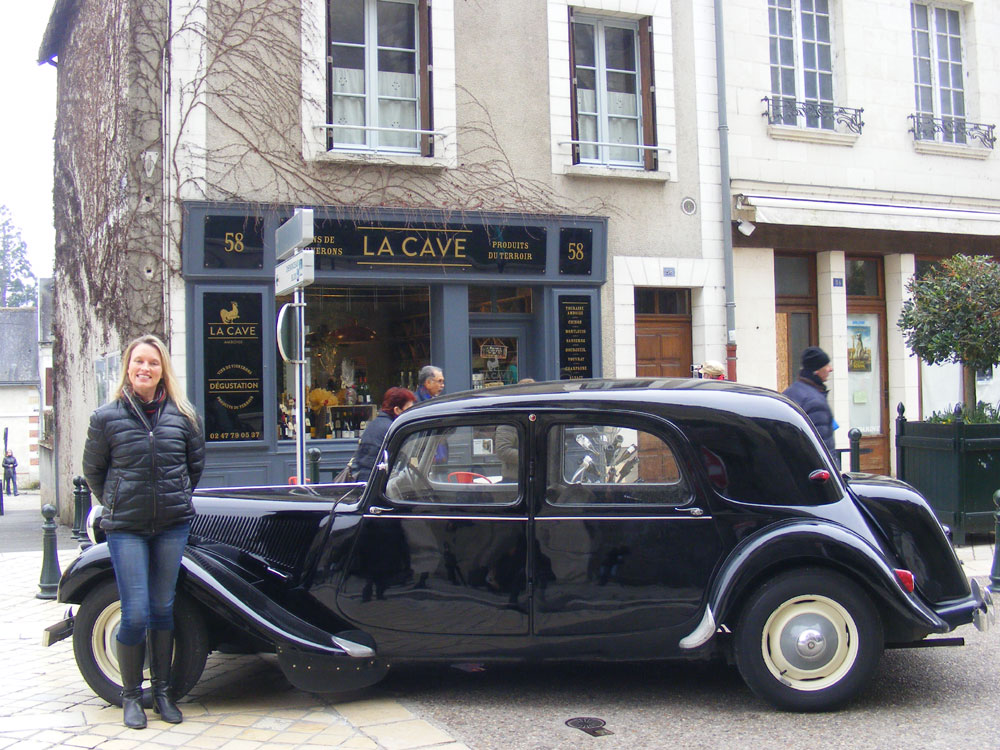
When we went to pick up Célestine from the auto-electricians we also took the opportunity to stop off and visit our friend Summer. She's just started working at La Cave Amboise, a wine boutique right opposite the exit to the Chateau Royal of Amboise (how perfect a location is that?!)

Summer got a bit over excited with the photo shoot and caused a considerable tail back. 
You can do that if you are a smiley American photographing a classic car (apparently).

La Cave is owned by Louisa Martin and Fréd Plou, from the Chateau de Montdomaine wine estate in Nazelles-Négron. Fréd is a very well known young winemaker in the area, from a winemaking family and formerly working in partnership at the Closerie de Chanteloup on the other side of town. He and Louisa also own Chez Bruno, the very popular restaurant in Amboise, just a few doors down from La Cave.

 Summer, Célestine and la Cave Amboise.

La Cave offers wine by the bottle, glass or tasting. To do a tasting you buy a card and help yourself by inserting your card into the tasting cabinet and holding down the button of your choice. The tasting gizmo will give you a full glass, a half or a quarter so you decide how much wine you want to taste and how much you want to spend. I tried four whites, tasting portions, which cost €1.25 each (I was very favourably impressed by Fréd's Vouvray). The shop offers six whites and six reds for tasting, all local. Their stock focuses on the Montdomaine wines especially, and local wines in general, but they have wines from other areas of France too, and a few spirits as well as terrines and foies gras.

 In case you are wondering why Simon was so rugged up, it was snowing when we left home.

Summer is American, married to a French man. They moved to the Amboise area when her husband retired and she runs the social networking group for anglophones Loire Connexion, who meet once a month in Amboise. It's kind of like the apéro soirées I run, but held at a bar so people buy their own food and drinks on site rather than bring bottles and platters to contribute to a buffet. To be honest I sort of stole her idea after hearing such good things about the gatherings and then finally attending one myself. We now go regularly.

Sunday, 1 April 2018

Candelo


Candelo is a village in the coastal mountains of south-east New South Wales. It was established in the 1860s and many of the buildings date from the 19th century. We stopped here for lunch with our friends Rick and Helen. There are two excellent cafés in town and we chose the General Store, where I had the best veggie burger ever, and a nostalgic treat from my childhood, hedgehog cake. Dee-lish-us!

Rick pours the rest of us water while we wait for our lunch.

The General Store.

Book exchange.