Wednesday, 28 January 2026

The 20th First Cowslip

This is our annual "First Cowslip of the Year" photo. Usually they are posted in Match, but occasionally we see one in early February. This is the first time we have seen a cowslip the wild in January.

This particularly unimpressive specimen is in the middle of Huub and Ingrid's driveway. It's no wonder it isn't sticking its head out 


Tuesday, 27 January 2026

A Walk in the Forest

 On 14 January I went for a walk in the Forest of Preuilly with Ingrid and Huub. It was 3.5 km, 14°C and took an hour and a half. Huub was vastly amused to be accompanying two women who spent half their time with their arses in the air, photographing small fungi at ground level. Here is a small selection of what we saw. There were a lot of bracket fungi.


 A waymarker (Fr. borne) for the Chemin de Saint Martin (the Way of Saint Martin, an important pilgrim route).

Chemin de Saint Martin waymarker, Foret de Preuilly, France.


Ochre Bracket Trametes ochracea (Fr. Tramète zoné) is not uncommon, but not abundant either. It is usually found on Aspen.

Ochre Bracket Trametes ochracea, France.


Sporodophoron cretaceum, a lichen that grows on the bark of mature oak trees.

Sporodophoran cretaceum, France.


Common Green Shield lichen Flavoparmelia caperata (Fr. Parmélie froncée) is widespread and abundant. The leaf like lobes don't adhere to the substrate they are growing on, and can be lifted up like flaps. The underside is black.

Common Greenshield lichen Flavoparmelia caperata, France.


Cherry Gall (Fr. Galle-cerise) made by the wasp Cynips quercusfolii on the underside of an oak leaf.

Cherry Gall made by Cynips quercusfolii, France.


Golden Ear fungus Naematelia aurantia (Fr. Trémelle orangée) is an irregular jelly like blob of yellow that parasitises Hairy Curtain Crust fungus.

Golden Ear fungus Naematelia aurantia, France.


Possibly Fence-rail Cladonia lichen Cladonia parasitica, which seems to be rather rare overall in Indre et  Loire and virtually impossible to tell from C. caespiticia without doing a chemical reaction test.

Fence Rail Cladonia Cladonia parasitica, France.


Luminescent Panellus Panellus stipticus (Fr. Panelle astringente), an abundant beige mushroom growing in layered groups on dead wood of deciduous trees.

luminescent Panellus Panellus stipticus, France.


Gilled Polypore Trametes betulina (Fr. Lenzite du bouleau) is a slightly downy dirty white bracket fungus. They can appear more coloured, but that is algae growing on the surface. They are mostly found on birch, oak, beech, alder and hazel.

Gilled Polypore Trametes betulina, France.


Rusty Swan-neck moss Campylopus flexuosus (Fr. ) is an attractive moss that is relatively common all over France and observable all year round. Underneath the bright green cushion is usually rusty red, and the leaves have a very distinctive wide central vein.

Rusty Swan-neck Moss Campylopus flexuosus, France.


Stinking Hellebore Helleborus foetidus (Fr. Pied-de-griffon), a toxic wild flower of oak woodland understorey. Touching it releases an unpleasant smell. The flowers produce a lot of nectar, no doubt very welcome for early emerging bumble bees, who love hellebores.

Stinking Hellebore Helleborus foetidus, France.

Monday, 26 January 2026

Aussie Style Pickled Beetroot

Today is Australia Day, a controversial national holiday, unknown outside of Australia, and even Australians can't decide what it is they are celebrating on this day or whether it should even be on this date. So I thought I'd write about something less controversial. Beetroot. Which in my opinion is Australia's national dish. Or at least, the very sweet pickled sliced version. It is an essential ingredient of any Aussie hamburger or mixed salad, both of which are served by humble cafés, restaurants and pubs up and down the land. Here is how I do it in France, so this recipe might not be authentic, but a hybrid introduced by me to many of my French friends, who, by the way, love it.


Cooked organic beetroot in the farm shop at les Jardins Vergers de la Petite Renaudière, our local market garden and orchard.

Cooked beetroot, France


Ingredients

2-6 cooked beetroots (I buy mine pre-cooked from my local organic market garden. They are boiled or pressure cooked whole and in their skins in big batches on the farm. If you need to cook your own, boil them in water for about 30 minutes, until you can slip a knife all the way through them easily.)

Pickling liquor:

200 g white sugar (note that French white sugar is more like castor sugar, but any cheap sugar will do)

450 ml vinegar (I use red wine vinegar in France, but distilled white or malt vinegar would be traditional)

125 ml water (optional, for if you need to extend the quantity a bit, or you want to cut the acidity a bit)

1 tbsp sea salt

½ tsp mustard seeds

½ tsp black peppercorns

½ tsp coriander seeds (optional)

½ tsp chilli flakes (optional)

2 sprigs of thyme (optional)

2 bay leaves (optional)

Method

  1. Peel the beetroot by cutting the tops and bottoms off and slipping the skins off.
  2. Cut the beetroot into slices, dice or wedges.
  3. Pack the beetroot into jars.
  4. Combine all the pickling liquor in a saucepan and bring to the boil.
  5. Stir the mixture on the heat until the sugar dissolves.
  6. Pour over the beetroot and seal the jars.
  7. Leave to mature for 2 weeks before eating.


Fresh organic beetroot in the farm shop at les Jardins Vergers de la Petite Renaudière, our local market garden and orchard.

Beetroot in an organic farm shop, France.


Homemade pickled beetroot.

Homemade pickLed beetroot.


Homemade pickled beetroot.

Homemade pickLed beetroot.


Beetroot with other salad items on the side of a lamb and red wine pie, in a café in Tenterfield, Australia.

Pie and saLad, AustraLia.


A typical Aussie burger, with a slice of beetroot above the tomato and below the beef patty, at a café in Talbingo, Australia.

Hamburger, AustraLia.


Laurent, who adopted the role of beetroot wrangler at a party we held.

Party, France.

Thursday, 22 January 2026

A New View on the World

We have been living in France for almost 17 years, and in that time, if we wanted French TV we had to look at it on our phones. We're in a shadow here, so any aerial to receive it to our TV would have to be 20' high, and provoke the council.

As I wrote two weeks ago, our TV was on its last legs. Luckily a TV came up on the soldes at SuperU for 99€, and Susan bought it with our shopping. We still don't get French TV through the aerial or the satellite, but once I sorted out some WiFi issues with a range extender we now get French TV via the France TV and TV1 apps.


To celebrate, we watched a 1970 musical film "Peau d'âne" ("Donkey Skin" in English), a French fairy tale by Charles Perrault about a princess who disguises herself in a donkey's skin to escape her father's incestuous desire to marry her.

It was... interesting, and it's nice to have French TV, but it will be a while until I next venture into the world of French movies.

Wednesday, 21 January 2026

Beavering Away

On Saturday we went for a little walk to visit a tree that Susan had seen the day before. 

The Eurasian Beaver (Castor fiber) is a different species to the North American Beaver. It is the largest rodent in Europe, and is just slightly smaller than it's American cousin.


At the beginning of the 20th century the Beaver population in France was restricted to the Rhône river, and was estimated at no more than a few dozen localised in the lower reaches. In an effort to avoid extinction, in the 1960s until the mid 1980s more than 250 were released in 15 different departments in the Centre, the North-east and in Brittany, all having been taken from the Rhône population.


Since that time the populations have grown slowly, with an expansion in range in some regions. The only river in Poitou Charentes where a reintroduction was attempted was the Creuse in Vienne where 4 beavers were released between 1970 and 1973 but this failed. In the period from 1973 to 1976, 13 beavers were released in the river Loir in Loir-et-Cher, and during 1994-1996 another 13 were released in the river Loir, in the departement of the same name. Both of these releases were successful. From the river Loir the beavers have bred and slowly increased their range and are now found in the rivers Vienne, Creuse, Gartempe, Anglin, Salleron, Clain, Thouet, and Argenton. We think they're also present in the Claise, because Tim has trailcam footage of a beaver in the Aigronne.

A pair of trees felled last year. By the time I took this photo it was raining, and the camera was having issues focusing. It has been passed through ChatGPT.


Anyway. As you can see, the beavers are making their presence felt, in this case in the Creuse at Yzeures.

Tuesday, 20 January 2026

Chopitty Chop Chop Chop

A couple of years ago Susan wrote about having a haircut and donating the resulting excess hair to cancer charity Fake Hair, Don't Care.

Time rolls around, and last week she emailed the hairdresser for a repeat performance. I happened to be in the room at the time and said "make one for me, too". I must admit I was in two minds about having a haircut, but it's been getting to the stage where I had to get my hair exactly right, otherwise it was in the way.

Anyways: last Friday we fronted at the hairdresser's and I had my first haircut in 6 years - the last time was in preparation for a work season that was demolished by the plague in 2020. Not all of my hair was suitable for wig making, but she did find enough to make a serious hank. The rest had been damaged, presumably by one or other if my treatments.

Before. I didn't realise that it was quite that long - or stylish.

The donation has been taken, now it's time to shape the rest


My hair, yesterday


It's still long enough (just) to put in a hair band for that aged rocker look, but I do feel like a weight has been lifted off my shoulders.


Monday, 19 January 2026

Truffles in the Touraine

Black Truffle Tuber melanosporum (Fr. Truffe noire) is native to the  Touraine Loire Valley, but has long since disappeared from the wild. According to the experts and old timers the best place to find truffles was under isolated oak trees in the middle of wheat fields, but seventy years of modern farming practices and fungicides sprayed on wheat crops have destroyed the habitat for truffles. The truffles benefitted from the disturbance of the soil with the plough and the minor damage done to the tree roots, allowing the truffle mycelium to latch on, providing the conduit for a symbiotic exchange of nutrients. It may explain why isolated mature oak trees in the middle of fields continue to be a not uncommon sight in the Touraine. 

Oak trees in the fields, Indre et Loire, France. Photo by Loire Valley Time Travel.
Oak trees dotted about the fields.

Nowadays, because of their extirpation in the wild, truffles are cultivated, in orchards planted with inoculated oak trees. Black Truffles fruit in the winter, and over winter there is a series of specialist markets, traditionally in the otherwise undistinguished village of Marigny-Marmande, and nowadays in several others.

Truffle orchard, Indre et Loire, France. Photo by Loire Valley Time Travel.
Truffle orchard.

Local growers tell me that alternating wet and warm weather from May to July is crucial to ensuring a good truffle harvest over the winter, from November to February, so I assume the harvest this winter is expected to be poor because of the hot dry conditions last summer. The markets before Christmas double as general seasonal gourmet markets, with other producers there to sell their venison, snails, nuts and dried fruits, preserves, winter pork and poultry products and cheeses, speciality breads, honey and wines. The markets after Christmas are all about the truffles, with far fewer stalls, and tree whips inoculated with truffle spores available for those who want to try a few in their garden for fun. Serious truffle buyers come in January, when the quality of the truffles is at its best. About six tonnes of truffles, 10% of national production, are harvested these days in the Loire Valley, from 400 ha of truffle orchards, making the area a major player nowadays. Back in 1900 the harvest of wild truffles here was a thousand tonnes.
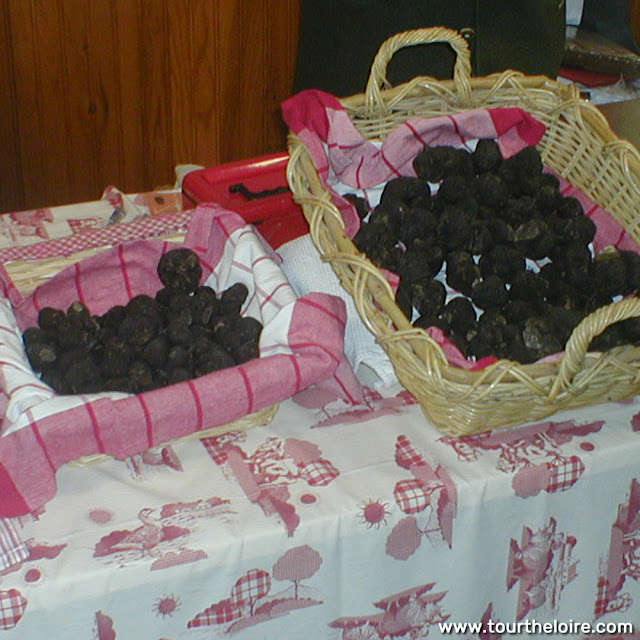
Black Truffles at a market, Indre et Loire, France. Photo by Loire Valley Time Travel.
Black truffles at the specialist market in Marigny-Marmande.

Anyone with a truffle orchard is playing a long game. The trees will take at least ten years to produce a truffle, and some may never do so. Others will go on to produce truffles for thirty years or more. My friendly local truffle guru, now deceased, told me that a good truffle orchard has a mixture of the local species of oak, and the evergreen species that is native to the south of France. The local oak is small, deciduous and adapted to the local poor dry chalky soils and will produce truffles earlier than the evergreen species, but is weakened by the truffles and has a shorter lifespan than the evergreens. He owned two lively truffle hounds, a Jack Russell called Pierre, and a wire haired dachshund called Odile. Truffle hounds can be any breed of dog, and are trained by getting them to play fetch with a truffle oil impregnated sparkling wine cork.


Me buying a truffle some years ago in Marigny-Marmande.

Buying a truffle, France.

The cultivation and commercialisation of truffles came about in the late 19th century because so many vines were grubbed up due to phylloxera. Instead of vines, farmers planted oaks. They understood that the trees would quite likely have truffles attach themselves to the roots. But by the end of World War One there was no labour to work on the land, then the Depression and another World War, and the trees had reached the end of their productive life. So truffles became once again scarce and expensive. 


Truffle orchard near the Chateau de Marigny-Marmande.

Truffle orchard, France.

Truffle orchards began being planted again in the 1970s, often by bourgeois enthusiasts at their country homes, keen to revive a tradition. INRA, the French national agronomy research institute, developed a technique of inoculation of oak and hazel saplings that resulted in a quarter of the trees producing truffles within a decade. Today 90% of French truffles are cultivated and there are about 20 000 truffle farmers in France. Drought and wild boars are the biggest problems that they face. The reason pigs are such good truffle hunters is that the aroma of truffle is the same as boar pheromones, so the sows go crazy for them. In the wild it means the truffles can spread due to the boars ploughing.


Further reading: Touraine Truffle Association (in French, with a list of markets where you can buy truffles)  https://www.latruffedetouraine.fr/ .

Friday, 16 January 2026

Fragrant Bracket

Fragrant Bracket fungus Trametes suaveolens, France.

Yesterday in Loches we parked right in front of this attractive fungus in its prime. I've identified it as the widespread but uncommon Fragrant Bracket fungus Trametes suaveolens (Fr. Tramètes parfumée) but have not had expert confirmation.

Fragrant Bracket fungus Trametes suaveolens, France.

It was growing on a weeping birch, which is not an unknown host for it, but apparently it is much more likely to be found on willow. The real telltale determining character is that it smells of aniseed. Unfortunately, because I didn't know that at the time, I didn't check.

Fragrant Bracket fungus Trametes suaveolens, France.

It is one of the fungi that causes white rot in old living or already dead wood.

Thursday, 15 January 2026

There haven't been any blog posts the past few days. You might think that it's because we've been busy (our usual excuse), but the real reason is exactly the opposite.

I suspect I've had some sort of virussy thing, which has really wiped me out. I went for a little walk on Sunday, but that's been it. I think that my system has been weakened by my treatment and even the slightest thing really knocks me on my heels.

It has given me time to think about projects, of which I gave many in mind. Two of them are (spoiler alert) a visit to Germany in June, and buying a new (preferably electric) car. These have involved many hours of reading. As long as I can retain some of the information gained I should be ok.

In the meantime, I've been trying to decode this:


I spend so long trying to work out what it means, I forget to wash myself.

Monday, 12 January 2026

Turnips versus Rutabagas

Turnips are very popular in France. They come in tempting pink and white, less tempting green and yellow, and the big globular variety known as 'golden'. Rutabagas are a bit less popular, but widely available. They also come in pink and white, and green and yellow. So how do you tell a turnip from a rutabaga? I asked Charlotte at the local organic market garden les Jardins Vergers de la Petite Rabaudière and she told me that turnips have fine tap roots that emerge abruptly from the swollen part of the root that you eat. Rutabagas taper into their tap root, which is much thicker. Easy peasy once you know how.

Rutabagas are known as swedes in England and Australia, and neeps in Scotland. I like rutabagas, which are yellow fleshed and a bit sweet. I am not so fond of turnips, which can be white or yellow fleshed, and are usually somewhat bitter. Rutabagas mash well, turnips do not.


Organic turnips in my local farm shop.

Organic Turnips, France.


Organic rutabagas in the farm shop.

Organic rutabagas, France.

Friday, 9 January 2026

You're Lucky to Even be Getting This

It was very windy last night. We had a couple of light flickers, the wind was loud in the telegraph wires, and stuff (I imagine out rubbish, which we put out last night) was blowing up the street.

I'm writing this last night in case the situation changes. Brittany and Normandy have had rolling blackouts, and we're on a warning for 90km/h winds.

Meanwhile, in Australia it's very hot and there are bushfires.

I'm not complaining about the cold.


*********Update*********

The wind didn't really happen, it's not particularly cold, and as yet it hasn't rained. Not that I blame the weather bureau: this weather forecasting thing is complicated.

Thursday, 8 January 2026

We Have Had White


It's been cold recently. After Christmas it got a little bit less bitter, but the past few days - phew!

Here's a couple of pics and some numbers: we had somewhere between 3 and 5cm of snow yesterday, and the lowest temperature for this week was -7°c. The highest temperature was 3 °c. We've had Hoar frost, freezing fog, sleet, and snow. The gusty winds/blizzards never eventuated.


Wednesday, 7 January 2026

Soldes, Hiver 2026

The official bi-annual sales start at 09:00 today.

We've written about the soldes before, when we were looking for a kitchen mixer, and once when we were looking for an oven. Both times we ended up making purchases not connected to the soldes, because other stuff happened that nade so-called official bargains irrelevant.

Our current TV. When I took the pic I was watching a program about Leonardo, and the image is Clos Lucé.


This year, for the first time in over 10 years, I'm paying attention to the soldes. Our television is over 13 years old, and although there's nothing wrong with it once it's working, it takes about 5 minutes after turning it on before any picture arrives. I think it's a problem with the power supply, but the only way to find out will invariably cost more than a new TV. Sooner or later it won't run at all.

My dilemma is that to get French TV I will need to get a smart TV, and I don't particularly want one of them. We don't have any subscriptions and don't intend buying any, I don't talk to electronics, and I don't sufficiently trust the purveyors of such stuff. We could get our satellite system changed, but that would mean we lose our UK satellite. I could maybe get some sort of stick or WiFi box for a dumb TV, but I'm not sure I can be bothered. You might think I could use the mini PC to watch French TV online, but it's a Windows 7 machine and neither of the official French TV sites will work.

Whichever way we go it will be a bigger TV than the one we have now. These days it's almost impossible to buy a TV as small as our current one.

Tuesday, 6 January 2026

Ceramic Apothecary Pots

Apothecary shelves in the museum at Issoudun.

Apothecary shelves, Issoudun, France.

It is rare, even today, for an old long established French pharmacy not to have a few brightly coloured ceramic pots, from the days when they were an apothecary. Their round forms are entirely covered with hand painted floral decorations and mysterious gothic inscriptions. These days they have lost their practical function and have become decorators and collectors items of some worth. Ceramicists and medical professionals worked together to create pots suitable to contain valuable herbal mixtures such as Theriaca (for snake bite) or Egyptian unguent. 


Apothecary cabinet at the Chateau de Chenonceau.

Apothecary cabinet, Chateau de Chenonceau, France.

This type of pottery arrived in Europe in the 7th to 14th centuries, with the Moorish and Arab invasions. The pots were valued for their decorative qualities and their durability.


The Apothecary at the Chateau de Chenonceau.

Apothecary, Chateau de Chenonceau, France.

The tin glazed (aka maiolica or, in French, faience) earthenware pots are known as albarelli, or gallipots, and were used between the 15th and 17th centuries in France. A fine collection of albarelli inspired confidence in the professional capabilities of the apothecary. The jars were sealed with parchment or leather tied on with string. Typically albarelli are cylindrical with a narrow collar at the top, which allows them to be easily gripped even they don't have handles. Other shapes are also widely used, adapted to purpose and contents.


Albarelli for tobacco, a medicinal product in the 16th century, at the Chateau de Chenonceau.

Albarelli (apothecary jars), Chateau de Chenonceau, France.


To see collections of 16th century apothecary pots in the Touraine and Berry I recommend visiting the Chateau de Chenonceau and the Musée de l'Hospice Saint-Roch in Issoudun.


 Apothecary shelves in the museum at Issoudun.

Apothecary shelves, Issoudun, France.

Monday, 5 January 2026

Couronne des rois

The tradition of 'Kings Cakes' at Epiphany is strong in France. In the north we have Galette des rois, made with puff pastry and almond cream (a half and half mixture of frangipane and creme patissiere). Usually I make a galette, but last year I decided to make the cake that is favoured in the south, which is brioche based. I used this recipe from Pardon Your French, and I thought it turned out rather well.


Ready to eat.

Homemade Couronne des rois


Glazed and decorated.

Homemade Couronne des rois


Just out of the oven.

Homemade Couronne des rois


Ready for the oven.

Homemade Couronne des rois.