We have made a video featuring the tiny village of Boussay, a few kilometres from where we live. I hope you enjoy it.
We are also on Instagram, so check us out to see a regularly updated selection of our very best photos.
We have made a video featuring the tiny village of Boussay, a few kilometres from where we live. I hope you enjoy it.
Here in the Touraine we are part of that great band of lard that stretches across the middle of temperate Europe. Here the pig is king and local delicacies tend to feature lard and include preserved meats of great inventiveness and variety (charcuterie). In the Touraine, a layer of lard is key to the preservation process, as we are not a salt producing province.
![]() |
| Fresh out of the oven. |
To our south the olive dominates the landscape and the cuisine. In the west duck fat replaces lard. But north of us, la vache (the dairy cow) is queen and butter the favoured culinary fat.
Kouign Amann (Butter Cake in Breton) is designed to use a substantial lump of butter to transform a simple flour, water and sugar concoction into something irresitably caramelly. It's all in the folding and layering and the subtle, sparing application of sea salt crystals, another Breton speciality.
It is quite tricky to produce an authentic result, especially outside of Brittany, but a few years ago I decided to give it a go. I was moderately successful and have been making it occasionally ever since. I habitually add apple slices to the recipe, which is not traditional, but which we prefer.
![]() |
| The dough folded for the first time. |
Kouign Amann is somewhere between cake, bread and pastry, with lots of caramelised sugar both gooey and crunchy.
Ingredients
12 g dry yeast
175 ml warm water
250 g flour
1/2 tsp sea salt
200 g sugar, plus extra sugar for rolling the dough
100 g butter, cut into 2 cm cubes and chilled, plus extra butter, melted
An apple, cored, peeled and sliced
Method
1. Dissolve the yeast and a pinch of sugar in the water in a medium sized bowl, stirring to mix well, then cover and leave in a warm place to develop a foam for 10 minutes.
2. Gradually add the flour and salt, until you have a soft, rather sticky dough.
3. Sprinkle flour on your work surface and knead the dough for several minutes until silky and elastic. You can add a bit more flour if necessary, if the dough is sticking to your hands.
4. Brush a bowl with melted butter and put the dough in, cover and leave in a warm place for 1-2 hours.
5. Cover a large plate with plastic wrap.
6. Roll the dough out into a 30cm x 45cm rectangle, with the long side parallel to the edge of your work surface.
7. Distribute the cubes of butter evenly over the dough and sprinkle with a quarter cup of sugar.
8. Distribute apple slices evenly over the dough.
9. Fold the short sides into the centre, as if you are folding a sheet of A4 paper into thirds to put into an envelope.
10. Sprinkle the folded dough with a quarter cup of sugar and fold into thirds again, perpendicular to the first folds.
11. Put the folded dough on the covered plate and refrigerate for an hour.
12. Wipe down your work surface, then sprinkle it generously with sugar.
13. Put the dough on the work surface, sprinkle it with a quarter cup of sugar, and roll it out into a 30cm x 45cm rectangle.
14. Fold the dough again as in Steps 9 and 10.
15. Put the dough on the plate and refrigerate for an hour.
16. Line a 20cm diameter cake tin with a sheet of baking paper or coat a pie plate with butter.
17. Heat the oven to 220C.
18. Sprinkle more sugar on the work surface, put the dough on the sugared work surface, sprinkle the dough with sugar, and roll out to roughly the size of your baking tin.
19. Manoeuvre the dough into the baking tin or pie plate.
20. Sprinkle the dough with the remaining sugar and about a tablespoon of melted butter.
21. Bake for 45 minutes.
22. The cake should be deeply caramelised, leave to cool for 10 minutes then take the cake carefully out of the pan and put on a rack to cool.
23. Serves 8-10.
I keep calling it a cake, but it is clearly of the bread family. The tell tale signs of yeast acting on gluten are there in the interior of the cake once its cooked and the feel of the dough before.
************************************************
![]() |
| My former colleagues happy to hear I brought a thermos of coffee! Photo courtesy of Laetitia Rey. |
Many of you will have seen in the news the dramatic scenes of winemakers in France desperately trying to save this year's vintage. After some days of unusually warm weather, bud burst was well underway on the vines from Burgundy to Bordeaux, and here in the Touraine Loire Valley. Then the weather changed, with clear sunny days, but minus temperatures over night. This is really bad news for tender young vine leaves as they are likely to burn with the combination of hard frost followed by bright sun. Once the buds are killed the vine will not produce a growing tendril, so it won't flower and with no flowers it can't fruit, so no wine.
![]() |
| An emblematic view over the church tower of Vouvray. Photo courtesy of Laetitia Rey. |
The wine growers use various strategies to combat frost, but the most common is to set out paraffin candles along the rows and hay bales around the edges. This method is chosen because you don't need permission from the authorities to do it, unlike some other anti-frost techniques. The candles are usually lit very early in the morning and can increase the temperature around the vines by two or three degrees. Sometimes that's all you need, but it is likely that all the effort has not paid off this time. The work is done by hardy volunteers, and is dirty and not very healthy. They get covered in soot, and worse, breath it in. But in desperation even the organic wineries have been using candles. They cost €2000 per hectare, a cost that Touraine wine growers will be reluctant to pass on to their consumers, so must bear the costs themselves. They worry that with diminished supplies of wine and many competitors, if they put their prices up they will lose customers, who will never come back. This time the damage has been so bad that the French government has declared a national agricultural disaster. This will mean that wine growers can benefit from tax breaks, automatic and rapid insurance payouts and low interest government guaranteed loans to tide them over.
![]() |
| Clos le Vigneau, both the name of the plot and the wine produced by Chateau Gaudrelle. Photo courtesy of Laetitia Rey. |
My friend and colleague, Laetitia Rey, lives in Vouvray, in the midst of the vines, and she is a freelance guide specialising in wine tourism [link]. She was out with much of the community over the very cold nights of April 7 and 8, and has kindly written an eye witness account of the action in the vineyards, illustrated with the dramatic photos she took at the time.
![]() |
| This little guy had survived 2 nights in a row. I hope he made it through the third one. Photo courtesy of Laetitia Rey. |
As I live in Vouvray (and was out 2 out of the 3 nights), I thought I could share what happened in the vineyard this week.
First you have to understand that frost is a pain, very difficult to predict as it is due to a combination of cold temperatures, humidity and, at sunset, sun exposure. Factors such as air mass and winds are decisive.
Depending on how developped the bud is, it can handle temperatures between -8° and 0° celsius. Unfortunately for us, it has been pretty warm here the past week and the buds broke. It means after a 30-min exposure at 0.6° celsius the bud (and future shoot carrying the fruits) scorched.
Back to Vouvray.
Monday night. First night out for the winemakers. The air is cold and dry. Temperatures drop to -5° abruptly. Those we can't fight (mostly for economic reason) understand spring 2021 is going to be rough.
Tuesday night. My former colleagues in Chateau Gaudrelle receive the first alert from the weather stations dispersed in the vineyard. -2° at only 10.00 pm. By the time they get there, it warmed up a bit. False alarm. Everyone goes back to bed until the second alert. The real one. -3° at 4.00 am. For 4 hours, the temperatures go up and down and finally stabilise at the sunset.
Wednesday night. The cold sets earlier. The fight starts at 2.00 am for most winemakers. Messages from Chinon say they are up to, from midnight for some. This time the humidity rate is high (over 80-85%). It has rained over a few plots in the evening. Without a proper ventilation (helicopter) combined to warm air (from heaters or straw bale), there will be some bad damage, again.
Thursday. The weather forecast says rain and temperatures over 0°celsius for the nights to come. Winegrower will probably stay home tonight. At least in Vouvray. Many have spend the day looking at their vines to count the burnt buds. Though most will wait a few day or even early May to announce the loss.
I had a walk in the vineyard as well. And the first glimpse is devastating..
![]() |
| The sun slowly warms up the air and the smoke from the candles protects the buds from the burn. Photo courtesy of Laetitia Rey. |
![]() |
| This is not winter fog but the smoke from frost protection. Hopefully the neighbourhood has been warned. Photo courtesy of Laetitia Rey. |
![]() |
| I let you imagine the smell on my clothes. Photo courtesy of Laetitia Rey. |
![]() |
| They made it through the week. Let's hope they won't have to face the cold later in April or May. Photo courtesy of Laetitia Rey. |
![]() |
| We recognise two sorts of smoke: the black one from the paraffin candles... Photo courtesy of Laetitia Rey. |
![]() | |
| ... and the white one from the straw bale fires. Photo courtesy of Laetitia Rey. |
![]() |
| In the end, here is a broken bud. This one cannot survive below 0° celsius. Yet it is still green and firm when gently pressed. Photo courtesy of Laetitia Rey. |
![]() |
| On an unprotected plot, a few rows away, there is about 50% of scorched buds. Photo courtesy of Laetitia Rey. |
![]() |
| Multiple fires in the distance to protect the vineyard from the rising sun. Photo courtesy of Laetitia Rey. |
And I've just seen that the whole thing will need to be repeated early next week, with another cold snap forecast.
![]() |
| Sign over a bakery. |
Since 2010, the Loches Heritage and Culture endowment fund, in association with the City of Loches, has offered financial incentives for the installation of medieval-type signs by shops in the old centre of town.
![]() |
| Sign on a restaurant. |
In keeping with the look and feel of old Loches, these signs indicate the different shops and engage the curiosity of visitors. Created, shaped, painted and hammered by specialized craftsmen, these signs ornament the central streets and have become an additional attraction for tourists.
![]() |
| Sign on a hairdresser. |
![]() |
| Sign on a newsagent. |
![]() |
| Sign on a charcuterie-traiteur (delicatessen-caterer). |
![]() |
| and another charcuterie (delicatessen specialising in pork products). |
![]() |
| Sign on a bar that serves food. |
![]() |
| Baker. |
![]() |
| Optometrist. |
![]() |
| Real estate agent. |
![]() |
| The newest of these signs, for a restaurant. |
![]() |
| Wine boutique. |
![]() |
| Fabien behind his counter in January. |
Our young newsagent, Fabien Petit has been running the small business he took on in April last year for coming up to a year now. Prior to him it had been closed for five months. Fabien comes from a local family and has a degree in Business Management from Tours University. During his studies he worked at a newsagency in Tours, then he worked in various sectors in several countries for a while before coming home to the south Touraine. He's a big fan of horse racing and contributes to a specialist magazine on the subject. His newsagency sells the same range of goods as previously -- newspapers, cigarettes and smoking or vaping accessories, lottery tickets and hot and cold drinks. He has added a small selection of books, games and souvenirs. The shop, at 9 rue Chaumont-Patin, is open Mon-Tue and Thu-Sat from 6:30 am to 1:00 pm and 2:00 pm to 7:30 pm (closing at 7:00 pm while we have a Covid19 curfew); Wed 6:30 am to 2:30 pm. Closed Sundays. In French a shop like this is a Bureau de tabac, or sometimes a Maison de la Presse.
![]() |
| The newsagent in Preuilly, photographed a few years ago. It still looks more or less like this. |
Valençay cheese is a goats milk cheese that comes from the Berry, in the area around the town of Valençay. Like the other goats cheeses of the Loire Valley it is a raw milk cheese, coated in ash and salt and eaten at about three weeks old.
![]() |
| A Valençay cheese, bought from the cheese truck at Loches market. |
Legend has it that Valençay was originally a classic pyramid-shaped cheese. In order not to remind Napoleon of his defeat in Egypt, Talleyrand, who was then living in the Château de Valençay, had them "beheaded" before offering them to him!
Of course, it's not true, but it's a great story.
![]() |
| Pure white inside. |
Only 26 farms produce the green labelled artisanal farmhouse cheese. Red labelled Valencay is also available, produced by half a dozen factories in the area. The two products differ because the farmhouse cheese must only contain the milk from a single 24 hour period, from a single herd (the one on the farm) whereas the factory cheese can contain milk from a 48 hour period from a number of farms. As well as producers there are specialist refiners too, who carefully mature and age the cheese under controlled conditions of temperature, humidity and air movement.
Each cheese weighs around 220 grams, and 340 tonnes of Valencay cheese are produced annually.
The proper way to cut it is from top to bottom, in wedges radiating out from the centre. Our friend, colleague and expert classic Citroen mechanic Jean-Louis does it with practiced ease, with the cheese in one hand and his pen knife in the other.
![]() |
| Ramsons growing on the banks of the Courtineau. |
![]() |
| Sweating the ramsons leaves with onion. |
![]() |
| Sauce for the freezer. |
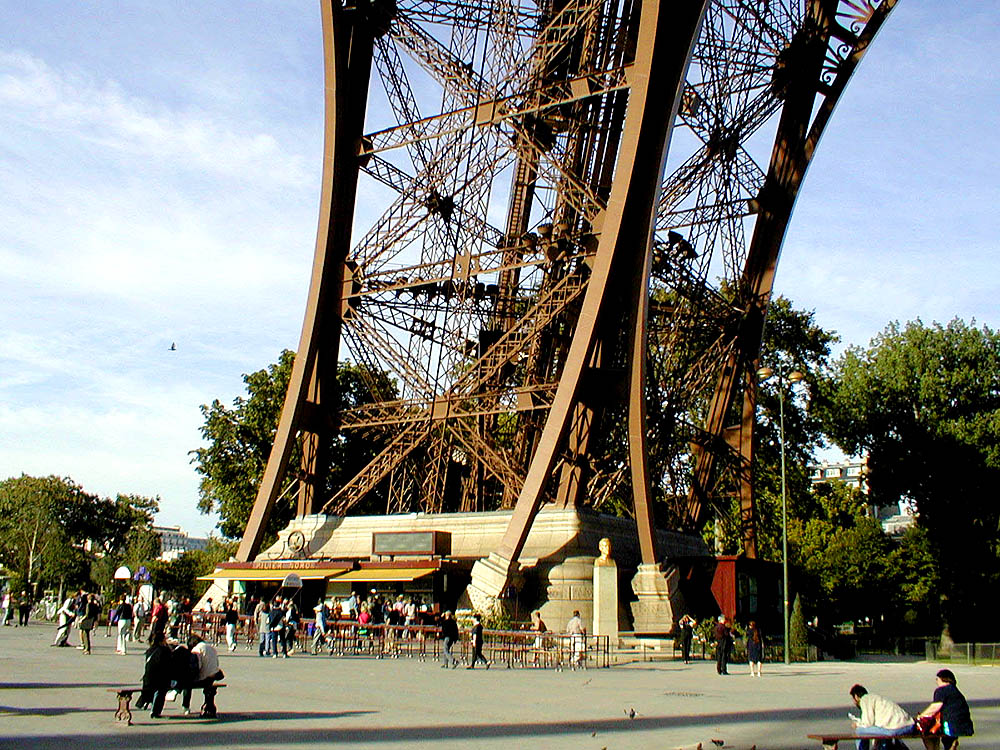
With the Olympic Games coming up in 2024 for Paris the decision has been taken to really spruce up the Eiffel Tower. It is normally repainted every 5 - 7 years but this time it will be taken back to bare metal, and the colour changed to be more like the original paint job. Too high a presence of lead particulates has stopped work on the repainting of the Eiffel Tower. For this 20th repainting it was decided to take the old paint off down to bare metal. The problem is that prior to 1995 all the layers contain lead, and despite the precautions they are finding too high levels of particulates in the air. The Eiffel Tower has lost 52 million euros during the pandemic, but is in receipt of government aid and has not sacked any of its 340 employees.
The Greek industrial coatings company that won the contract appears to have underestimated the health and safety requirements of the Paris City Authority. Taking the paint off, even with a chemical gel type paint stripper, has meant that the paint layers prior to 1995, which all contain lead, are being exposed and lead is being released into the air at higher than the safe levels.
So far, a solution has not been found.
Work halted in February.
Note: these photos date from 2002, and are just for illustrative purposes. They do not reflect the current situation.
All over France there are old concrete pillars with enamel plaques, placed at intersections to tell you where you are. From the end of the First World War to the beginning of the Second World War responsibility for road signage was taken up by those interested in promoting private motorcar touring. Michelin is the most well known, but the early motoring clubs, like the Automobile Club de l'Ouest also sponsored road signs.
The design of these reinforced concrete pillars with enamel panels became standardised in 1928, but the entire scheme wasn't officially sanctioned until 1931. All the signs bore the name of the sponsor, and often the name of the Region or Département (County). In 1946 the authorities had a change of heart and refused all donations of this sort. In addition, the signs were banished from major intersections and could now only be placed on minor roads. Michelin finally ceased producing them in 1971. They are very easy to date, as each sign has the date of manufacture hand painted on the enamel.
![]() |
| This sign is telling you it is 8 kilometres to Preuilly on the Chemin de Grande Communication 50 (now Route Départementale 50). |
The date on this one at Abilly indicates it was made in 1925, in the standardised form, but before it became the only option. Indre et Loire, our 'county' is particularly rich in Michelin signs, most probably because there was a Michelin factory in Joué les Tours. This one was sponsored by the Automobile Club de l'Ouest, the organisation created in 1906, that still to this day run the famous 24 hour races at Le Mans.
The free standing signs are referred to as les panneaux de signalisation routieres Michelin, signalétiques Michelin or bornes Michelin. If they are attached to a wall they are called plaques Michelin.
Driving a classic car on a classic route - the old RN10, the road between Paris and Bordeaux, on a cold late winter's day.
![]() |
| Chateau de Forges. |
![]() |
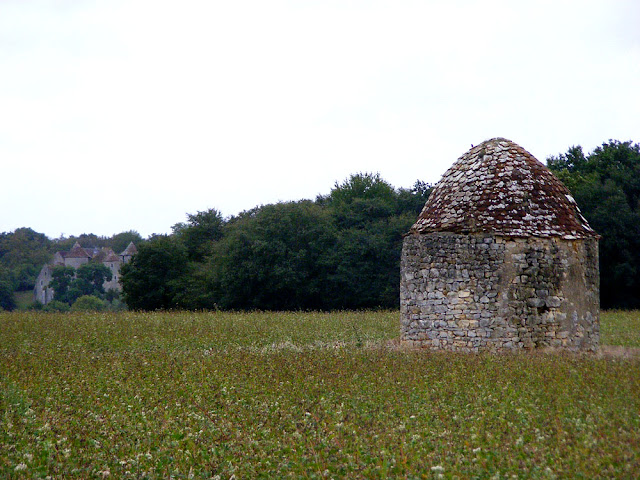
| Chateau de Forges in the background, an unusual vine hut in the foreground. |
![]() |
| Chateau d’Ingrandes: |
Chateau d’Ingrandes: The original 11-12th century castle here was English, part of Eleanor of Aquitaine’s territory. It was captured by the great French knight Bertrand du Guesclin, and then rebuilt in the 14th and 15th centuries. Today it is owned by the remarkable Jacqueline Drouart. She and her husband bought it in 1982 and were determined to save it. She is now a widow, but her life’s ambition is to finish the restoration, so that it is not a burden on their children when they inherit it. She offers accommodation. https://www.facebook.com/ChateauIngrandes/
![]() |
| Chateau d’Ingrandes: |
![]() |
| Chateau de Plaincourault. |
Chateau de Plaincourault: A former stronghold of the Knights Hospitallers although surprisingly, this is a 19th century building. The old chateau fell into such disrepair that it was entirely reconstructed, on the old footprint, in 1872. I have heard that it recently sold for €725 000. It has been a family home, but available for events and filming.
![]() |
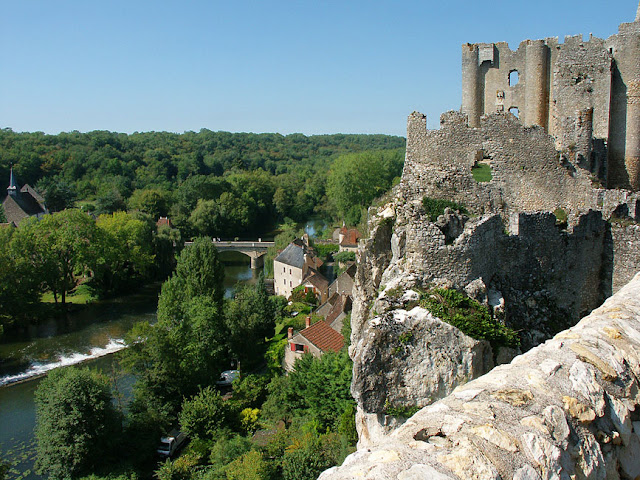
| Angles sur l'Anglin. |
Chateau d’Angles-sur-l’Anglin: The ruins of this castle, built to defend French territory in the 12th century, but taken over by the English in the mid-14th century. It looms over the river on one side and the village on the other. You can follow in the footsteps of the English attackers up the somewhat precarious path ascending the cliff that they took. By the late 14th century it was back in French hands, thanks once again to du Guesclin. The castle is open to the public for visits. https://www.tourisme-vienne.com/en/activite/5/forteresse
![]() |
| Chateau d'Angles sur l'Anglin. |