Sunday, 27 July 2025

Memorial to the Rafle de Loches

This memorial plaque has been a long time coming. It says:

"Remember the French arrested by the Gestapo on 27 July 1944 in the canton of Loches dead for their country in the German camps.

In this school, 58 men and 6 women lived their first day of suffering with calm, courage and dignity.

49 of them gave their life for your future, your happiness and your freedom."


The new memorial.

Memorial to the deportees, loches, France.

"27 July 1944:  Loches roundup.

On 27 July 1944, at dawn, Gestapo agents, accompanied by militiamen and German soldiers, came from Tours and took over the town. More than 200 people were arrested, at home and in the street. Suspected of helping the Resistance, they were gathered in the courtyard of the girls' school, on the corner of rue Alfred de Vigny and rue des Jeux.

Civilians, members of the police force, the Loches sub-préfet, gendarmes from Loches and the surrounding area, who had been ordered into town several days earlier, were taken captive. They were interrogated for part of the day.

The courtyard of the girls' school was turned into a prison. By the evening, 58 men and 6 women had not been released. They were taken to the detention centre in Tours then deported to the Nazi camps of Neuengamme and Ravensbrück, where the majority of them would meet their death.

This stele is a place of memory and recollection. It's also the last memorial grave of these victims of Nazism condemned to disappear in the 'Night and Fog' (Nacht und Nebel decree) in the deportation and extermination camps.

We must remember and never forget."


This side street is now called rue des Déportés.

Rue des deportées, loches, France.

The subsequent list of names and their professions shows first those who died, and then those who returned. 

Further Reading: Link to my previous blog post about the Rafle de Loches  https://daysontheclaise.blogspot.com/2024/08/le-rafle-de-loches.html

Saturday, 26 July 2025

Bleu d'Auvergne

I was excited to see this in the Coles supermarket in Manly. I was also "excited" by the price.


$84 per kilo is about 47€. We often buy exactly the same cheese at home in France for about €12 a kilogramme. It's makes a fairly regular appearance in our household as a very reliable inexpensive blue cheese - especially if it's in the anti-gaspillage (anti - waste food nearing it's end of display date) section at 30% off.

Friday, 25 July 2025

Berrichonne Churches

Yesterday we took cousin Linda and explored some churches south-east of le Blanc. Here's three photos.

The seven deadly sins

I don't know why, but this made me smile


The Three Living. The Three Dead have disappeared 


The plan is to write about each church in turn at some stage in the future.

Thursday, 24 July 2025

Dinner at the Guinguette

My cousin Linda is in town, so in celebration of two special events we had dinner at the guinguette. Here is a slightly unkind photo.


Wednesday, 23 July 2025

Four-spotted Antlion

Twice this summer we have had pleasure of a visit by an uncommon and striking insect called a Four-spotted Antlion Distoleon tetragrammicus (Fr. Fourmilion longicorne). The adults look a bit like damselflies, but are much more sedentary. The juveniles are tiny ferocious predators that look like bits of bark with oversized jaws.

Four-spotted Antlion Distoleon tetragrammicus, France.

Antlions belong to the insect order Neuroptera, which includes lacewings and owlflies. The Antlions make up the family Myrmeleontidae.

Four-spotted Antlion Distoleon tetragrammicus, France.

Four-spotted antlions are present in southern Europe up to about Paris in the north, and in North Africa. 

Four-spotted Antlion Distoleon tetragrammicus, France.

They can be found during the day in open oak or pine woodland on dry calcareous hillsides, as well as nearby fallow land.

Four-spotted Antlion Distoleon tetragrammicus, France.

 The adults appear from June to August. The larvae, unlike other antlion species, do not dig funnel traps, but live in the dry leaf litter.

Tuesday, 22 July 2025

The Man Who Drew Angkor Wat


 There is a street in Loches named after him.

Street sign, France.

The naval officer, explorer, talented draftsman, curator and native of Loches, Louis Delaporte was the first to bring the temples at Angkor Wat and Khmer art to the attention of the French general public. Nowadays the temples are famous the world over and the site is UNESCO World Heritage listed. This year there is an exhibition honouring Delaporte in Loches, on the centenary of his death.


Louis Delaporte's Navy Lieutenant's uniform. This is for an adult, but it is modern young adolescent size.

Louis DeLaporte's uniform, France.


It was in Cochin, in 1866, when Louis Delaporte was recruited by Commander Doudart de Lagrée to join a mission up the Mekong. His skill with a pencil was surely what led to the young 24 year old sailor being appointed as cartographer and official artist on the mission. The aim was to establish the navigability of the river with a view to a possible commercial link with China. The French Navy convoy made a detour via the ruins of the temple of Angkor Wat. It was a revelation for the young man from Loches. Little did he know that these vestiges of the past virtually buried under the jungle would transform his life.


A cast made by Delaporte's team in 1881-82 of a low relief frieze from Angkor Wat. It shows a scene from the battle of  Lanka. The central character is the demon Ravana in his chariot. He has kidnapped Rama's wife and is being attacked by Rama's allies the monkeys.

Cast of a relief frieze from Angkor Wat.

The exhibition underlines how Delaporte's role was to record in 'photographic' detail the sculptures, the people, their way of life, the landscape, in pencil and watercolours. His talent was recognised from the age of 13, when his artistic skill permitted him to attend a special naval college, and then the naval school at Brest when he was 16. Two years later he was on an expedition to Mexico.


Two casts and a watercolour from Angkor Wat.

Casts and a watercolour from Delaporte's Angkor Wat collection.

This first expedition, and those that followed, were utterly fulfilling. Driven by his enthusiasm he produced many more drawings than his orders required. He was highly observant of his surroundings, and worked in a supportive environment, particularly in Asia. His curiosity is a legacy for future ethnographers.


Two casts of devata from the 12th century. Devata are female divinities and feature on many walls and columns at Angkor Wat. Often standing, bejewelled and serene, they have a protective role.

Casts from Angkor Wat.

Once he returned to France Delaporte contributed to a vast Atlas of Exploration published in 1873. He devoted the remainder of his life to his passion for Khmer architecture, and worked at the Museum of Indochina at the Trocadero. He left this job in 1924 at the age of 82.


The Delaporte family home in Loches.

Delaporte family home, France.


Drawings of Angkor Wat by Louis Delaporte.

Drawings of angkor Wat by Louis DeLaporte.


Watercolour of Angkor Wat by Louis Delaporte.

Watercolour of Angkor Wat by louis Delaporte.


Letters, notebook pages and other ephemera from the Louis Delaporte archive.

louis Delaporte ephemera.


Further Info: https://www.ville-loches.fr/exposition-angkor-louis-delaporte-article-3-10-147.html

Monday, 21 July 2025

Almonds in France

 Almond blossom (March).

Almond blossom, France.

The French consume a lot of nuts, and three sorts in particular are grown in France - almonds, walnuts and hazelnuts. Almonds are especially widely used as they are one of the mainstays of the French pâtissier's art. All over France, almond paste, meal or powder appears in yesterday's croissant; as marzipan, macarons or nougat; and in biscuits and cakes of all sorts. In restaurants, almond slivers come swimming in the beurre noisette with fish. 


Homegrown almond, with its leathery green sheath behind.

Almond.

Almonds are not much grown in the Touraine, which is walnut country, but almond trees are seen in many gardens to the south of us, in the Charente. The flavour can be sweet (milky fresh blanched almonds), moreishly nutty (unblanched dried almonds) or somewhat overpowering (almond extract). Excitingly, the flavour of almonds, like the kernels of other stone fruits, comes from highly aromatic chemicals which include cyanide. Almonds must be quite closely related to peaches, because on the tree, still clothed in their fleshy outer layer, the crop looks like rather poorly performing peaches.


Green (fresh) almonds from Spain in the supermarket at la Roche Posay (June). 

Green (fresh) almonds in a supermarket, France.

Once upon a time pastry chefs and confectioners pounded their own almonds to make paste for their goods. Almond paste had been a stock in trade of the patissier since Renaissance times. 


Organic locally grown almonds at the market in Preuilly (September).

Organic almonds at a market, France.

Terraroma, in Provence, is the largest almond producer in France, with 20 000 trees producing top quality nuts which are much prized by confectioners (Fr. confiseurs). The sweet almonds are grafted onto bitter almond stock, and some of the trees are 200 years old. But most almonds used in France are grown in Spain. France simply can't supply the demand.


Organic almond orchard in Provence (June).

Almond orchard, France.

Sunday, 20 July 2025

The Country Women's Association

The Country Women’s Association (CWA) has been a cornerstone of rural Australian life for over a century. Founded in 1922 at the Royal Easter Show in Sydney, the organisation was created by women who recognised the urgent need for connection, support, and services in isolated country communities.

The CWA hall in Batlow


At the time, rural women faced enormous challenges: poor medical access, limited education for their children, and almost no public infrastructure. Many endured harsh conditions on remote farms, often with no electricity, running water, or nearby neighbours. The CWA provided a vital lifeline, offering not just social support but also practical assistance, health information, and advocacy.

Members raised funds to build restrooms for women and children in country towns, set up baby health clinics, and campaigned for improved rural hospitals and roads. The organisation expanded rapidly, with branches forming across all Australian states and territories throughout the 1920s and ’30s.

The Morongla Mechanics Institute Building is also a CWA hall


While the CWA is often associated with scones and tea, its legacy runs much deeper. Its members have long been grassroots activists, lobbying governments on issues such as drought relief, mental health, domestic violence, and rural education.

My first encounter with the CWA was when my family was on holiday on the Gold Coast when I was 9 years old. The CWA ran a tea room, and my parents would often call in for a cup of tea and a biscuit.

Saturday, 19 July 2025

Don't Sit Here

We saw this sign on our way to Shelly Beach in Cabbage Tree Bay, Manly. I hope no-one was on the seat at the time.


Friday, 18 July 2025

"I will rest pleasantly here"

Louise Marie Madeleine Guillaume de Fontaine, known as Madame Dupin after her marriage, was born in Paris in 1706 and died at the Chateau de Chenonceau in 1799.

Famous for her beauty and her lively femininity, Louise Dupin was a celebrity during the Enlightenment, and ran a glittering literary salon. She is the step-great-grandmother of the author George Sand (real name Aurore Dupin).


Approaching the Chateau de Chenonceau.

Chateau de Chenonceau, France.

Louise Dupin was one of the pioneers of the feminist movement. She worked tenaciously for ten years on a history which brought forgotten women back into focus, aided by her secretary, Jean-Jacques Rousseau. She advocated equality, access to knowledge and marital freedom. She suggested that marriage should be a temporary or renewable contract. She attacked civil marriage as unfair, and was in favour of priests marrying.

Louise was the first of three illegitimate daughters of the banker Samuel Bernard and Marie Anne Armande Carton Dancourt, known as Manon, who was the daughter of well known actors.


A portrait of  Louise Dupin by Nattier hanging in one of the salons in the Chateau de Chenonceau. I think this would have been painted to commemorate her betrothal so she is about 16 years old in this portrait.

Portrait of louise Dupin by Nattier, France.

Both sides of her family were wealthy and Protestant in origin, and her father's family were the descendents of Dutch merchants. Her mother's family came from Picardy and were Huguenot gentlefolk. Both families, who were rising rapidly in the world, could see which way the wind was blowing, and renounced their Protestantism well before the Edict of Nantes was revoked. Both her natural father and her mother's husband were happy to acknowledge Louise as their own, and she had half siblings who were the children of her mother and her mother's husband.

She and her sisters were known as The Three Graces, but Louise seems to have been the star -- the most beautiful, the most intelligent, the best liked and the least prone to getting into awkward scrapes. She was educated in a convent and was clearly an eager student. But any thoughts of an academic life would have been suppressed. She was always destined to become a wife and mother.


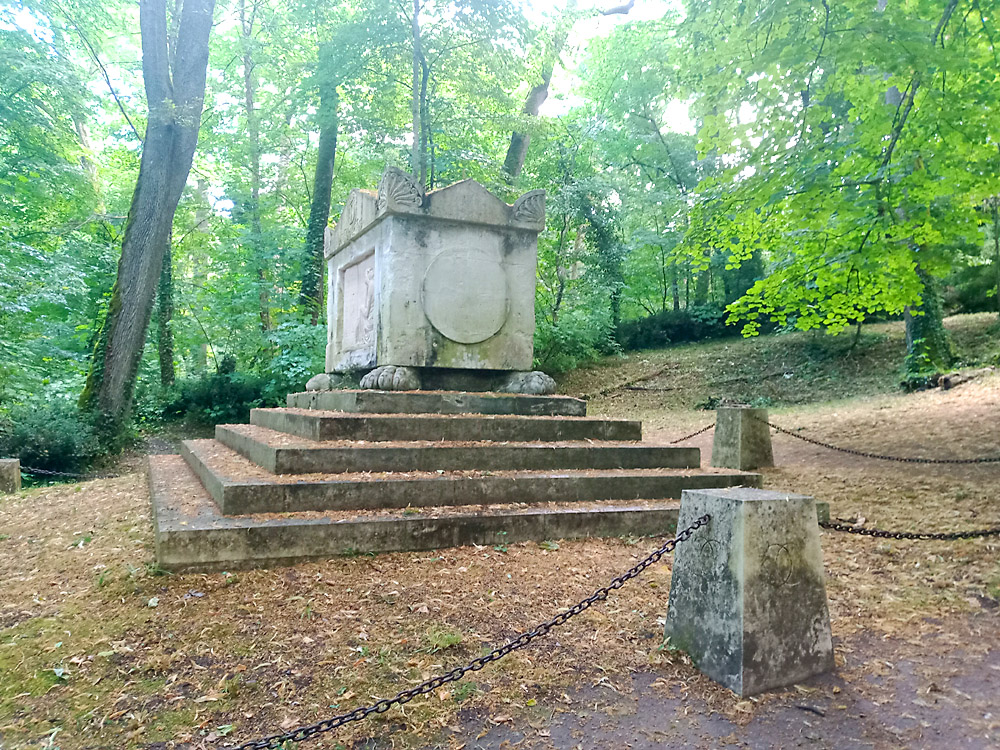
The tomb of Louise Dupin.

Tomb of louise Dupin, France.

Her natural father decided to offer her in marriage to his protegé Claude Dupin, from Chateauroux. The link between the two men came about because Dupin had offered hospitality to an elderly relative of Bernard's when she became ill whilst travelling. Dupin even went to the extent of accompanying the old woman back to Paris once she was well enough to travel again, and Bernard was much impressed. Dupin was in his forties and widowed with a six year old son. Louise was sixteen.

Thanks to his father in law Dupin's career took off, and he became one of Louis XIV's super rich tax farmers, and he was granted a minor noble title. The couple had a son, and invest in a good deal of real estate, including the Hotel Lambert in Paris and the Chateau de Chenonceau, which they purchased from the Duke of Bourbon. The most important property they acquired was the Chateau de Naillac in Le Blanc, which with its land, the entire town, and fishponds, was worth four times the Chateau de Chenonceau.


The tomb of Louise Dupin.

Tomb of louise Dupin, France.


Louise was the perfect society hostess, charming and beguiling both aristocrats and intellectuals. She welcomed many of the great names of the Enlightenment, such as Voltaire (who describes her in glowing terms), Montesquieu (with whom the Dupins eventually fell out), Buffon, and Rousseau (who embarrassed himself by declaring mad passionate but entirely unrequited love for Louise). Only the jealous hostess of a rival salon has anything bad to say about her. These salons provided an essential network for the diffusion of ideas and the progression of science, philosophy and politics.

Every year the Dupins spent the autumn at Chenonceau. Louise, being from a family of actors, was passionate about the theatre, and so she set up a small theatre in the southern end of the first floor gallery over the river. She also sponsored less fortunate women and children (including the wife of Rousseau and his abandoned children) and advocated for the education of girls. In her opinion women should have access to employment in the public service and to jobs considered exclusively for men.

Sadly her own son caused her considerable worry. He was a gambler and lost a fortune, obliging his parents to pay his debt. Finally they sent him away to a tropical island colony, where he died of Yellow Fever. His illegitimate daughter was lovingly raised by her grandmother and was one of Louise's principle heirs.


The Chateau de Chenonceau.

Chateau de Chenonceau, France.

Claude Dupin died in 1769 and Louise received the Chateau of Chenonceau, the Chateau de Naillac le Blanc estate, and a town house in Paris as her share of the estate. Later, because of the political upheaval of the Revolution she moved permanently from Paris to Chenonceau. Like most of her friends she left Paris the day after the storming of the Bastille, but unlike many of her friends she chose to stay in France. Tucked away in the Touraine countryside she dedicated herself to raising the children, legitimate and illegitimate, of relatives who had been executed. She also ensured that the Chateau was not looted or seized as State property.

In the last year of her life she sponsored a promising young local medical student called Pierre Bretonneau. He went on to become a household name in France, and one of the hospitals in Tours is named after him.

She died at Chenonceau at the age of 93. Her instructions as to what was to happen on the occasion of her death are very clear. She was not to be buried immediately, probably out of fear of being buried alive. She had chosen a place in the woods in the grounds of the Chateau on the southern side of the river Cher, and specified that her coffin was to be of simple pine. She felt that she could 'rest pleasantly here'.

Thursday, 17 July 2025

A New Toy

.... but an old passion.

Anyone who knew me back in the day would tell you that music was my thing. I played my first professional concert when I was 16, and didn't stop with the music in some professional or semi-professional capacity until 30 years later.

And then I stopped.

Recently though, I have thought that I really should use the skills (and equipment) I accumulated in that time. So naturally, the first thing I did was buy a new guitar, just to motivate me. Money can't buy happiness, but it can buy a guitar, and that's the same thing.


It's an acoustic bass guitar, made in either Indonesia or China. I am amazed at the quality of cheap guitars compared with 50 years ago. The materials are excellent, all the frets are in the right places, and it's put together well. It did need the standard fettling (truss rod adjusted, the bridge and nut recut, and the frets dressed) but even expensive instruments can need that. I didn't feel confident doing that work myself, so we visited the luthier in Loches. (More on that later).

I don't have any calluses on my fingers, and my muscle memory is a bit dodgy, but I'm surprised at how quickly it's coming back to me.

I'll let you know how it's going.


Wednesday, 16 July 2025

Through the Ages

Here are pictures of us at the Tour de France, as seen by the TV cameras.

2008

2009

2021

2023

2025

All the other times the camera has missed us, but I think we're getting better at choosing our locations.

Tuesday, 15 July 2025

Low Food Miles Apples

Our ComCom (Communauté de communes Loches Sud Touraine) has joined a network to allow small local producers to distribute within our local area more efficiently. The platform, which originated in Lyon, is called la Charrette ('the cart'). It connects and matches producers, distributors and social canteens (schools, aged care facilities, etc).


Tony at the market in Preuilly with organic apples.

Organic apples at a market in France.

In the Sud Touraine 80% of consumers do most of their food shopping at the supermarket. The supermarkets do sell local produce, 'playing the game'. However, most supermarket shoppers may like the idea of 'local' but are motivated by other concerns when spending. 

There are exceptions within the supermarket franchises, with several managers of local supermarkets convinced of the value of stocking local produce. They've done deals with nearby breweries, dairy co-operatives, orchards and graziers. They acknowlege it takes more time, and the products have to be carefully positioned, but they find it rewarding both personally and financially.


Sandy at the market in Preuilly with organic apples.

Organic apples at a market in France.

Buying 'local' is an act of political and social responsibility. Thus the local authority is keen to encourage and facilitate it.

I buy my organic apples from local orchardists Tony and Sandy, who own Fruit Ô Kalm, just outside of town. They deliver a small part of their production to the primary school canteen in Yzeures sur Creuse. Tony says that when he delivers €50 worth of apples to the school, it's not really financially rewarding, but it's about contributing to the education of the kids, and acting on his and Sandy's personal values. Tony and Sandy's fruit can now also be found at Saveurs Lochoises, thanks to the ComCom's new network. He's happy, but if he could sell enough in Loches he would not bother to go all the way to Tours to sell his produce. Distributing his own produce several times a week is really time consuming, and can be expensive. The new network can help with that, bringing producers together so they can share deliveries. At the moment there are 80 members of the network.


Bus stop advertisement for Centre-Val de Loire produce.

Advertisment for Centre-Val de loire produce, France.

Tony and Sandy are already used to working with similar networks and use the regional network Bio Centre-Val de Loire to get their produce to Paris. It costs them €150 per pallet, but it's worth it when that is transporting €2000 worth of produce.

The schools and other social canteens (Fr. restauration collective) are important drivers of the project, as since the beginning of last year they have to be working with good quality ingredients that are at least 50% from sustainable sources, and 20% organic.


Information from the ComCom newsletter No 12 été 2025.

Monday, 14 July 2025

Tour de France 2025

Yesterday the Tour de France came through Preuilly-sur-Claise. The town had decorated itself with banners, sculptures and beer tents, and was looking really festive. There was a number of costumed people, including Danes (of course) and Knights (!?). Everyone else but us was wearing free velux hats, as we obviously arrived too late.

We started the day with an early and somewhat hasty lunch at the guinguette with Niall, Antoinette and some of Niall's family. We then headed up to the abbey in time to see the caravan pass and gather some plunder. The caravan wasn't as extensive as previous years, but that means we have less tat to deal with. Having said that, I gained a really useful combination key-ring/supermarket trolley token holder. Hooray for useful tat!


After that excitement we rehydrated and had a sit down, and watched the approaching cyclists on TV. You can either participate these events or take photos. This year we participated, so no photos of caravan or cyclists. Susan had our Australian flag, and I had a message for my Dad.

Susan, flag wrangling with assistance from Olivier's grandson

Beer tents and Danes. Not coincidence, I suspect.

Once the excitement was over we headed home, arriving just in time to watch the race on ITV's +1 service. Just as the bikes reached Preuilly they went to a life long ad break, only returning as the cyclists reached Bossay. Booo!!!!

Luckily, France TV came to the rescue. You should be able to see me, but they missed Susan.


We had an ace - but 34°C - hot day. Not as hot as it was for the cyclists, who averaged over 50km an hour for the 174 km race.

(If you click on the video, then click on the little square box bottom right, you should get the video full screen)

Saturday, 12 July 2025

Lamington

This is a proper sized lamington (don't worry, that's a side plate) photographed in Tenterfield, New South Wales.


As much as the idea appeals, we're not making lamingtons as snack food for watching the Tour de France tomorrow. Look for us and our Aussie flag as the Tour passes through Preuilly sur Claise.

Friday, 11 July 2025

What is so Special About the Tours Trams

When you are designing public transport, nothing is left to chance. Lighting warmth, the colour of metal grab bars, the texture of the seats, everything is considered and carefully designed. Passengers are 'nudged' into the desired behaviour by clever science and design. 

Tram in Tours, France.

The lighting in the trams in Tours is set to more 'warmth' in winter, and 'colder' in summer, which influences how comfortable passengers feel. Studies show that manipulating the light makes people perceive the temperature as nearly two degrees warmer or cooler.

Tram in Tours, France.

The trams in Tours are intended to look radical and different. They don't have headlights for example, but instead they've been fitted with two big vertical strips of lights, which act visually like an extension of the rails. The trams are the very incarnation of the City. The mirror surface created by polished steel and tinted glass is intended to play with the water flowing alongside in the Loire River, and reflect the surrounding landscape. 

Tram in Tours, France.

Inside there is a nod to the former industrial heritage of the City, which was one of the first producers of silk in France. The interiors reference a special silk called Gros de Tours, which was a particular shade of red. The red interiors of the trams give a sort of special Tours heritage corporate look, but they also create a warm and comfortable feeling.

Tram in Tours, France.

Tram design is not just about making them attractive. It must also correspond with the identity of the City. It's a subtle piece of territorial marketing.