Monday, 16 October 2023

Chataignes and Marrons

Last October one of the market stalls I buy mushrooms and vegetables from in La Roche Posay had sweet chestnuts. There were two different sorts, marked 'marrons' and 'chataignes', and they were different prices. So I asked the stallholder what the difference is.

Cultivated and wild foraged sweet chestnuts at a market, Vienne, France. Photo by Loire Valley Time Travel.
Cultivated sweet chestnuts (marrons) on the left at €7.50/kg and wild sweet chestnuts (chataignes) on the right at €5.80.

According to him, marrons are cultivated, and a premium product, whereas chataignes are the wild ones that are foraged in the forest. But beware -- marrons can also refer to horse chestnuts, which are not edible.

In cultivated chestnuts, known as marrons in French, there is just a single big 'nut' in the husk (Fr bogue), whereas in the wild chataigne there are usually three 'nuts' nestled together in the prickly husk. The popularity of the term marron came about because chestnuts were seen as poverty food and the word 'chataigne' was associated with hard times.

Chataignes are smaller and paler, and traditionally dried to preserve them and kill any insect infestation, then ground make flour. They were important for preventing famine in areas that were too steep to grow grains of any sort. Marrons are used fresh for roasting and candying (the famous marrons glacé that are such a treat at Christmas time) because they peel more easily.

Saturday, 14 October 2023

A Perfectly Splendid Ground Beetle

Carabus splendens (Fr. la Carabe splendide) is endemic to the Pyrenees and the southern Massif Central. I photographed this one on my way to stake out a spot on the mountain at Cambasque to watch the finish of Stage 6 of the Tour de France earlier this year. Simon found it, sadly dead, on the track.

Carabus splendens, Hautes Pyrenees, France. Photo by Loire Valley Time Travel.

This is a big, really shiny, beetle, about 30 mm long, living in forest habitats, both broadleaf deciduous and conifer. It is found all over the Pyrenees, from sea level to at least 1500 metres and sometimes beyond. Mostly nocturnal, it eats snails, slugs and caterpillars.

Thursday, 12 October 2023

A Tapestry Returns to Chenonceau

Recently a tapestry has returned to the Chateau de Chenonceau after having been away for months.

It is known as 'A l'Aristoloche' and is one of a number of tapestries woven in the late 15th century in the Oudenaarde (Audenarde) area of Flanders featuring a European interpretation of the leaves and flowers of the newly discovered and thoroughly exotic South American vines Aristolochia spp. Earlier versions of this style of tapestry are dubbed 'cabbage leaf' tapestries because of the lush big leaves that feature throughout the design. So there is a sort of merging of European and exotic flora in order to create these once verdant textiles.

Detail of the newly conserved A l'Aristoloche tapestry at the Chateau of Chenonceau.

A l'Aristoloche tapestry (detail), Chateau de Chenonceau, Indre et Loire, France. Photo by Loire Valley Time Travel.

I say once verdant because when they left the tapestry weaver's atelier these works would have been a riot of many shades of green. Now they are predominantly blue, as their natural plant based dyes have aged differently. What you see now is indigo, from the woad plant, a very strong and fast dye. But originally it would have been overdyed with dyers greenweed, which produces yellow and the effect would have been green. The yellow has now faded and we just left with the blue.

There is an Aristolochia native to Europe but although curious looking, it is nowhere near as striking as its South American cousins. I don't know if the European tapestry weavers were aware that the tropical vine they were doing their best to interpret from sketches or even just written descriptions had a local version. In any case, with the Aristolochia tapestries the important thing was to make them as exotic and lush as possible. In reality, Aristolochia spp leaves are usually large, flat and heart shaped, although they do vary a bit from species to species. The flowers are tubes which turn up at the ends into a bowl shape, leading to one of their vernacular names, "dutchman's pipe".

The A l'Aristoloche tapestry hangs in Catherine de Medici's private apartments at the Chateau of Chenonceau. Photo from just prior to the tapestry's conservation restoration.
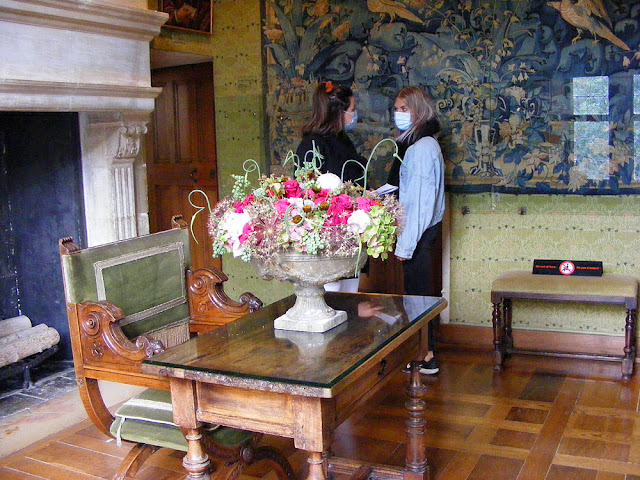
Catherine de Medici's private apartments, Chateau de Chenonceau, Indre et Loire, France. Photo by Loire Valley Time Travel.

In the case of the tapestry at Chenonceau it also includes depictions of other South American flora and fauna. Columbus was just back from the New World and there was great excitement amongst the merchant classes as they imagined what they might be able to trade in and how much money they might make. The tapestry features Hoatzins (birds that look like scruffy crested pheasants), tropical fruits and epiphytic orchids, all unknown to Europe prior to the 1490s. But there are also traditional European fruits and flowers included, perhaps to deliver certain specific messages, such as pomegranates for fertility, prosperity and abundance, or lilies for virtue and once again, fertility. The European species of Aristolochia is known as "birthwort" because of the flower's resemblance to the birth canal, so perhaps after all, the tapestry weavers did know that the European and American plants were connected.

But there is a less obvious symbolism associated with this tapestry and the many like it. Columbus's return from the New World was widely heralded as him having rediscovered the Garden of Eden, so on one level this tapestry is a representation of the beauty of God's Creation in a relatively obvious way. Ironically, given the influence of the ascetic mystic Savonarola and his bonfires of the vanities as a ritual to rid the world of sin, this luxury object and its idea of the Garden of Eden is also connected to a more widespread developing belief that the world was about to end. In this way of thinking, Columbus's rediscovery of the Garden of Eden was a signifier or precursor to the End Times, and many wealthy people were preparing themselves for the event by commissioning works of art which showed that they acknowledged God's power and were ready to submit to God's rule. These sorts of subtle, multi-layered messages contained in decorative works are very typical of the decades around 1500 in France.

The tapestry has no historical connection to the Chateau of Chenonceau or any of its owners as far as I know. I assume it was bought at auction in Paris in the mid-twentieth century by Gaston Menier, then the owner of the chateau. He amassed a museum quality collection to set dress his chateau and entice the general public in to see it decked out as it might have been in its sixteenth century heyday.

For the entirety of the tapestry's absence it was represented by a lifesize high definition photograph on a sheet of vinyl hanging on the wall. Curators do this sometimes so there isn't an awkard gap in the display. There is no active attempt to deceive the visitor but my guess is that the majority of people never realised they were not looking at a real tapestry. I certainly saw people faithfully photographing the 'fake' with every indication that they thought it was the real thing.

Wednesday, 11 October 2023

Archaeology at the Nymphaeum

Just outside of the village of Le Grand Pressigny, in what was the grounds of the chateau, is a small and clearly once high status building. It is a nymphaeum, built to create a leisure space around a spring. For many years it has been in poor repair, but last year it was announced a grant had been procured to restore the building.

Nymphaeum, Le Grand Pressigny, Indre et Loire, France. Photo by Loire Valley Time Travel.

Last time I passed an archaeological dig seems to be in progress, but there is no information about what might have been unearthed. By the look of it, there was once another circular pool right in front of the nymphaeum.

Originally nymphaeums were shrines dedicated to nymphs, who were mythological beings associated with sacred springs, woods and other natural features. 

The village of Le Grand Pressigny, situated on the confluence of the Claise and Aigronne Rivers, has existed since before the 6th century. The 16th century nymphaeum was intended to allow women to meet and bath in private, staying warm and dry in its shelter afterwards, to chat and relax.

Tuesday, 10 October 2023

Walking from Rond du Chene to Leugny

On Wednesday 27 September I joined Joel and Denise, Tilly and a friend, Marie-France, and Jean-Jacques to walk 9 kilometres from Rond du Chene, the hunting lodge in the middle of the Forest of La Guerche, down to Leugny on the Creuse River, and back up again by a different route. Walking the Creuse Valley always involves some properly steep bits, so this was real exercise. With photo and drinks breaks it took us 2 and a half hours.

Entering the forest along one of the many rides that radiate from the Rond du Chene hunting lodge.

Walking in the Foret de la Guerche, Indre et Loire, France. Photo by Loire Valley Time Travel.

Taking a shortcut along an unmaintained track that has become overgrown with Purple Moor Grass Molinia caerulea (Fr. Molinie bleue).

Walking in the Forest de la Guerche, Indre et Loire, France. Photo by Loire Valley Time Travel.

This orange blob on a dead pine tree will is a young polypore fungus I think.

Young polypore fungus, Indre et Loire, France. Photo by Loire Valley Time Travel.

I think this big white slug munched fungus on a pine stump is Scaly Sawgill Neolentinus lepideus (Fr. Lentin squamuleux), a species notorious for attacking railway sleepers and causing train accidents.

Neolentinus lepideus, Indre et Loire, France. Photo by Loire Valley Time Travel.

European Holly Ilex aquifolium (Fr. Houx commun).

Holly Ilex aquifolium, Indre et Loire, France. Photo by Loire Valley Time Travel.

Ash-black Slug Limax cinereoniger (Fr. Grande Limace).

Ash-black Slug Limax cinereoniger, Indre et Loire, France. Photo by Loire Valley Time Travel.

Red Slug Arion rufus (Fr. Grande loche).

Red Slug Arion rufus, Indre et Loire, France. Photo by Loire Valley Time Travel.

The fluffy seedheads of Travellers' Joy Clematis vitalba (Fr. Clématite des haies).

Travellers Joy Clematis vitalba, Indre et Loire, France. Photo by Loire Valley Time Travel.

A Turkish Snail Helix lucorum (Fr. Escargot turc) being pursued by a Glow-worm Lampyris noctiluca (Fr. lampyre) larva in the streets of Leugny. Glow-worm larvae predate snails, but I think this one might have literally bit off more than it can chew. Turkish Snails are large -- up to 60 mm across the shell.

Turkish Snail Helix lucorum being pursued by a Glow-worm Lampyris noctiluca larva, Indre et Loire, France. Photo by Loire Valley Time Travel.

The River Creuse at Leugny. Although the water is crystal clear here at the moment, the current is swift enough that there are signs warning you that swimming is dangerous. There was once a river port, mainly for shallow draft river boats carrying cargo.

River Creuse, Indre et Loire, France. Photo by Loire Valley Time Travel.

The church and neighbouring fortified manor house in Leugny.

Church, Indre et Loire, France. Photo by Loire Valley Time Travel.

Monday, 9 October 2023

Fruit at the Market

The new season's apples and pears are in, as well as grapes. I buy most of my fruit from Fruit O'Kalm, my local organic orchard, who have a stall at the Saturday morning farmers' market in Preuilly sur Claise. 

 Quinces, donated by a parent and available at the primary school for whatever you wished to pay, proceeds go to the school.

Quinces, Indre et Loire, France. Photo by Loire Valley Time Travel.

Sandie choosing apples for me. I know her well enough that I would be allowed to choose my own apples, but it is traditional in France to allow the vendor to choose the fruit and for the customer not to touch it prior to purchase. The big apples are Melrose.

Apple producer, Indre et Loire, France. Photo by Loire Valley Time Travel.

This year for the first time Fruit O'Kalm has an almond crop. They planted the trees several years ago, but they take a while to produce a crop. Also in this photo, Chasselas grapes and the last of the blood peaches.

Organic locally grown almonds, Indre et Loire, France. Photo by Loire Valley Time Travel.

Two pear varieties, Beurre Hardy and Harrow Sweet, along with the last of the figs.

Organic locally grown pears at a market, Indre et Loire, France. Photo by Loire Valley Time Travel.

New season Gala and Pilot apples.
Organic locally grown apples at a market, Indre et Loire, France. Photo by Loire Valley Time Travel.


Saturday, 7 October 2023

Eglise Saint Severin, Paris

The church of Saint Séverin in Paris is in the 5th arrondissement, near the Seine. It has been the parish church for this part of Paris since the 9th century, and there has been a chapel on this site since the 6th century. After being razed by the Vikings in the 9th century, a new church was built in the 13th century, then added to in the 15th. The bell from this period is the oldest in Paris and the gargoyles are rather marvellous.

Eglise Saint Severin, Paris, France. Photo by Loire Valley Time Travel.

Its main claim to fame is that it is the last intact charnel house in Paris. The cemetery opened in 1250 and in 1430 was formed by galleries on three sides of the courtyard. Today the bones have been removed, and the galleries look like a cloister. The priests lived in rooms above the galleries. 

Eglise Saint Severin, Paris, France. Photo by Loire Valley Time Travel.

There were two ways you might be interred in the cemetery. If you were poor you would be tossed into a communal pit. If you were rich your body would be laid out to rot until there was nothing but a skeleton. Then your bones would be stacked up in one of the galleries.

Eglise Saint Severin, Paris, France. Photo by Loire Valley Time Travel.

But in 1674 the charnel houses were banned because of the collapse of parts of the Cimetiere des Innocents due to the weight of bodies, and the galleries did indeed become cloisters. The bones were removed to the Catacombs and by the 18th century the galleries were even closed in with glazing. In the 19th century the western galleries were demolished.

Friday, 6 October 2023

Money Bags on the Window

Carved window embrasure, Chateau Royal d'Amboise, Indre et Loire, France. Photo by Loire Valley Time Travel.

In the Cupbearer's room in the Chateau Royal d'Amboise there is a rather surprising carved window.

Carved window embrasure, Chateau Royal d'Amboise, Indre et Loire, France. Photo by Loire Valley Time Travel.
 

The window embrasure, decorated with pilgrims' staffs, purses full of coins and a saddlebag, is a reminder that Amboise was a stopover for pilgrims on their way to Saint-Martin-de-Tours before continuing on to Santiago de Compostela.

Carved window embrasure, Chateau Royal d'Amboise, Indre et Loire, France. Photo by Loire Valley Time Travel.

The window embrasure also features fleurs de lys and ermine tails, the symbols of Charles VIII and Anne of Brittany, who transformed the chateau from a fortress to a late medieval luxury country residence.

Thursday, 5 October 2023

Walking Around Abilly

On 20 September I joined Joel, Denise, Tilly, Helene and Jean-Jacques on a 8.5 km walk taking 2 hours. We walked up from the greenway, through the forest, past the medieval fortified farm of La Chatiere and back down to the greenway.

Sheep dogs guarding a barn full of sheep.

Sheep dogs guarding sheep in a barn, Indre et Loire, France. Photo by Loire Valley Time Travel.

A small abandoned vineyard. The variety looks like gamay to me.

Abandoned vineyard, Indre et Loire, France. Photo by Loire Valley Time Travel.

Common Heather Calluna vulgaris (Fr. Callune). I showed Jean-Jacques how to use the PlantNet app [link] to identify this plant.

Common Heather Calluna vulgaris, Indre et Loire, France. Photo by Loire Valley Time Travel.

Sweet Chestnut Castanea sativa (Fr. Chataignier) fallen leaves (Fr. les feuilles mortes) and chestnuts in their prickly husks (Fr. les bogues).

Sweet Chestnut Castanea sativa fallen leaves and chestnuts, Indre et Loire, France. Photo by Loire Valley Time Travel.

This view will change in the next few years. The 29 ha site will became a 40 000 unit solar farm, with sheep grazing beneath the photovoltaic panels.

Proposed site for solar farm, Indre et Loire, France. Photo by Loire Valley Time Travel.

Wild Privet Ligustrum vulgare (Fr. troène commun), growing in a hedge.

Wild Privet Ligustrum vulgare, Indre et Loire, France. Photo by Loire Valley Time Travel.

Wednesday, 4 October 2023

Botany Outing to the Loire Sands at Ile Perchette

Dominique Tessier led an outing on the Loire sands at the Ile Perchette near Noizay on Saturday 16 September. 

The Loire sands in the riparian zone are a repository of acid sand loving plants in a sea of the calcareous clay which is the usual soil type in the wider Loire Valley. Along with seven species of willow on the banks, there are also all sorts of rarities. But the habitat is increasingly threatened by invasive Paspalum and water primroses Ludwigia spp (Fr. Jussie), which choke native species out.


Compact Dock Rumex thyrsiflorus (Fr. Patience à fleurs en thyrse), with leaves munched by Green Dock Beetle Gastrophysa viridula (Fr. Chrysomèle de l'Oseille) I assume, although I never saw one in action.
Compact Dock	Rumex thyrsiflorus, Indre et Loire, France. Photo by Loire Valley Time Travel.
Licorice Milk-vetch Astragalus glycyphyllos (Fr. Astragalle réglisse), uncommon and not found much in the Touraine away from the more calcareous banks of the Loire.
Licorice Milk-vetch	Astrogallus glycyphyllos, Indre et Loire, France. Photo by Loire Valley Time Travel.
Greater Musk-mallow Malva alcea (Fr. Mauve alcée), a calcareous soil lover that is typically found on the higher levels of river banks.
Greater Musk-mallow	Malva alcea, Indre et Loire, France. Photo by Loire Valley Time Travel.
Red Bartsia Odontites vernus (Fr. Odontite rouge), a hemiparasite which despite the name, flowers in the autumn.
Red Bartsia	Odonites vernus, Indre et Loire, France. Photo by Loire Valley Time Travel.
Water Mint Mentha aquatica (Fr. Menthe aquatique), which was attracting several species of bees, including some which normally specialise in other plants.
Water Mint	Mentha aquatica, Indre et Loire, France. Photo by Loire Valley Time Travel.
A faded and worn Common Carder Bumble Bee Bombus pascuorum (Fr. Bourdon des champs).
Common Carder Bee	Bombus pascuorum, Indre et Loire, France. Photo by Loire Valley Time Travel.
Common Carder Bumble Bee.
Common Carder Bee	Bombus pascuorum, Indre et Loire, France. Photo by Loire Valley Time Travel.
Female Shiny-vented Sharp-tailed Bee Coelioxys cf inermis.
Shiny-vented Sharp-tailed Bee	Coelioxys inermis, Indre et Loire, France. Photo by Loire Valley Time Travel.
 
Dominique talking about Tape Grass Vallisneria spiralis (Fr. Vallisnérie spiralée), very rare in the wild here. Boats and coypu rip the weed up and it washes up on the shore.
Botanist talking about Vallisneria spiralis, Indre et Loire, France. Photo by Loire Valley Time Travel..
Male Bellardia sp, a type of blow fly.
Bellardia sp, Indre et Loire, France. Photo by Loire Valley Time Travel.
Hawthorn Crataegus monogyna (Fr. Aubépine), covered in berries.
Hawthorn	Crataegus monogyna, Indre et Loire, France. Photo by Loire Valley Time Travel.

Tuesday, 3 October 2023

Growing My Hair For a Good Cause

Two years of hair growth. Photo by Loire Valley Time Travel.
My hair in July 2022, three months before I got it cut.

Last year I donated two years worth of hair growth to a charity called Fake Hair Don't Care. Basically, I couldn't go to the hairdressers during the Covid lockdowns, and simply never got round to it once I was allowed to afterwards. Finally, once it was waist length and really starting to annoy me, I emailed Christelle at Zen Coiffure in Preuilly and booked a slot.

Getting hair cut for wigmaking charity, France. Photo by Loire Valley Time Travel.
Washed, dried and ready to cut.

Christelle was familiar with the procedure, but she was dealing with rather a lot of hair, so the whole appointment took over an hour. Even though I'd spent the summer swimming, she said my hair was in really good condition. Barely any split ends, and tangle free. I never dye or treat my hair with anything other than a twice weekly wash with Head and Shoulders 2 in 1. It never gets dried with a hair dryer, and I made Christelle laugh by telling her I did own a hair dryer, but it lived in the downstairs toilet and had been bought for thawing the pipe to the cistern when it froze.

Hair for donation to wigmakers, France. Photo by Loire Valley Time Travel.
My hair cut off and ready to send to Fake Hair Don't Care.

Fake Hair Don't Care mostly give the hair to wigmakers who supply wigs to people living with cancer, but they also ask if you are willing for them to sell your hair to raise money for cancer charities.

Haircut, France. Photo by Loire Valley Time Travel.
The new haircut.

Monday, 2 October 2023

Reine des Reinettes Apple

Reine des Reinettes is a variety of apple that has been cultivated since at least the 18th century. It seems to have appeared in the Netherlands around 1770.


 Reine des Reinettes in our orchard.
Reine des reinettes apple, Indre et Loire, France. Photo by Loire Valley Time Travel.

It is a type of pippin and today is one of the most popular apple varieties in France, considered top quality.

The trees blossom around the same time as Golden Delicious and can be fertilized by that variety and Granny Smith. French orchards often grow it because of its use as a cross pollinator.

This year our little old Reine des reinettes trees are so loaded the branches are drooping to the ground.
 
Reine des reinettes apple, Indre et Loire, France. Photo by Loire Valley Time Travel.

In the kitchen it is particularly used in tarte Tatin. The fruit is yellow skinned, with red striations. The apples have pale yellow flesh, juicy and sweet with a good acidic balance.

Eat them between December and March. The trees have a tendency to fruit in alternate years only.