Friday, 15 October 2021

We Have Been Working

 On Tuesday, for the first time in 25 months, we used one of our Traction Avant cars for work.

We took Claudette to Loches and Chenonceau, and then on Wednesday we visited Azay le Rideau, Villandry, and Domaine de Candé. It felt novel (but reassuringly familiar) dining in restaurants and visiting chateaux. Lets hope it's something we will be doing more of next year!!

To celebrate, a photo that Susan took yesterday morning.


Thursday, 14 October 2021

A Prehistoric Tool

The other day we popped in to see some friends. Over coffee, served in small bowls made by a local potter, the conversation turned to prehistoric tools. Our area is famous for the fine flint blades made here in Prehistoric times, and the number of flint cores known as 'livres de beurre' (pounds of butter) that the manufacture of these blades left.

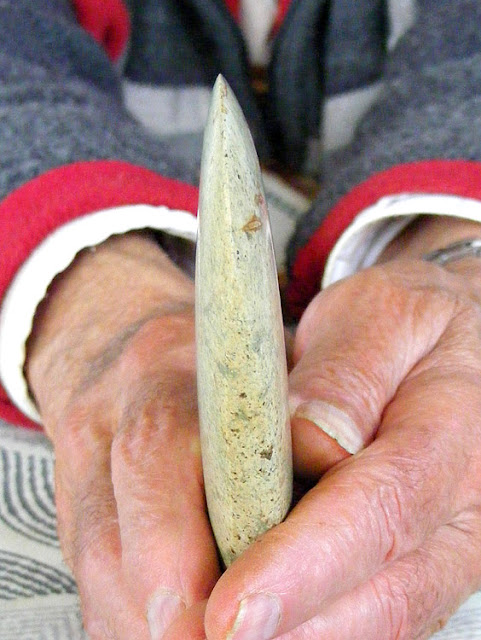
Neolithic jadeite axe, private collection, Indre et Loire, France. Photo by Loire Valley Time Travel.

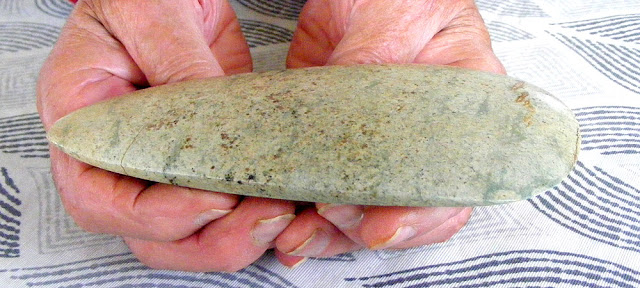
J asked us if he had ever shown us the stone axe he had found years ago on the banks of the River Creuse. He hadn't, so out it came. What an astonishing object! Smooth and nearly perfectly symmetrical, it is impossible to believe it was made thousands of years ago, and by rubbing one stone against another by hand, for hours and hours.

J told us he had been on his way to buy a mower in Pleumartin. He had a bit of time, so he stopped off at a ford across the river and had a potter about. He noticed something green in the mud and realised immediately that it must be something interesting. 

Neolithic jadeite axe, private collection, Indre et Loire, France. Photo by Loire Valley Time Travel.

His reading has revealed that it is made of jadeite, from a site in Italy. He thinks the axe was probably ceremonial or a status symbol, not a practical tool. There is certainly no sign of use on it. It probably arrived in the Touraine via the trade routes that already existed in Neolithic times, and that it may have been accidentally dropped while crossing the ford.

He is planning to leave it to the Museum of Prehistory in Le Grand Pressigny, as it is better than any of the similar axes they have in their collection.

Wednesday, 13 October 2021

Spotted!!

We have been seen on streetview before - this is Claudette on streetview in April 2016, in the car park at Chenonceau:


And this is Claudette in 2018 (but the original image has been removed from streetview)


And now... the Cactus. This was taken on the day before my birthday this year, in Cauterets. I can date it exactly because of the weather, and because other photos taken on the same streetview visit show the fishing competition that was happening the 22 July. At the time we were at the top of the mountain reconnoitering how we would go walking at altitude.


If you can't find her, here's help - and you can see the cable car we took to get to the altitude we were walking at.


Tuesday, 12 October 2021

Walking Around Le Grand Pressigny in Early October

 These photos are from a walk we did around Le Grand Pressigny on 4 October.

Coton du Tuléar dog, France. Photo by Loire Valley Time Travel.
Bodhi belongs to Amanda and Leslie, and he is a Coton du Tuléar, a Madagascan breed of dog.

Top of 16C tower, Le Grand Pressigny, Indre et Loire, France. Photo by Loire Valley Time Travel.
The top of the 16th century Tour Vironne, part of the Chateau du Grand Pressigny.

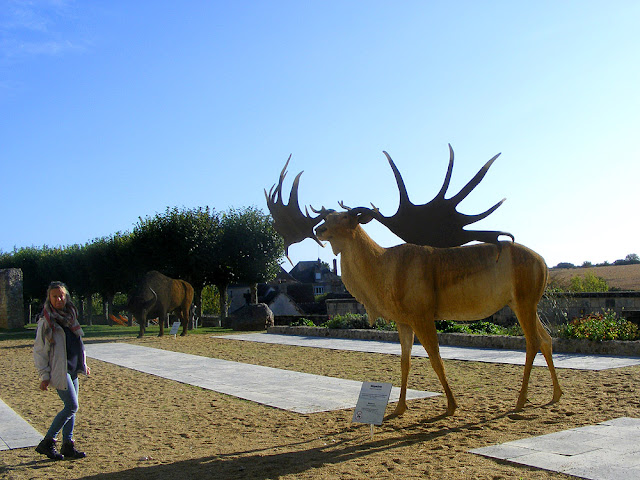
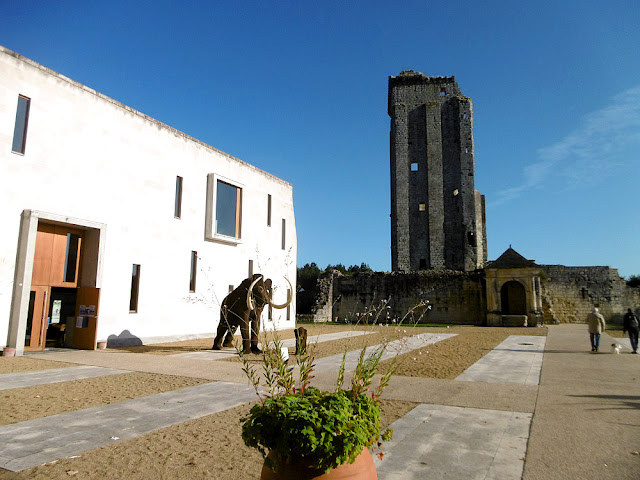
Model of a Giant Elk at the Museum of Prehistory, Le Grand Pressigny, Indre et Loire, France. Photo by Loire Valley Time Travel.
Amanda meets a Giant Elk at the Museum of Prehistory in Le Grand Pressigny.

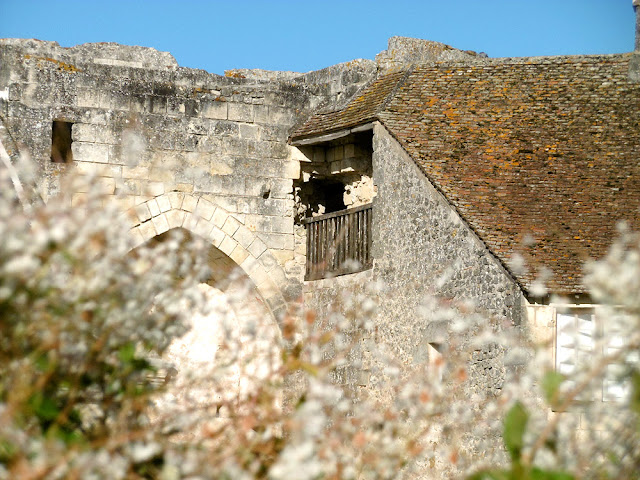
12C ruined tower, Le Grand Pressigny, Indre et Loire, France. Photo by Loire Valley Time Travel.
Ruined 12th century tower, which came crashing down one morning in the 1980s.

Jackdaw, Indre et Loire, France. Photo by Loire Valley Time Travel.
Two Jackdaws, small grey crows, resting on the ruined tower.

17C Nymphaeum, Le Grand Pressigny, Indre et Loire, France. Photo by Loire Valley Time Travel.
The 17th century Nymphaeum, with a spring fed pool which allowed weary walkers to refresh themselves. [link]

Ploughed fields, Le Grand Pressigny, Indre et Loire, France. Photo by Loire Valley Time Travel.
Ploughed fields.

Municipal compost and water bladder, Le Grand Pressigny, Indre et Loire, France. Photo by Loire Valley Time Travel.
At this point our way was blocked by a large pile of municipal compost.

Chateau du Grand Pressigny, Indre et Loire, France. Photo by Loire Valley Time Travel.
A nook, or possibly cranny, in the Chateau du Grand Pressigny.

A courtyard at the Chateau du Grand Pressigny, Indre et Loire, France. Photo by Loire Valley Time Travel.
A courtyard at the chateau.

Entrance to the Museum of Prehistory, Le Grand Pressigny, Indre et Loire, France. Photo by Loire Valley Time Travel.
Entrance to the Museum of Prehistory.


Monday, 11 October 2021

How to Cook Ceps


Ceps (also known as porcini in Italian and cèpes in French) start popping up in the forests in October. Many locals collect their own, and those with a license to do so collect them commercially, so you can buy them in the market during the season. Bay-brown Bolete retails for about €600 per kilo. Depending on the weather, some years they are abundant, some years they are scarce.

Bay-brown Bolete.
Bay-brown Bolete Xerocomus badius.  Indre et Loire, France. Photographed by Susan Walter. Tour the Loire Valley with a classic car and a private guide.

There are three main species, closely related, that are the most prized -- Edible Cep Boletus edulis (Fr. Cèp de Bordeaux); Bay-brown Bolete Xerocomus badius (Fr. Bolet bai); and Dark Bolete Boletus aereus (Fr. Tête de negre). There are other related species, also edible, but generally referred to as boletes, and usually just used to bulk out the better species.

Bay-brown Bolete, showing the spongey underside of the cap.
Bay-brown Bolete Xerocomus badius, showing tubes and pores under cap.  Indre et Loire, France. Photographed by Susan Walter. Tour the Loire Valley with a classic car and a private guide.

To prepare them to eat, brush the caps off, remove the stems and discard (or use in a dish where they will be pureed with other things), check for slugs. Remove the spongey pores and tubes under the cap by pushing at it gently with your thumb. This sponge is full of water and not very nice to eat.

Slices of Bay-brown Bolete laid out to dry.
A Bay Bolete sliced and drying before cooking.  Indre et Loire, France. Photographed by Susan Walter. Tour the Loire Valley with a classic car and a private guide.

Slice the mushrooms and discard any bits that have maggots. Spread out in a single layer on a tea towel or paper towel and leave overnight. This dries them out a bit and means they don't produce too much water when cooked. At this point they can be bagged and frozen, dried on low heat in the oven or in a dehydrator, or cooked immediately.

Dark Bolete.
Dark Bolete Boletus aereus.  Indre et Loire, France. Photographed by Susan Walter. Tour the Loire Valley with a classic car and a private guide.

To cook fresh or from frozen, melt a knob of butter and a dash of olive oil in a frying pan on medium high heat. Add the mushrooms to the pan, along with a pinch of salt, some ground pepper and crushed garlic. Fry for 3-4 minutes, tossing or stirring frequently. Tip off any liquid the mushrooms have released. You can add some cream and chopped parsley at this point, and serve with grilled steak.

Edible Cep in the Forest of Montgoger.
Edible Cep Boletus edulis.  Indre et Loire, France. Photographed by Susan Walter. Tour the Loire Valley with a classic car and a private guide.

A basket of boletes gathered in the Forest of Preuilly.
A basket of boletes gathered in the forest.  Indre et Loire, France. Photographed by Susan Walter. Tour the Loire Valley with a classic car and a private guide.

Ceps foraged in the Forest of Preuilly waiting to be prepared in our kitchen.
Ceps foraged in the forest waiting to be prepared.  Indre et Loire, France. Photographed by Susan Walter. Tour the Loire Valley with a classic car and a private guide.


Yum  
 
************************************************

For details of our private guided tours of chateaux, gardens, wineries, markets and more please visit the Loire Valley Time Travel website. We would be delighted to design a tour for you.

We are also on Instagram, so check us out to see a regularly updated selection of our very best photos. 

Sunday, 10 October 2021

The Manly Ferry "Queenscliff"

On this coming Wednesday (at 1.40pm Sydney time), the Freshwater class ferry "Queenscliff" will make its last journey from Manly to Circular Quay before being retired. I suspect that the 11 mile trip will be more full than usual as Sydneysiders farewell a boat that has been part of harbour life since 9 July 1983.

Sydneysiders have the same relationship with the big Manly ferries as Londoners do with the Routemaster bus, so two of the four ferries will be retained because that's what people want to see. The Freshwater class ferries are evocative of a former age: the early 20th century boats that were operating when I arrived in Sydney in 1967.


The new catamaran ferries are faster, cleaner but much, much smaller, carrying 400 people rather than the 1000 people the Freshwater class boats carry. Of course, when the Freshwater boats were introduced there was controversy because they replaced much larger (and much more elegant) boats that carried over 1,500 people.

It will be pleasant to be able to visit the parks around Sydney harbour without the booming engine note of the old ferries resonating all over the place - something Susan and I noticed with surprise when we were last in Sydney - but travel in Sydney may never have quite the illusion of romantic sea travel again.

Saturday, 9 October 2021

View in Burgundy

As opposed to a view OF Burgundy, which would be a completely different thing.


We enjoy the scenery once you cross the Loire River heading east. We haven't done it many times, but when we do we always comment that we can see "proper" hills ahead, something the Touraine lacks.

Friday, 8 October 2021

Casters on the Bridge

The other day I was at Chaumussay, standing on the bridge over the Claise. I noticed that an angler had dropped some bait and there was a little group of fly pupae lying on the pavement.

Casters (fly pupae used as bait by anglers), Indre et Loire, France. Photo by Loire Valley Time Travel.
Blow fly pupae dropped on the bridge by an angler.

Maggots, the larvae of flies, have been used for centuries as bait for fish hooks. They are easy to raise yourself or they can be bought from a fishing supply shop. They go by different names depending on what size they are. The small ones are squatts, the medium sized ones are pinkies and the big ones maggots. Within a few days maggots will transform into pupae, known to fishermen as casters and also used as bait. Maggots sometimes come in rainbow colours to further attract the fish. This is achieved by feeding them dyed meat before sale and they will take on the colour of their food.

Urban Blow Fly Calliphora vicina, Indre et Loire, France. Photo by Loire Valley Time Travel.
A female Urban Blow Fly Calliphora vicina feeding on Ivy Hedera helix nectar.


Most bait maggots in Europe are blow flies Calliphoridae, either the Urban Bluebottle Calliphora vicina, or the greenbottle Lucilia sericata, but they could be the House Fly Musca domestica, which belongs to the Muscidae family. All of them can be raised in warm conditions in decaying animal flesh, usually chicken.

Angler, Indre et Loire, France. Photo by Loire Valley Time Travel.
A rather well equipped angler at the village pond in Preuilly.

My reading suggests they are mainly used for Carp, Barbel and Chub here.

Thursday, 7 October 2021

Les Dames Blanches -- Witches or Wols

I photographed this street sign for Impasse de la Dame Blanche in a hamlet called Les Viaullières. It set me wondering who the eponymous White Lady was. Does a white robed woman appear to the gullible and hypersensitive if they hang around this corner in the dark of night? What dire event might she be warning us about? Or was one of these houses once occupied by a wise woman, one who had a reputation for being able to cast spells and enchant the unwary?

Local opinion dismisses the idea that the street is named after a ghostly apparition, or a reference to a witch, both of which might be referred to as une dame blanche. It seems to be more likely that the passage is named after the presence in the area of Barn Owls, sometimes called les Dames Blanches in French, although usually referred to as les Chouettes effraies. Superstitiously they are viewed as a bad omen (the name means 'scary owl') and in local Berrichon traditions are associated with witches. Barn Owls, one of the few bird species that has an almost global distribution, are largely snowy white and can emit blood curdling screams whilst in flight.

Street sign, Indre et Loire, France. Photo by Loire Valley Time Travel.

And -- just around the corner there is a very clear witch mark, on the windowsill of a barn...

Witch mark, Indre et Loire, France. Photo by Loire Valley Time Travel.
Symbols like this, intended to ward off witches attempting to enter, were drawn on buildings in proximity to openings.

Wednesday, 6 October 2021

Developments at Clos Luce

Chateau du Clos Lucé at night, Amboise, Indre et Loire, France. Photo by Loire Valley Time Travel.
The front of the Chateau du Clos Lucé as we left.

The Chateau du Clos Lucé has been owned for over a century by the Saint Bris family. It is famous for being the last home of the great Leonardo da Vinci. For many years now the property has been open to visitors, and recently the family have employed a wonderfully dynamic and switched on marketing manager called Gaël Ibramsah. Thanks mainly to him, and the 500th anniversary in 2019 of the death of Leonardo resulting in lots of special events happening to mark the occasion, visitor numbers have topped half a million.

Leonardo galleries at Clos Luce, Amboise, Indre et Loire, France. Photo by Loire Valley Time Travel.
Inside the new gallery.


Last Friday we went to a special after hours invitation only event to view the new gallery dedicated to the life and works of Leonardo. It is housed in the old Guillemot photographic chemicals factory next door to the lovely chateau, which the Saint Bris family snapped up when it closed due to the impact of digital photography. Guillemot were the first producers in the world of photographic paper and the last producers in France. Now landscaped as a lovely park, the grounds are crisscrossed by a stream which has been divided into multiple channels as part of the former functions of the factory.

Visit to Clos Lucé, Amboise, Indre et Loire, France. Photo by Loire Valley Time Travel.
Gaël introducing the new gallery.


Clos Lucé has now become a one-stop shop for all things Leonardo. There is plenty of space in the garden for kids to run around and the interior of the house is now very nicely appointed to give you a feel for when Leonardo lived there. In various outbuildings and the garden you can see well made models of the machines and devices that Leonardo sketched in his note books.

Guillemot factory manager's house, Clos Luce, Amboise, Indre et Loire, France. Photo by Loire Valley Time Travel.
The Guillemot factory manager's house. The next big project at Clos Lucé will be to turn this building into a 12 room hotel.


Gaël Ibramsah, the marketing manager, has offered us the chance to bring one of the Tractions one day and do photographs in the grounds. He also tried to convince Simon to grow a big bushy beard so he could play Leonardo at events. Gaël pointed out that Leonardo was a great big man, very unusual for his time, and Simon, with his long wavy silver hair, would be perfect -- if only he would let the beard grow. I commented that since Leonardo was a vegetarian, any resemblance probably stops before dinner.

Halle Eiffel, Clos Luce, Amboise, Indre et Loire, France. Photo by Loire Valley Time Travel.
This building, the Halle Eiffel, behind the chateau, makes it obvious that half the site was until recently industrial. This is was where Guillemot stored their packaging materials.

It is perhaps inevitable given his cult status that the whole focus is on Leonardo, with other former owners and residents such as Anne of Brittany barely rating a mention, despite it being their home for longer. However, I think the chateau complex is currently run in a way that can make the owners proud.

Tuesday, 5 October 2021

Walking Around Chaumussay, September 2021

These photos are from a 10 km walk beginning and ending in Chaumussay, taken at the very end of September.


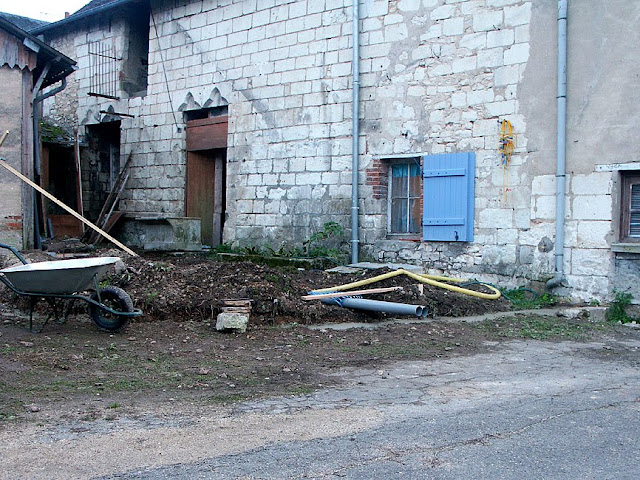
Dodgy looking renovations, Indre et Loire, France. Photo by Loire Valley Time Travel.
Some dodgy looking renovations in progress. But to be fair, the people who own this place live elsewhere, but are slowly slowly restoring a complex of buildings.

Harvesting sunflowers, Indre et Loire, France. Photo by Loire Valley Time Travel.
Harvesting sunflowers.

Walking through a hamlet, Indre et Loire, France. Photo by Loire Valley Time Travel.
Walking through a hamlet.

Horse fly Atylotus loewianus, female, Indre et Loire, France. Photo by Loire Valley Time Travel.
An uncommon horse fly (Fr. Taôn) Atylotus loewianus, female, on Wild Carrot Daucus carota (Fr. Carotte sauvage)

Garden cabin, Indre et Loire, France. Photo by Loire Valley Time Travel.
When I first saw this I thought it was a fun chook house, but having looked more closely at the photo I think it might be a fun cubby house.

Reflections in the Claise River, Indre et Loire, France. Photo by Loire Valley Time Travel.
Reflections by the bridge over the Claise.

Bridge over the Claise at Chaumussay, Indre et Loire, France. Photo by Loire Valley Time Travel.
View from the bridge over the Claise at Chaumussay towards the shrines to the Virgin Mary and Saint Mark on the hillside beyond.

Monday, 4 October 2021

Poor Pear Crop


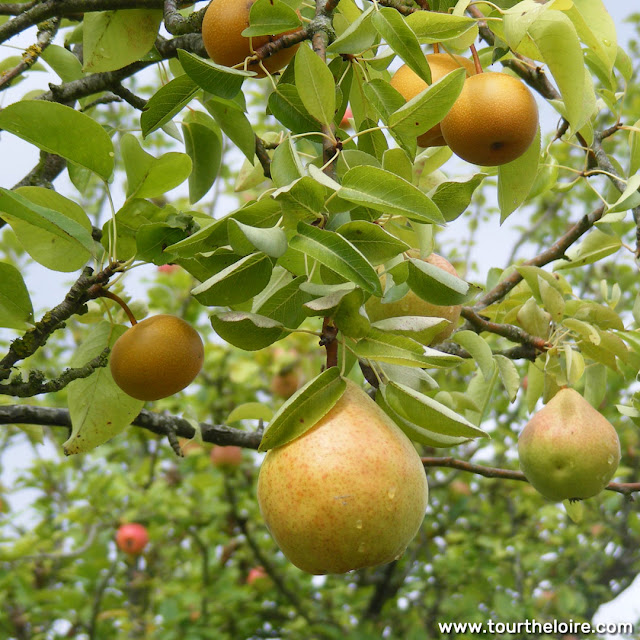
Doyenne de Comice and Nashi pears, Indre et Loire, France. Photo by Loire Valley Time Travel.
Doyenne de Comice and Nashi pears in our orchard a few years ago.

It isn't just us apparently. Everywhere in France the pear crop has been poor this year. Growers are reporting a yield that is 30% down on last year. We didn't get any at all! Luckily, our local organic commercial orchard had better luck, and currently has beautiful pears in stock. The crop losses are due to a cold wet spell in the spring, so pollination and fruit formation was poor.

Saturday, 2 October 2021

Château de Mauvezin

This is the Château de Mauvezin, in the Hautes-Pyrénées. We drove past in July on our way back from Cauterets, but stopped off to take a photo. It isn't the best view of the chateau (that is here), but it's a view.

I posted it because if I had titled this blog post "A Goat Shelter in the Pyrenees" you may not have read any further. Which would have been a pity...


Friday, 1 October 2021

Something Familiar About This...

13C hostelry, Nievre, France. Photo by Loire Valley Time Travel.

This building in La Charité sur Loire in Burgundy is known these days as the 'cellier' (pantry) but it was most probably a hostelry associated with the great Clunaic priory. It dates from the end of the 13th century or beginning of the 14th century, and is made up of a ground floor divided into three vaulted rooms, a presumed refectory and kitchens. The first floor is a vast single room, with a wood panelled double vaulted ceiling.

13C window, Nievre, France. Photo by Loire Valley Time Travel.
13th century window with trilobe decorative top.

So does it remind you of anywhere else? Here's a clue...

13C barn, Indre et Loire, France. Photo by Loire Valley Time Travel.
The back of our place.