Tuesday, 12 September 2023

Tomato Season

Susan wrote yesterday about quinces, but tomatoes are having a good season too. On Saturday our neighbour Edward knocked on the door and donated a bucket of tomatoes to us. I had to unload the tomatoes from the bucket immediately, because Edward needed the bucket for more tomatoes.


They're now roasted and awaiting preservation.

Monday, 11 September 2023

Quince Jelly

Quinces will be in again soon, and if you live in the Touraine and don't have a quince tree - don't worry - someone will offer you a bucketful of quinces. Quince trees seem to be loaded almost every year, and they are a sadly under utilised fruit.

Quince. Photo by Loire Valley Time Travel.
Cut in half, it is obvious they are related to apples and pears.
 

Gélée de coings, as quince jelly is called in French, is one of the easiest and most reliable jams you can make. Quinces have so much natural pectin there is never a problem with set and because you strain the liquid from the solids for the end product, there is no fiddling about peeling and coring the fruit. Chop them up as roughly as you like.

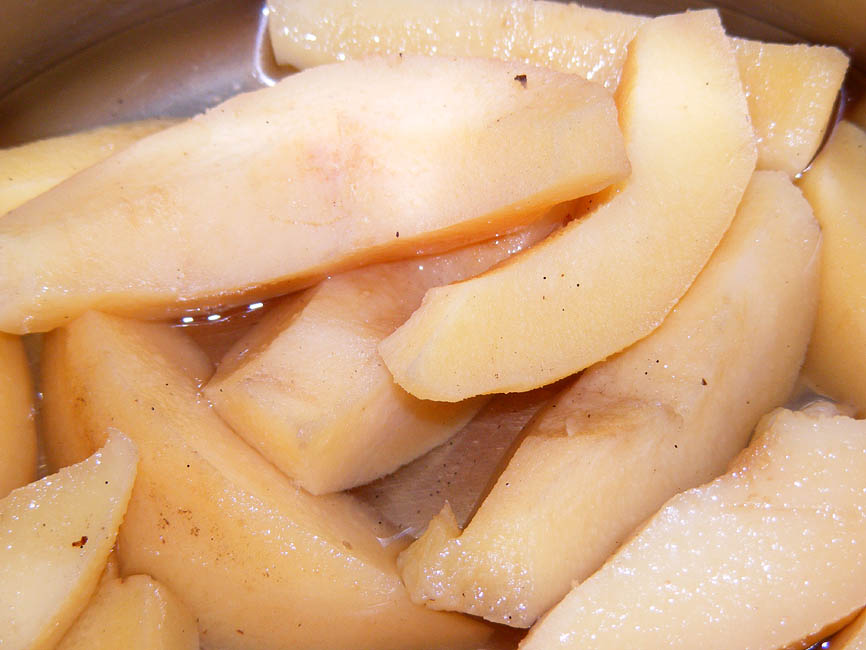
Homemade stewed quinces. Photo by Loire Valley Time Travel.
Neatly peeled, cored and thickly sliced - not for jelly, but beingpoached for dessert. The longer they poach the pinker they will get.

I start by washing them and rubbing the fuzz off. Then I cut them into largish chunks. Combine the quinces with an equal quantity of sugar and set aside in the fridge for a couple of days. Follow the same method as for apple jelly.

Quince pulp being filtered to make jelly. Photo by Loire Valley Time Travel.
A jelly bag stand, straining under the weight of quince pulp.

Once you have made the jelly and have a bag full of pulp, pips and skin, don't throw it out. Run it through a food mill to extract the pips and scaly bits and make quince paste with the resulting pink purée.

Quince paste is a specialty of Orleans dating from the Middle Ages and known as Cotignac. Quince is used a lot in the Maghreb (former French colonies in North Africa) in tajines. Locally it is prepared as compote to accompany game, but this requires a lot of time and work. Quinces are also used to make a liqueur by many people here, macerating the fruit with sugar and combining the juice drawn off with eau de vie (also known as marc de fruit).

Saturday, 9 September 2023

Mediterranean Sea Holly

Mediterranean Sea Holly Eryngium bourgatii (Fr. Panicaut de Bourgat) is a perennial wild plant in the Apiaceae family. It is related to carrots, parsnips, celery and parsley but is often referred to incorrectly as a 'thistle'. It is endemic to the Pyrenees and Iberian peninsula, Morocco, Lebanon and Turkey.

An unusual white one, photographed near Lac du Gaube in the Pyrenees.

Mediterranean Sea Holly Eryngium bourgatii, Hautes Pyrenees, France. Photo by Loire Valley Time Travel.

It grows from about 20 centimetres up to 50 centimetres tall and is usually an intense blue. The stems are upright and robust and the stiff leaves and bracts very spiny. The flowers come in July and August. You can find it on subalpine calcareous grasslands.

Photographed above Cauterets on our walk down to the Tour de France finish line on 6 July.

Mediterranean Sea Holly Eryngium bourgatii, Hautes Pyrenees, France. Photo by Loire Valley Time Travel.

Like other sea hollies, it attracts bees, moths and butterflies and bugs.

Friday, 8 September 2023

Sleeping Magi

Recently I bought a small work of art by my friend Bryan Ecceshall. It is

‘Sleeping Magi and Angel (after a sculpture in Autun Cathedral)’
Ink and Acrylic on Paper
250mm x 175mm
 
 Sleeping Magi with Angel by Bryan Eccleshall.
Sleeping Magi with Angel (after a sculpture in Autun Cathedral), Bryan Eccleshall. Photo by Loire Valley Time Travel.
 
It's based on a postcard found in a secondhand book on the frescoes of Piero della Francesca. The postcard was addressed to a medieval historian [link]. By coincidence, at the time Bryan bought the book, I was admiring the frescoes of Piero della Francesca in Arezzo.
 
Sleeping Magi, Loches, Indre et Loire, France. Photo by Loire Valley Time Travel.

By another coincidence, I recognised the image of the Sleeping Magi very well. Not from Autun Cathedral, but from Saint Ours in Loches. It's not a very common image so I was quite intrigued to learn of the one in Autun.
 
A fresco by Piero della Francesca in Arezzo.
 
Fresco, Piero della Francesca, Arezzo, Italy. Photo by Loire Valley Time Travel.

The scene refers to the story of the angel coming to the Magi in a dream to tell them to return home by a different route, because there was danger if they returned the way they had come. At the same time the angel warns the Holy Family to flee to Egypt to escape Herod.

Thursday, 7 September 2023

A Killer in the Orchids

Scorpion Flies are weird looking predatory insects with long spotted wings and a stabbing mouth called a rostrum. The males also have an appendage on the tip of their abdomen which they curl up over their back, scorpion fashion. Despite their English name they are not flies at all, but a separate order of their own, called Mecoptera.

Female scorpion fly Panorpa sp, Indre et Loire, France. Photo by Loire Valley Time Travel.
Female scorpion fly Panorpa sp (Fr. Panorpe).

Normally they don't do much in the way of impressive hunting, the way dragonflies and robber flies do. Scorpion Flies mostly eat already deceased insects. With their rostrum they will also suck up nectar sometimes. They are completely harmless to humans.

According to a report I read recently, they are known to hang out on orchids, especially marsh orchids Dactylorrhiza spp, laying in wait for unsuspecting insect visitors coming for the generous nectar that some orchids offer.


Heath Spotted Orchid Dactylorhiza maculata, France. Photo by Loire Valley Time Travel.
Heath Spotted Orchid Dactylorhiza maculata (Fr. Dactylorhize maculé).

Dactylorhiza have pinky purple flowers and labella (lower petals) with dark stripes to direct insects to the landing patch. But they are swindlers. There is no nectar to reward the insect, despite the signs the orchid displays. They need the insects as pollinators though, and practice this clever deception to get what they need without expending too much energy on nectar production.

Eusocial wasp Vespula sp on Broad-leaved Helleborine Epipactis helleborine, Indre et Loire, France. Photo by Loire Valley Time Travel.
Broad-leaved Helleborine Epipactis helleborine (Fr. Epipactis à larges feuilles).

The insects which come to orchids are often flies, and so they are the most common victims of the Scorpion Flies. The orchid stigmas are coated in a sticky sugary substance which is attractive and nutritious for the flies, but it is also a trap. In hot weather it ferments and the flies become drowsy, drunken and sometimes stuck inside the orchid flowers, making them easy prey for the Scorpion Flies. Even if the fly is inside the orchid flower the Scorpion Fly can access them with their strong rostrum, and if necessary chew or bore through the orchid to get at the fly.

Heath Spotted Orchid Dactylorhiza maculata, France. Photo by Loire Valley Time Travel.
Heath Spotted Orchid Dactylorhiza maculata (Fr. Dactylorhize maculé).

Orchids also host spiders which will prey on insect visitors too. The Scorpion Flies have been known to simply steal prey from spider webs on orchids. If the orchid in question is one that gives nectar, such as Broad-leaved Helleborine Epipactis helleborine, the Scorpion Flies will suck up nectar. Once again the orchid is laying a trap, but this time it is because the nectar is alcoholic and narcotic. Anything that sucks it up, including the Scorpion Flies, will end up addicted in a very short space of time.

Common Spotted Orchid Dactylorhiza fuchsii, France. Photo by Loire Valley Time Travel.
Common Spotted Orchid Dactylorhiza fuchsii (Fr. Orchis de Fuchs).

Orchids, particularly Helleborines Epipactis spp, are often infested with aphids, and these are often predated by Scorpion Flies. The aphids destroy the orchid flowers while they are still at the bud stage, so in this respect the Scorpion Flies are the orchids' ally.

Wednesday, 6 September 2023

Record Numbers at the Swimming Pool

According to our mayor, who I ran into when I was leaving the pool the other day, we've had record numbers at the pool this year, topping last year's record numbers. One very hot day there were nearly 400 people over the course of the day. That was the day swimming was like completing an obstacle course and I had to keep dodging people doing unexpected things in the lanes. There are a lot of holiday swimmers around, who haven't got the hang of pool etiquette. But we are a nice well run pool, and everyone gets on fine. I'm happy to share a lane because everybody starts somewhere and I can remember being a newbie in a pool with proper grown up swimmers. 

Public swimming pool, Indre et Loire, France. Photo by Loire Valley Time Travel.

This year has been much more temperate than last year, but even so we had a week of proper heatwave, with night time temperatures not going below 20C sometimes, and day time maximums in the high 30s. No wonder everyone has been at the pool lately.

I was particularly pleased to see the Ukrainians making themselves at home. They have developed a good relationship with Filou, the deservedly popular lifeguard/pool manager and they've bought themselves some inflatables for the kids. Filou stored them and made sure other kids don't help themselves.

Spotted at the pool on several occasions.

AIS bag spotted in France. Photo by Loire Valley Time Travel.

And now it's over for another year. The pool closed on 1 September and won't reopen until May or June 2024.

Tuesday, 5 September 2023

Narcotic Nectar in Helleborine Orchids

Epipactis spp orchids, often known as Helleborines in English, are a genus that includes some species that produce narcotic nectar. The labellum, or lower petal, is cup shaped at the base, pinched in at the front to form an attractive landing pad for pollinators. The cup shaped base holds a lot of nectar. The nectar is mostly sugars, but can also contain yeasts and bacteria which cause the nectar to ferment and produce ethanol, resulting in amusing drunken pollinators. So far, not so unusual.

Broad-leaved Helleborine Epipactis helleborine with eusocial wasp Vespula sp pollinator, Indre et Loire, France. Photo by Loire Valley Time Travel.
Broad-leaved Helleborine with eusocial wasp Vespula sp pollinator in our orchard a few years ago.

But studies in the past few decades have revealed more. Also present in the nectar of certain species are several sorts of narcotic substances, most notably the morphinan oxycodone. These substances cause the pollinating insects to become sluggish and spend much more time in the flowers, thus increasing the likelihood that the orchid pollenia attaches to them and is subsequently transported to another plant, without the insect grooming and removing the pollenia before it can come into contact with another orchid flower and achieve pollination. 

Broad-leaved Helleborine Epipactis helleborine with eusocial wasp Vespula sp pollinator, Indre et Loire, France. Photo by Loire Valley Time Travel.
Broad-leaved Helleborine with eusocial wasp Vespula sp pollinator in our orchard a few years ago.

Broad-leaved Helleborine Epipactis helleborine (Fr. épipactis à larges feuilles) is one of these narcotic producing species, normally pollinated by eusocial wasps, which become addicted to the narcotics in the nectar so they visit the orchids again and again. 

Further Reading: A paper on the subject by Romanian orchid expert Nora de Angelli [link].

Monday, 4 September 2023

Lillet Makes a Comeback

Created 150 years ago, Lillet (pronounced lee-lay) is once again fashionable.

Lillet and a non-alcoholic alternative on the bar at L'Image in Preuilly sur Claise.

Lillet, France. Photo by Loire Valley Time Travel.

Until a few years ago it had been something only your granny drank. But thanks to a vigorous promotional campaign in the drinks industry by Pernod-Ricard, the parent company of the producers of Lillet, it is now exported to about 50 countries around the world. Nowadays it is no longer consumed as a digestive, but as a cocktail ingredient, especially simple spritzers.

The back label on a Lillet rosé bottle in the supermarket.

Lillet, France. Photo by Loire Valley Time Travel.

Coming in white, pink or red versions, Lillet is an aperitif from Bordeaux which is now back in the limelight, having long been considered obsolete. Lillet is only made at one distillery, at Podensac in the Gironde.

Every morning 60 000 litres of Bordeaux wine is delivered to the factory. The recipe is secret, but Lillet is 85% wine from the region, some quinine and 15% fruit liqueur which has macerated in a oak barrel at the factory. Once all the ingredients are mixed it then sits in barrels made from locally grown low tannin oak for a further two to four months.  It is not herbal, like a vermouth would be. Instead the bitterness comes from citrus and quinine. Then in 1985 the secret recipe was reformulated to reduce both the quinine content and the amount of sugar. And in 2011 Lillet Rosé was released, made from a more complex mixture of fruits than either the red or the white.

White and rosé Lillet at the supermarket.

Lillet, France. Photo by Loire Valley Time Travel.

Ten million litres were made in 2022, compared to 800 000 litres in the 1930s, and ten times what was made in 2014. The drink we know today was invented in 1887, by Raymond and Paul Lillet, two brothers who were wine merchants (Fr. négociants), using Sauternes, although there was an earlier version dating from 1872. Its heyday was considered to be in the 1950s and 60s, when the American market discovered the drink. The company remained family owned for 113 years, until 2016 when Raymond's grandson, Pierre Lillet, died. Today Germany and Austria are big consumers, and although Britain and the US remain important, they are considered more as historically where it was consumed in the 20th century.

Lillet isn't nearly as alcoholic as some of its competitors, and is more like a fortified wine than a spirit. Technically it is an aromatised wine-based aperitif. That gives it a good deal of versatility and it can be paired with white meat, cheeses and desserts or used as an ingredient in chicken dishes or desserts, rather than just used as an aperitif or a cocktail ingredient. But most famously it was used in the Vesper Martini, James Bond's staple drink.

Lillet in the supermarket.

Lillet, France. Photo by Loire Valley Time Travel.

The company is proud of its sustainable practices, using tankers fueled by bioethanol and composting all grape waste. Packaging, including the bottles, are lightweight and untreated.

It is recommended to keep Lillet in the fridge once opened. In modern bars and households it is served with tonic, lots of ice and a garnish like a strawberry.

Saturday, 2 September 2023

High Altitude Thrips

Thrips belong to the taxonomic order Thysanoptera (so they are not bugs or beetles or flies, but an order all of their own).

Thrips on a daisy, photographed at nearly 2000 metres above sea level, near Lac du Gaube in the Pyrenees.

Thrips, Hautes Pyrenees, France. Photo by Loire Valley Time Travel.

There are more than 6000 species, some of which are known as 'thunderbugs' and others which are considered garden or crop pests, being vectors for a number of plant viruses. But many are pollinators. Thrips are the sort of organisms that frequently get transferred from one Continent to another due to global trade, so many places have both native and introduced species. The ones that live on Australian Acacias are particularly well studied. Many species are social, living in colonies and prepared to defend their territory. 

New species are regularly discovered. A few are predatory, eating mites and tiny insects; some are parasites; some cause galls on their host plants and about half feed on plants, eating leaves and buds, creating galleries or silver trails; the others feed on fungi. In turn, thrips are predated by other insects such as Robber Flies Asilidae and some flower bugs. Thrips are very small, sometimes under 2mm in length, and have sucking piercing mouthparts. Many are attracted to bright floral coloured clothing and have been known to 'bite' humans (they are attempting to feed and are harmless). 

They've been around for a long time, with thrips found attached to pollen in amber from the Cretaceous period. Apparently they often cause havoc in plant breeding nurseries, by transporting pollen from one plant to another in a way the horticulturalists don't want to happen. Charles Darwin had trouble with them when he was studying pollenisation and noted that 'no netting will keep them out'. They are prone to aggregating inside houses and can insert themselves between a laptop computer or television LCD screen and its glass cover (I've had that happen, with a thrips walking around all over my screen for days). Thrips are resistant to insecticides and there is no real way of controlling them if numbers get out of hand.

Friday, 1 September 2023

A Farm Labourer and Resistance Fighter

Maurice Manchet was the son of Maxime Abel Manchet (born in 1884 in Gy-en-Sologne, Loir-et-Cher), a day labourer and Célestine Couture (born in 1890 in Epeigné-les-Bois, Indre-et-Loire). His parents were married in April of 1910 in Saint-Martin-le-Beau (Indre-et-Loire); they were both gagistes (which in the agricultural vocabulary of the time designates people receiving wages for a service rendered, without however being a servant). Maurice was their first child. A second son Robert was born in 1914, while his father was already mobilized, but died at Azay-sur-Indre (Indre-et-Loire) at the age of 8 months. 

Maxime Manchet was mobilized in August 1914, and sent as a soldier in the 312th Infantry Regiment, where he was killed at Verdun on December 8, 1916. As he was killed in action, he was declared to have 'died for France' and Maurice Manchet, fatherless at the age of 3, became a ward of the State after the War. In the 1926 census, he was living with his mother, a farmer in Azay-sur-Indre. In 1944, married to Yvette Emilie Lanneau, he was living in Dolus-le-Sec (Indre-et-Loire) where he worked as a farm labourer. He joined the Resistance and joined a maquis group in the region of Loches (Indre-et-Loire).

Memorial to Resistance fighters, Indre et Loire, France. Photo by Loire Valley Time Travel.

On August 16, 1944, the town of Loches was liberated for the first time by the joint action of several local maquis. But four days later, on August 20, German troops recaptured the town, a strategic point on their retreat south of the Loire. Violent fighting then took place between groups of maquisards and German troops in Loches and in several neighbouring municipalities, resulting in the death of about twenty Resistance fighters. In the municipality of Chanceaux-près-Loches, on the western outskirts of Loches, seven Resistance fighters were killed (four of whom were not identified). Among the three maquisards identified was Maurice Manchet. His body was not discovered until September 2, 1944, around 5:00 p.m. (and recognized on September 3 by his family) at a place called La vallée des Châtaigniers, in the municipality of Chanceaux, "the individual had his right leg shot through and his skull shattered". This description suggests that he may have been wounded and then summarily executed.

He obtained the mention "Died for France" on January 29, 1948 and his name is inscribed on the monument of Dolus-le-Sec. His name is engraved on the memorial erected in Dolus (Manchet and an unknown, sergeant Bouboule?) as well as in Chanceaux on the monument surmounted by a cross of Lorraine, and on the plaque to the victims of the wars located in the church.

 Bouboule is an odd name, like a nickname for someone who is short and fat.

Source: https://maitron.fr/spip.php?article212141, notice MANCHET Maurice, Abel par Annie Pennetier, Michel Thébault, version mise en ligne le 1er mars 2019, dernière modification le 15 avril 2020.

Thursday, 31 August 2023

The Plastic of the Future

The Tinder Fungus Fomes fomentarius (Fr. Amadouvier) could be used to replace certain plastics and be used in a variety of sectors, such as medicine. It's a common fungus in the Northern Hemisphere, growing on wood and can reach up to 50 cm across. Used as a firelighter since prehistoric times, it has also already been used in medicine in a number of ways (cauterisation, bandage, compress) and has been used to make clothes or decorative objects. 

Tinder Fungus Fomes fomentarius, Indre et Loire, France. Photo by Loire Valley Time Travel.
Growing on a fallen log in the forest.

The biomaterials industry has been flourishing for some years. Mycomaterials in particular are popular because they have numerous advantages -- they are organic, biodegradable and their manufacture requires much less CO2. They are also more economical.

Tinder Fungus Fomes fomentarius, Indre et Loire, France. Photo by Loire Valley Time Travel.
I discovered this one on a recently felled log, neatly sliced across to reveal the structure.

Today mycomaterials present an interesting alternative to leather and synthetic textiles. They can also replace certain synthetic polymers to make packaging, furniture and even used as building construction materials and insulation.

Tinder Fungus Fomes fomentarius, Indre et Loire, France. Photo by Loire Valley Time Travel.
Tinder fungus on display at an exhibition put on by the Association de Botanique et de Mycologie de Sainte Maure de Touraine.

Tinder fungus has three layers with different qualities: the crust, which is a bit porous but dense and relatively uniform; the flesh, which is spongey, soft and leathery; and the tubes, which are hollow and parallel. Tests show that the flesh and tubes have qualities which are comparable to pine, leather and crossply, but the mycomaterial weighs less. Another possible advantage is that the fungus can be manipulated into growing into a particular form.

Tinder Fungus Fomes fomentarius, Indre et Loire, France. Photo by Loire Valley Time Travel.
Growing in the forest.

Scientists and engineers are working on mycomaterials in nanocomposites and polysaccharides. The product could also be used in a medical context as engineered tissue or make orthopedic implants.

Wednesday, 30 August 2023

Aurore and the Unicorn


'Mon seul desir', depicting the supreme courtly virtue of largesse, being generously distributed.

This year conservators have been testing the fibres and dyestuffs on La Dame et la Licorne (the Lady and the Unicorn) tapestries in the Cluny museum. They want to know for sure what the chemical components of the dyes are so they can reproduce them, and develop a strategy for protecting the colours.

The panels depicting hearing or joy, and sight or leisure. 
Joy is playing her portable organ, Leisure is enticing the unicorn in her mirror.

In the early days of the 19th century a little girl called Aurore Dupin would come down to the Berry countryside to stay with her grandmother in Nohant-Vic. Later, as a young woman with her own young family, she inherited the house at Nohant and came to live there to escape her husband and the political troubles in Paris. Although Aurore came from a wealthy family, because her husband controlled the purse strings she was forced to earn her own living. And thus, the novelist George Sand was born.

A genet, domesticated in medieval times in preference to cats to catch rodents around the house.

At Nohant Aurore/George was free to indulge love affairs with Chopin, Prosper Mérimée (Inspector General of Historic Monuments) and the artist Manceau, amongst others. Her children were raised in an atmosphere of creativity and independence. Everyone in the household wrote, made art or performed.

A rotund heron doing backstroke in 'Mon seul desir'.

In the 1830s and 40s many wealthy aristocratic and bourgeois people quit Paris as the political situation was not stable. One of George Sand's friends holed up in Boussac in the Creuse and set up a printing press there. She visited Boussac several times and on one of these visits came across an extraordinary set of tapestries hanging in the local chateau, at that time the offices of the local authority. She saw immediately that they were something special and invited Prosper Mérimée down to view them. As a result they were heritage listed in 1865 and in 1882 sold to the Cluny.

The lion, who appears in all the panels, carrying the crescent moon arms of Antoine le Viste.

The medieval Chateau of Boussac was one of George Sand's favourites and she used it as the setting in one of her novels, describing it as 'irregular, graceful and pretty in its simplicity'. Who commissioned the tapestries was long a mystery but now studies suggest that it was Antoine le Viste in about 1500. The modern scholarly opinion is that they can be read in multiple ways and represent both allegories around the five senses and the six Courtly Virtues (frankness, beauty, joy, largesse, riches and leisure) of Guillaume de Lorris's Roman de la Rose. In addition they contain a bestiary and a flora. Antoine le Viste was married to a member of the powerful Tourangelle family the Briçonnets (who built Chenonceau and Candé about a decade after the tapestries were probably woven). The mystery surrounding the set of tapestries is compounded and continues because George Sand wrote of eight panels -- and yet only six exist at the Cluny.

A terrier on a cushion, in 'Mon seul desir'.

Prosper Mérimée mentions in correspondence that he was told by the local mayor that there were other, even more beautiful tapestries at one time in the chateau, but a former owner had cut them up to make cart covers and carpets. Were these the missing panels, or is there some forgotten corner of the chateau hiding them behind a collection of battered furniture or rolled up in an old cart?

Tuesday, 29 August 2023

A Hero of the Resistance

As we were walking back to our garage from lunch at a pizza restaurant with our mechanic and a friend in Saint Pierre des Corps one day I noticed this commemorative street name plaque on an ordinary private house. Who was Honoré d'Estienne d'Orves I wondered. And what a mouthful of a name!

He turns out to be a fascinating character, a real old school patriot. He was born in 1901 into an old aristocratic family, became a French naval officer, and when France surrendered in the Second World War he joined de Gaulle's Resistance in London. With the Dutch Resistance fighter Yan Doornik and fellow Frenchman Maurice Barlier he set up the Free French information and communications network Nemrod. 

Commemorative street name plaque, Indre et Loire, France. Photo by Loire Valley Time Travel.

His mother was a Vilmorin [link], the family of famous horticulturalists and seed merchants (botany was an aristocratic pursuit back in the day...). At one stage he seriously courted his cousin Louise Vilmorin, but at the time she preferred Antoine de Saint-Exupéry.

Just before Christmas 1940 he and a radio operator called Georges Marty (real name Alfred Gaessler) crossed the Channel and established themselves in the Nantes home of Resistance members, a couple called Clément. Theirs was the first radio communications link between Occupied France and London. He then went to Paris to get his friend Max André to set up a network there. When he returned to Nantes it became clear that Alfred Gaessler was a double agent, but the group found out too late and 23 members of the network were arrested.

D'Estienne d'Orves was condemned to death along with 8 of his comrades. They were not executed immediately though, and kept in prison until a real showcase moment occurred. He was arrested in January 1941, but not shot until August of that year, an act of reprisal against the assassination of a German officer in Paris. Barlier and Doornik died alongside him.

Further Reading: an article in History Net on the 80th anniversary of his death [link].

Monday, 28 August 2023

How Many Baguettes!?

Wheat crop, Indre et Loire, France. Photo by Loire Valley Time Travel.

One hectare of soft French winter wheat will yield 25 000 baguettes. Nine million hectares are sown to wheat in France and the yield is about six tonnes a hectare (so it takes 6 tonnes of wheat to make those 25 000 baguettes). That wheat, ground into flour, costs the boulanger about 10c per baguette.

Baguettes, Vienne, France. Photo by Loire Valley Time Travel.

The French wheat harvest is 30 to 40 million tonnes annually and France is the fifth largest wheat producer in the world, and second largest exporter of wheat (Australia is the ninth biggest producer and fourth biggest exporter, mostly of hard wheat, unlike France). 

Wheat crop, Indre et Loire, France. Photo by Loire Valley Time Travel.

Chances are your baguette in France was made with wheat grown in Centre Val de Loire. The Region is the biggest cereal producer in Western Europe.

Saturday, 26 August 2023

Mazarine Blue

The Mazarine Blue Cyaniris semiargus (Fr. Azuré des anthyllides) is a small blue butterfly. The upper side of the males is violet blue with a dark brown edge and white fringe. Females are brown all over. The undersides of both sexes are beigey grey, with a few tiny black dots.

Mazarine Blue Cyaniris semiargus and Adonis Blue Polyommatus bellargus, Hautes Pyrenees, France. Photo by Loire Valley Time Travel.

The caterpillars overwinter in the nests of ants, which take care of them. Prior to that they eat Red Clover Trifolium pratense (Fr. Trèfle des prés). The adult butterflies fly from April to October. 

The species occurs all over temperate Europe and Asia, up to 2500 metres above sea level. In France it is widely distributed but not common in the north-west. I photographed these near Lac du Gaube in the Pyrenees. They were with an Adonis Blue Polyommatus bellargus (Fr. Azuré bleu céleste) - the bright blue butterfly in the photo - sucking minerals from some unidentified poo. 

Typically they are found in damp grassland and scrub, where the host plant grows. The population appears to be stable and it is not considered to be at risk of extinction.

Thursday, 24 August 2023

A Spot of Birdwatching in the Brenne

A couple of weeks ago Ingrid and I were early for a rendez-vous with a botanist in the Brenne so we opted for a spot of birdwatching from the Etang Purais hide [link]. It's the biggest hide in the LPO Chérine Reserve, but on a dull summer morning we had it all to ourselves.


The Etang Purais, near Lingé in the Brenne, Indre.

Etang Purais, Indre, France. Photo by Loire Valley Time Travel.

A pair of Mute Swans (Fr. les Cygnes tuberculés) take off.

Mute Swans, Indre, France. Photo by Loire Valley Time Travel.

A Mute Swan taking off.

Mute Swan, Indre, France. Photo by Loire Valley Time Travel.

Eurasian Coots (Fr. les Foulques macroules) obligingly perch on the artfully placed fallen tree that is right in front of the hide so that birdwatchers can get a good view of anything using it.

Coots, Indre, France. Photo by Loire Valley Time Travel.

Mute Swan.

Mute Swan, Indre, France. Photo by Loire Valley Time Travel.

Red-crested Pochards (Fr. les Nettes rousses) in non-breeding plumage. In the past 50 years the Brenne has become a significant breeding location for this species of diving duck.

Red-crested Pochards, Indre, France. Photo by Loire Valley Time Travel.

Mute Swan.

Mute Swan, Indre, France. Photo by Loire Valley Time Travel.

A Whiskered Tern (Fr. Guifette moustac) preens on a post. Etang Purais is one of their most important breeding sites in France, where they nest on the floating water lily leaves.

Whiskered Tern, Indre, France. Photo by Loire Valley Time Travel.

Info board in the carpark at the Etang Purais.

Info board, Etang Purais, Indre, France. Photo by Loire Valley Time Travel.

A flying flock of Ouessant sheep, an ancient breed from Brittany, being used for conservation grazing, a technique for maintaining the reserve.

Ouessant sheep flying flock on a nature reserve, Indre, France. Photo by Loire Valley Time Travel.

Inside the hide. There are a number of nice paintings of different bird species on the walls.

Inside a birdwatching hide, Indre, France. Photo by Loire Valley Time Travel.