Wednesday, 15 April 2020

How Tongues Help Talking (2017)


Several years ago I met a French scientist on a botanical outing and we've stayed in touch despite the fact that she no longer lives in France. She emailed me to offer to help with a network of interpreters I've set up to help with medical tele-consultations during the Covid-19 crisis, in situations where either the patient or the doctor does not feel comfortable speaking in a second language. Marie speaks French, English and Spanish fluently, and probably a bit of Finnish too, as her husband and in-laws are Finnish. Nowadays with iphones that will easily do three way phone calls and software such as whats app, you do not need to be in the same country to participate in this sort of project.

I thought I would re-post my report of the botanical outing where we met, from May 2017.

***********************************************************

 Tongue Orchid habitat.
Tongue orchid Serapias lingua habitat.  Indre et Loire, France. Photographed by Susan Walter. Tour the Loire Valley with a classic car and a private guide.

On Sunday 14 May Marc Fleury led a botany outing to see the last remaining colony of Tongue Orchid Serapias lingua (Fr. Sérapias à languette)  in Indre et Loire. The site is hidden away, well off the main road, and was once used as a source of kaolin for porcelin making. It is wet in the winter and dry in the summer, covered in rough grassy open areas and patches of scrub. Perfect for not just Tongue Orchids, but Loose-flowered Orchid Anacamptis laxiflora (Fr. Orchis à fleurs lâches) and Green-winged Orchid Anacamptis morio (Fr. Orchis bouffon). Apparently there are Autumn Lady's-tresses Spiranthes spiralis (Fr. Spiranthe d'automne) too, later in the season.

 Tongue Orchids don't stand out much, being pale in colour and no higher than the grass they are growing through.
Tongue Orchid Serapias lingua in wet grassland.  Indre et Loire, France. Photographed by Susan Walter. Tour the Loire Valley with a classic car and a private guide.

It is an extensive colony of Tongue Orchids, with hundreds of plants over, I would guess, about a hectare. It's quite difficult to avoid standing on a few plants, and the tracks through the site were quite boggy.

 Green-winged Orchid, so named because the distinctive stripes on the lateral sepals are sometimes green.
Green-winged Orchid Anacamptis morio.  Indre et Loire, France. Photographed by Susan Walter. Tour the Loire Valley with a classic car and a private guide.

Tongue Orchids are one of the few orchid species that produces more than one bulb each year, so you often get multiple flower spikes very close together. They have evolved to have a large 'tongue' or labellum as their bottom petal. This serves as a landing pad for insects. The flowers act as a cosy resting place and insects often spend the night tucked up in them. When they emerge, with any luck, they have an orchid pollenia stuck to their back and will transport it to the next plant for cross-fertilisation.

The flower colour can be quite variable, so here is a rather dark tongued specimen.
A dark morph of Tongue Orchid Serapias lingua.  Indre et Loire, France. Photographed by Susan Walter. Tour the Loire Valley with a classic car and a private guide.

The former kaolin pit, now filled with water and very deep. It is L-shaped and bends away to the left beyond the edges of the photo.
Abandoned kaolin pit.  Indre et Loire, France. Photographed by Susan Walter. Tour the Loire Valley with a classic car and a private guide.

Four-spotted Chaser Libellula quadrimaculata (Fr. Libellule à quartre taches), staking its claim to one end of the kaolin pit.
Four-spotted Chaser Libellula quadrimaculata.  Indre et Loire, France. Photographed by Susan Walter. Tour the Loire Valley with a classic car and a private guide.

Ragged Robin Lychnis flos-cuculi (Fr. Silène fleur de coucou), another lover of wet grasslands.
Ragged Robin Lychnis flos-cuculi.  Indre et Loire, France. Photographed by Susan Walter. Tour the Loire Valley with a classic car and a private guide.


************************************************

For details of our private guided tours of chateaux, gardens, wineries, markets and more please visit the Loire Valley Time Travel website. We would be delighted to design a tour for you.

We are also on Instagram, so check us out to see a regularly updated selection of our very best photos. 

Tuesday, 14 April 2020

Revisiting Rivarennes (2016)


I'm doing a series of reposts on the blog because nothing much of interest is happening in Preuilly if you discount the Covid-19 lockdown. I got an email from Eileen the other day, so I thought I'd bring back the post I wrote about my visit to her four years ago.

**********************************************

Rivarennes is a small village on the River Creuse in the Brenne. I was invited to go over there to check out the surrounds and the appointed day turned out to be thoroughly miserable weather wise, but thoroughly enjoyable company and scenery wise.

Nottingham Catchfly.
Nottingham Catchfly Silene nutans. Indre. France. Photographed by Susan Walter. Tour the Loire Valley with a classic car and a private guide.

I am super pleased with this photo of Nottingham Catchfly Silene nutans (Fr. Silène penché). They are night flowering, and the flowers only last a few hours. Normally when I see them the petals are rolled back on themselves and the flower is dying. Because it was such a dull moist day they were in good condition for once and I got this nice shot of them with artistic droplets of water. They are a common plant here on flinty chalk soil, growing in dry sunny places.

Chateau de la Tour, Rivarennes. Indre. France. Photographed by Susan Walter. Tour the Loire Valley with a classic car and a private guide.

Built in the 14th century to control the river crossing, the Chateau de la Tour was captured by the English in 1370. It is privately owned.

Eileen on the track through Les Chézeaux.
Botanising in the Brenne. Indre. France. Photographed by Susan Walter. Tour the Loire Valley with a classic car and a private guide.

Eileen and Andrew are the energetic new owners of a tiny house, a large garden and a parcel of woodland in Rivarennes. They asked me over to check out the nearby nature walk of Les Chézeaux, which we were hoping would reveal lots of orchids. Later in the year there will apparently be Martagon Lilies Lilium martagon (Fr. Lis martagon) flowering too. The latter is a species on the north-eastern edge of its range and there are only ten sites in the Brenne where you can see it (most of them near Rivarennes and the surrounding villages along the Creuse).

The oldest house in Rivarennes.
Oldest house in Rivarennes (14C). Indre. France. Photographed by Susan Walter. Tour the Loire Valley with a classic car and a private guide.

This house, known as Le Pavillon, may not look very special but it is a 14th century tower house. There is an inscription above the door which refers to the killing in the church of a local lad by the lord of the chateau in 1626.

Jachère fleurie.
Wild flower meadow, Rivarennes. Indre. France. Photographed by Susan Walter. Tour the Loire Valley with a classic car and a private guide.

This lovely patch of jachère fleurie has been sown in the water meadow on the edge of town. When I visited it was dominated by Dames-violet Hesperis matronalis (Fr. Julienne des dames) and Oxeye Daisy Leucanthemum vulgare (Fr. Marguerite). Both plants would be native to this spot and the reason this jachère fleurie is better than the average non-native cosmos heavy effort is that Indre Nature have an office in Rivarennes. Apparently they have had to put a sign up asking people not to pick the flowers. It hasn't been very successful though. People are regularly sighted bearing away armfuls of flowers. Infuriating!

Grass Pea.
Grass Pea Lathyrus sphaericus. Indre. France. Photographed by Susan Walter. Tour the Loire Valley with a classic car and a private guide.
The pretty little Grass Pea Lathyrus sphaericus (Fr. Gesse à graines rondes) is uncommon, but there was a nice patch of them growing by the bike path. I've only ever seen single plants before.

A mutant Monkey Orchid.
Monkey Orchid Orchis simia. Indre. France. Photographed by Susan Walter. Tour the Loire Valley with a classic car and a private guide.

In the end we only saw one species of orchid in flower, which was disappointing. There was a Lady Orchid Orchis purpurea (Fr. Orchis pourpre) which had been picked, and some other orchids not yet in flower. All we saw in flower were Monkey Orchids Orchis simia (Fr. Orchis singe), at least one of which had been picked, and one of which had a mutation and was 'limbless'. They should look like this, with 'arms' and 'legs' which remind one of a monkey.

Notable Plants to be Seen at Rivarennes:
Broad-leaved Whitebeam / Sorbus latifolia / Alisier de Fontainebleau (M-J) 
Peach-leaved Bellflower / Campanula persicifolia / Campanule à feuilles de Pêcher (J-J)
Small Teasel / Dipsacus pilosus / Cardère velue (J-J-A)
Narrow-leaved Helleborine / Cephalanthera longifolia / Cephalanthère à longues feuilles (M-J)
White Helleborine / Cephalanthera damasonium / Cephalanthère blanche (M-J)
Bird-in-a-Bush / Corydalis solida / Corydale solide (M-A-M)
Berry Catchfly / Cucubalus baccifer / Cucubale à baie (J-A)
Plantain-leaved Leopards Bane / Doronicum plantagineum / Doronic à feuilles de Plantain (A-M-J)
Small-leaved Helleborine / Epipactis microphylla / Epipactis à petite feuilles (J-J)
Narrow-lipped Helleborine / Epipactis muelleri / Epipactis de Müller (J-J)
Irish Spurge / Euphorbia hyberna / Euphorbe d'Irlande (A-M-J-J)
Bloody Cranes-bill / Geranium sanguineum / Géranium sanguin (J-J)
Isopyrum / Isopyrum thalictroides / Isopyre faux-Pigamon (M-A-M)
Fingered Sedge / Carex digitata / Laîche digitée (A-M-J)
Toothwort / Lathraea squamaria / Lathrée écailleuse (M-A)
Violet Limodore / Limodorum abortivum / Limodore à feuilles avortées (M-J)
Martagon Lily / Lilium martagon / Lis martagon (June)
Great Wood-rush / Luzula sylvatica / Luzule des bois (M-J)
Yellow Birds-nest / Monotropa hypopitys / Monotrope sucepin (J-J)
Robust Marsh Orchid / Dactylorhiza elata subsp sesquipedalis / Orchis élevé (M-J)
Early Marsh Orchid / Dactylorhiza incarnata / Orchis incarnat (M-J)
Military Orchid / Orchis militaris / Orchis militaire (A-M-J)
Wych Elm / Ulmus glabra / Orme de montagne (M-A)
Herb Paris / Paris quadrifolia / Parisette (M-J-J)
Hard Shield Fern / Polystichum aculeatum / Polystic à aiguillons
Soft Shield Fern / Polystichum setiferum / Polystic à soies
Primrose / Primula vulgaris / Primavère acaule (M-A)
Oxlip / Primula elatior / Primavère élevée (M-A-M)
Wild Liquorice / Astragalus glycyphyllos / Réglisse sauvage (J-A)
Common Bistort / Polygonum bistorta / Renouée bistorte (M-J-J-A-S)
Early Squill / Scilla bifolia / Scille à deux feuilles (M-A-M)
A ragwort / Senecio erraticus / Séneçon erratique (J-J-A-S)
Wild Grapevine / Vitis vinifera subsp silvestris / Vigne sauvage (M-J)


************************************************

For details of our private guided tours of chateaux, gardens, wineries, markets and more please visit the Loire Valley Time Travel website. We would be delighted to design a tour for you.

We are also on Instagram, so check us out to see a regularly updated selection of our very best photos. 

Monday, 13 April 2020

Wild Foraged Asparagus


This year there is no chance of wild foraged asparagus as we are in lockdown. I never dreamt when I wrote this post last year to schedule for the new asparagus season in 2020 that we would be in this situation.

*******************************************

Photograph Susan Walter. Tour the Loire Valley with a classic car and a private guide.

Everyone looks forward to the new season asparagus appearing at the markets in France. The beginning of the asparagus season can vary by about a month. Sometimes it is available from the beginning of April, but sometimes you have to wait until May. Then it has all finished by the end of June.

In the Loire Valley the asparagus you get at the market is mostly white, and mostly grown in the Sologne or around Richelieu, where the soil is sandy. If like me you prefer the green you quickly learn which producers will sell a bit of green in addition to their white, or you go foraging for naturalised asparagus in the fields. It pops up all over the place, and so long as you pick it at just the right moment, is delicious. It is not wild asparagus -- that is a different plant, very rare, not worth eating and only occurring near the sea. This is naturalised garden asparagus, germinated from seeds left by birds (asparagus has red berries very popular with many species of birds).

Friends of mine, who live north of the Loire, tell me that there is an abandoned asparagus field near them that they go and harvest every year. Last year they got 5 kilos of free asparagus from one visit.

Photograph Susan Walter. Tour the Loire Valley with a classic car and a private guide.

Cook your foraged asparagus the same day as you pick it, or the day after. It comes in all lengths and thicknesses, so wash and cut into even sized pieces as necessary, either across into lengths that fit in the steamer, or down the length so that all the pieces need the same cooking time. Steam for about 8 minutes. Once plated, season with sea salt crystals, freshly ground mixed peppercorns, a few crispy lardons, a squeeze of lemon juice and some grated parmesan cheese. Place a poached egg on top. Obviously, you can substitute cultivated fresh green asparagus, homegrown or bought at your local greengrocers.

Cooked and photographed by Susan Walter. Tour the Loire Valley with a classic car and a private guide.


Yum

************************************************

For details of our private guided tours of chateaux, gardens, wineries, markets and more please visit the Loire Valley Time Travel website. We would be delighted to design a tour for you.

We are also on Instagram, so check us out to see a regularly updated selection of our very best photos. 

Sunday, 12 April 2020

Thar's Gold in Them Thar Hills


Gold was discovered in Australia in 1851, the year my father's ancestors arrived in the country. When we visited our friends Leon and Sue they took us to one of the gold mining sites near them, on Mount Alexander, known variously as the Garfield Mine or the Forest Creek Mine.

Garfield mine remains, Victoria, Australia. Photographed by Susan Walter. Tour the Loire Valley with a classic car and a private guide.

Seams of quartz were mined here from 1856 to extract the gold and the evidence of holes in the ground, humps and hillocks, and remnants of industrial structures are all around. From the 1880s the quartz was crushed using a giant waterwheel on this site, the largest ever constructed in Australia.

Warning sign on former goldfield site. Victoria, Australia. Photographed by Susan Walter. Tour the Loire Valley with a classic car and a private guide.

It was very windy while we were there and I genuinely thought we were at risk from falling branches, if not whole trees. The trees here are very tall Eucalypts, which don't feel safe in extremely windy weather.

************************************************

For details of our private guided tours of chateaux, gardens, wineries, markets and more please visit the Loire Valley Time Travel website. We would be delighted to design a tour for you.

We are also on Instagram, so check us out to see a regularly updated selection of our very best photos. 

Saturday, 11 April 2020

Pavlovsky Lighthouses


At the outbreak of the First World War Saint Jean de Luz was a fashionable get away for the comfortably off.

Although the local architecture featured the traditional Basque style farmhouse, the new arrivals, wealthy and attracted to modernity, engaged young architects to design their villas.

 The Pavlovsky lighthouse on the Saint Jean de Luz side of the harbour.
Lighthouse designed by Andre Pavlovsky, Saint Jean de Luz, Pyrenees-Atlantiques. France. Photographed by Susan Walter. Tour the Loire Valley with a classic car and a private guide.

André Pavlovsky (1891 - 1961) probably most represents these inventive contemporary talents that would profoundly transform the Basque architectural landscape.

Son of a Russian family who had moved to Paris, he spent his summers in Saint Jean de Luz before moving there permanently in 1924. He then joins the trending neo-Basque modernist group of architects, chief amongst whom was Henri Godbarge. Little by little his work became more modernist, using concrete and big windows, and the effects of light and shadow.

 Pavlovsky lighthouse on the Ciboure side of the harbour.
Lighthouse designed by Andre Pavlovsky, Ciboure, Pyrenees-Atlantiques. France. Photographed by Susan Walter. Tour the Loire Valley with a classic car and a private guide.

In 1929 he worked on a number of important hotels and bars. The same year he was approached by the wealthy residents of the Chantaco quarter, who had bought property in the area, attracted by the golf. Five big villas, including one for René and Simone Lacoste, were designed and built under his supervision.

His signature style blended modernism with traditional Basque, neo-Basque and Hispanic elements, such as empty triangular cartouches, pedemented lozenges, oval windows decorated with keys, oculi.

In 1936 he delivered his most prominent project, the rebuilding of the two lighthouses at the entrance to the harbour, giving him the opportunity to stress the vertical.

By the end of the Second World War the demand for grand villas was much reduced. From then on he designed apartment blocks and public buildings, and concentrated on photography. In the 1950s he designed a renowned motel in the nearby hills.

At the end of his life he wrote 'You should never slavishly copy, but interpret and only stick to the general idea of what has gone before. In a word, evolve!' 


************************************************

For details of our private guided tours of chateaux, gardens, wineries, markets and more please visit the Loire Valley Time Travel website. We would be delighted to design a tour for you.

We are also on Instagram, so check us out to see a regularly updated selection of our very best photos. 

Friday, 10 April 2020

Fabricating Face Masks


I finally gave in last Saturday and made a face mask. I cleared a workspace, set up the sewing machine, got out all my sewing tools and rummaged in one of my chests of fabrics. Patterns for face masks in several designs are all over the internet and I chose one that involved economical rectangular pieces and simple straight sewing. The fabric is tablecloth material on the outside and bed sheet or curtain lining on the inside. The mask has got a pocket for a filter, but I don't really know what to use as a filter. I'm going to trial a layer of outdoor furniture cover fabric slipped in to the pocket.

Wearing a homemade mask in the Covid-19 lockdown.  Indre et Loire, France. Photographed by Susan Walter. Tour the Loire Valley with a classic car and a private guide.

The sewing machine clunked and chuntered a bit. It probably needs oil, and maybe even a service. It didn't cope well with how thick the mask gets once you pleat it. But it coped, as did I.

I felt like the end of the world was coming and I was a prepper though. But the pharmacy doesn't have any masks, and even if they did I would rather they went to medical staff who will wear them properly and not waste them. The advice now is to wear a mask if possible if you are in public, so I can do my civic duty.

The finished mask is surprisingly comfortable and doesn't seem like it will slip while on, so that's good. I'd like to be able to wear it without touching it so that it isn't a complete waste of time. I've now made Simon one too, although he is less likely to be in a position where he should wear it.

I wore it to the supermarket on Tuesday. About half the shoppers were wearing masks (and all the staff). Only a few had donned home made masks. One was an old man in a simple elasticated arrangement made from a piece of flannellette sheet. Another was a young woman in a very smart and neatly constructed shaped mask in navy floral. Mine was by far the most colourful and the most obviously homemade.

Meanwhile, this notice has appeared on a garage door near us.
Homemade poster on a garage door thanking key workers during the Covid-19 lockdown.  Indre et Loire, France. Photographed by Susan Walter. Tour the Loire Valley with a classic car and a private guide.

It says 'Thank you to all those who work for us!' at the top. Then the caption on the illustration is 'Please take care! Thank you.' All around the illustration, clockwise from top right, it lists the different types of workers -- tradesmen, farmers, teachers, carers, the armed forces, police, shopkeepers, delivery staff, post office staff (and at the bottom, 'and anyone we overlooked').


************************************************

For details of our private guided tours of chateaux, gardens, wineries, markets and more please visit the Loire Valley Time Travel website. We would be delighted to design a tour for you.

We are also on Instagram, so check us out to see a regularly updated selection of our very best photos. 

Thursday, 9 April 2020

A Walk in the Woods (2012)


At this time of year I should be going on botany outings at least once every couple of weeks. But not now while the Covid-19 lockdown is in place. So here is a repost from 9 April 2012 to give you a flavour of how a spring botany outing goes.

*********************************************

A Polypodium sp fern growing out of a limestone rock.
Polypodium sp fern.  Indre et Loire, France. Photographed by Susan Walter. Tour the Loire Valley with a classic car and a private guide.
The second part of the botanical club outing on 1 April was to a limestone butt along the Vallée du Feuillet on the outskirts of Truyes (part one is here). These limestone butts are common in the southern Touraine and botanically outstandingly rich. All sorts of lime loving plants spring up here, often growing directly out of the soft limestone rocks themselves. Some, like the hellebores and daphnes, periwinkles and polypody ferns that we found are better known these days as garden plants. It's a real privilege to see them in the wild.

An ancient walled path along one edge of the ridge.
An old stone wall.  Indre et Loire, France. Photographed by Susan Walter. Tour the Loire Valley with a classic car and a private guide.
All through the woodland there are violets growing under the trees. There are at least three different species and it was a good opportunity to compare very similar species such as the Early Dog Violet and the Common Dog Violet. I was jolly glad I spent the winter updating Loire Valley Nature and was up to speed with how to identify violets to species level.

Common Dog Violet (with pale, thick, notched spur, if you are interested)
Common Dog Violet Viola riviniana.  Indre et Loire, France. Photographed by Susan Walter. Tour the Loire Valley with a classic car and a private guide.

Early Dog Violet Viola reichenbachiana
(with dark pointed spur and 'rabbit ear' top petals)
Early Dog Violet Viola reichenbachiana.  Indre et Loire, France. Photographed by Susan Walter. Tour the Loire Valley with a classic car and a private guide.
We didn't spend the whole time botanising either. In amongst the dead fallen leaves of winter and the spring wild flowers there were several oil beetles. I got some excellent French practice in by telling the group about oil beetles. Naturally, on these occasions, half my vocabulary and a good deal of my grammar and syntax mysteriously disappears.

Oil beetles are part of a family that contain a poison called cantharidin. This toxin is the active ingredient in aphrodisiac mixtures that predate viagra. They work, but it is all too easy to take a lethal dose. The beetle eats toxic plants to accumulate the poison in its body - in this case members of the buttercup family, especially Wood Anemone. While we were observing an oil beetle it started to ooze orange liquid from its knees, a sign it was getting a bit stressed and attempting to warn us off by producing the poison. Thanks to Tim photographing a couple a few days earlier and needing a species ID, I had been reading up on oil beetles only the day before the outing and knew lots of detail about these unusual and increasingly uncommon creatures.

A male Violet Oil Beetle Meloe violaceus...
Male Violet Oil Beetle Meloe violaceus.   Indre et Loire, France. Photographed by Susan Walter. Tour the Loire Valley with a classic car and a private guide.

...and his food plant Wood Anemone Anemone nemorosa
Wood Anemone Anemone nemorosa.  Indre et Loire, France. Photographed by Susan Walter. Tour the Loire Valley with a classic car and a private guide.
A newish housing development of maybe 20 homes nestles at the base of the limestone outcrop. The houses seem to be occupied by couples in their 30s with school aged children. The way the houses have been integrated into the landscape is rather well done, with a combination of suburban neighbourhood and house in the woods achieved. I thought it looked like a pretty good place to grow up. I hope they know how special their limestone woods are.

Susan

************************************************

For details of our private guided tours of chateaux, gardens, wineries, markets and more please visit the Loire Valley Time Travel website. We would be delighted to design a tour for you.

We are also on Instagram, so check us out to see a regularly updated selection of our very best photos. 

Wednesday, 8 April 2020

Our Very First Tour (2010)


We are still in lockdown so here is another repost. This one is an account of our very first real tour as Loire Valley Time Travel with real paying clients, from 8 April 2010.

*******************************************

Célestine with Chenonceau in the background.
Citroen Traction Avant with the Chateau of Chenonceau.  Indre et Loire, France. Photographed by Susan Walter. Tour the Loire Valley with a classic car and a private guide.We went up to Tours in Célestine yesterday to meet Scott from New York and his mother Sally from Alaska for a day excursion while they are on holiday in France. They braved a train strike to get from Paris to Tours, and I hope they got back OK, as today is Sally's birthday (Happy Birthday to you, Sally). After the hustle and bustle of a few days in Paris they found it very pleasant to come to the peace and quiet of the Touraine for a day.

The gardens at Chenonceau are looking pretty.
Catherine de Medici garden at the Chateau of Chenonceau.  Indre et Loire, France. Photographed by Susan Walter. Tour the Loire Valley with a classic car and a private guide.
The predicted rain held off and we visited Chenonceau, lunched at Le Bonheur est Dans le Pré in Bléré (pronounced the best lunch they've had so far in France by Scott), then on to Clos Lucé in Amboise, Leonardo da Vinci's last home (where they've made a little Leonardo go a loooooong way!).

After that we dropped in to the Château Gaudrelle caves on the Quai de la Loire in Rochecorbon (Vouvray), which Sally loved. We tasted a range of 8 wines, from a dry sparkling white (€6/bottle) through to a sweet dessert wine (€18/half bottle). It was a most interesting lesson in how terroir influences wines because we had the opportunity to taste two wines made the same year, from the same grape variety, same age vines, growing only metres apart. These two wines were completely different, and the only variable is that the soil changes in those few metres from argilo-siliceuse (sandy clay, somewhat acidic) to argilo-calcaire (clay and limestone, which is alkaline). The dessert wine is made with grapes that are allowed to dry on the vine until they are like dried currants. Hence the sugar is very concentrated (140g compared to 3g in the still dry white). It's more expensive because the same quantity of grapes produces far less wine. After being shown the wine production areas we all bought a selection of wine and who should we bump into there but Jim Budd, the wine writer, who has also written about his visit on his blog.

Jim Budd (left) with Alexandre Monmousseau,the owner / winemaker of the Château Gaudrelle
winery, with Scott in the background buying winefrom Alexandre's partner Eric Pasquier.
Tasting room at Chateau Gaudrelle, Vouvray.  Indre et Loire, France. Photographed by Susan Walter. Tour the Loire Valley with a classic car and a private guide.
To finish off the day we went round the as ever impressive gardens at Villandry, then it was back to Tours so Scott and Sally could catch their train back to Paris.

Susan

************************************************

For details of our private guided tours of chateaux, gardens, wineries, markets and more please visit the Loire Valley Time Travel website. We would be delighted to design a tour for you.

We are also on Instagram, so check us out to see a regularly updated selection of our very best photos. 

Tuesday, 7 April 2020

Fromagerie Moreau, Pontlevoy (2015)


Five years ago we had clients who were goats cheese producers from Michigan. They wanted to meet French goats cheese makers. A friend recommended we contact Jean Luc Bilien at Fromagerie Moreau in Pontlevoy. Our subsequent lunch with him and visit to the fromagerie was a great success, and we've been friends ever since.

This is a repost from 7 April 2015, in the absence of anything new and exciting happening while we are in lockdown.

**********************************************

Goats cheese maturing. Loir et Cher. France. Photographed by Susan Walter. Tour the Loire Valley with a classic car and a private guide.

The Fromagerie Moreau is conveniently situated in a 19th century farmyard right in the small town of Pontlevoy. For the past 4 years it has been owned and run by Jean Luc Bilien. When the Moreaus wished to retire Jean-Luc purchased the fromagerie part of the business and their farmhand purchased the goats.

Topping up Selles sur Cher moulds. 
All that curd will drain down to about a third of the mould.
Topping up Selles sur Cher goats cheese moulds with more curd. Loir et Cher. France. Photographed by Susan Walter. Tour the Loire Valley with a classic car and a private guide.

Now the goats live on a farm about 4 km away and the farmer supplies Jean-Luc exclusively with milk for the cheese. The fromagerie makes AOP Sainte Maure de Touraine and Selles sur Cher cheeses. They are classed as artisanal (not farmhouse), as the cheese is made from milk purchased from the farm ie they are two separate businesses, not all under one roof.

Experiments and special orders tucked away in a corner of the drying room.
Experimental and special order goats cheeses maturing. Loir et Cher. France. Photographed by Susan Walter. Tour the Loire Valley with a classic car and a private guide.

Jean Luc originally trained as an agronomist, but when he left university he went to Brazil and ended up working in a cheese factory, training on the job as a cheesemaker. When he and his Brazilian wife and their children returned to France to live he wanted to make cheese in a less industrial fashion and so he bought Fromagerie Moreau.

The fromagerie's AOP cheeses, 
Sainte Maure de Touraine logs and Selles sur Cher disks.
Sainte Maure de Touraine and Selles sur Cher goats cheeses. Loir et Cher. France. Photographed by Susan Walter. Tour the Loire Valley with a classic car and a private guide.

Almost all of the cheese is sold in Paris, loaded into the fromagerie's own trucks and delivered to cheese shops and restaurants all over the city on Mondays. Only 4% of the cheese is sold direct from the farm or at the weekly market in Montrichard. Nevertheless, Jean Luc is happy to welcome visitors to the fromagerie.

The non-AOP cheeses, faisselle (fresh curd), pyramids, pavés and crottins.
A selection of artisanal goats cheeses. Loir et Cher. France. Photographed by Susan Walter. Tour the Loire Valley with a classic car and a private guide.

There is a well stocked shop selling his cheese and other local artisanal products such as wine, onion and fig preserves, honey and terrines. The cheese is not sold by weight but by the piece. Alongside his AOP cheeses he also offers pavé de Pontlevoy, crottins and pyramids.

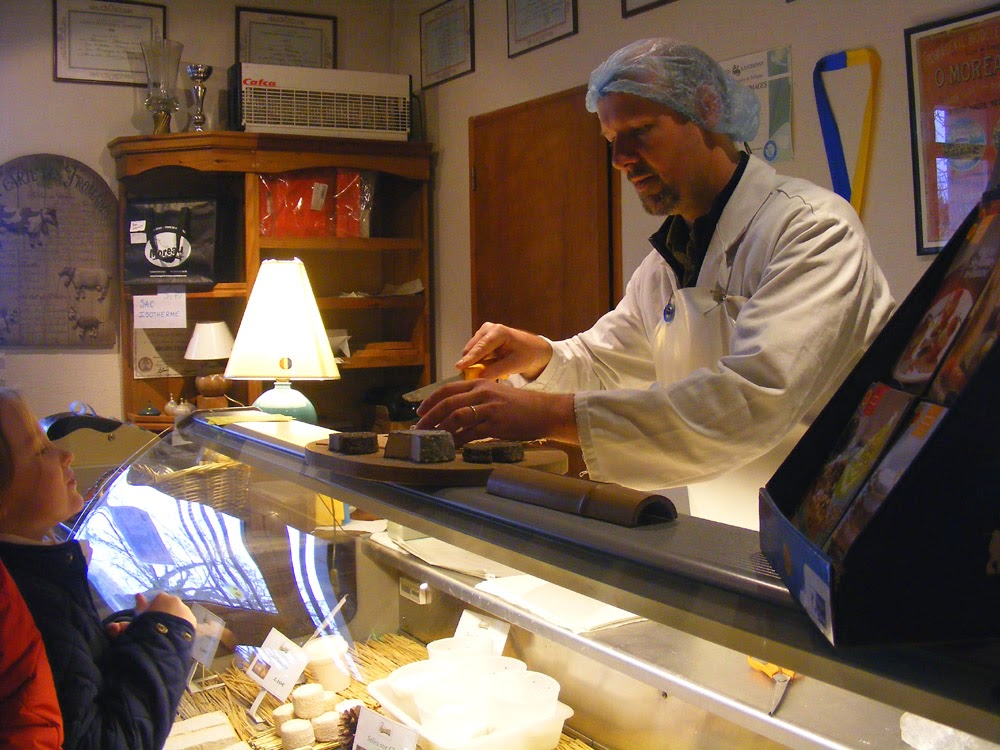
Jean Luc carefully cutting tasting samples.
Sampling goats cheese in a farm shop. Loir et Cher. France. Photographed by Susan Walter. Tour the Loire Valley with a classic car and a private guide.

If you are interested you can also watch the cheese being put into moulds, and if there is a group of you and you book, you can do a full tour which includes visiting the farm and the goats. Jean Luc has converted part of the longère building to a classroom and produced an excellent video that can be shown in either English or French so visitors learn about the entire process on the farm and in the fromagerie.

Selles sur Cher of different ages, for tasting.
A tasting platter of different ages of Selles sur Cher goats cheese. Loir et Cher. France. Photographed by Susan Walter. Tour the Loire Valley with a classic car and a private guide.

He has a staff of 8 people, none of whom came from a cheesemaking background, and have all learned on the job. He is proud of them and quick to praise them and tell you what a great team they make. 

Sainte Maure de Touraine goats cheese in the maturing cellar. Loir et Cher. France. Photographed by Susan Walter. Tour the Loire Valley with a classic car and a private guide.


************************************************

For details of our private guided tours of chateaux, gardens, wineries, markets and more please visit the Loire Valley Time Travel website. We would be delighted to design a tour for you.

We are also on Instagram, so check us out to see a regularly updated selection of our very best photos. 

Monday, 6 April 2020

Pate de Paques Berrichon


Baked and photographed by Susan Walter. Tour the Loire Valley with a classic car and a private guide.

Pâté de Pâques berrichon translates as 'Berry Easter Paté' and is a speciality of the area just to the east of us known as the Berry. It is sausage meat and hard boiled eggs wrapped in pastry and appears in all the local boulangeries and butchers for the two weeks surrounding Easter. It is tasty and popular and last year I thought I would tackle it myself for the first time. It turns out to be quite easy to make.

Cooked and photographed by Susan Walter. Tour the Loire Valley with a classic car and a private guide.

Ingredients
A quantity of flaky pastry
200 g sausage meat
3 hard boiled eggs
Some sprigs of parsley, roughly chopped
2 cloves garlic, crushed
Freshly ground pepper (a blend of different peppercorns is nice)
Salt
Freshly ground nutmeg
A beaten egg to glaze

Method
  1. Heat the oven to 250°C.
  2. Mix the meat with the parsley, garlic, pepper, salt and nutmeg to taste. 
  3. Roll the pastry into a rectangle 35 cm x 20 cm.
  4. Form the meat into a sausage shape about 30 cm long and place slightly off center along the length of the pastry.
  5. Cut the eggs in half and place along the top of the sausage meat.
  6. Brush the long edge of the pastry nearest to the meat with egg, fold over the pastry and enclose the filling, pressing, pinching or folding to make sure you have a good seal all around.
  7. Transfer to a silicone lined backing tray.
  8. Brush the top of the pastry with egg and cut a couple of small air vents in the top.
  9. Put in the oven, turn the temperature down to 200°C and bake for 30 minutes.
  10. Feeds 6-8 warm or cold.
Baked and photographed by Susan Walter.  Tour the Loire Valley with a classic car and a private guide.
In case you are wondering, I doubled the quantities and made two at once.

I had homemade flaky pastry dough in the freezer, but of course, ready rolled from the supermarket is an option too.

Baked and photographed by Susan Walter. Tour the Loire Valley with a classic car and a private guide.

Traditionally the sausage meat would be a 50/50 mixture of pork and veal, easily available here in the Touraine, but you could substitute 100% pork if veal mince isn't a thing where you live.

Baked and photographed by Susan Walter. Tour the Loire Valley with a classic car and a private guide.

I steamed the eggs (which came from the much pampered hens belonging to some friends) rather than boiled them. It makes them easier to peel.


Yum

************************************************

For details of our private guided tours of chateaux, gardens, wineries, markets and more please visit the Loire Valley Time Travel website. We would be delighted to design a tour for you.

We are also on Instagram, so check us out to see a regularly updated selection of our very best photos. 

Sunday, 5 April 2020

Grist Artisan Baker, Kyneton


Grist is an artisan baker in Kyneton, Victoria, Australia. The building they occupy is an old 1830s flour mill and our friends Sue and Leon, who live in a nearby town, took us there for coffee and pastries back in December 2017. Just like artisan small businesses in France they are currently struggling to cope with the changes to lives and shopping habits that Covid-19 has caused.

An old milling machine.
Old flour milling machine, Kyneton, Victoria, Australia.  Photographed by Susan Walter. Tour the Loire Valley with a classic car and a private guide.

Entering Grist.
Grist Artisan Bakers, Kyneton, Victoria, Australia. Photographed by Susan Walter. Tour the Loire Valley with a classic car and a private guide.

The counter.
Grist Artisan Bakers, Kyneton, Victoria, Australia. Photographed by Susan Walter. Tour the Loire Valley with a classic car and a private guide.

Old repairs to the floor.
The floor at Grist Artisan Bakers, Kyneton, Victoria, Australia. Photographed by Susan Walter. Tour the Loire Valley with a classic car and a private guide.

French style composite millstone on the veranda.
French style composite millstone on the veranda  of Grist Artisan Bakers, Kyneton, Victoria, Australia. Photographed by Susan Walter. Tour the Loire Valley with a classic car and a private guide.

Sue and Leon.
Having coffee and pastries at Grist Artisan Bakers, Kyneton, Victoria, Australia. Photographed by Susan Walter. Tour the Loire Valley with a classic car and a private guide.


************************************************

For details of our private guided tours of chateaux, gardens, wineries, markets and more please visit the Loire Valley Time Travel website. We would be delighted to design a tour for you.

We are also on Instagram, so check us out to see a regularly updated selection of our very best photos.