Thursday, 24 August 2023

A Spot of Birdwatching in the Brenne

A couple of weeks ago Ingrid and I were early for a rendez-vous with a botanist in the Brenne so we opted for a spot of birdwatching from the Etang Purais hide [link]. It's the biggest hide in the LPO Chérine Reserve, but on a dull summer morning we had it all to ourselves.


The Etang Purais, near Lingé in the Brenne, Indre.

Etang Purais, Indre, France. Photo by Loire Valley Time Travel.

A pair of Mute Swans (Fr. les Cygnes tuberculés) take off.

Mute Swans, Indre, France. Photo by Loire Valley Time Travel.

A Mute Swan taking off.

Mute Swan, Indre, France. Photo by Loire Valley Time Travel.

Eurasian Coots (Fr. les Foulques macroules) obligingly perch on the artfully placed fallen tree that is right in front of the hide so that birdwatchers can get a good view of anything using it.

Coots, Indre, France. Photo by Loire Valley Time Travel.

Mute Swan.

Mute Swan, Indre, France. Photo by Loire Valley Time Travel.

Red-crested Pochards (Fr. les Nettes rousses) in non-breeding plumage. In the past 50 years the Brenne has become a significant breeding location for this species of diving duck.

Red-crested Pochards, Indre, France. Photo by Loire Valley Time Travel.

Mute Swan.

Mute Swan, Indre, France. Photo by Loire Valley Time Travel.

A Whiskered Tern (Fr. Guifette moustac) preens on a post. Etang Purais is one of their most important breeding sites in France, where they nest on the floating water lily leaves.

Whiskered Tern, Indre, France. Photo by Loire Valley Time Travel.

Info board in the carpark at the Etang Purais.

Info board, Etang Purais, Indre, France. Photo by Loire Valley Time Travel.

A flying flock of Ouessant sheep, an ancient breed from Brittany, being used for conservation grazing, a technique for maintaining the reserve.

Ouessant sheep flying flock on a nature reserve, Indre, France. Photo by Loire Valley Time Travel.

Inside the hide. There are a number of nice paintings of different bird species on the walls.

Inside a birdwatching hide, Indre, France. Photo by Loire Valley Time Travel.

Wednesday, 23 August 2023

Vuelta España Stage Three

When we were Andorra last month we decided we wanted to do a walk in our customary fashion: take a gondola and chairlift ride to the top of a mountain and walk down. We were defeated by the weather - it was foggy, windy, and threatening to rain.

Having driven to the base of the gondola we decided to ride the first step of our walk. Luckily, when we arrived at the top of the ride the weather wasn't too wild and there was a veritable garden of wildflowers for Susan to explore.

What we didn't realise is that we had arrived at the finish of this coming Monday's stage of the Vuelta España. (Stage three, 28/8)

What is even more remarkable is that, purely by chance, on our way back to our apartment we drove (in reverse) the last 36km of the stage.


The cyclists will travel up these roads to the Coll d'Ordino

 
down the other side to the town of Ordino, and up the valley


and up the hill to the finish at Arinsal


Tuesday, 22 August 2023

Strawberry Clover

Strawberry Clover Trifolium fragiferum, Indre, France. Photo by Loire Valley Time Travel.

Valérie showed me a species of clover that was new to me the other day, in the field we crossed to get to the Etang Purais. It was Strawberry Clover Trifolium fragiferum (Fr. Trèfle à fraises). 

Strawberry Clover Trifolium fragiferum, Indre, France. Photo by Loire Valley Time Travel.

This little clover takes its name from its large pink fruits, which, with a little imagination, resemble strawberries. It's a creeping plant with a stem rooted at the nodes. Its stems and petioles are hairy. It can be found in lawns and along roadsides. Wet pasture such as where we found it in the Brenne is a typical habitat for the species.

Strawberry Clover Trifolium fragiferum, Indre, France. Photo by Loire Valley Time Travel.

It is uncommon enough to be a ZNIEFF determinant species (so it is a sign of good biodiversity on a site with scientific interest).

Monday, 21 August 2023

Growing Mushrooms Underground

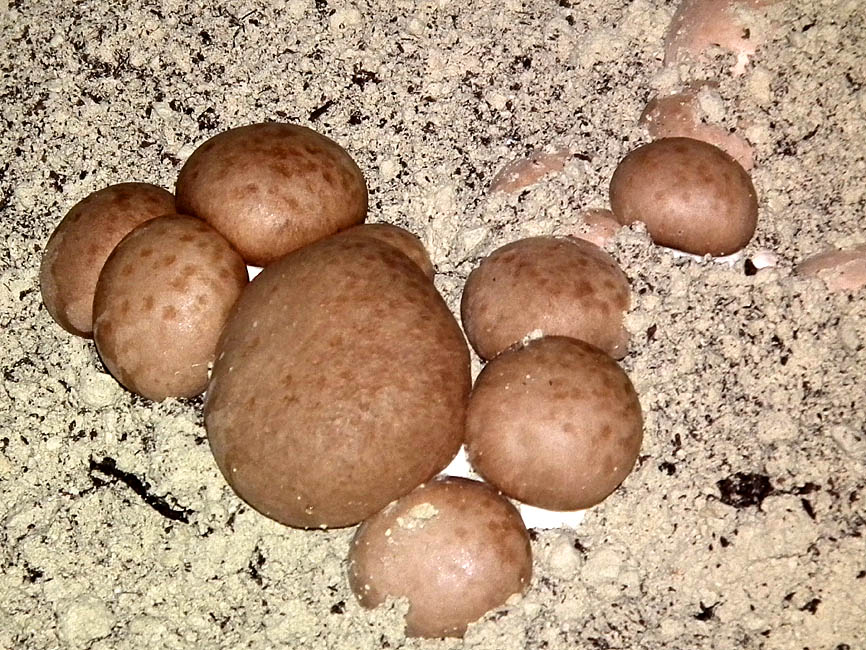
Julien Delalande is the fourth generation of his family to be growing mushrooms in La Cave des Roches at Bourré, in Loir et Cher, where there are about 600 kilometres of underground galleries under the village.

Cave grown chestnut mushrooms, Loir et Cher, France. Photo by Loire Valley Time Travel.
Chestnut mushrooms growing in La Cave des Roches.

Julien and his brother grew up in Bourré and their family have been mushroom farmers since 1893. Before that their ancestors were quarrymen, stone cutters and river boatmen.

Cave grown yellow oyster mushrooms, Loir et Cher, France. Photo by Loire Valley Time Travel.
Yellow oyster mushrooms growing in La Cave des Roches.

La Cave des Roches is what is left of the old Saint Roch co-operative of mushroom growers, one of the last growing button mushrooms underground on a large scale up to the beginning of the 20th century.

Cave grown shiitake mushrooms, Loir et Cher, France. Photo by Loire Valley Time Travel.
Shiitake mushrooms growing in La Cave des Roches.

According to Julien the family's underground galleries extend for several hundred kilometres, on seven levels (although some are now dangerous and no longer accessible). This maze of underground passages was where the fine white limestone that was used to build the most beautiful chateaux such as Chenonceau and Chambord was extracted.

Underground mushroom cultivation gallery, Loir et Cher, France. Photo by Loire Valley Time Travel.
Underground mushroom cultivation in La Cave des Roches.

But today the site is no longer used to extract stone, and has become a major production site for mushrooms. Julien Delalande produces several varieties all year long, for example shiitakes, grey and yellow oyster mushrooms, button mushrooms and wood blewits. In fact, 40% of the world's wood blewit (Fr. pieds bleus) production (approximately 400 kg per week) comes from these troglodyte caves.

Cooking wood blewit mushrooms, France. Photo by Loire Valley Time Travel.
Cooking wood blewit mushrooms.

Thanks to the ventilation, the hygrometry, the constant temperature of 12C° these troglodyte caves allow cultivation for a longer season, and the mushrooms are of a higher quality, with a firmer texture and finer taste.

Cave grown wood blewit mushrooms, France. Photo by Loire Valley Time Travel.
Cave grown wood blewit mushrooms.

Julien advises that the best way to cook them is to pan fry them in neutral oil (not walnut or olive) for 7 to 12 minutes depending on the variety. You have to cook the varieties separately then in the middle of cooking add a little garlic, fresh chopped parsley then finish with a knob of butter.

Cultivated wood blewit mushrooms, Loir et Cher, France. Photo by Loire Valley Time Travel.
Cultivated wood blewits in La Cave des Roches.

He loves growing mushrooms, but also discovering new grafitti by the quarrymen on the walls of the tunnels.

Carving in troglodyte cave, Loir et Cher, France. Photo by Loire Valley Time Travel.
Carving in the underground village.

Julien's father, Maurice Delalande, had the idea of an underground village, which he and two friends, Slobodan Bugaric and Christian L'Hermitte started making in 1998. It is a fairytale space carved into the solid rock that can be visited from April to November and during the winter holidays. The guided tours are a good hour during which you will learn about the work of the mushroom grower and that of the quarryman.

Carving in troglodyte cave, Loir et Cher, France. Photo by Loire Valley Time Travel.
Carved representation of a blacksmith's workshop in the underground village.

La Cave des Roches [link].

Sunday, 20 August 2023

The Sydney Opera House

In 1967 my family arrived in Sydney*.

One of the first things I remember is seeing the Sydney Opera House with only half its tile cladding in place. I knew nothing about the building except that to my not quite seven year old eyes it was amazing. At the time I had no idea about the controversy surrounding it, and I suspect many outside Australia still don't.

"52 years ago (1968), with the help of David Attenborough, a 24-year-old Australian filmmaker named John Weiley wrote and directed Autopsy on a Dream. It screened just once. Weiley's film was a critical look at the turbulent, drawn-out creation of Australia's greatest landmark, from buoyant beginnings to a final act shrouded in controversy, as young Peter Hall inherited a gargantuan task from dismissed, beloved architect Jørn Utzon." (Sydney Opera House).

The film is fascinating for a number of reasons: the controversy behind the Opera House, the footage and sounds of Sydney in 1968, and the people interviewed.

It's almost an hour long, but for anyone interested in Australian history it's fascinating, and an hour well spent.

* for that story click here https://daysontheclaise.blogspot.com/search?q=Emigrating+to+Australia

Saturday, 19 August 2023

One-flowered Wintergreen

 Apologies for the poor photos but I thought the plant was interesting enough to post even with bad images. It is One-flowered Wintergreen Moneses uniflora (Fr. Pyrole à une fleur), photographed at the Pont d'Espagne near Cauterets in the Pyrenees.

One-flowered Wintergreen Moneses uniflora, Hautes-Pyrenees, France. Photo by Loire Valley Time Travel.

This is a small herbaceous plant that survives several years thanks to its fine, branched underground rhizome. The round leaves grow in a rosette, evergreen and glossy, 1 to 2 cm in diameter. There is only one flower per rosette, nodding on a 5 to 10 cm stem. The white, slightly crinkled petals are spread wide and flat. Flowering is from May to October.

One-flowered Wintergreen Moneses uniflora, Hautes-Pyrenees, France. Photo by Loire Valley Time Travel.

The species is distributed throughout the Northern Hemisphere, wherever it is cool and damp (so often restricted to the mountains). It grows especially in damp shady conifer forests, amongst moss. Commercial pine plantations have caused its range to expand in Europe.


Friday, 18 August 2023

Celebrating National Acadian Day and Going to the Guinguette

15 August is a public holiday, Ascension, in France, but in Canada it is la Fete Nationale de l'Acadie, celebrating the French Canadians known as Acadians, who found themselves in difficulties when the British took over the French territories in Canada in 1759.

Guinguette, Indre et Loire, France. Photo by Loire Valley Time Travel.

This year several places locally decided to celebrate as well. Many Acadian families came from the area just to our south and west, and the history is well known here.

Guinguette, Indre et Loire, France. Photo by Loire Valley Time Travel.

La Halle, the popular guinguette in Boussay, staged a 'Fete Acadienne' on the eve, featuring French Canadian 'artists' such as 'Carine' Dion, 'Jules' Vigneault and 'Foie' de Pirate. I actually don't know who the performers really were, but a lot of the audience clearly did. The crowd loved it. I must admit, I was expecting a more zydeco infused evening, but there wasn't  an accordion in sight.


Guinguette, Indre et Loire, France. Photo by Loire Valley Time Travel.

I joined friends (after aquagym) and it was a great night out. The poor staff at La Halle were overwhelmed by numbers though and we didn't get to eat until 10 pm. Even for France in the summertime, that's a bit late! The meal was a set menu of cooked ham, mashed potato and salad, followed by squidgy chocolate cake, costing €17.

Guinguette, Indre et Loire, France. Photo by Loire Valley Time Travel.

Two nights earlier I had been there for a different local group, and got to witness a respected regional television journalist starting a conga line (Fr. une chenille). I was invited to join (she's one of my swimming buddies) but being uptight and anglo I declined.

Guinguette, Indre et Loire, France. Photo by Loire Valley Time Travel.

August in France is all about going to the guinguette in the evening! A guinguette is a summer pop up open air bar that serves simple food, has live music and dancing and is almost always situated on a river or a lake. We have an equally popular one in the old public laundry, La Lavoir, in Preuilly, and recently we went with clients to the big one in Montbazon for that authentic French holiday experience.

Guinguette, Indre et Loire, France. Photo by Loire Valley Time Travel.

Thursday, 17 August 2023

Collecting Tiny Flies in the Brenne

For more than 20 years I have been in touch on and off with Professor Valery Korneyev, a Ukrainian entomologist now living in exile in Berlin. For some years he has been reviewing various genera of fruit flies Tephritidae and this year I was lucky enough to be in a position where I could help a bit with his research. These days, by the way, he is funded by the Humboldt Foundation Researchers at Risk fund at the Natural History Museum of Berlin. Back in Ukraine he is Collections Manager and Head of Entomology for the Schmalhausen Institute of Zoology of the National Academy of Sciences of Ukraine in Kyiv.


Valery posing with the postcard I sent him.

Professor Valery Korneyev, dipterist.
Photo courtesy of Professor Valery Korneyev.

He wanted specimens of a tiny fly called Myopites blotii from France, preferably as close to Paris as possible. The fly causes galls in Common Fleabane Pulicaria dysenterica, so the easiest way to find the flies is to find a patch of fleabane.


Me checking fleabane flowers for galls in the field.

Checking fleabane flowers for galls, Indre, France. Photo by Loire Valley Time Travel.
Photo courtesy of Ingrid de Winter.

I enlisted my botanist contact Valérie Lagny to find a suitable location and she picked the Etang Purais, part of the LPO Chérine Reserve in the Brenne. This meant that if we wanted to take samples we would need permission, but it was for a good cause, so it was just a question of asking.


Me pooting flies. My pooter uses the venturi principle, so I blow in it and it sucks up tiny insects. It was made for me by my friend Paul.

Pooting, Indre, France. Photo by Loire Valley Time Travel.
Photo courtesy of Ingrid de Winter.

On the day we had arranged to do the field work the weather was distinctly iffy, trying to rain all morning. Valérie took me to a nice big patch of fleabane and I set to work. The flies were not super abundant, but there were enough that I managed to collect 12 for Valery. I was impressed at how good Valérie had got at spotting the flies since they aren't in her normal line of work. My friend Ingrid, who is a Dutch nature guide and one of my swimming buddies, had also accompanied us and spent the morning practicing with her new camera. 


Me on site at the Etang Purais. The fleabane is the yellow flowered plant.

Entomology field work, Etang Purais, Indre, France.
Photo courtesy of Ingrid de Winter.

Once home I put half the flies in alcohol to preserve them and the others in the freezer. Once I was ready to send them to Valery the frozen flies got gently transferred to kitchen paper impregnated with a little alcohol, then slid into a small box supplied by my friend Tim. Everything was labelled appropriately to show species name, date caught, location caught and who caught them.


Entomologists often stick their heads in their nets. It's a good way of seeing what you've got whilst blocking escape.

Entomology field work, Etang Purais, Indre, France.
Photo courtesy of Ingrid de Winter.

Everything was put into a snaplock bag then into a cardboard box sealed with lots of tape, along with a covering note on a postcard I'd picked up at the Polish Institute in Brussels in March. It seemed like the perfect moment to use it.


Myopites blotii on Common Fleabane Pulicaria dysenterica at the Etang Purais, Indre.

Myopites blotii on Common Fleabane Pulicaria dysenterica, Indre, France.
Photo courtesy of Ingrid de Winter.

I posted the box to Valery in Berlin and he got it in two days. He says the flies arrived in good condition and he is really happy. I'm pleased. Valérie and I are now awaiting his scientific note on the species with interest.


Some of the specimens of Myopites blotii I collected for Valery. They are about 3 mm long.

Myopites blotii, Indre, France. Photo by Loire Valley Time Travel.

Wednesday, 16 August 2023

A Good Life

Recently I got the sad news that my friend Jeannine had died. Her funeral is on Friday. I hadn't seen her for several years as she had got very frail from ongoing cancer treatments, but our mutual friend Marie-Claude saw her regularly.

Photo of Jeannine Demeulant on a mycology outing, courtesy of Marie-Claude Derrien.

I got to know Jeannine because I joined the Association de botanique et de mycologie de Sainte Maure de Touraine (aka Botamyco37). She was the secretary and editor of the journal for quite a few years. 

Photo of Jeannine Demeulant on a botany outing, courtesy of Marie-Claude Derrien.

She was known amongst her aquaintances as 'la petite dame joviale' (the jovial little lady), which is not a bad description. She was indeed rather short, quick to laugh and joke, lively and a good communicator, infectiously enthusiastic. There were many passionate interests in her life -- music, reading, history, art, travel and botany (especially bryology, the study of mosses, an interest which developed late in her life and at which she turned out to be brilliant).


Jeannine spraying moss on a tree with water so it can be more easily identified, in Sainte Maure de Touraine.

Surveying mosses, Indre et Loire, France. Photo by Loire Valley Time Travel.

On outings she often talked with love and pride about her family, children, grandchildren, neices and nephews, and latterly even great grandchildren. They all seemed to be doing interesting things. She confided recently to Marie-Claude that she had had a good life, with good parents, a good job (she was a pharmacist), successful children and got to travel a lot.


Jeannine searching for lichens on an oak tree in the Foret de Preuilly.

Searching for lichen, Indre et Loire, France. Photo by Loire Valley Time Travel.

When I arrived in France, with execrable French, and not knowing much about the local flora or fauna, she was cheerful and patient with me on many botanical outings over the years. Sneakily, she did not admit for years that she spoke some English, and could read it very well. She made me speak French, which she occasionally corrected when she felt it necessary. I greatly appreciated her willingness to engage with me and how welcome she made me feel in the Association.

Photo of Jeannine Demeulant on a botany outing courtesy of Marie-Claude Derrien.

As our mutual friend Marc said:

Que ton dernier chemin soit bordé de fleurs des champs.

May your last journey be lined with wild flowers.


Tuesday, 15 August 2023

Vultures Part Two

On past blog posts I have expressed a wish to see vultures, and excitement when I have done so. 

The past four visits to the Pyrenees we have seen griffon vultures, but we have never seen any of the other species. Until...

I was looking through our photos from last month and realised there were a few I hadn't looked at properly. Imagine my surprise when I realised we had photos of a raptor I didn't recognise. I did some research and jumped to a conclusion I wasn't at all certain about. Susan asked some of her nature friends... and they concurred.

Meet Gypaetus barbatus, the Bearded Vulture or Lammergeier, the most exciting vulture in Europe. 


They may not be beautiful photos, but they were shot from the hip with a point and shoot camera.