Friday, 10 November 2023

Fete de la Nature et des Saveurs Automnale

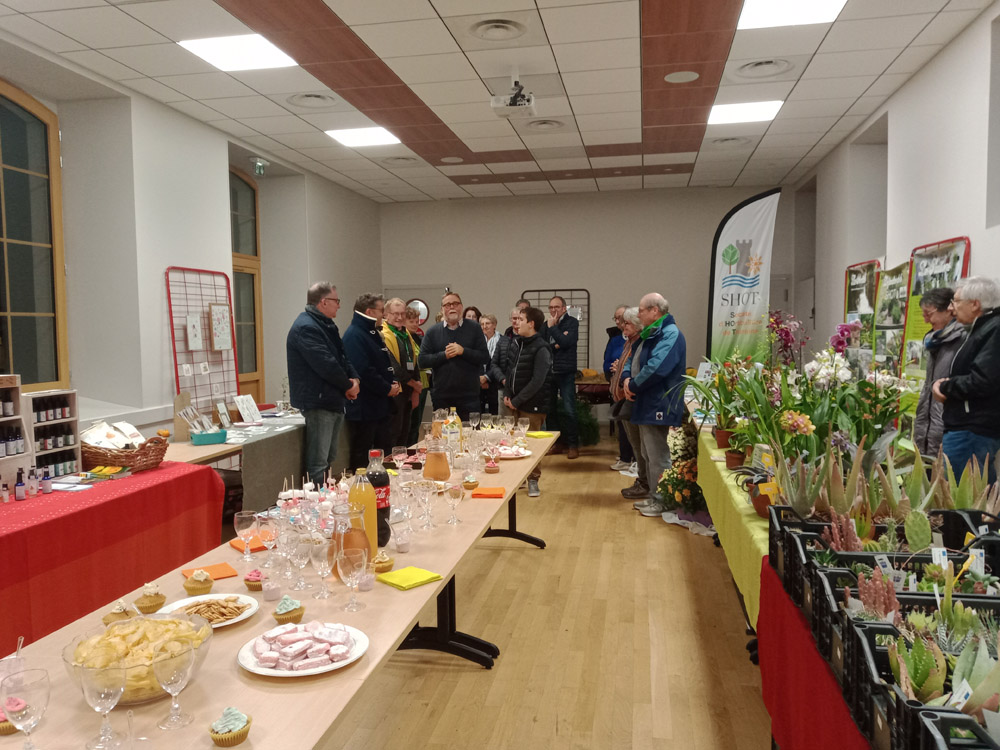
Over the weekend I participated in the Fete de la Nature et des Saveurs Automnale. It was the brainchild of my friend Didier Raas and was organised largely by him, in partnership with Jacky Perivier, the mayor of Yzeures sur Creuse, the Touraine Horticultural Society (SHOT), the Croqueuers de pommes and the Association de botanique et de mycologie de Saint Maure de Touraine (Botamyco37). I got to interact with lots of visitors to the fete, and got interviewed for the local newspaper.

Corinne finessing the fungi exhibition.

Fungi exhibition, Indre et Loire, France. Photo by Loire Valley Time Travel.

The Horticultural Society of Touraine's stand. Their leaflets offer a range of excellent advice about gardening in the Touraine.

Horticultural Society of Touraine stand at a fete, Indre et Loire, France. Photo by Loire Valley Time Travel.

Who knew that Spike Milligan was alive and well, living in the Touraine and an expert on apples? Or it could be Jean-Pierre and a couple of Gérards, all delighted to help you with your apple questions.

Croqueurs de pomme, Indre et Loire, France. Photo by Loire Valley Time Travel.

This platter of lollies was leftover from an October Rose vin d'honneur that was cancelled, so waste not want not, and it was served at the Fete's low key opening ceremony.

Lollies, Indre et Loire, France. Photo by Loire Valley Time Travel.

The opening ceremony with Jacky giving a speech. Also present the local member of parliament, who insisted on being addressed as Vincent, and Jules, a politician en herbe as they say in French.

Vin d'honneur opening ceremony for a fete, Indre et Loire, France. Photo by Loire Valley Time Travel.

A couple of houses in the centre of Yzeures  sur Creuse.

House, Indre et Loire, France. Photo by Loire Valley Time Travel.

A house in the centre of Yzeures sur Creuse.

House, Indre et Loire, France. Photo by Loire Valley Time Travel.

All the trees in the centre of Yzeures sur Creuse are wrapped in pink agricultural plastic. This can be bought for wrapping hay bales, and a percentage of the price goes to breast cancer research.

Trees wrapped in pink plastic for breast cancer awareness, Indre et Loire, France. Photo by Loire Valley Time Travel.

Turned wooden fruit.

Turned wooden fruit, Indre et Loire, France. Photo by Loire Valley Time Travel.

Jean-Pierre Couturier identifying a mystery apple from Alain's garden. This is one of several services the Croqueurs de pomme offer.

Identifying an apple for a member of the public, Indre et Loire, France. Photo by Loire Valley Time Travel.

Natural pigments being prepared and used by Aurore l'Hiver Nait. She does workshops in Montrésor.

Natural paint pigments, Indre et Loire, France. Photo by Loire Valley Time Travel.

Thursday, 9 November 2023

Fungi Foray in the Forest of Preuilly

On 17 October Didier Raas led a fungi foray in the Forest of Preuilly. We still hadn't had any significant rain by that date, so the pickings were lean. Still worth going on and some interesting finds nonetheless. And very good for reinforcing knowledge, and personal networking.

The fungi foragers set off.

Fungi foragers, Indre et Loire, France. Photo by Loire Valley Time Travel.

Red-capped Scaber Stalk Leccinum aurantiacum (Fr. Bolet orangé des chenes), an abundant edible species used to bulk out the really prized ceps.

Red-capped Scaber Stalk mushroom Leccinum aurantiacum, Indre et Loire, France. Photo by Loire Valley Time Travel.

Verdigris Agaric Stropharia aeruginosa (Fr. Strophaire vert-de-gris), a very small specimen of a very beautiful mushroom, identifiable by its flaky edged cap, which would normally also be greasy, but it was too dry. A species of grassy track or woodland edges.

Verdigris Agaric Stropharia aeruginosa, Indre et Loire, France. Photo by Loire Valley Time Travel.

A polypore Lenzites sp, showing the slug munched upper.

Polypore Lenzites sp, upper, Indre et Loire, France. Photo by Loire Valley Time Travel.

The same mushroom, showing the underside.

Polypore Lenzites sp, underside, Indre et Loire, France. Photo by Loire Valley Time Travel.

Humpbacked Brittlegill Russula caerulea (Fr. Russule amère) syn R. amara, showing the yellow gills. The cap has a central boss which is diagnostic. The spores are also yellow, and the stipe does not react to chemical tests like the species below. This species only grows under conifers, and the ultimately 8-10 cm diameter wine coloured cap is conical when the mushroom is young. The mushroom has a really noticeable fruity smell, a bit like ripe figs, which is well worth remembering to check for.

Humpbacked Brittlegill Russula caerulea, Indre et Loire, France. Photo by Loire Valley Time Travel.

Beechwood Sickener Russula nobilis group (Fr. Russule émétique compacte) syn R. mairei, showing a blue reaction to being painted with the chemical gaiac, which mycologists carry to test certain mushrooms. This species is an emetic, so not edible.

Beechwood Sickener Russula nobilis group, Indre et Loire, France. Photo by Loire Valley Time Travel.

Iodine Bolete Boletus impolitus (Fr. Bolete dépoli) syn Hemileccinum impolitum. The blue in this case has appeared naturally as a reaction to being cut. This species smells faintly of walnuts. The cap is light and the stem yellow with no net. It is edible, but only mediocre eating.

Iodine Bolete Boletus impolitus, Indre et Loire, France. Photo by Loire Valley Time Travel.

Bolete Eater Hympomyces chrysosperma, a parasite attacking bolete mushrooms.

Bolete Eater Hympomyces chrysosperma, Indre et Loire, France. Photo by Loire Valley Time Travel.

Macrolepiota fuliginosa (Fr. Lépiote fulgineuse), a parasol mushroom which is more common here than the better known M. procera. The diagnostic to separate the two species is that the mottled stem stains brown when scraped for M. fuliginosa and not for M. procera. It is edible, which tells you it has a cap diameter of more than 10 cm.

Macrolepiota fuliginosa, Indre et Loire, France. Photo by Loire Valley Time Travel.

Earthstar Geastrum sp, rather rare. [Update: Didier Raas has identified this as Hygroscopic Earthstar Astraeus hygrometricus.]

Earthstar Geastrum sp, Indre et Loire, France. Photo by Loire Valley Time Travel.


Didier's top tips this time were:

  • Never feed mushrooms to children under 8 years old.
  • Don't eat Parasol mushrooms/Lepiotes that have caps under 10 cm in diameter.
  • A non-exhaustive checklist to help you identify bolete species:
  1. Colour of tubes?
  2. Colour of pores?
  3. Does cap peel easily?
  4. Does cap overhang tubes?
  5. Do tubes separate easily from flesh?
  6. Scales or net on stem?
  7. Cap waxy or dry?

Wednesday, 8 November 2023

Autumn Decorations in the Chateaux

Both the Chateau Royal d'Amboise and the Chateau de Chenonceau have had some really striking autumn floral and vegetal decorations. Using the orange of pumpkins and complementing them with rich reds, purples and browns they have created some loveliness in a period of wind and wet.

The Great Hall, Chateau Royal d'Amboise.

Autumn decorations, Chateau Royal d'Amboise, Indre et Loire, France. Photo by Loire Valley Time Travel.

A fireplace in the Long Gallery, Chateau de Chenonceau.

Autumn decorations, Chateau de Chenonceau, Indre et Loire, France. Photo by Loire Valley Time Travel.

"The Guards Room", Chateau de Chenonceau.

Autumn decorations, Chateau de Chenonceau, Indre et Loire, France. Photo by Loire Valley Time Travel.

"Gabrielle d'Estrée's bedroom", Chateau de Chenonceau.

Autumn decorations, Chateau de Chenonceau, Indre et Loire, France. Photo by Loire Valley Time Travel.

Tuesday, 7 November 2023

Fungi Foray at the Pyramide de Saint Quentin

On Saturday 14 October Didier Raas led a fungi foray to the Pyramide de Saint Quentin in the Forest of Loches. 


Didier teaching the group about mushrooms.

Expert mycologist teaching a group about mushrooms, Indre et Loire, France. Photo by Loire Valley Time Travel.

Parasol Cystolepiota sp.

Cystolepiota sp, Indre et Loire, France. Photo by Loire Valley Time Travel.

The thick smooth volva (the 'egg sac' at the base of the stem/stipe) of a Caesar's mushroom Amanita caesarea (Fr. Amanite de Césare).

Caesar's mushroom Amanita caesarea volva, Indre et Loire, France. Photo by Loire Valley Time Travel.

Ringed Milkcap Lactarius zonarius (Fr. Lactaire zoné). The stalk breaks like chalk, therefore it is either Lactarius or Russula. There is 'milk', so it must be Lactarius and not Russula. This species has a strong stinging peppery taste like wasabi, but if you find a Lactarius under pine trees it is more likely to be an edible species.

Ringed Milkcap Lactarius zonarius, Indre et Loire, France. Photo by Loire Valley Time Travel.

Deep Root mushroom Hymenopellis radicata (Fr. Collybie radicante).

Deep Root Mushroom Hymenopellis radicata, Indre et Loire, France. Photo by Loire Valley Time Travel.

Fungi foragers walking through the forest.

Fungi foragers, Indre et Loire, France. Photo by Loire Valley Time Travel.

Ochre Spreading Tooth fungus Steccherinum ochraceum (Fr. Hydne ochré). The 'teeth' are more like tiny fingers, with rounded ends.

Ochre Spreading Tooth fungus Steccherinum ochraceum, Indre et Loire, France. Photo by Loire Valley Time Travel.

Didier carefully extracting a White Laced Shank mushroom Megacollybia platyphylla (Fr. Collybie à lames larges) from a fallen branch.

White Laced Shank mushroom Megacollybia platyphylla, Indre et Loire, France. Photo by Loire Valley Time Travel.

Pearly Parachute mushroom Marasmuis wynneae/bulliardi (Fr. Marasme de Bulliard), attached to an oak leaf vein.

Pearly Parachute mushroom Marasmius wynneae/bulliardi, Indre et Loire, France. Photo by Loire Valley Time Travel.

Turkey Tail bracket fungus Trametes versicolor (Fr. Polypore versicolore).

Turkey Tail bracket fungus Trametes versicolor, Indre et Loire, France. Photo by Loire Valley Time Travel.

Turkey Tail.

Turkey Tail bracket fungus Trametes versicolor, Indre et Loire, France. Photo by Loire Valley Time Travel.


Some of the Top Tips that were revealed over the course of the morning were:

  • There are over 250 edible mushroom species in France; over 350 toxic species and 39 of them are deadly.
  • Don't use an ID app to identify mushrooms. Apps work well these days for plants, but aren't good enough for other groups, especially for mushrooms if you are planning to eat them. The most popular app in France is Champinouf. It just picture matches, so is more or less useless.
  • Never rely on colour alone to identify a mushroom. Always use a suite of characteristics to arrive at an identification.
     

Monday, 6 November 2023

Opal Apples

Organic Opal apples, Indre et Loire, France. Photo by Loire Valley Time Travel.

Opal is a yellow apple that our local organic orchard is growing and has at the market at the moment. It was developed in the 1990s in the Czech Republic after a natural hybrid of Golden Delicious and Topaz occurred at the Institute of Experimental Botany in Prague. It thrives in sunny dry areas, similar to the conditions required for growing wine grapes, so it is quite widely grown in the Loire Valley. Sweet, firm but not overly crisp, juicy, and lightly russetted at the stem end, its big claim to fame is that it does not brown when cut. I like it and buy it often.

Saturday, 4 November 2023

A Night Walk in the Chianti Hills

When we were in Italy in June we stayed in a villa on the outskirts of the village of Poggia alla Croce, near Figline (a small town which was our closest shopping centre) and half an hour by train from Florence. On the town website there was an interesting event advertised for when we were there, so we decided to go. 

Musical night walk, Tuscany, Italy. Photo by Loire Valley Time Travel.

It was run by the local community cafe, which we discovered was actually a garden shed with a terrace that volunteers served drinks from. There was a mobile telephone number for booking places on the event and so I sent them a message.

The event was apparently a return of a beloved musical evening with an orchestra combined with a walk in the dark up to the cisterna (the spring which supplied the town water at the top of the hill) and back again. Just to be sure we had a place we popped in to the café and asked. Yes, no worries, they had received my message. Turn up at 9pm to join the walk. Bring a head torch.

Musical night walk, Tuscany, Italy. Photo by Loire Valley Time Travel.

I was prepared and had brought my head torch from home, and luckily there was a Decathlon in Figline, so we went shopping for head torches for Simon, Rosie and Jon. All sorted and we turned up on time to see what was going to happen.

The orchestra was small, young and from Florence. Their conductor, who was obviously well known locally, gave a long speech, of which we understood only a few key words of course. He introduced the president of the local association, who have a short jokey speech and introduced our guide. He was taciturn but clearly also locally well known and regarded. I gathered he was a professional nature guide.

Musical night walk, Tuscany, Italy. Photo by Loire Valley Time Travel.

Once the orchestra had played a few numbers -- film scores we think -- we headed up the hill. It was quite steep and I huffed and puffed quite a lot. Once we got to a point where we could look out and see the lights of Figline there was a pause in a clearing for a musical number, and I realised that several of the musicians had accompanied us up the hill, with their instruments. It hadn't dawned on me before, because we could hear the orchestra playing below, and at appropriate moments had stopped to clap and cheer them on. 

Two more musical stops were made and we passed a World War II trench which people made sure to point out to us. There were also info boards explaining the wild plants around us and it is no doubt an interesting walk in the daylight. 

Musical night walk, Tuscany, Italy. Photo by Loire Valley Time Travel.

It turned out that the walk was a sort of walk through musical history, from Bach, through the Romantics to something atonal from the 20th century. Naturally the conductor took the opportunity at each stop to give a long explanation, making sure to look sexy, intellectual and trendy at all times, with his long silver hair, narrow legged jeans and definitely not hiking footwear.

The last musical stop was at the huge cross set on top of the hill. Just before we reached it we looked out in the other direction to see the lights of Florence in the middle distance, and fireworks for the festival of San Giovanni (Saint John).

Then it was back down the hill on the other side, past the citerna. One of the absolute highlights coming back was that we saw quite a few fireflies along the side of the road. Everyone was very excited to see them and they caused a lot of chat and attempts at photographing them. I have several photos showing a pin prick of light in an otherwise black image.

At the end we all regrouped on the terrace and there was more music from the orchestra. And then everyone walked home.

Friday, 3 November 2023

Eoliennes Bollee

The Eolienne Bollée is a type of windmill invented by Ernest-Sylvain Bollée (1814-1891) which operated as a water pump. It was produced in France from 1872 to 1933, with around 350 windmills being made, which were installed mainly in France, in 44 departéments (counties). There are about 80 still extant.

A fully restored Eolienne Bollée, at Esvres sur Indre.

Eolienne Bollee wind turbine, Indre et Loire, France. Photo by Loire Valley Time Travel.


Ernest-Sylvain Bollée used the word 'éolienne' for the first time in 1885 as a noun and not as an adjective ('énergie éolienne'). The word first appeared in the dictionary (Larousse) some years later, in 1907.

 The Eolienne Bollée in the grounds of the Chateau de la Bourdaisiere.

Eolienne Bollee wind turbine, Indre et Loire, France. Photo by Loire Valley Time Travel.


There were several inventors and industrialists in the Bollée family (foundry owners, automobile manufacturers) over several generations. In 1857 Ernest-Sylvain Bollée patented a hydraulic ram (Fr. bélier hydraulique), in 1868 a wind turbine, and in 1885 his son Auguste-Sylvain Bollée patented a wind funnel.

 The remains of an Eolienne Bollée and pump shed in the grounds of the Chateau de Nitray. The wind turbine has been converted to a windsock, as a previous owner designed and manufactured light planes.

Eolienne Bollee wind turbine, Indre et Loire, France. Photo by Loire Valley Time Travel.


The company manufacturing the wind turbines was owned by the Bollée family from 1872 to 1898. After the death of his father Auguste-Sylvain Bollée (1847-1906) withdrew to an apartment in Paris to paint, and finally sold the business in 1898 to Edouard-Emile Lebert. He presented the wind turbine at the Exposition Universelle (World's Fair) in Paris in 1900 and it became a commercial success. Edouard-Emile Lebert sold the business in 1918 to Gaston Duplay and in 1926 it became the Société anonyme des Eoliennes Bollée.

 The Eolienne Bollée at the agricultural high school at Amboise. 

This is the only one which is heritage listed.

Eolienne Bollee wind turbine, Indre et Loire, France. Photo by Loire Valley Time Travel.


Of the 352 Eoliennes Bollée identified, 65 were installed in Indre et Loire, 42 in Sarthe, 26 in Yonne, 18 in Loir et Cher and 17 in Maine et Loire.
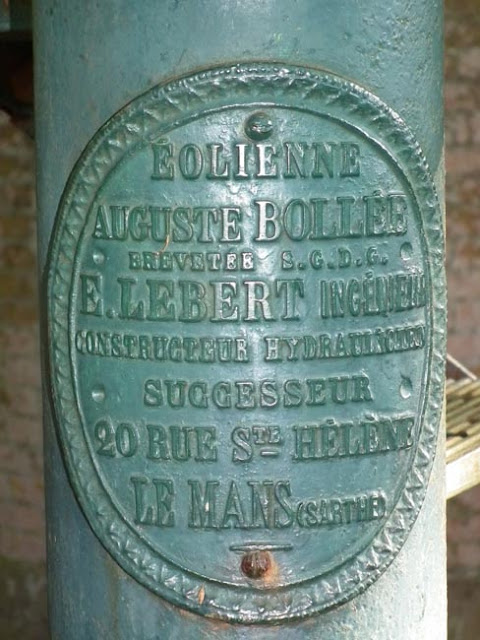
 

Makers plate, Eolienne Bollee wind turbine, Indre et Loire, France. Photo by Loire Valley Time Travel.
The manufacturers plate on the Eolienne Bollée in the grounds of the Hotel Domaine des Hauts de Loire, just outside Onzain.


Some technical details, translated from Wikipedia:

In his 1868 patent, Ernest-Sylvain Bollée claimed the use of a fixed "steering" wheel fitted with curved blades designed to direct the air streams perpendicular to the plane of each blade of the drive wheel located behind and on the same horizontal axis, "so as to impart motion more directly to the latter". The drive wheel controls the transmission by means of a bevel gear, and to compensate for the reaction of the drive torque, which prevents the drive wheel "from remaining completely perpendicular to the direction of the wind current", Ernest-Sylvain Bollée off-centers its horizontal axis of rotation in relation to the vertical axis of orientation. The entire drive unit is pivot-mounted on a needle at the end of a large guyed column. A spiral staircase extending around the cast-iron column provides access to a platform above and adjacent to which are the steering and drive wheels, the mill-steering mechanism and the upper bevel gear housing.

Subsequent changes were adopted:

  •     Ernest-Sylvain Bollée replaced the steering vane with a "Delamolère" steering reel.
  •     The vertical transmission shaft was routed inside the column.
  •     Under the 1885 patent, Auguste-Sylvain Bollée installed a funnel system around the periphery of the steering wheel to capture a greater quantity of air, thereby increasing the mill's speed and power. A half-sphere on the hub completed the arrangement.
  •     The original chain-and-bucket water lift was replaced by a pump.
  •     From 1898 onwards, Lebert adopted a lattice tower to replace the guyed Bollée column. At the same time, the spiral staircase was replaced by a simple ladder.


The pump shed at the Domaine des Hauts de Loire, 

connected to the wind turbine by a drive shaft on the left.

Pump shed, Eolienne Bollee wind turbine, Indre et Loire, France. Photo by Loire Valley Time Travel.


There were different sized Eoliennes Bollée, designed to perform in different circumstances. Type one was the smallest and placed on an open high spot away from trees and buildings. Type two was often placed in a woodland and care had to be taken that it overtopped the trees. Type three was the larger model, suitable for installation in a valley. There was a fourth, even bigger model, but it doesn't seem to have been used much.

Thursday, 2 November 2023

Olivier at Work

The other day I had to pop in to our local graphic designer's office. I was delighted to see on his desk a galley of the new guide to Zones naturelle d'interet ecologique, faunistique et floristique (ZNIEFF) in the south Touraine. The author is my friend Francois and I contributed photos and field work. It will be out soon.

Graphic designer, Indre et Loire, France. Photo by Loire Valley Time Travel.

If you are in the Sud Touraine and need any graphic design and printing for cards, posters, advertising, decor, educational material and much more, talk to Olivier Lorain. He's based in the old railway station in Preuilly sur Claise, and can be contacted (in French) by email ollorain@icloud.com or mobile +33 6 74 43 40 38.

Cariactures by Olivier Lorain from a meeting, Indre et Loire, France. Photo by Loire Valley Time Travel.

He also does charming sketches of the villages and houses around here, and funny cariactures of his friends and people he spots. Plus he's a jolly nice chap who is on the committee of the Association d'Acceuil et Accompagnement de Refugiés en Sud Touraine (AARST) with me.

Further reading:  Olivier's FB album

Wednesday, 1 November 2023

La Chapelle de Tous les Saints

The little funerary chapel in the park at the end of our street has been restored. Inside its altar has been reinstated, the windows have glass, the carpentry beams repaired, the painted wooden ceiling and the Danse Macabre painted on the walls carefully conserved.

Conservators working on a medieval danse macabre in a chapel, Indre et Loire, France. Photo by Loire Valley Travel Time.
Conservators working on the danse macabre.

Medieval danse macabre wall painting depicting women, Indre et Loire, France. Photo by Loire Valley Time Travel.
The south wall of the chapel, depicting women characters, before conservation.

Medieval danse macabre wall painting depicting men, Indre et Loire, France. Photo by Loire Valley Time Travel.
The north wall of the chapel depicts male characters in the danse macabre (photo before conservation).

Conservator talking about wall paintings, Indre et Loire, France. Photo by Loire Valley Time Travel.
Corinne Tual, a wall paintings conservator, talking about the project to the public.

Amateur performance of a danse macabre, Indre et Loire, France. Photo by Loire Valley Time Travel.
Amateur theatrical performance interpreting the danse macabre.

Medieval painted wooden vaulted ceiling in a chapel, Indre et Loire, France. Photo by Loire Valley Time Travel.
Detail of the conserved painted oak ceiling vault.

Detail of a danse macabre wall painting before conservation, Indre et Loire, France. Photo by Loire Valley Time Travel.
A panel of the danse macabre wall painting prior to restoration.


Below -- photos of the conserved wall paintings and restored altar.

Chapelle de tous les saints after conservation, Preuilly sur Claise, Indre et Loire, France. Photo by Loire Valley Time Travel.

Chapelle de tous les saints after conservation, Preuilly sur Claise, Indre et Loire, France. Photo by Loire Valley Time Travel.

Chapelle de tous les saints after conservation, Preuilly sur Claise, Indre et Loire, France. Photo by Loire Valley Time Travel.