Tuesday, 18 October 2022

Walking From Ronde du Chene

Ronde du Chene is a hunting lodge in the middle of the Forest of La Guerche. I joined French friends for a 9 kilometre walk there on Thursday 6 October. We walked through mixed deciduous forests, down narrow paths cut into the limestone, up past my favourite section of the forest which sadly is being logged and all the beautiful old beech trees have been selectively felled, then on to the lovely little hamlet of Bas Montant and back up the hill and through the pine forest.

Warty Amanite Amanita strobiliformis, Indre et Loire, France. Photo by Loire Valley Time Travel.
Warted Amanita Amanita strobiliformis (Fr. Amanite solitaire), a generally rare mushroom, was abundant along the sunken limestone paths. Note the characteristic Amanita spp volva on the left, a sort of 'eggshell' that the mushroom pops out of.

Beech logs, Indre et Loire, France. Photo by Loire Valley Time Travel.
Beech logs.

Sloes on Blackthorn Prunus spinosa, Indre et Loire, France. Photo by Loire Valley Time Travel.
Sloes on Blackthorn Prunus spinosa (Fr. Prunellier sauvage).

Walking groups meet in the forest, Indre et Loire, France. Photo by Loire Valley Time Travel.
Our group meet another group of walkers doing the circuit in the opposite direction. They came from Vouneuil sur Vienne.

Electric fence, Indre et Loire, France. Photo by Loire Valley Time Travel.
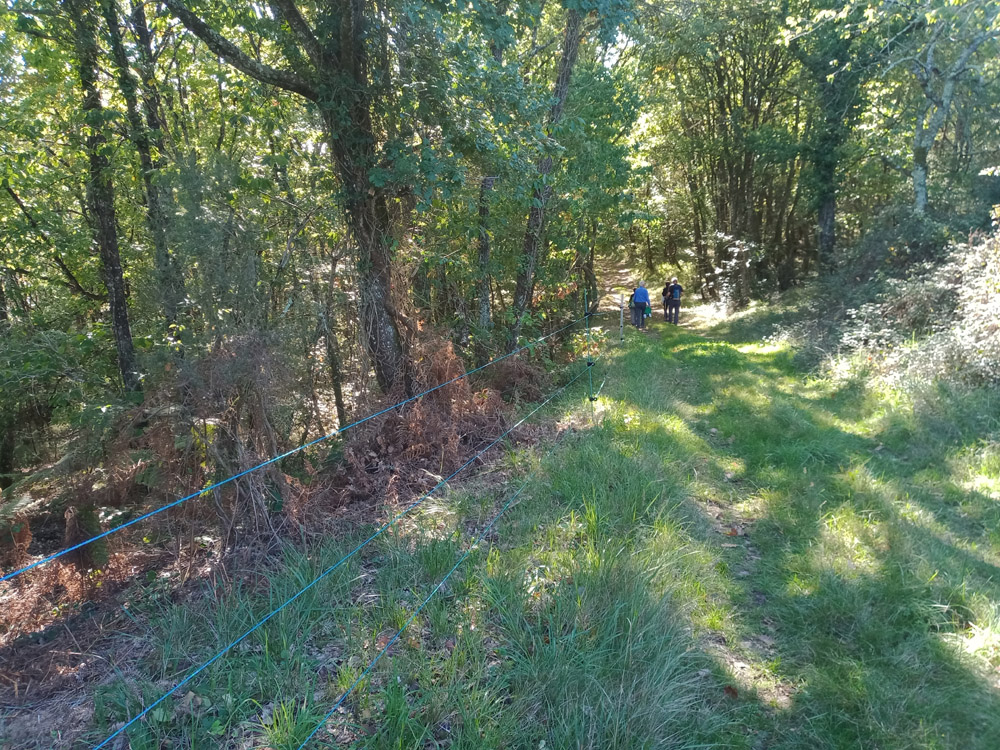
Blue electric fence strands have gone up everywhere in the Forest of La Guerche since I was last there.

Hiker eating dried banana, Indre et Loire, France. Photo by Loire Valley Time Travel.
Jean-Jacques is not smoking a cigar, he's eating a whole dried banana.

Sycamore growing in wall, Indre et Loire, France. Photo by Loire Valley Time Travel.
Some sort of sycamore, growing an a garden wall in the hamlet of Bas Montant.

Possibly Great Wood Mushroom Agaricus langei, Indre et Loire, France. Photo by Loire Valley Time Travel.
Possibly Great Wood Mushroom Agaricus langei (Fr. Agaric rougissante).

Manmade pig wallow in forest, Indre et Loire, France. Photo by Loire Valley Time Travel.
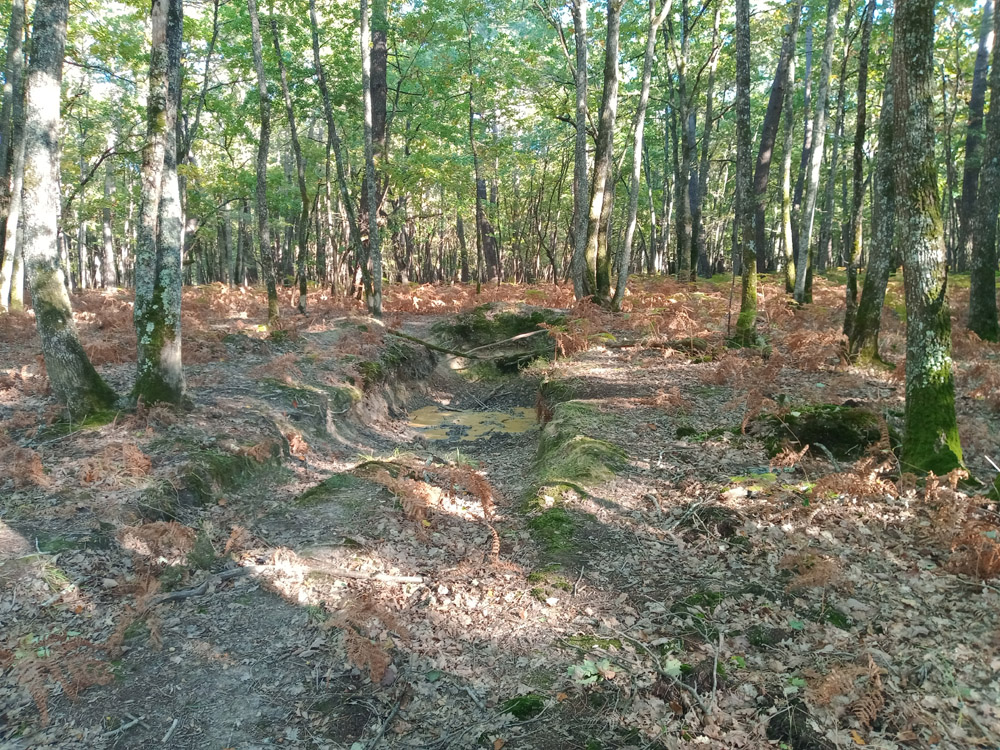
Manmade wallow for wild boar. I assume to encourage them away from the nearby étang (dam) which had very low water.

Bracket fungus and false chanterelles, Indre et Loire, France. Photo by Loire Valley Time Travel.
A bracket fungus and some false chanterelles Hygrophoropsis aurantiaca (Fr. fausse chanterelle).

Orange Oak Bolete Leccinum aurantiacum, Indre et Loire, France. Photo by Loire Valley Time Travel.
Orange Oak Bolete Leccinum aurantiacum (Fr. Bolet orangé).

Monday, 17 October 2022

How to Cook Wild Foraged Porcini Mushrooms


Wild foraged porcini prepared for cooking, Indre et Loire, France. Photo by Loire Valley Time Travel.
Edible Ceps and Orange Oak Boletes prepared for cooking.

Ceps (also known as porcini in Italian and cèpes in French) start popping up in the forests in October. Many locals collect their own, and those with a license to do so collect them commercially, so you can buy them in the market during the season. Bay-brown Bolete retails for about €600 per kilo. Depending on the weather, some years they are abundant, some years they are scarce.

Maggot damage in a wild porcini mushroom, Indre et Loire, France. Photo by Loire Valley Time Travel.
Maggot damage in an Edible Cep. I chucked this mushroom.

There are three main species that you will find in the Touraine Val de Loire, closely related, that are the most prized -- Edible Cep Boletus edulis (Fr. Cèp de Bordeaux); Bay-brown Bolete Xerocomus badius (Fr. Bolet bai); and Dark Bolete Boletus aereus (Fr. Tête de negre). There are other related species, also edible, but generally referred to as boletes, such as Orange Oak Bolete Leccinum auranticum (Fr. Bolet orangé), abundant and well worth eating, but usually just used to bulk out the better species.

Maggot damage in a wild porcini mushroom, Indre et Loire, France. Photo by Loire Valley Time Travel.
Maggot damage in an Edible Cep. If it is only in the 'sponge' that's fine, as you will be removing it anyway.
 
To prepare them to eat, brush the caps off, remove the stems and discard (or use in a dish where they will be pureed with other things), check for slugs. Remove the spongey pores and tubes under the cap by pushing at it gently with your thumb. This sponge is full of water and not very nice to eat.

Maggot damaged wild porcini mushroom, Indre et Loire, France. Photo by Loire Valley Time Travel.
If the maggot damage comes all the way out at the top, discard the mushroom.

Slice the mushrooms and discard any bits that have maggots. Spread out in a single layer on a tea towel or paper towel and leave overnight. This dries them out a bit and means they don't produce too much water when cooked. At this point they can be bagged and frozen, dried on low heat in the oven or in a dehydrator, or cooked immediately.

A selection of ceps and boletes from the forest, Indre et Loire, France. Photo by Loire Valley Time Travel.
A nice haul of ceps and boletes from the forest.

To cook fresh or from frozen, melt a knob of butter and a dash of olive oil in a frying pan on medium high heat. Add the mushrooms to the pan, along with a pinch of salt, some ground pepper and crushed garlic. Fry for 3-4 minutes, tossing or stirring frequently. Tip off any liquid the mushrooms have released. You can add some cream and chopped parsley at this point, and serve with grilled steak.

Edible cep Boletus edulis and Orange Oak Bolete Leccinum aurantiacum, Indre et Loire, France. Photo by Loire Valley Time Travel.
Left Edible Cep Boletus edulis (Fr. Cepe de Bordeaux), right Orange Oak Bolete Leccinum aurantiacum (Fr. Bolet orangé).

Friday, 14 October 2022

Walking From Neuilly le Brignon

On Monday 10 October we walked 6 kilometres with friends, from Neuilly le Brignon, up the hill and through the woods, through a prehistoric settlement and down to a dolmen, past a medieval moated chateau and back along the ridge on the opposite side of the little River Brignon. Thank you to David for organising. There were some impressive mushrooms along the way. On the way home we took a short detour in order to be able to top the car up with petrol at Descartes during the refinery workers strike, which is causing shortages, and we have to go to Tours.

The Brignon at Neuilly le Brignon, Indre et Loire, France. Photo by Loire Valley Time Travel.
The Brignon at Neuilly le Brignon.

A bracket fungus and Ganoderma lucidum, Indre et Loire, France. Photo by Loire Valley Time Travel.
Blushing Rosette Abortiporus biennis (Fr. Polypore bisannuel) on the left, and Laquered Bracket Ganoderma lucidum (Fr. Ganoderme luisant) on the right.

Laquered Ganoderma Ganoderma lucidum, Indre et Loire, France. Photo by Loire Valley Time Travel.
Laquered Bracket Ganoderma lucidum (Fr. Ganoderme luisant), often confused with a well known  Asian medicinal species known as Reishi or Lingzhi, which it resembles.

Spectacular Rustgill Gymnopilus junonius, Indre et Loire, France. Photo by Loire Valley Time Travel.
Spectacular Rustgill Gymnopilus junonius (Fr. Gymnopile remarquable), a hallucinogenic mushroom that is popularly known as Big Laughing Jim.

Walking, Indre et Loire, France. Photo of Loire Valley Time Travel.
Walking where prehistoric man walked, between a settlement and a dolmen.

The Pierre Chaude dolment, Indre et Loire, France. Photo by Loire Valley Time Travel.
The Pierre Chaude dolmen, a prehistoric tomb.

Back of the Chateau du Chatelier, Indre et Loire, France. Photo by Loire Valley Time Travel.
The back of the Chateau du Chatelier.

A garden on the Brignon at Le Chatelier, Indre et Loire, France. Photo by Loire Valley Time Travel.
A garden on the Brignon at Le Chatelier.

Le Chatelier, Indre et Loire, France. Photo by Loire Valley Time Travel.
Le Chatelier.

Buying petrol during a refinery workers strike, Descartes, Indre et Loire, France. Photo by Loire Valley Time Travel.
Buying petrol during the refinery workers strike.

Thursday, 13 October 2022

What's Going On With the Blog

We started this blog in August 2006 as an open letter to our families about our big adventure in France. The first blog post was us breaking the news that we had paid a deposit and signed the compromis de vente on a house in Preuilly sur Claise. Doing it this way meant that everyone got all the news at the same time, and multiple emails didn't have to be composed.

At first we only wrote when we had news, which meant only three posts in the first month, and they were basically "the story so far". We then started with our observations of life in France, working on the house, dealing with French bureaucracy, and reporting on our visits.

In November 2007 we did our first non France post, and that was about the opening of the new Eurostar line which passed close to our London home. By then we had a number of regular readers and followers, a number of whom we had met.

Since then we have tried to cover whatever is going on in our lives (with some exceptions), including our travels, family events, recipes, and lots of nature information from Susan, in addition to the Preuilly sur Claise stuff.

It wasn't until the 21st February 2008 that we started blogging every day, and until COVID kicked in over 12 years later we continued to blog every day. Finding interesting stuff to write about during lockdown was difficult, and we stopped first our regular Sunday writings about Australia, and then our Saturday posts "further afield".

Although the lockdown is over we're still only writing five days a week, less when real life gets in the way, and that's probably how we will continue for the foreseeable future.

Writing a good blog post takes time: sometimes it feels like we have spent most of the day doing it. It's no wonder that many great blogs have fallen by the wayside. When we started blogging it was the funky newish technology and everyone was doing it. Since then many pretenders to the throne have come along and we sampled most of them until Tictoc arrived. That was a social media too far, so we are sticking with three or four blogs, two Instagram accounts and a number of Facebook and Twitter accounts. But it all takes time.

We have no intentions of stopping the blog, but we hope you will understand if you arrive and discover that there's nothing new to see.


Wednesday, 12 October 2022

New Doctor in Preuilly

Yesterday a new general practioner doctor started work in Preuilly. The old doctor retired a couple of weeks ago. The new doctor is Catalan. His name is Dr Josef Boronat. We had thought we would be getting the Romanian wife of the dentist, but she is still doing an internship to get her qualification recognised in France.

Doctor's surgery, Indre et Loire, France. Photo by Loire Valley Time Travel.
The door facing us on the other side of the carpark is the new doctor's surgery.
 

I picked up our medical records yesterday morning from the old doctor's surgery. The new doctor has set up in a new surgery, behind the post office and near the dentist. We have registered with Dr Camille Labbé in Le Grand Pressigny. Her English is good, and for medical issues, this is a relief. It's a slight inconvenience to have to drive to the next village for the doctor, but she can be booked online on Doctolib rather than only by phone, and that's much easier.

Tuesday, 11 October 2022

Fungi Foray at the Etang de Pas aux Anes in the Forest of Loches

On Tuesday 4 October fungi expert Didier led an outing to the Etang de Pas aux Anes in the Forest of Loches. Joining us was a group of disabled adults and their carers from a residential home called La Confluence, in Saint Cyr sur Loire. 

Basket of mushrooms and a field guide, Indre et Loire, France. Photo by Loire Valley Time Travel.
A basket with mushrooms and a field guide. Species from top: Camembert Brittlegill Russula amoenolens (Fr. Russule à odeur de topinambour); Rosy Russula Russula lepida (syn R. rosea, Fr. Russule jolie); Rooting Bolete Boletus radicans (syn Caloboletus radicans, Fr. Bolet radicant) – bitter, light cap; Magpie Inkcap Coprinopsis picaceus (Fr. Coprin pie); Yellow Brain Tremella mesenterica (Fr. Beurre de sorcière); White Knight Tricholoma album (Fr. Tricholome blanc).

Suede Bolete Xerocomus subtomentosus, Indre et Loire, France. Photo by Loire Valley Time Travel.
Suede Bolete Xerocomus subtomentosus (Fr. Bolet subtomenteux), not toxic, but not very interesting to eat.

A basket of mushrooms (Russula nobilis, Pholiote, Amanita pantherina), Indre et Loire, France. Photo by Loire Valley Time Travel.
A mixed basket of mushrooms, including Beechwood Sickener Russula nobilis (Fr. Russule noble, with red cap, white flesh and blue stain reaction to sulphuric acid), a bouquet of Pholiotes [Update: Pholiotus gummosa] and a Panthercap Amanita pantherina (Fr. Amanite panthère).

Matt Bolete Xerocomatus pruinatus, Indre et Loire, France. Photo by Loire Valley Time Travel.
Matt Bolete Xerocomus pruinatus (syn Boletus pruinatus, Fr. Bolet pruineux), not toxic but not worth eating.

Cortinarius violaceus, Indre et Loire, France. Photo by Loire Valley Time Travel.
Wood Blewit Clitocybe nuda (Fr. Pied bleu). Or is it?...

Devils Fingers Clathrus archeri, Indre et Loire, France. Photo by Loire Valley Time Travel.
Devils Fingers Clathrus archeri (Fr. Anthrus d'Archer), an Australian species believed to have arrived in France on sheeps wool fleeces destined for the woollen mills of the north-east of France.

Mycology outing, Indre et Loire, France. Photo by Loire Valley Time Travel.
Walking along the dam wall of the Etang de Pas aux anes.

Reflections on the Etang de Pas aux anes, Indre et Loire, France. Photo by Loire Valley Time Travel.
Reflections on the Etang de Pas aux anes.

Yellow Stainer Agaricus xanthodermus, Indre et Loire, France. Photo by Loire Valley Time Travel.
Yellow Stainer Agaricus xanthodermus (Fr. Agaric jaunissante) looks like a delicious Field Mushroom, but it will give you a stomach ache.

Demonstrating different boletes, Indre et Loire, France. Photo by Loire Valley Time Travel.
Demonstrating the differences between bolete genera -- Suillus wet cap; Xerocomus dry cap; Leccinum scaly stem.

European Holly Ilex aquifolium, Indre et Loire, France. Photo by Loire Valley Time Travel.
European Holly Ilex aquifolium (Fr. Houx commun). Technically you are not allowed to gather holly sprigs in the Forest of Loches, although taking a few twigs will be tolerated.

Didier was full of tidbits of information as ever:

  • 1 gram of soil can contain 20 metres of fungi mycelium.
  • Never eat any mushroom raw. There is increasing evidence that it is not safe.
  • Edible Cep/Cepe de Bordeaux v Summer Cep/Cepe d’été – net pattern on stem in different proportions. Cepe d'Eté emerges earlier, with no cream edge on cap. Bay Bolete/Bolet bai is an accumulator of a radioactive substance.
  • He reminded me that Brown Rollrim Paxillus involutus has brown spores, which is a very good way of distinguishing this toxic species from lookalikes. This is important when specimens are old and atypical looking.
  • Brittlegills Russula spp -- stem breaks with a crack; Milkcaps Lactaria spp -- stem breaks with a crack + droplets of 'milk' when gills scraped.
  • Russula acrifolia is super acrid and blushes when the stem is scraped.
  • There was a court case where a husband accused his wife of trying to poison him with mushrooms. She had served Inkcaps Coprinus sp, and he had drunk wine and she hadn't, so he was affected and she wasn't as Inkcaps and alcohol cause a reaction.

We were joined by the Forest Technician Fabien and from him I learnt that:

  • There is a 5 litre a day per person foraging limit on mushrooms in the Forest of Loches.
  • Every so often someone will turn up in a campervan, stay for a week and gather all the edible mushrooms they can.
  • There is a hunt every Monday and Friday in the Forest of Loches from October.

Monday, 10 October 2022

Mogettes de Vendee

Originating in Mexico and brought back to Europe by several Spanish navigators, the white bean rose to fame thanks to Pope Clement VII*, who received some as a gift. The monks who were given the responsibility of growing the beans found that the Marais Poitevin was ideal, and the bean's ease of cultivation and keeping qualities meant that it was adopted throughout France very quickly (unlike the potato, which was not accepted in France as food for humans until the end of the 18th century, despite being introduced from South America at much the same time as the white beans).

After some decades had elapsed, the maritime climate of the Vendée, on the Atlantic coast, had allowed the area to become one of the principle territories where the white bean was cultivated and it became known as the Mogette. The name 'mogette' is a corruption of 'maugette' which is 'little monk' in Occitan.

Mogettes de Vendee (white cannelini beans), France. Photo by Loire Valley Time Travel.
SuperU's excellent gourmet brand 'Saveurs' mogettes de Vendée.

Today the Mogette de Vendée is renowned as a top quality product. There are 70 producers who are certified Label Rouge (the most trusted food standard label in France, not organic, but ensuring sustainable, traditional farming methods, and quality is valued over quantity) and since 2010 can be labelled as IGP (Indication Géographique Protegée), guaranteeing their origin. The Vendée is still one of the major producers of white beans in France and they are harvested in August.

For those of you who have stood before the dried beans in the supermarket and wondered about which was which: lingots are the same as mogettes, but grown outside the Vendée, and both are what in English you would call cannellini beans; cocos are smaller, and in English are navy beans.

*Clement VII was the nephew of Lorenzo the Magnificent, the Medici ruler of Florence around the turn of the 15th century. He had a famously difficult papacy, full of conflict and unrest, and died from being poisoned by a dish of mushrooms in 1534. It is unclear whether it was an accident or he was deliberately poisoned.

Friday, 7 October 2022

Looking Good

This is a photo I took with my phone 4 weeks ago at Cheverny. I was waiting in Claudette on a blustery and overcast day, while Susan was inside the chateau. For a brief moment the clouds parted, and I made the most of the opportunity.

Work for the year is just about over, so soon Claudette will be coming home for some love and attention. We need to replace the starter cable, and refit her dynamo.

Thursday, 6 October 2022

Oops! We Did It Again

Today there really is no post. We've been all over the place lately, but not really in circumstances where we could take photos anyone (even us) would be interested in.

Yesterday morning, for instance, we went to Loches on an errand, then I went for a 25 km ride on the Vicar after lunch. Neither of these are really blog worthy, but they do take up time. The most exciting thing that happened on the ride was that my path was crossed by a baby snake. I didn't get a photo, it was moving too fast.

So there you go... No blog post today.

Wednesday, 5 October 2022

Two for One

Yesterday Simon and I both separately posted blogs by accident, so no post today. If you haven't read them please just scroll or click through to yesterday. His post was about the weather, mine was about pollution.

Just to make this pretty, a photo Simon took in Preuilly yesterday morning.


Tuesday, 4 October 2022

Summer's Over

This year has been an odd one for weather. At the start of summer all the indications were that it would be one of those summers I remember from childhood in Australia where it never seemed to stop raining.

Then it turned hot and dry and it started to get like it would never rain again. Then... the past two weeks have been wet and cold. This week we are returning to warmer weather, but not hot.

Yesterday morning the weather was so confused we were walking in fog with wet feet from the grass, but everyone felt they were overdressed for the temperature.


Of course this is only an impression, and like all impressions of the weather it's probably wrong.

Agricultural Pollution and Lichen in the Aigronne Valley

Surveying lichens, Indre et Loire, France. Photo by Loire Valley Time Travel.
Marie-Claude identifying a lichen she has prised off this riverside ash tree.
 

At the beginning of the year I suggested to the Association de botanique et de mycologie de Sainte Maure de Touraine that we have an outing to look at lichens on my friends Tim and Pauline's property in the Aigronne Valley. It was set for 22 October, so my lichen expert friend Marie-Claude thought it was about time we did an initial survey in preparation for the outing.

Surveying lichens, Indre et Loire, France. Photo by Loire Valley Time Travel.
Marie-Claude checking out some lichen on a piece of fallen tree branch.
 

Well, were we in for a shock. Because the site is run like a small private nature reserve it never occurred to me that it would not be brimming with lichen of all sorts, including rarities. But this is not at all the case. In a quick survey of a couple of hours we only found a couple of dozen species, and most of them were crustose, which are not ideal for a teaching outing, as their details are too small for beginners to really be engaged by. There were very few of the big show foliose types which are excellent for impressing beginners with how lovely and intriguing lichens are. Trees that should have been covered in lichens had a few desultory patches.

Common Orange Lichen Xanthoria parietina apothecia, Indre et Loire, France. Photo by Loire Valley Time Travel.
One of the most pollution tolerant lichens, Common Orange Lichen Xanthoria parietina, showing some rather old and discoloured apothecia (spore bearing structure).
 

Marie-Claude's assessment is that the lichens are missing because of agricultural pollution, specifically nitrates. The species that were present were all nitrogen lovers, or those that could tolerate nitrogen. Those that were sensitive to nitrogen were simply not present. It seems likely that there is excess nitrogen present in the air, water and soil, due to modern farming practices.  Instead of the meagre 20 species we recorded, if the site had been unpolluted, we would have found twice the number of species.
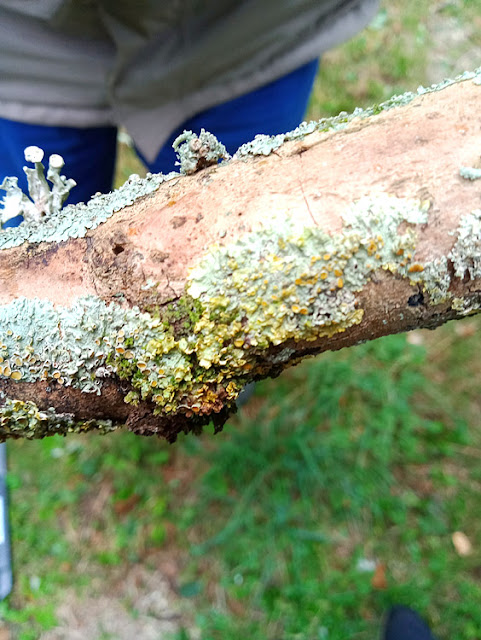
Common Orange Lichen Xanthoria parietina, Indre et Loire, France. Photo by Loire Valley Time Travel.
The foliose Common Orange Lichen, demonstrating its habit of going orange in the sun and green in the shade. This branch obviously has patches of both.


It was very depressing, and all Tim and Pauline's work is being ruined by the actions of surrounding farmers. When I got home I emailed Yohann, our local river technician. He takes a particular interest in the Aigronne Valley and Tim and Pauline's place particularly. I knew he'd be interested, and depressed, as I was. I asked him about what water pollution levels he or his colleagues had measured and if I've understood the tables of figures correctly, this is what they revealed:

86% of land along the Aigronne is put to agricultural usage. The river is considered to be at medium risk of pesticide pollution and at high risk of nitrate (NO3) pollution increasing over the current level recorded at 34mg/litre. 

Script Lichen Graphis scripta, Indre et Loire, France. Photo by Loire Valley Time Travel.
The crustose Script Lichen Graphis scripta.

Further reading told me that the level of nitrate considered natural and normal is 1-2 mg/litre and anything over 10mg/litre is considered to be hazardous. The nitrates in agricultural environments are salts formed by nitrogen containing fertilizers reacting with oxygen. Easily dissolved in water they can cause eutrophication, where algal blooms occur, then decompose, depleting oxygen in the water and killing organisms like fish that require well oxygenated water to live.

As a consequence of all this, we have decided to hold the outing on 22 October at the Pierre Percée, an ancient standing stone near Draché, which is covered in lichen, and surrounded by maple trees that have a nice range of species too.

Monday, 3 October 2022

Not For the Pot

It is wild mushroom foraging season again in the Touraine Val de Loire. One of the first species I spotted whilst out and about in September is one you definitely do not want to end up in your omelette.

Brown Rollrim Paxillus involutus, Indre et Loire, France. Photo by Loire Valley Time Travel.
Brown rollrim mushroom.

There are 39 species of toxic mushrooms in France. Not many of them are lethal, but a few of them will leave you with chronic sub-lethal effects that might make you wish you had died. The Brown Rollrim Paxillus involutus (Fr. Paxille enroulé) is one of these. What's scary is that they are abundant in the Loire Valley, in the autumn, under birch trees especially, and the species was not widely acknowledged as toxic until the 1980s, so there are still old field guides knocking about which list it as edible. Indeed, in rural areas of Eastern Europe it is still eaten by some people.

If you fancy yourself as a mushroom forager, but value your kidneys, learn to identify this mushroom.

Friday, 30 September 2022

Grizzled Skipper

Grizzled Skipper Pyrgus malvae (Fr. Hespérie de l'Ormiere) is a small day flying lepidoptera of a type known as a skipper. They are generally regarded as and included with butterflies, rather than moths, but they have antennae that terminate in hooked clubs rather than round ended clubs, so they don't look like other butterflies.

Grizzled Skipper Pyrgus malvae, Indre et Loire, France. Photo by Loire Valley Time Travel.
I was rather surprised to encounter this individual on the street a couple of days ago.

The Grizzled Skipper has been found to be a species complex, and individuals found in southern France are probably always the newly designated P. malvoides. In Indre et Loire it seems we have the northern species, P. malvae. They prefer open chalk grassland and woodland clearings where their caterpillar host plants, various strawberry family species, are likely to occur.

There are several lookalike species apart from the externally identical P. malvoides. It is always worth looking at them closely just in case the individual is one of the rarer species, but to be sure you have to use an identification key, carefully answering a series of questions about different aspects of the pattern on the wings.

Grizzled Skipper Pyrgus malvae, Indre et Loire, France. Photo by Loire Valley Time Travel.
A Grizzled Skipper photographed several years ago on wet earth in our orchard, showing the characteristic molar shaped mark on the upperside of the hind wing

They are one of the earliest butterflies on the wing in the spring, with a first generation appearing in April, and the second generation are still active in September or even October. It is most abundant in May, with much lower numbers seen in the other months.

Thursday, 29 September 2022

All the Way Home

Susan took this photo from the passenger seat of the Cactus last week as we returned home from work. At this time of year we leave home an hour before sunrise, and get back just as the sun is setting again.