Monday, 22 July 2024

Duralex

Duralex International is a French company based in La Chapelle Saint Mesmin in the county (Fr. département) of Loiret, which manufactures tableware from toughened glass. The business was placed in receivership in April this year. At one stage owned by the famous glassworks Saint Gobain, they were also affiliated with Pyrex.

Established in 1927 near Orléans by the vinegar producer Dessaux, the glassworks was sold in 1930 to the perfumier François Coty, who used it to manufacture perfume bottles. 


Duralex Picardie glasses in our kitchen.

Duralex Picardie glasses. Photo by loire Valley Time Travel.

In 1934 the business was acquired by Saint Gobain and in 1935 the factory employed 575 people. Saint Gobain had just invented toughened (tempered) glass, and the factory was put to work making headlights and windscreens for cars. In the 1970s the factory produced sanitary ware and in the 1980s they were making the doors for washing machines. 

At the same time, from 1945 onwards, the factory was making tableware. Their small round Gigogne glass was launched in 1946 and it became a cult object. The nine faceted Picardie glass was released in 1954 and became even more iconic. Generations of pupils in school cantines remember comparing their 'age', by checking the number on the bottom of each glass. The 'youngest' had to then fetch the water jug for that table.

The markings on one of the Duralex glasses in our  kitchen.

Base of a Duralex glass. Photo by loire Valley Time Travel.

These numbers, from 01 to 50, represent the number of the machine the glass was made on. It allows the factory to quickly identify a machine with a problem and fix it.

The 1960s were a golden age for the factory, with these two products known world wide. In 1965 an advertisement for Duralex won best publicity film at Cannes, and MoMa in New York and the Elysée Palace in Paris were selling the glasses in their gift shops. At the time the factory employed 1500 people.

The decline began in the 1970s and Saint Gobain sold the business to an Italian glassmaker. In 2004 the company was sold to one of its executives, with investment backers. Within a year he had filed for bankruptcy and the business was bought by their biggest customer, a Turkish wholesaler. He promptly asset stripped the factory, left it in even more debt and disappeared back to Turkey. Half the machinery and stock is missing and there is a European arrest warrant waiting for him.

After a year a Franco-British industrialist, Antoine Ioannides became president of the company and he and his brother invested some tens of millions of euros. Things were going well, and then there was a serious problem with some specialist equipment after a new furnace was installed. The business was insured but claiming the money was taking years. And then Covid hit and the principal end users of their product, cafés and bars all over the world, were all closed. It was the killer blow and the Ioannides decided to sell to try to recup some of their investment.

The business started winding down but they could not completely close down the furnace for technical reasons. It limped on with a skeleton staff. Finally in 2020 it was placed in receivership. 

Then International Cookware (Pyrex) stepped up and took over. But in 2022, after becoming the Maison Française du verre, they got caught out by the hike in energy prices. This time the furnaces were shut off, for five months, and the 250 employees put on chômage partiel (a government scheme which means that employees are paid 80% of their wage by the State, to ensure a business in temporary difficulty doesn't close permanently with all employees becoming unemployed).

In March 2024 the company was taken over by New Duralex International. They were promptly asked to pay the 'rights to pollute' fee that was associated with the previous management. Within a month they'd asked the court to proceed with receivership. 

Last month the local authority offered to buy the land and buildings of the glass factory, in order to help the employees buy the business as a workers co-operative (Fr. Societé Cooperative et Participative). The workers have 6 months to get something together to save the company and their jobs.

Friday, 19 July 2024

Entree libre

Some shops in France have a little sign in the window or hanging on the door that says 'Entrée libre'. Anglophones think to themselves 'free entry'!? WTF, it's a shop, of course it's free entry if they want any customers!!

But 'free entry' in the sense of there is no entry fee would be 'entrée gratuite' in French. 'Entrée libre' actually translates as 'enter freely', as in - 'come in, feel free to browse...'. And the implication is that there is no obligation to buy.

Entree libre sign in shop window, Carnac, Morbihan,France. Photo by loire Valley Time Travel.

It's a hangover from the days when you did not enter a shop unless you had a firm intention to buy something. The shopkeeper would let you in and out usually, and upon entering you would discuss your purchasing requirements with them first, before being shown a selection to choose from on the counter. Or you might have a list, which you handed over and the shopkeeper gathered the items for you. Shops were often set up as a small space with a counter at the front, with all the goods in a storeroom behind. 

It started to change in the 1960s, but prior to that the relationship of customer to merchant had hardly changed since medieval times. There was an expectation that you chatted with the shopkeeper, exchanging pleasantries and news. If you wanted to browse you went to the market rather than a shop.
Thursday, 18 July 2024

An Update on My Health

Two weeks on from having my prostate removed and things are improving. All my stitches have dissolved and I no longer have any dressings on my wounds. The nurse still calls every day to administer my anticoagulant injection, and do my weekly blood test.  The catheter came out just over a week ago, so I am retraining my bladder. Getting out of a chair, sneezing and coughing are still a challenge, but the "Protections pour fuites" are working, and lasting longer.

Yesterday I even went for a walk. It wasn't a long walk compared to my normal efforts in July, but it was a walk in some considerable heat, and afterwards I really knew I'd done it - very tired and needing a lie down. 

So, all good, and getting better.


Wednesday, 17 July 2024

The Cabinet des Sciences at the Chateau de Chenonceau

The Chateau of Chenonceau has a new permanent exhibition. It has become the custodian of an extraordinary collection of over 40 scientific instruments and pieces of laboratory equipment that once belonged to Louis-Claude Dupin de Francueil.


Top left, a bell in a vacuum, used to demonstrate that sound does not travel through a vacuum; top right, a lighter in a vacuum, used to demonstrate the effect lack of oxygen has on a flame; bottom left, an adjustable convex mirror, for making distorted images; bottom right, a gold leaf electroscope, which shows that two electrically charged objects which repel one another have the same polarity.

18C Scientific instruments, Chateau de Chenonceau, France. Photo by loire Valley Time Travel.

Dupin de Francueil was the eldest son of Claude Dupin, the owner of Chenonceau in the 18th century, and the grandfather of the writer George Sand (real name Aurore Dupin). His stepmother, Louise, was part of the Enlightenment movement, hosting a salon that received the great men of the day such as Montesquieu, Diderot and Voltaire. Her secretary, before he became famous, was none other than Jean-Jacques Rousseau. Being herself interested in the sciences, she allowed Rousseau to work with her stepson, to create a collection of scientific instruments which were intended as pedagogic tools, to demonstrate phenomena such as forces, movement, vacuums and so on, so they could be understood by their application and consequences. This unique collection was owned by the Touraine Archeological Society, but they have nowhere to display it and it has been passed to the Département d'Indre et Loire. Now it has returned, on loan, to its place of origin.


 Terracotta retorts, used to heat substances and recover the gases given off.

18C laboratory equipment, Chateau de Chenonceau, Indre et loire, France. Photo by loire Valley Time Travel.

In 1745-47, during the Dupin's habitual autumn residence at the Chateau of Chenonceau, Rousseau, a keen botanist and seeker of knowledge, and Dupin de Francueil, interested in chemistry, natural history and experimental physics, set up a laboratory in the stableblock. There, they occupied themselves with measuring, experimenting and testing new theories of physics and astronomy. Included in the collection are armillary spheres, a 's Gravesande gutter, a hydrostatic balance, and a hoist with 8 pulleys. The instruments were made by Dupin de Francueil himself, with the assistance of Rousseau, who came from an artisanal family background of watchmakers. 


Top, a hydrostatic balance, used to demonstrate density; bottom left, a Heron's fountain, a closed circuit hydraulic system; bottom right, a conical flask, used in atmospheric pressure demonstrations.

18C scientific instruments, Chateau de Chenonceau, Indre et loire, France. Photo by loire Valley Time Travel.

It seems Dupin de Francueil had ambitions to be admitted to the French Academy of Sciences, but nothing seems to have come of it. He took chemistry lessons with Academician Guillaume-François Rouelle in Paris and commissioned Rousseau to write a book to popularise science, but it remained unfinished.

These activities were fashionable in France at the time and some important science came out of private laboratories such as the one at Chenonceau. But further than the science, the instruments in this collection are of a very high quality, and reflect the refined style of French objects from the time of Louis XV. Only the collection of the Conservatoire des Arts et Métiers in Paris rivals the one now at Chenonceau.

Tuesday, 16 July 2024

Once Upon A Time in Loches - the New German Occupation August 1944


Poster from an exhibition on the Liberation of Loches, Indre et Loire, France. Photo by Loire VaLLey Time TraveL,

"The evening of 20 August was taken up with negociations between the German officers and the Loches Liberation Committee. After numerous difficulties and threats to burn the town an agreement was reached in the middle of the night. Loches, occupied anew, must deliver 20 hostages who will be executed if there is the least attack against the Germans within a radius of 5 kilometres around the town. 

On 21 August the Germans intended to reassert their presence. The 20 hostages, bargaining chips, were placed under heavy guard, at the Lasnier house, opposite the Chateau de Vauchignard. As a warning to the residents of Loches, three barracks in Place de Verdun were torched, as well as the Tivoli camp. A group of German soldiers visited the farmlet of Corbery and executed three of the four young Resistance fighters who were found there. The German lieutenant in charge of the garrison at Loches visited the hospital with the aim of capturing and shooting the maquisards wounded in the fighting the day before. The intervention of Dr Paul Martinais, who was engaged in caring for a German soldier when the officer arrived, meant that summary executions were prevented. 

In the following days the tension was palpable in the streets, felt equally by  Loches residents and the Germans. Confusion and suspicion reigned. German trucks passed through the town, heading for the Eastern Front. In the night of 30 August the German soldiers stationed in Place de Verdun fired on a German column that they mistook to be maquisards, and whose passage had not been scheduled. Around Loches fighting raged between the maquis and the German troops, who sought to rejoin their comrades further East at any price."

***********************************************

This poster is part of an exhibition in the Chancellerie on 'Loches in 1944' https://www.ville-loches.fr/expositions-article-3-10-56.html

Monday, 15 July 2024

La Puxisardinophilie

Sardine tin collecting is a thing, especially in France, and in French it's called puxisardinophilie ('puxi' is the same root as pyx, a box used to carry the Eucharist wafers). A sardine tin collector can also be referred to as a clupéidophile (sardines are part of the Clupeidae family of ray-finned fish, which includes herring as well). Generally, puxisardinophile is used for collectors of unopened tins, whilst clupéidophile indicates someone who collects empty tins. It's affordable so anyone can do it. Most collectors buy unopened tins, and they may choose to focus on a particular area or factory's output, or they may collect globally. 


A collection on the wall of a bar in Carnac, Brittany.

Sardine tin collection in a bar in Carnac, Brittany, France. Photo by loire Valley Time Travel.

The sardines from Brittany are considered to be the best in the world, and the Breton company Connétable is the oldest extant fish cannery in the world, founded in 1853. The very best Bretonne sardines are caught only in July, August and September, when their fat content is highest. Top quality sardines in tins must have a minimum of 10% fat to be given a vintage year (Fr. millésimée) and a use by date of ten years after processing, both printed on the tin. Also printed on the tins are the name and home port of the boat that caught the sardines inside. After canning these premium sardines will be aged by the factory for a year before being sold to consumers. Collectors will often age them another decade after the use by date and say that by then the bones have dissolved and the taste and texture has refined. If the tin is undamaged this is not dangerous. Plain olive oil rather than fancy marinades are favoured.

The reason the tins are collectable is because there is a long tradition, almost as long as sardines have been canned, of tins being printed with designs by professional contemporary artists. This means that the vintage sardines can be issued as limited editions -- doubly special and collectable! And there are also artists subverting the tradition, by using sardine tins as their medium.


Collectable tins of sardines at Galland Epicerie de terroirs in Amboise, a high end French regional products grocer.

Tins of sardines in an epicerie fine, Amboise, France. Photo by loire Valley Time Travel.

Sardines are a delicate fish, not easy to keep in good condition after they are caught. Prior to canning being possible they were dried on outdoor racks, or pressed between layers of salt in barrels. From the 1820s large scale canning was underway and there were many factories processing sardines.

Sardines were the first staple food to be marketed in the modern sense. Once the means existed to preserve them and ship them inland, especially to Paris, these new markets needed to be encouraged to purchase such an unfamiliar product. So, along with advertising and promotional campaigns for fancier products such as chocolate and tonic drinks of high alcohol content and dubious health benefits, the humble sardine was introduced to its new public with painted wall advertisements, posters and newspaper space. The cleverest way of boosting sales was the use of eye-catching colourful and collectable tins. This is now so well established that it is just about the only way sardines are promoted these days, apart from occasional specials in supermarket catalogues.


The range of tinned sardines in one of my local supermarkets. Even the supermarket own brand has vintage sardines.

Tinned sardines in a French supermarket. Photo by Loire VaLLey Time TraveL.

These days sardines are rather polarising as a foodstuff. You either love them or you hate them. Many people find them too stinky and unappetising, and can't face them, despite knowing all about their Omega-3 fatty acid health benefits and their sustainability (at least, the Atlantic stocks...). Canned tuna is as far as these people are prepared to go. Fortunately Simon and I love sardines, so we always keep a tin or two in the pantry. 

Tins of Bretonne sardines make great gifts when you travel, as they are lightweight, sealed and robust. Likewise they are a good product to pick off the shelf and donate when your local food bank is collecting at the supermarket.


The tin of sardines currently in our pantry.

Tin of sardines. Photo by loire Valley Time Travel.

Tinned sardines (Fr. sardines en boîte) are best served simply, just with some good bread to sop up the oil, and a few drops of lemon juice. 

The Bretonne sardines are Sardina pilchardus. The sardine fishing and processing industry employs several thousand people in Brittany. The port of Douarnenez was for many years the biggest sardine fishing port in the world, and a pioneer in industrial fish canning. Nevertheless the industry has had its ups and downs in the region, with changes to manufacturing processes and fluctuating stocks of fish.

Saturday, 13 July 2024

Why Visit Morbihan (Brittany)?

 Part of the Carnac alignment of standing stones (menhirs).

Alignment of prehistoric standing stones, Carnac, Morbihan, Brittany, France. Photo by loire Valley Time Travel.

We recently spent a very successful short break in Morbihan, staying in a cabin (Fr. mobile home) in a caravan park at Carnac. Morbihan is a county (Fr. département) in the south of Brittany (Fr. Bretagne) on the Atlantic coast, around the Gulf of Morbihan. Inland it is agricultural, on the maritime side it is fishing and pleasure boat ports. It is a beautiful part of France, where the hydrangeas are blue and the stone is granite. To my mind there are three main reasons for going to Morbihan:


Wild Foxgloves Digitalis purpurea (Fr. Digitale pourpre) were abundant on roadsides and woodland edges.

Foxglove Digitalis purpurea, Morbihan, Brittany, France. Photo by loire Valley Time Travel.


1. The prehistoric stone structures.

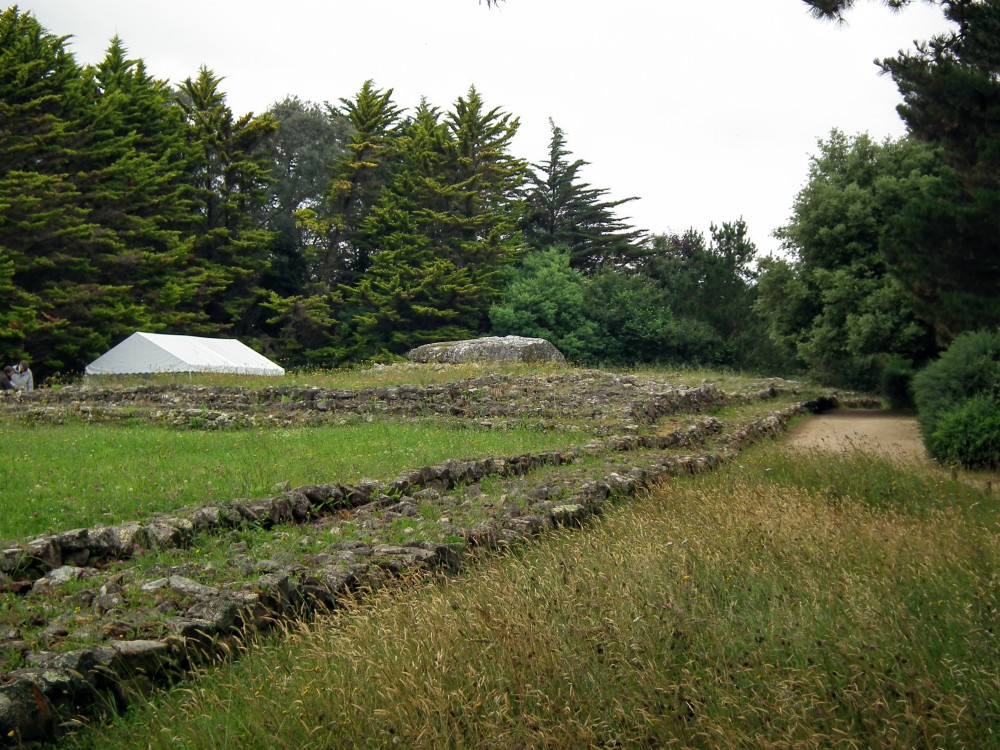
The number of prehistoric menhirs (standing stones), cairns (dry stone covered chamber tombs) and tumuli (earth covered tombs) is astonishing. They are everywhere! and each more interesting and intriguing than the next. We stayed across the road from the famous alignments of Carnac. Which is impressive enough, as it is several rows of standing stones which go on for some kilometres. But then we visited the island of Gavrinis, and got to go inside the cairn. The young archaeologist conducting the tour was excellent. After that we saw the related tombs across the water at Locmariaquer and then a few more that I don't even remember the name of. Some are publicly owned, carefully guarded by heritage professionals and there is an entry fee. Others are on private property and access is freely granted. They date from the time four to six thousand years ago that man was just settling down to live in small fixed communities rather than being nomadic. We were awestruck to be allowed inside these remarkable links with the distant past, and to be allowed to take photos. Frankly it beggars belief that Morbihan is not UNESCO World Heritage Listed for its prehistoric landscape.


The remains of a marvellous meal of Breton mussels (Fr. moules bretonne).

Remains of a meal of mussels, Morbihan, Brittany, France. Photo by loire Valley Time Travel.

2. The distinctive Bretonne cuisine, in which dairy and seafood feature strongly.

Brittany has maintained its own culture and even its language rather better than some other regions of France. The list of gourmet delicacies that come from Brittany is long: kouign amann (butter cake); far breton (prunes in a thick pancake); palets, galettes and sablés bretons (plain biscuits); seafood especially shellfish (mussels, oysters, clams) and sardines; cider; salted butter; salted butter caramel; crèpes and galettes (savoury crèpes made with buckwheat flour); quatre quart (pound cake); cocos de Paimpol (dried white beans); andouille de Guémené (chitterlings); lait ribot (buttermilk); cotriade (fish soup); farz (pasta made from buckwheat flour); artichokes; strawberries; pink onions. Some of these have made it out of Brittany and can be encountered anywhere in France now, especially in places where Bretons migrated to, like the Montparnasse quartier of Paris. But others, whilst known to foodlovers, have to be discovered in their home territory. We had the best mussels we've ever eaten, quite by chance, by lobbing up to a restaurant on a small harbour because it was lunchtime and we were passing. No consulting of restaurant reviews, just a quick perusal of the menu board outside to check they did the kind of food we liked at the price we wanted to pay. Kouign Amann is a must have if you are in Brittany, and we bought ours from a small stall in Carnac market that was selling nothing else. 


 Le Grand Menhir at Locmariaquer fell not long after it was erected and broke into four enormous chunks.

le Grand Menhir, locmariaquer, Morbihan, Brittany, France. Photo by loire Valley Time Travel.

3. Sailing and other water sports.

We didn't participate in any watersports this time, but it was clear that the Gulf of Morbihan is a paradise for anyone wanting to learn to sail or get to grips with sea canoeing, paddle boarding or kite surfing. It's a big protected inlet and there are hundreds of boats big and small moored in the many harbours. We saw yachts ranging from century old yawls that now take tourists out to islands for day trips, to enormously tall masted trimarans with the very latest in high tech sails [link]. Even if you know nothing about boats it's picturesque and alluring.


 Kouign Amann at the market in Carnac.

Kouign Amann at the market in Carnac, Morbihan, Brittany, France. Photo by Loire VaLLey Time TraveL.

Once you've visited the area you know why hundreds of French families have holidayed there since the 19th century, even though Brittany is famous for weather which includes drizzly rain nearly every day. There is so much to do, so much opportunity to just relax and take it easy, and the visibility of the Breton culture means that you know you are not at home. The locals clearly rely on tourists for a significant chunk of their annual income, but the place has not been turned into a caricature of itself. Bretons are proud to speak their language and practice their culture and would do so whether there were tourists or not. I was interested to see that the SuperU supermarket in Carnac had an extensive selection of local produce, including ceramics, baked goods, drinks and caramels. It was a one stop souvenir shop as far as I was concerned and I bought a mug, some pommeau (an apple liqueur), beer, kouign amann (again...) and salted caramel sauce. At the market there was a stall selling the iconic stripey shirts that Bretons are stereotyped as wearing. Of course it was aimed at the tourists, but the locals do genuinely wear them too, so we bought one each. They are good quality and weren't expensive.


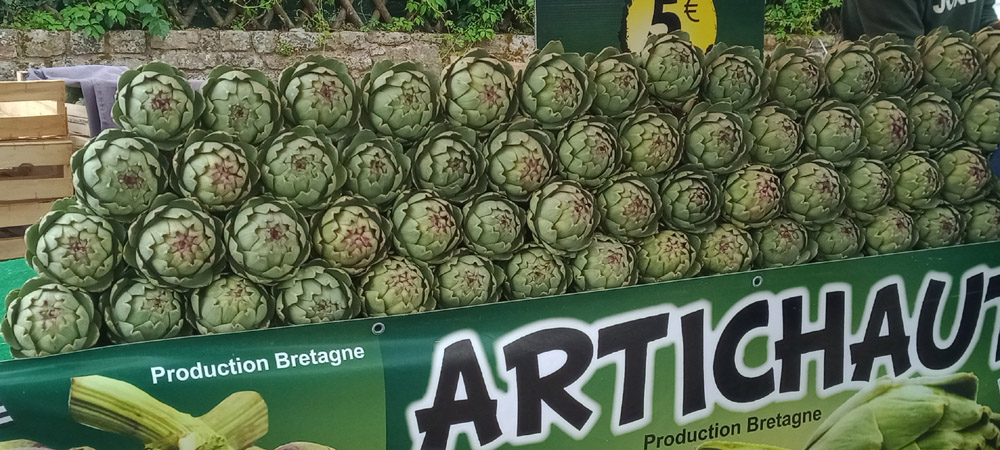
 Artichokes at Carnac market.

Artichokes at the market in Carnac, Morbihan, Brittany, France. Photo by Loire VaLLey Time TraveL.

We had such a nice time we can't believe we never made it up there before, and we certainly have plans to return.


Caravan park. Our cabin was through the arch.

Caravan park, Carnac, Morbihan, Brittany, France. Photo by Loire VaLLey Time TraveL.


Some sort of aquatic exercise class. 

The photo makes it look as if it was very early in the morning, but in fact it was 10 am.

Swimming at Carnac, Morbihan, Brittany, France. Photo by Loire VaLLey Time TraveL.


Part of the alignment of prehistoric standing stones at Carnac.

Part of the alignment of prehistoric standing stones at Carnac, Morbihan, Brittany, France. Photo by loire Valley Time travel.


Embarking at Gavrinis Island.

Embarking at Gavrinis island, Morbihan, Brittany, France. Photo by loire Valley Time Travel.

Friday, 12 July 2024

Thursday, 11 July 2024

Who's a Happy Little Vegemite?

We all have foods we remember from our childhoods which we revert to when we need a little comfort. One of mine is Vegemite, something we have mentioned on the blog before.


Vegemite was created in 1922 by chemist Dr. Cyril Percy Callister. In response to the disruption of supply of imported British Marmite after World War I, Fred Walker & Co. commissioned Callister to develop a local alternative. Using leftover brewer's yeast, he created Vegemite, a rich source of Vitamin B. It was initially marketed as a health food, but struggled to gain popularity until the 1930s when a marketing campaign boosted its profile. By the 1940s, Vegemite had become a staple in Australian households, further enhanced by an advertising campaign and jingle in the early days of commercial TV.

Compared to Marmite, Vegemite is thicker and more of a spreadable paste. The name was chosen as a result of a competition.

After I came out of hospital I mentioned that Vegemite on toast would be really nice, but buying it it France was twice as expensive as in Australia. Jean piped up to say that she was in England, her local Tesco's sold Vegemite, and that she was returning to France soon.

A couple of days later she popped round with 2 jars. I instantly made myself Vegemite on toast and had a Proustian rush.

Wednesday, 10 July 2024

We're Not Doing Much

You won't be surprised to hear that we haven't been out and about much lately. What with daily visits from the domiciliary nurse, the Tour de France on TV and the fact it's been warm outside, I have been resolutely domestic. Yesterday was my first excursion outside since getting home from the hospital, and that was a car ride to le Grand Pressigny to see our General Practitioner (in french, médecin traitant).

Hardly photogenic stuff.

So instead, a photo of some Charolais cattle we encountered on a walk near Chaumussay the day before I went into hospital.


Tuesday, 9 July 2024

Once Upon A Time in Loches -- Fighting August 1944

 Poster for an exhibition on the liberation of loches, Indre et loire, France. Photo by loire Valley Time Travel.

"After the 'Liberation' of Loches the maquisards put up road blocks on the routes coming into town, fearing German reprisals because troops were passing through, having been ordered to march to the East. The country was not yet liberated. At Loches several German columns attacked the town on 20 August from several different points of access.

*Route de Tours, at the spot called Marray a small German contingent attempted to get into town at 9 am, but an hour of fighting was enough to make them turn back.

*Route de Ligueil, at around 10:30 am nearly 500 German soldiers attacked the road block at Blanchardiere Farm. Facing them were 11 maquisards of the FTPF. After 2 hours of battle the Germans retreated, but took around a hundred inhabitants of Ligeuil hostage and positioned them around their convoy. Equipped with these human shields, they turned back towards la Blanchardiere in the early afternoon. Despite 3 hostages fatally wounded, the maquisards held their position and the Germans turned around to head for Bournan and Sainte Maure.

*Route du Perusson, at the same time a German convoy was engaged in fighting at la Cloutiere. The FTPF, installed at the Tivoli Camp, joined the men of the Maquis Lecoz who were defending the road block. Around 6 pm the German Army gave up and turned back, realising that they were too few to face these French Resistants.

*Route de Manthelan, more than 600 German soldiers crossed the Forest of Manthelan in the late morning. They extended their front line from the Mouzay road to the Chanceaux road, then progressed up to the Ligeuil road. Against the Germans, the maquisards were ill equipped and too few in number, and they could not hold the position. Around 5:30 pm the enemy fired a canon on the Donjon de Loches from Bel-Ebat. The maquisards fought even in retreat, after the loss of about 20 men during the days fighting. Loches fell..."

***********************************************

This poster is part of an exhibition in the Chancellerie on 'Loches in 1944' https://www.ville-loches.fr/expositions-article-3-10-56.html

Monday, 8 July 2024

Classic Clafoutis

 Homemade clafoutis just out of the oven.

Homemade clafoutis.

We love clafoutis. It's a simple seasonal dessert popular in all the regions of France where cherries do well. I've posted about it before [link], but thought it was time for a reprise of this classic of French provincial cuisine. This is a particularly creamy version which I like a lot.


Ingredients for clafoutis.

Ingredients for clafoutis. Photo by loire Valley Time Travel.

Ingredients

3 eggs

½ cup sugar

Pinch of salt

½ cup flour

2 tbsp butter, melted

1 cup milk

½ cup cream

1 tsp vanilla extract

Finely grated zest of half a lemon

300 g (about 3 cups) of cherries


Method

  1. Set the shelf above the middle and heat the oven to 180°C.
  2. Butter a flan dish.
  3. Put the eggs, sugar and salt in a jug and using a stick blender, whisk them for at least a minute.
  4. Add the flour and blend well.
  5. Add the melted butter and blend well.
  6. Add the milk, cream, vanilla and lemon zest and blend well.
  7. Pour the batter into the flan dish.
  8. Gently drop the cherries into the batter.
  9. Bake for 35 minutes. It should be just set, maybe a bit wobbly in the centre and browning at the edges.
  10. Let cool slightly and serve warm, cut into wedges.

 Ready for the oven.

Clafoutis ready for the oven.

Serves 8.

Saturday, 6 July 2024

Locmariaquer

When we were in Brittany (what feels like years ago now) the stone alignments of Carnac were our first priority - a novelty that you get blasé about pretty quickly because there are so many of them.

Once we had been to Gavrinis we needed to go to Locmariaquer. One of the large stones in the ceiling of Cairn of Gavrinis was once part of a huge carved dolmen at Locmariaquer, and there were other attractions - it was raining, and the idea of spending time out of the rain was appealing.

The first thing you see is the Er Grah tumulus, a long mound of stone covering multiple burial chambers. And by long, I mean 140 metres long and about 15 metres wide. Many of the stones used in its construction have been used elsewhere, but it's still an amazing piece of work. There has been considerable restoration done on the tumulus since it was used as a car park in the 1970s. It's really difficult to get an idea of how big it is, so here's an aerial view.


The Table des Marchands is a cairn that has a large capstone supported by upright stones. This has a couple of carved stones inside a la Gavrinis, including some on the ceiling. Like Gavrinis, it's a dry stone construction over a long chamber.


The third amazing thing is the Grand Menhir Brisé, a large broken standing stone. The stone was originally 20.60 metres tall and weighed about 330 tons. It stood upright, but now lies in several pieces, and quite a large chunk (according to our guide at Gavrinis) found its way there. There were once nineteen menhirs in an alignment, all of them apparently worked and smoothened.

Remember: all the rock you see, plus another piece, were all part of one standing stone.


These structures are believed to have been erected during the Neolithic period, around 4500 to 3300 BCE. The purpose of the megaliths is not definitively known, but as usual they are thought to have had ceremonial or religious significance.

One thing that struck me was continuity of purpose. At the foot of the monuments is the town cemetery.


Friday, 5 July 2024

Nice Legs!

You would have thought I could have found a better pair of shoes to go with those stockings.


This is the most disturbing image I will be posting.

Thursday, 4 July 2024

An Update on Simon

It has finally happened! I said on Monday that I was coming home. Then circumstances played against me.

After the operation on Wednesday and all looking good, I had a massive setback on Thursday night. I had a migraine that meant all I could do for 24 hours was lie down and chew painkillers. I didn't eat anything at all on Friday, which they understood whilst not being totally happy about.  Then I fainted in the shower - completely out. I had someone in there with me so I didn't fall.  I was better on Saturday, ate two half meals and sat up for a bit. Then I fainted in the shower again.

Then, on Monday, when they were supposed to be releasing me, I got them to help me to the bathroom, got them to pose me because I thought I wanted a to use the toilet, and the next thing I knew I was on the floor with them trying to lift me. That gave me a huge egg on the forehead, a black eye, and a bruise on the cheek. All that meant I had an extra 2 days in while they did tests.

But it's good. I got home yesterday, and I'm already 200% better. I have to have a daily visit from the nurse for the next 27 days for an anticoagulant injection, but the catheter comes out on Monday - and that's damn good news!! I've never been more uncomfortable. I do have to wear the sexy, sexy support stocking for a few more weeks.

But the surgeon looked smug every time he inspected his handiwork, and the nurse at the hospital said it was "impeccable"

I have to say that while the staff were brilliant the food at the hospital was less than inspiring. There wasn't a single meal I finished, and the lack of food is probably what made me faint.

Wednesday, 3 July 2024

Oakmoss Rebounds

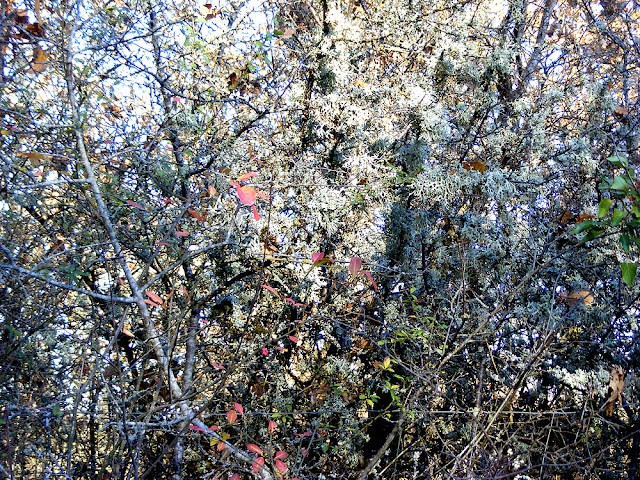
Apparently Oakmoss Evernia prunastri has bounced back to abundance in Europe now that so many coal-fired power stations have closed. The lichen was sensitive to the sulphur dioxide pollution emitted by the power stations. Oakmoss was once an important ingredient in high end perfumes, but it is now superceded by a synthetic substance because so many people are allergic to the real thing. Beware if you are handling firewood too.

Oakmoss is a very special lichen, known far and wide as a precious ingredient in high end perfumes, most famously, Chanel No 5. Its scientific name is Evernia prunastri, or mousse de chêne in French, and it is not rare at all in the Touraine Loire Valley. It can be found everywhere, growing on just about any species of tree and is one of the most abundant lichens in Indre et Loire.

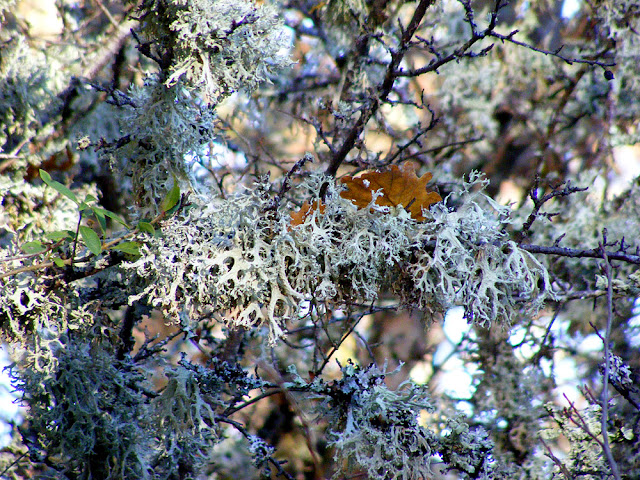
Oakmoss Evernia prunastri, Indre et Loire, France. Photo by Loire Valley Time Travel.

It provides musky and woody notes to perfume, but some people have an allergic skin reaction to it -- not just women using perfume containing it, but sometimes foresters too, who are handling wood with the lichen growing on it. It is generally regarded as the most likely suspect when someone shows signs of being allergic to a perfume. In bad cases it can cause restlessness, vomiting, dizziness, tremors, kidney damage and convulsions.

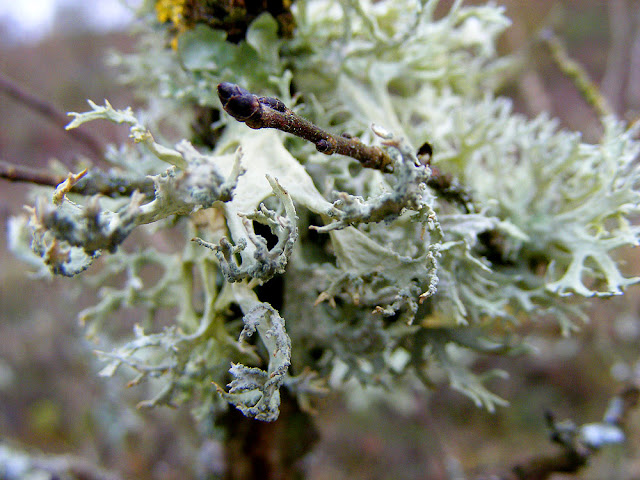
Oakmoss grows in large clumps on the branches and twigs of trees, resembling bundles of tiny greenish white antlers. It is most abundant in open, windy, unpolluted locations and about 6000 tonnes a year is commercially harvested in Macedonia and Bulgaria, from where it goes to Grasse in France for processing. The compounds extracted are used as base notes and fixatives and are crucial elements in 'Fougere' and 'Chypre' style perfumes. However, it is fairly rapidly being superceded by synthetic products, following a European Directive to accurately label and list the percentages of certain extracts to which many people are allergic.

Oakmoss Evernia prunastria, Indre et Loire, France. Photo by Loire Valley Time Travel.

Fougere style perfumes are nearly always marketed for men -- typical brands being Brut by Fabergé and Paco Rabanne's Pour Homme. Oakmoss is combined with fragrances such as lavender, vetiver, citrus and geranium.

Chypre perfumes are based on a blend of citrus and oakmoss which is often modified with patchouli, musk and labdanum, and enhanced with rose or jasmine. The original Miss Dior was a chypre style perfume, but the formula has been changed now, probably due to issues with oakmoss allergies. Lagerfeld is a chypre perfume aimed at both sexes.

Oakmoss Evernia prunastri, Indre et Loire, France. Photo by Loire Valley Time Travel.

In the past it has been used by the Romans to make a purple dye, and by the Egyptians in various ways when they were mummifying a body.

Tuesday, 2 July 2024

Once Upon a Time in Loches -- 'Liberation' August 1944


Poster for an exhibition about the liberation of loches, Indre et loire, France. Photo by loire Valley Time Travel.

"Following these events (the roundup and reprisals) the mistrust of the people of Loches towards the occupiers increased. At the national level, since the Allied landings in Normandy on 6 June 1944, the Germans fell back towards the Eastern Front. As French towns were progressively liberated, Loches nutured the hope that the occupation would end on their territory.

During the night of 15-16 August 1944 the German soldiers evacuated their camp at Tivoli where they had been installed since 23 July,  after having noisily destroyed their stocks of ammunition and startling all the nearby inhabitants. The FTPF took charge the morning of 16 August and secured the former German camp. The news of the departure of the Germans was picked up by Captain Lecoz mid-afternoon. He was hanging out at Chanceaux with his men and decided to change the plan by entering triumphantly into Loches with his maquisards. Loches seemed to be liberated and the people of Loches acclaimed him as the liberator of their town.

From 16 August Lecoz's men engaged in hunting collaborators, proven or not. Those who could have helped the enemy were gathered together in Place de Verdun in front of everyone with brutality. A patriotic ceremony was organised to congratulate the Resistants. A new town organisational structure was put in place. A 'Liberation Committee' was created by the Resistance commanders, who designated Raymond Mallet as mayor and sous-préfet. The people of Loches turned towards the future and the post-War."

*******************************************

This poster is part of an exhibition in the Chancellerie on 'Loches in 1944' https://www.ville-loches.fr/expositions-article-3-10-56.html

Monday, 1 July 2024

A News Round Up

1 July 2024 means that my little brother is 60. I don't want to make this about me, but it does mean I can't be 55 any more. Happy Birthday JB!!!

The other news is that I will be home this afternoon after a week in hospital. 

Last August I received a phone call from my doctor telling me I had to make an appointment ASAP. Never good news...  The eventual outcome was that on Wednesday last week I had my prostate removed. That is all done now, so I am planning a future that doesn't involved being probed or going through the atomic donut every other week.

Susan has been making the hour each way trip to Tours every day, and I've been on morphine. That's why there was no blog post on Saturday.

Friday, 28 June 2024

Boats in Brittany


There are a lot of boats in and around the Gulf of Morbihan. These are a few of the more interesting ones.

The Unity of Lynn, an English smack, was launched in 1906 in Boston, Lincolnshire. Her homeport is Saint Goustan, Auray.


The Lys Noir is a French gaff rigged yawl built by the Barrière d'Arcachon shipyards in 1914.


Sails of Change is a maxi-trimaran preparing for a huge challenge. The objective is to win the Jules Verne Trophy by beating the round-the-world record held since 2017: 40 days, 23 hours, and 30 minutes.


Thursday, 27 June 2024

The Cairn de Gavrinis

When I first thought about going to Brittany, my aim was to see the Alignments of Carnac, which I first read about in the book "The Crystal Cave", a retelling of the legend of Merlin by Mary Stewart. Reading about other things we might do whilst in the area, I looked at ferry rides to islands in the Bay if Biscay - Belle-Île-en-Mer, or Île d'Houat. Both of these held some appeal, but then a note about Gavrinis caught my eye.

The Cairn de Gavrinis is on the island of Gavrinis in the Gulf of Morbihan. It's a Neolithic passage tomb built about 5,500 years ago at the beginnings of agriculture and the move away from being hunter gatherers. At that time the Gulf of Morbihan was a series of broad river valleys, and sea level was about 25 metres lower than it is now. The photos make look like it was earth covered, but the earth and grass has accumulated naturally, and originally the bare stone would have been visible from a long distance. It would have been a real statement piece, proclaiming that the territory was occupied.

The Cairn from the entrance to the Gulf of Morbihan, 3km away.

The island and tomb can only be visited in small groups on a guided tour. We have had great results booking these sorts of visits in the past, and the photos looked intriguing. We took the ferry from Larmor-Baden, which costs 20€ and includes the ferry to the island and a tour given by an archeologist. For some reason I didn't expect to be able to actually walk into the tomb without someone standing over me, nor be allowed to take photos (albeit without a flash).

Our ride out to the island approaches

The cairn is of a large mound of stones, built without mortar, approximately 50 metres in diameter and 6 metres high, covering a passage that leads to a central chamber. Inside is a passage about 14 metres long, lined with large slabs of stone many of which are adorned with carvings of spirals, lines, and other geometric patterns. 

The entrance to the Cairn. This is how it would originally have looked, but this face has been restored.

At the end of the passage is a chamber with a corbelled roof constructed from large stone slabs forming a rectangular room. The purpose of the cairn and its carvings is presumed to be related to burial practices and the veneration of ancestors.

Our photos were taken without a flash. Some of the professional photos are much more revealing.


Excavations and studies have revealed that some of the stones used in the construction of Gavrinis came from other locations, including from earlier tombs, and parts broken from large menhirs. The carvings are mysterious and abstract, and many interpretations and theories exist. I doubt we'll ever know what they mean, but it's keeping "better" minds than mine occupied.