Thursday, 7 December 2023

Mapping on the Go

For the past eight years I have been using navigation and mapping based on Open Street Maps (OSM) rather than the better known G**gle Maps.

At first I used Maps.Me, but that organisation was sold to a marketing and finance company. That's when I deleted the Maps.Me app and went over to Organic Maps. Organic Maps was founded by the same team that started Maps.Me, but the new app features no location tracking, no data collection, and no ads. You simply download the maps for where you are, then it runs without a data connection.

EDIT: It's also totally free!

There is a very good reason for using a navigation and mapping app based on OSM. Many organisations (including public authorities) use the maps and provide details. In some cases, especially where local authorities are involved, very detailed details.

This is what a general overview of Paris looks like on OSM.

 
Zoom in towards Place des Vosges


and again


and now, really zoom in

You will see that just about everything is marked: trees, playgrounds, seating, litter bins (trash cans), drinking fountains and fire hydrants. Move the map and you would see post boxes, bollards, shops, hotels, footpaths, bike paths, museums, restaurants, pay parking machines, underpasses, tunnels... Just about everything.

And now... G**gle Maps. Because G**gle is all about profit you get shops and advertising, but only minimal tourist and geographical information.


This is what the same map looks like in Organic Maps.

In another blog post I have described how to use Organic Maps. Click here.


Wednesday, 6 December 2023

A Fun Finissage

Looking from the kitchen to Mme Lorain's former hairdressing studio. Gael and Isabelle in the background. The works on the easels are needlepoint.

Village art gallery, Indre et Loire, France. Photo by Loire Valley Time Travel.

If you live in France and have friends who are artists you will most likely have been invited to a vernissage. That's the French for the opening of an art exhibition.

A hand painted panel on a door.

Painted panel on cupboard door, Indre et Loire, France. Photo by Loire Valley Time Travel.

I had missed the opening of Christophe Lorain's gallery in Preuilly, housed in his parents' former home and studios (hairdressing and artistic). But amusingly, when the exhibition of a textile artist (his wife, Daniele Delatang), a decorative imitation flower maker, a photographer and a painter came to an end they held a 'finissage'. This is a made up word they invented or borrowed for the occasion. Quite a few people came, and sparkling wine and nibbles were served.

 These hanging brushes were intriguing. I don't know what the story behind them is.

Brushes. Photo by Loire Valley Time Travel.
Sketches and drawings by Sacha Lorain, Christophe's niece. Note the pragmatic mail box arrangement.
Sketches and drawings by Sacha Lorain, Indre et Loire, France. Photo by Loire Valley Time Travel.
The high gloss photographs, mostly closely cropped images of bits of crushed cars, highlighting the abstract folds and patterns in the metal, looked very effective against the limestone. The photographer is on the left.
Photography exhibition, Indre et Loire, France. Photo by Loire Valley Time Travel.
Handmade Christmas decorations on a handmade alternative Christmas tree.
Handmade Christmas decorations, Indre et Loire, France. Photo by Loire Valley Time Travel.

Several new galleries in nearby villages have also opened, and Christophe's idea is to work in partnership with them, maybe creating a tourist trail that summer visitors can follow. There are some talented artists working in the area, creating sometimes quite unexpected and engaging pieces from a wide variety of media, so let's hope doing the Sud Touraine Artists Trail becomes a thing.

Tuesday, 5 December 2023

Walking From Maire

On Thursday 23 November I joined Joel and Denise, Danielle, Dominique and Helene, Astrid and Jean-Jacques to walk 9.5 kilometres from Mairé. It drizzled a bit and there were lots of big mushrooms. This walk has nearly 200 metres of elevation gain which is almost unheard of for the Touraine, and it was exhausting! It took two and three quarter hours with photo and rest stops. We walked mostly through forest.

 The entrance to the Chateau Rocheuse. Just as we got here a resident with a very enthusiastic labrador emerged and we were greeted with a lot of furry wriggling and bouncing.

Entrance to the Chateau Rocheuse, Vienne, France. Photo by Loire Valley Time Travel.

Fly Agaric Amanita muscaria (Fr. Amanite tue-mouches), the most classic of toadstools.

Fly Agaric Amanita muscari, Vienne, France. Photo by Loire Valley Time Travel.

Looking across the Creuse Valley from the hamlet of Les Ringeres.

Looking across the Creuse Valley, Vienne, France. Photo by Loire Valley Time Travel.

Forest on the ridge above the Creuse, dominated by oak and beech.

Oak forest along a ridge above the Creuse, Vienne, France. Photo by Loire Valley Time Travel.

I think these are Giant Funnel Leucopaxillus giganteus (Fr. Leucopaxille gigantesque).

Giant Funnel Leucopaxillus giganteus, Vienne, France. Photo by Loire Valley Time Travel.

Rather old Yellow Stainer mushrooms Agaricus xanthodermus (Fr. Agaric jaunissant).

Yellow Stainer mushroom Agaricus xanthodermus, Indre et Loire, France. Photo by Loire Valley Time Travel.

A young Yellow Stainer from the same colony, on the side of a rural track.

Yellow Stainer mushroom Agaricus xanthodermus, Indre et Loire, France. Photo by Loire Valley Time Travel.

Panthercap Amanita pantherina (Fr. Amanite panthère).

Panthercap Amanita pantherina, Indre et Loire, France. Photo by Loire Valley Time Travel.

An Agaricus sp, I can't work out which one. It was growing very close to the Panthercap, and until I got right up to it I thought both mushrooms were the same species.

Agaricus sp, Indre et Loire, France. Photo by Loire Valley Time Travel.

A typical Touraine view.

View of the landscape, Vienne, France. Photo by Loire Valley Time Travel.

This American Red Oak had got itself in a twist.

Twisted American Red Oak, Vienne, France. Photo by Loire Valley Time Travel.


Monday, 4 December 2023

Hands Off Our Cheese Boxes!

 This brand will be able to continue with its use of wooden boxes, despite not being an AOC cheese.

Camembert, France. Photo by Loire Valley Time Travel.

There has been social media panic and outrage recently over proposed new EU legislation on packaging, to ensure it is all biodegradeable. The way the legislation was expressed it was widely interpreted as forbidding the use of the wooden boxes that some French cheeses are packaged in. But there was never an intention to apply the legislation to any product traditionally packaged in wood that has Indication Géographique Protegée (IGP) or Appellation d'Origine Controlée (AOC) certification. So certified Camembert, Epoisses, Mont d'or and Pont l'Eveque are safe. 

A pre-Christmas window display of Mont d'Or in a Paris cheese boutique.

Mont d'Or cheese window display, Paris, France. Photo by Loire Valley Time Travel.

The aim of the new legislation is not just to ensure sustainable materials are used in packaging, but even more to reduce the total quantity of packaging. As an Irish MEP I saw on television put it, there isn't much sense in replacing a pile of plastic packaging with a pile of the same quantity of cardboard packaging.

Mont d'Or on the right, not only in a poplar wood box, but encircled by the traditional band of spruce to give it the special flavour.

Tomme de Savoie and Mont d'Or French cheeses. Photo by Loire Valley Time Travel.

But what could be more sustainable and biodegradable than packaging made of wood I hear you ask? The problem arises within the recycling system, as there is no dedicated logistics chain for wood, and it would be onerous to create one. There simply isn't the quantity of waste material to make it worthwhile at this point, and there is no requirement to recycle wooden packaging. Ultimately though, some people are looking at wooden boxes as a possible source of good clean wood for chip burners, already widely used for community heating facilities, and they could also be composted. 

Oysters from the Atlantic coast in a poplar wood box.

Oysters from the Atlantic coast in a poplar wood box, France. Photo by Loire Valley Time Travel.

The manufacturing of wooden food packaging boxes employs around 2000 people at 45 companies in France. They make 200 million little boxes annually, not just for cheeses, but for oysters and strawberries as well. The industry lobbied hard and won their point. So wooden boxes get to stay, and no doubt thrive.

Cheese display in my local supermarket, including two Camemberts and a Chaource in wooden boxes.

Cheese display in a supermarket, Vienne, France. Photo by Loire Valley Time Travel.

Epoisses.

Epoisses cheese, France. Photo by Loire Valley Time Travel.

Camemberts in the chiller cabinet at my local supermarket.

Camembert in a supermarket chiller cabinet, Indre et Loire, France. Photo by Loire Valley Time Travel.

Saturday, 2 December 2023

Pont du Gard

On our trip to the south of France in June visiting the Pont du Gard was high on our list, one of our 'must sees'. It did not disappoint. We booked a guided visit online and were very pleased that we did. We had thought it was in English but it turns out they don't do many English language tours and it was in French. It didn't bother us in the slightest, but it is something to be aware of if you go there. Booking a guided tour is the only way of accessing the aqueduct level of the bridge.

Pont du Gard, France. Photo by Loire Valley Time Travel.

The Pont du Gard is a three level bridge carrying a Roman aqueduct on the third level. It is in Gard, between Uzes and Nimes, not far from Nimes. Probably built in the first half of the 1st century it allowed the aqueduct to traverse the Gardon River and get water from Uzes to Nimes. According to the latest research, it seems to have gone out of use as an aqueduct at the beginning of the 6th century.
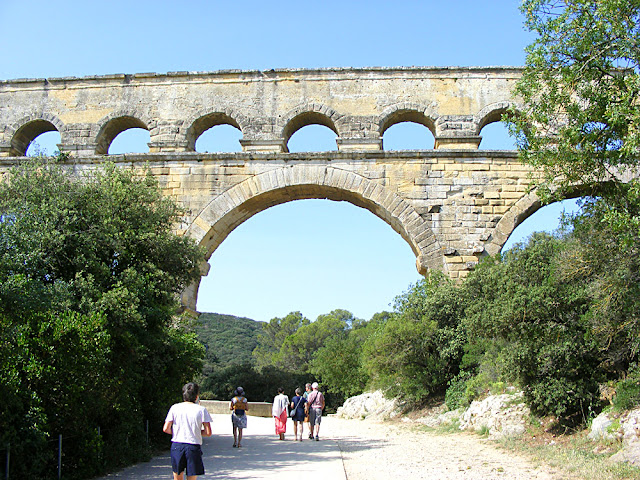
Pont du Gard, France. Photo by Loire Valley Time Travel.

In the Middle Ages and again in the 17th century the piles of the second level had a section removed to allow the structure to be used as a road bridge. This dangerously destabilised the structure, and the damage was eventually repaired in the 18th century. From the 16th century the exceptional architecture of the bridge attracted attention and it benefitted from regular restorations intended to preserve its integrity. An actual road bridge was built abutting the aqueduct in the mid-18th century. It is the highest aqueduct bridge known from the Roman world and is now listed as UNESCO World Heritage.


You can see the triple arches that form each of the second level arches in this photo, the road bridge added in the 18th century (now pedestrianised) and the projecting stones for supporting scaffolding.
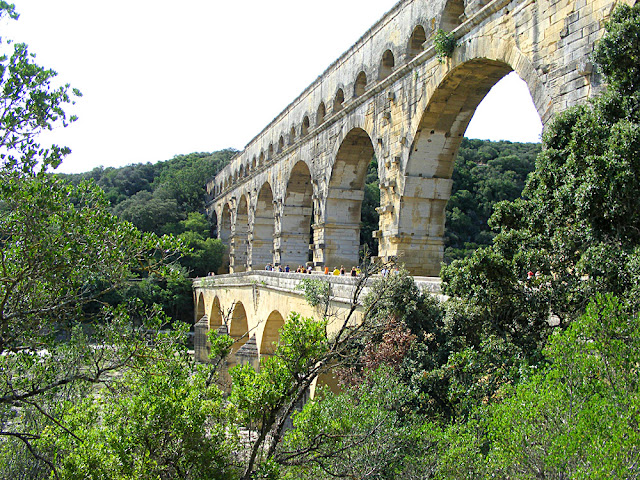
Pont du Gard, France. Photo by Loire Valley Time Travel.

The total length of the aqueduct that the bridge forms part of is 52 kilometres, 35 kilometres of which is underground, as is more typical of Roman aqueducts. It is testiment to the extraordinary engineering skills of those that constructed it. The fall from Uzes to Nimes is only 12.6 metres, and the distance between the two as the crow flies about 20 kilometres. However, the aqueduct has to snake about all over the countryside because of the lay of the land. In addition there was the challenge of making the structure strong enough to withstand the tremendous floods that the Gardon is prone to. Dating the structure is possible because of pieces of ceramics and coins found inside. It is estimated that a thousand workers must have laboured for 5 years to complete it. The gradient on the the aqueduct bridge itself is a fall of 2.5 centimetres in 456 metres. The gradient varies quite a bit along the route of the aqueduct, but the engineers were manipulating as best they could the extremely shallow fall, partly to be able to limit the height of the already exceptionally high bridge.


Simon entering the aqueduct channel on top of the bridge.

Pont du Gard, France. Photo by Loire Valley Time Travel.

There are 11 million blocks of stone in the structure, weighing a total of 50 400 tonnes. They were hoisted into place by means of a 'squirrel cage' (a pulley system powered by a man walking on a treadmill). There was scaffolding supported by stones projecting from the bridge, and the arches were supported by wooden forms whilst under construction. Each of the big arches are constructed as multiple independent arches which abut one another. This technique of 'ring vaulting' was used on other Roman bridges too.


You can see in this photo how much the limescale has accumulated and constricted the conduit.

Pont du Gard, France. Photo by Loire Valley Time Travel.

The aqueduct carried on average 400 000 cubic metres of water per day (460 litres per second). The water took a day to travel from the source at Uzes to the collection basin in Nimes. In fact, Nimes had several wells and a nearby spring, so the aqueduct was not a necessity, but rather a prestige project, to feed the baths, gardens and fountains in the town.


Fortunately I worked out quite quickly that if 'Topknot Woman' could walk through without bending, then so could I.

Pont du Gard, France. Photo by Loire Valley Time Travel.

From the 4th century it ceased to be maintained and mineral deposits built up, reducing capacity by two thirds or even three quarters. The lack of maintenance probably coincided with the take over of Uzes by the Franks and of Nimes by the Visigoths. The aqueduct began to be used as a handy repository of building material.


Looking back through the aqueduct.

Pont du Gard, France. Photo by Loire Valley Time Travel.

The stone came originally from nearby quarries. On the exterior of the arches you can see stones which project, which were for supporting scaffolding as the bridge went up. The stones are marked to indicate their position and there are apparently some witch marks (phalluses scratched into the stone to ward away evil). We didn't see any of this, but there is plenty of graffiti all over the stones, put there by people over the centuries who have come to see the famous bridge. Many journeymen masons have left their mark on a structure they considered to be an obligatory stop on their traditional tour around France as they honed their trade. Those on an 18th century Grand Tour also considered it an obligatory stop, as did a number of French kings on tour with their courts.


Looking downstream from the top of the aqueduct bridge. If I visit again I'll make sure to bring my swimsuit.

Pont du Gard, France. Photo by Loire Valley Time Travel.

On the upstream side the wall of the bridge bulges out, a result of the expansion and contraction of the stones over a long period of time as the temperature changes. The bridge was constructed without mortar, and instead used oak tenons to lock together the blocks of stone, some of them up to 6 tonnes in weight. Only the upper level uses rubble stones held together with mortar. The stone used is a local shelly limestone, rather coarse, easy to cut and full of shells.


The groove in the top of the aqueduct bridge wall was made from thousands of feet walking across over the centuries. No guard rail. One side for crossing in one direction, the other side for crossing in the other direction.

Pont du Gard, France. Photo by Loire Valley Time Travel.

The enclosed aqueduct channel is 1.8 metres high and was sealed with Roman lime based cement then painted with a reddish iron oxide limewash, which was to prevent the limescale in the water degrading the surface. It is big enough for a man to easily enter to do maintenance, a big part of which was removing debris and vegetation from the structure.


Our guide demonstrates the construction of the aqueduct channel. Everything to the left of her hands is limescale. She is indicating the rubble stones and mortar layer which is the actual construction. Between the two there is a narrow band of cement which seals the channel.

Pont du Gard, France. Photo by Loire Valley Time Travel.

Despite the age and tribulations of the edifice, it has never suffered serious structural damage from the legendary Gardon floods. In 2002 the flood waters rose to three quarters of the way up the lower arches. In 1958 the waters rose all the way up to completely cover the lower level of the aqueduct bridge.


Some distance from the bridge the aqueduct dives off into the undergrowth.

Pont du Gard, France. Photo by Loire Valley Time Travel.

From the beginning of the 21st century a lot of work has been done to improve the site, remove the tourist tat and protect it from the influx of visitors. There is a museum and the surrounding landscape has been carefully restored. Access to the site is by foot only, and access to the Roman aqueduct by guided tour only. It is one of the most visited heritage monuments in France, with about a million and a half visitors annually.

Friday, 1 December 2023

Walking From Abilly

This 6 kilometre walk with the Phoenix en Claise group was cancelled three weeks in a row because of bad weather, before we finally managed to get out on Monday 20 November 2023.

Fallen London Plane tree Platanus hispanica (Fr. Platane commun) leaves at the entrance to the Chateau of Abilly.

London Plane tree leaves, Indre et Loire, France. Photo by Loire Valley Time Travel.

I think this is Cloud Funnel Clitocybe nebularis (Fr. Clitocybe nébuleux). This species is widely considered to be edible, but it has a very unpleasant cats piss smell, so I don't know why anyone does. Plus it is so similar to a couple of species toxic enough to give you a very uncomfortable time if you misidentify it. [Update: ID confirmed by Didier Raas.]

Clouded Funnel Clitocybe nebularis, Indre et Loire, France. Photo by Loire Valley Time Travel.

Dog Rose Rosa canina (Fr. Rosier des chiens) with beautiful pink thorns.

Dog Rose Rosa canina, Indre et Loire, France. Photo by Loire Valley Time Travel.

A pair of Percheron draft horses watch us pass under ominous skies.

Percheron horses, Indre et Loire, France. Photo by Loire Valley Time Travel.

Dog Rose hips (Fr. gratte-culs -- literally 'itchy arses', because the fine hairs inside the hips are so irritating to the digestive system when the hips are eaten).

Dog Rose Rosa canina hips, Indre et Loire, France. Photo by Loire Valley Time Travel.

La Manoir de la Chatiere, a medieval fortified farm.

Fortified medieval farm house, Indre et Loire, France. Photo by Loire Valley Time Travel.

The beautiful pink and orange berries of a Spindle Tree Euonymus europaeus (Fr. Fusain).

Spindle Tree Euonymous europaeus, Indre et Loire, France. Photo by Loire Valley Time Travel.

White Saddle mushroom Helvella crispa (Fr. Helvelle crépue). This is what they look like -- sort of torn and ragged, with very corded looking stems. They are typically found along tracks, as these were.

White Saddle mushroom Helvella crispa, Indre et Loire, France. Photo by Loire Valley Time Travel.

Reflections in the mill pond that would once have been part of the chateau estate.

Reflections in a mill pond, Indre et Loire, France. Photo by Loire Valley Time Travel.