Thursday, 9 April 2020

A Walk in the Woods (2012)


At this time of year I should be going on botany outings at least once every couple of weeks. But not now while the Covid-19 lockdown is in place. So here is a repost from 9 April 2012 to give you a flavour of how a spring botany outing goes.

*********************************************

A Polypodium sp fern growing out of a limestone rock.
Polypodium sp fern.  Indre et Loire, France. Photographed by Susan Walter. Tour the Loire Valley with a classic car and a private guide.
The second part of the botanical club outing on 1 April was to a limestone butt along the Vallée du Feuillet on the outskirts of Truyes (part one is here). These limestone butts are common in the southern Touraine and botanically outstandingly rich. All sorts of lime loving plants spring up here, often growing directly out of the soft limestone rocks themselves. Some, like the hellebores and daphnes, periwinkles and polypody ferns that we found are better known these days as garden plants. It's a real privilege to see them in the wild.

An ancient walled path along one edge of the ridge.
An old stone wall.  Indre et Loire, France. Photographed by Susan Walter. Tour the Loire Valley with a classic car and a private guide.
All through the woodland there are violets growing under the trees. There are at least three different species and it was a good opportunity to compare very similar species such as the Early Dog Violet and the Common Dog Violet. I was jolly glad I spent the winter updating Loire Valley Nature and was up to speed with how to identify violets to species level.

Common Dog Violet (with pale, thick, notched spur, if you are interested)
Common Dog Violet Viola riviniana.  Indre et Loire, France. Photographed by Susan Walter. Tour the Loire Valley with a classic car and a private guide.

Early Dog Violet Viola reichenbachiana
(with dark pointed spur and 'rabbit ear' top petals)
Early Dog Violet Viola reichenbachiana.  Indre et Loire, France. Photographed by Susan Walter. Tour the Loire Valley with a classic car and a private guide.
We didn't spend the whole time botanising either. In amongst the dead fallen leaves of winter and the spring wild flowers there were several oil beetles. I got some excellent French practice in by telling the group about oil beetles. Naturally, on these occasions, half my vocabulary and a good deal of my grammar and syntax mysteriously disappears.

Oil beetles are part of a family that contain a poison called cantharidin. This toxin is the active ingredient in aphrodisiac mixtures that predate viagra. They work, but it is all too easy to take a lethal dose. The beetle eats toxic plants to accumulate the poison in its body - in this case members of the buttercup family, especially Wood Anemone. While we were observing an oil beetle it started to ooze orange liquid from its knees, a sign it was getting a bit stressed and attempting to warn us off by producing the poison. Thanks to Tim photographing a couple a few days earlier and needing a species ID, I had been reading up on oil beetles only the day before the outing and knew lots of detail about these unusual and increasingly uncommon creatures.

A male Violet Oil Beetle Meloe violaceus...
Male Violet Oil Beetle Meloe violaceus.   Indre et Loire, France. Photographed by Susan Walter. Tour the Loire Valley with a classic car and a private guide.

...and his food plant Wood Anemone Anemone nemorosa
Wood Anemone Anemone nemorosa.  Indre et Loire, France. Photographed by Susan Walter. Tour the Loire Valley with a classic car and a private guide.
A newish housing development of maybe 20 homes nestles at the base of the limestone outcrop. The houses seem to be occupied by couples in their 30s with school aged children. The way the houses have been integrated into the landscape is rather well done, with a combination of suburban neighbourhood and house in the woods achieved. I thought it looked like a pretty good place to grow up. I hope they know how special their limestone woods are.

Susan

************************************************

For details of our private guided tours of chateaux, gardens, wineries, markets and more please visit the Loire Valley Time Travel website. We would be delighted to design a tour for you.

We are also on Instagram, so check us out to see a regularly updated selection of our very best photos. 

Wednesday, 8 April 2020

Our Very First Tour (2010)


We are still in lockdown so here is another repost. This one is an account of our very first real tour as Loire Valley Time Travel with real paying clients, from 8 April 2010.

*******************************************

Célestine with Chenonceau in the background.
Citroen Traction Avant with the Chateau of Chenonceau.  Indre et Loire, France. Photographed by Susan Walter. Tour the Loire Valley with a classic car and a private guide.We went up to Tours in Célestine yesterday to meet Scott from New York and his mother Sally from Alaska for a day excursion while they are on holiday in France. They braved a train strike to get from Paris to Tours, and I hope they got back OK, as today is Sally's birthday (Happy Birthday to you, Sally). After the hustle and bustle of a few days in Paris they found it very pleasant to come to the peace and quiet of the Touraine for a day.

The gardens at Chenonceau are looking pretty.
Catherine de Medici garden at the Chateau of Chenonceau.  Indre et Loire, France. Photographed by Susan Walter. Tour the Loire Valley with a classic car and a private guide.
The predicted rain held off and we visited Chenonceau, lunched at Le Bonheur est Dans le Pré in Bléré (pronounced the best lunch they've had so far in France by Scott), then on to Clos Lucé in Amboise, Leonardo da Vinci's last home (where they've made a little Leonardo go a loooooong way!).

After that we dropped in to the Château Gaudrelle caves on the Quai de la Loire in Rochecorbon (Vouvray), which Sally loved. We tasted a range of 8 wines, from a dry sparkling white (€6/bottle) through to a sweet dessert wine (€18/half bottle). It was a most interesting lesson in how terroir influences wines because we had the opportunity to taste two wines made the same year, from the same grape variety, same age vines, growing only metres apart. These two wines were completely different, and the only variable is that the soil changes in those few metres from argilo-siliceuse (sandy clay, somewhat acidic) to argilo-calcaire (clay and limestone, which is alkaline). The dessert wine is made with grapes that are allowed to dry on the vine until they are like dried currants. Hence the sugar is very concentrated (140g compared to 3g in the still dry white). It's more expensive because the same quantity of grapes produces far less wine. After being shown the wine production areas we all bought a selection of wine and who should we bump into there but Jim Budd, the wine writer, who has also written about his visit on his blog.

Jim Budd (left) with Alexandre Monmousseau,the owner / winemaker of the Château Gaudrelle
winery, with Scott in the background buying winefrom Alexandre's partner Eric Pasquier.
Tasting room at Chateau Gaudrelle, Vouvray.  Indre et Loire, France. Photographed by Susan Walter. Tour the Loire Valley with a classic car and a private guide.
To finish off the day we went round the as ever impressive gardens at Villandry, then it was back to Tours so Scott and Sally could catch their train back to Paris.

Susan

************************************************

For details of our private guided tours of chateaux, gardens, wineries, markets and more please visit the Loire Valley Time Travel website. We would be delighted to design a tour for you.

We are also on Instagram, so check us out to see a regularly updated selection of our very best photos. 

Tuesday, 7 April 2020

Fromagerie Moreau, Pontlevoy (2015)


Five years ago we had clients who were goats cheese producers from Michigan. They wanted to meet French goats cheese makers. A friend recommended we contact Jean Luc Bilien at Fromagerie Moreau in Pontlevoy. Our subsequent lunch with him and visit to the fromagerie was a great success, and we've been friends ever since.

This is a repost from 7 April 2015, in the absence of anything new and exciting happening while we are in lockdown.

**********************************************

Goats cheese maturing. Loir et Cher. France. Photographed by Susan Walter. Tour the Loire Valley with a classic car and a private guide.

The Fromagerie Moreau is conveniently situated in a 19th century farmyard right in the small town of Pontlevoy. For the past 4 years it has been owned and run by Jean Luc Bilien. When the Moreaus wished to retire Jean-Luc purchased the fromagerie part of the business and their farmhand purchased the goats.

Topping up Selles sur Cher moulds. 
All that curd will drain down to about a third of the mould.
Topping up Selles sur Cher goats cheese moulds with more curd. Loir et Cher. France. Photographed by Susan Walter. Tour the Loire Valley with a classic car and a private guide.

Now the goats live on a farm about 4 km away and the farmer supplies Jean-Luc exclusively with milk for the cheese. The fromagerie makes AOP Sainte Maure de Touraine and Selles sur Cher cheeses. They are classed as artisanal (not farmhouse), as the cheese is made from milk purchased from the farm ie they are two separate businesses, not all under one roof.

Experiments and special orders tucked away in a corner of the drying room.
Experimental and special order goats cheeses maturing. Loir et Cher. France. Photographed by Susan Walter. Tour the Loire Valley with a classic car and a private guide.

Jean Luc originally trained as an agronomist, but when he left university he went to Brazil and ended up working in a cheese factory, training on the job as a cheesemaker. When he and his Brazilian wife and their children returned to France to live he wanted to make cheese in a less industrial fashion and so he bought Fromagerie Moreau.

The fromagerie's AOP cheeses, 
Sainte Maure de Touraine logs and Selles sur Cher disks.
Sainte Maure de Touraine and Selles sur Cher goats cheeses. Loir et Cher. France. Photographed by Susan Walter. Tour the Loire Valley with a classic car and a private guide.

Almost all of the cheese is sold in Paris, loaded into the fromagerie's own trucks and delivered to cheese shops and restaurants all over the city on Mondays. Only 4% of the cheese is sold direct from the farm or at the weekly market in Montrichard. Nevertheless, Jean Luc is happy to welcome visitors to the fromagerie.

The non-AOP cheeses, faisselle (fresh curd), pyramids, pavés and crottins.
A selection of artisanal goats cheeses. Loir et Cher. France. Photographed by Susan Walter. Tour the Loire Valley with a classic car and a private guide.

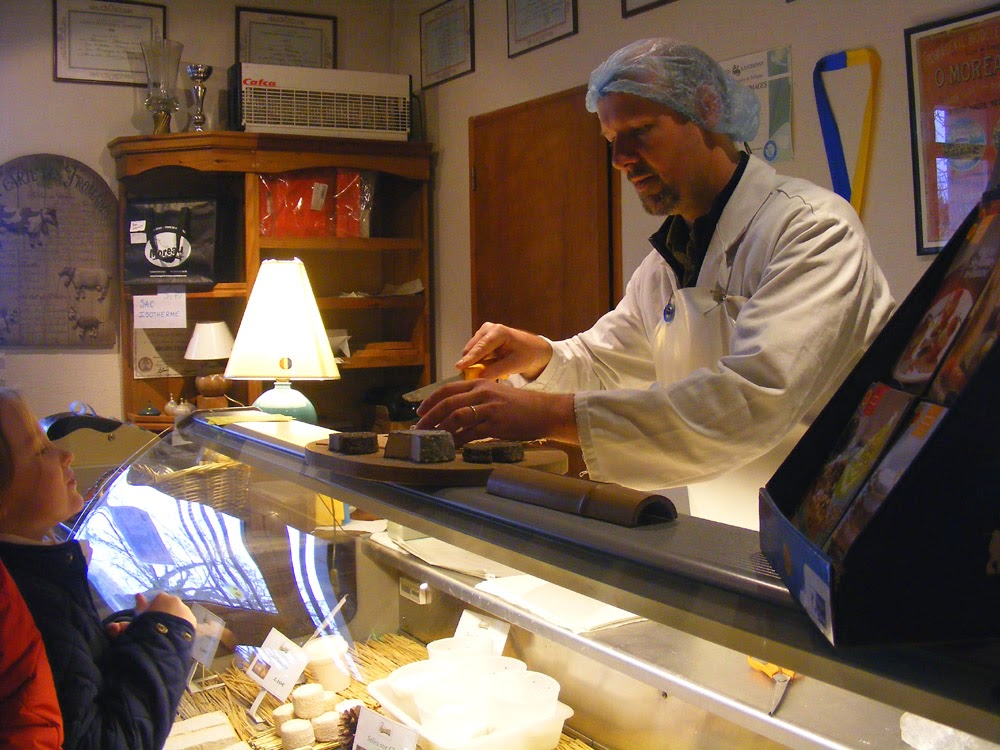
There is a well stocked shop selling his cheese and other local artisanal products such as wine, onion and fig preserves, honey and terrines. The cheese is not sold by weight but by the piece. Alongside his AOP cheeses he also offers pavé de Pontlevoy, crottins and pyramids.

Jean Luc carefully cutting tasting samples.
Sampling goats cheese in a farm shop. Loir et Cher. France. Photographed by Susan Walter. Tour the Loire Valley with a classic car and a private guide.

If you are interested you can also watch the cheese being put into moulds, and if there is a group of you and you book, you can do a full tour which includes visiting the farm and the goats. Jean Luc has converted part of the longère building to a classroom and produced an excellent video that can be shown in either English or French so visitors learn about the entire process on the farm and in the fromagerie.

Selles sur Cher of different ages, for tasting.
A tasting platter of different ages of Selles sur Cher goats cheese. Loir et Cher. France. Photographed by Susan Walter. Tour the Loire Valley with a classic car and a private guide.

He has a staff of 8 people, none of whom came from a cheesemaking background, and have all learned on the job. He is proud of them and quick to praise them and tell you what a great team they make. 

Sainte Maure de Touraine goats cheese in the maturing cellar. Loir et Cher. France. Photographed by Susan Walter. Tour the Loire Valley with a classic car and a private guide.


************************************************

For details of our private guided tours of chateaux, gardens, wineries, markets and more please visit the Loire Valley Time Travel website. We would be delighted to design a tour for you.

We are also on Instagram, so check us out to see a regularly updated selection of our very best photos. 

Monday, 6 April 2020

Pate de Paques Berrichon


Baked and photographed by Susan Walter. Tour the Loire Valley with a classic car and a private guide.

Pâté de Pâques berrichon translates as 'Berry Easter Paté' and is a speciality of the area just to the east of us known as the Berry. It is sausage meat and hard boiled eggs wrapped in pastry and appears in all the local boulangeries and butchers for the two weeks surrounding Easter. It is tasty and popular and last year I thought I would tackle it myself for the first time. It turns out to be quite easy to make.

Cooked and photographed by Susan Walter. Tour the Loire Valley with a classic car and a private guide.

Ingredients
A quantity of flaky pastry
200 g sausage meat
3 hard boiled eggs
Some sprigs of parsley, roughly chopped
2 cloves garlic, crushed
Freshly ground pepper (a blend of different peppercorns is nice)
Salt
Freshly ground nutmeg
A beaten egg to glaze

Method
  1. Heat the oven to 250°C.
  2. Mix the meat with the parsley, garlic, pepper, salt and nutmeg to taste. 
  3. Roll the pastry into a rectangle 35 cm x 20 cm.
  4. Form the meat into a sausage shape about 30 cm long and place slightly off center along the length of the pastry.
  5. Cut the eggs in half and place along the top of the sausage meat.
  6. Brush the long edge of the pastry nearest to the meat with egg, fold over the pastry and enclose the filling, pressing, pinching or folding to make sure you have a good seal all around.
  7. Transfer to a silicone lined backing tray.
  8. Brush the top of the pastry with egg and cut a couple of small air vents in the top.
  9. Put in the oven, turn the temperature down to 200°C and bake for 30 minutes.
  10. Feeds 6-8 warm or cold.
Baked and photographed by Susan Walter.  Tour the Loire Valley with a classic car and a private guide.
In case you are wondering, I doubled the quantities and made two at once.

I had homemade flaky pastry dough in the freezer, but of course, ready rolled from the supermarket is an option too.

Baked and photographed by Susan Walter. Tour the Loire Valley with a classic car and a private guide.

Traditionally the sausage meat would be a 50/50 mixture of pork and veal, easily available here in the Touraine, but you could substitute 100% pork if veal mince isn't a thing where you live.

Baked and photographed by Susan Walter. Tour the Loire Valley with a classic car and a private guide.

I steamed the eggs (which came from the much pampered hens belonging to some friends) rather than boiled them. It makes them easier to peel.


Yum

************************************************

For details of our private guided tours of chateaux, gardens, wineries, markets and more please visit the Loire Valley Time Travel website. We would be delighted to design a tour for you.

We are also on Instagram, so check us out to see a regularly updated selection of our very best photos. 

Sunday, 5 April 2020

Grist Artisan Baker, Kyneton


Grist is an artisan baker in Kyneton, Victoria, Australia. The building they occupy is an old 1830s flour mill and our friends Sue and Leon, who live in a nearby town, took us there for coffee and pastries back in December 2017. Just like artisan small businesses in France they are currently struggling to cope with the changes to lives and shopping habits that Covid-19 has caused.

An old milling machine.
Old flour milling machine, Kyneton, Victoria, Australia.  Photographed by Susan Walter. Tour the Loire Valley with a classic car and a private guide.

Entering Grist.
Grist Artisan Bakers, Kyneton, Victoria, Australia. Photographed by Susan Walter. Tour the Loire Valley with a classic car and a private guide.

The counter.
Grist Artisan Bakers, Kyneton, Victoria, Australia. Photographed by Susan Walter. Tour the Loire Valley with a classic car and a private guide.

Old repairs to the floor.
The floor at Grist Artisan Bakers, Kyneton, Victoria, Australia. Photographed by Susan Walter. Tour the Loire Valley with a classic car and a private guide.

French style composite millstone on the veranda.
French style composite millstone on the veranda  of Grist Artisan Bakers, Kyneton, Victoria, Australia. Photographed by Susan Walter. Tour the Loire Valley with a classic car and a private guide.

Sue and Leon.
Having coffee and pastries at Grist Artisan Bakers, Kyneton, Victoria, Australia. Photographed by Susan Walter. Tour the Loire Valley with a classic car and a private guide.


************************************************

For details of our private guided tours of chateaux, gardens, wineries, markets and more please visit the Loire Valley Time Travel website. We would be delighted to design a tour for you.

We are also on Instagram, so check us out to see a regularly updated selection of our very best photos. 

Saturday, 4 April 2020

Disabled Accessible Beach


Disabled accessible beach, Saint Jean de Luz. Pyrenees-Atlantiques. France. Photographed by Susan Walter. Tour the Loire Valley with a classic car and a private guide.

Saint Jean de Luz has a section of their Grand Plage ('big beach') set up so it is accessible for those with reduced mobility and/or sight loss.

Disabled accessible beach, Saint Jean de Luz. Pyrenees-Atlantiques. France. Photographed by Susan Walter. Tour the Loire Valley with a classic car and a private guide.

A specialist assistant is present during July and August. An audio system helps those with sight loss get to the beach more easily. Three adapted chairs, with floats and fat tyres are available so people with reduced mobility can get over the sand and into the water, under the supervision of a professional carer. A boardwalk has been laid down from the street to the specially equipped section of the beach.

Disabled accessible beach, Saint Jean de Luz. Pyrenees-Atlantiques. France. Photographed by Susan Walter. Tour the Loire Valley with a classic car and a private guide.

The specialist assistants are available to help you with the adapted chairs every afternoon in July and August. From May to September you can come with your own carer and get access to the adapted chairs independently from 11 am to 6 pm, on presentation of your disability card. 


************************************************

For details of our private guided tours of chateaux, gardens, wineries, markets and more please visit the Loire Valley Time Travel website. We would be delighted to design a tour for you.

We are also on Instagram, so check us out to see a regularly updated selection of our very best photos. 

Friday, 3 April 2020

Anniversary of Our First Night in the House (2007)


It is the thirteenth anniversary of our first night in our house in Preuilly. We hadn't moved in at that point, but were still just coming over from London from time to time. It was like camping we had so few home comforts. This is a repost from 3 April 2007.

**************************************

This was a long standing planned trip, partly in order to try put a little pressure on M.Galland (the roofer) to start soon.

We had booked on SpeedFerries, leaving on their first sailing of the new season. On the Monday before we left we received an email saying that the start of service had to be delayed, so we had to make alternate arrangements. Luckily I was able to book a ticket with Norfolk Lines, which is a longer journey (2 hours to Dunkerque, which also adds the best part of an hour to the drive) so all was not lost. The amended booking meant that we had to leave home at 3.30am in order to make our 6.00am sailing from Dover, which meant that by the time we arrived in Preuilly we had been on the road for 13 hours including a diversion through Rouen, a town which appears to have me totally jinxed.

Our first port of call was M. Bertucelli to check on the plumbing works, which we were assured were complete. This caused us to rush to the house, as the thought of having our own toilet was very exciting.

Renovations in progress.  Indre et Loire, France. Photographed by Susan Walter. Tour the Loire Valley with a classic car and a private guide.

Arriving at the house, first port of call was to wonder at the new technology - a flushing WC. We flushed, and the cistern didn't fill up. I turned on the stopcock inside the house (which made no difference) so we moved outside to the external stopcock. This is a metre under a metal plate in the middle of our neighbour's driveway. I leaned into the hole to turn the water on... and my mobile phone and hankie dropped out of my pocket into 6 inches of muddy water. I don't know if it was the sacrifice of my phone that caused the water to flow (could have been turning the tap on) but we now have tapwater and a flushing WC. Excellent!!

The next move was to set up our kerosene heater (donated to us from the junk left by previous tenants of our house in London). This meant a trip to Yzeures to buy fuel and various foodstuffs. It's always a pleasure to wander around a hardware store after driving for 13 hours....

We had our first dinner together in the house, vegetable soup, followed by bacon and beans and pastries for dessert. We weren't exactly warm, but the heater took the edge of what was to be a cold night.

Eating our first meal in our French house in 2007.  Indre et Loire, France. Photographed by Susan Walter. Tour the Loire Valley with a classic car and a private guide.
It rained during the night, which meant our slumbers were accompanied by the sound of dripping water, but at least none of it entered the room we were sleeping in. We did decided, however, that we would erect our picnic tent/gazebo thing in the front room, and put the bed in there. This would provide us with a waterproof roof, and a lot more room so we could set up washing facilities. It also means that we can have our clothing in the same room we sleep in, making inter-room dashes in the cold unnecessary.

Bed set up inside in a tent while we renovate.  Indre et Loire, France. Photographed by Susan Walter. Tour the Loire Valley with a classic car and a private guide.
Friday was occupied with cleaning the front room, setting up the tent, moving the bed, putting a curtain over the space a door would normally occupy (and will, one day, occupy again). We also found time to visit M. Galland, the bank and the supermarket (and the hardware store). This set the pattern for the weekend - cleaning, visiting hardware stores, and plotting how we will proceed with the work.


The dump/recycling depot.  Indre et Loire, France. Photographed by Susan Walter. Tour the Loire Valley with a classic car and a private guide.The only real diversion came on Saturday, when we met the man from the dechetterie (the local dump, although it's more of a transfer station) whom our neighbours had organised to remove the piles of cuttings from our garden. He took a trailer of clippings to the tip, and we followed. He explained the system to us, and we trotted off to collect our own carload of stuff to junk. Most of it was "mixte", but we did have some glass, wood and cardboard which went in their respective skips, as did the old paintbrush cleaning mixture. As they say in the area; "Au pays de Descartes, je pense, donc je trie" (In the land of Descartes, I think, therefore I sort).

Cowslips
Cowslip Primula veris.  Indre et Loire, France. Photographed by Susan Walter. Tour the Loire Valley with a classic car and a private guide.
 We were amazed by how cold it was, considering how advanced spring seems to be. All the roadsides were covered in cowslips (coucou in French, the first of the wild primroses to appear) and the cherries and plums were blooming, as were the magnolias. Until recently, cowslips were big news in England, as modern farming techniques had destroyed much of their habitat. Thankfully they are on the way back in the UK, but we have never seen them in these numbers

On Sunday afternoon we rewarded ourselves with a drive in the country. as we drove on the road towards le Grand Pressigny (a trip we have done many times) I noticed, for the first time, the chateau at Etableau, a hamlet about 1.5 km from le Grand Pressigny. Why we have never noticed this before I can't say. It isn't as if it is small or anything....

Etableau.

Chateau d'Etableau.  Indre et Loire, France. Photographed by Susan Walter. Tour the Loire Valley with a classic car and a private guide.
Ruined keep of the chateau of Le Grand Pressigny.  Indre et Loire, France. Photographed by Susan Walter. Tour the Loire Valley with a classic car and a private guide. 
We also saw a different view of the chateau at le Grand Pressigny, which makes it look like a cutaway from a Richard Scarry book.

Although it sometimes feels like we aren't progressing with the house, it is coming on peu en peu and we are getting a lot better idea of what it is we want to do with it, which is a lot better than acting before you've decided!!

Simon

************************************************

For details of our private guided tours of chateaux, gardens, wineries, markets and more please visit the Loire Valley Time Travel website. We would be delighted to design a tour for you.

We are also on Instagram, so check us out to see a regularly updated selection of our very best photos. 

Thursday, 2 April 2020

Wild Tulips (2016)


This is a repost from 2 April 2016. The tulips have been lovely this year by all accounts, but I can't get up there to see them.

Wild Tulip Tulipa sylvestris.  Indre et Loire, France. Photographed by Susan Walter. Tour the Loire Valley with a classic car and a private guide.

Last year Jim Budd wrote about having visited the Vouvray vineyards and being shown Wild Tulip Tulipa sylvestris (Fr. Tulipe des bois). Until then I had no idea the species occurred here so I made a note in my diary to check them out this year. I asked our friends at Chateau Gaudrelle if they had any in their parcels and luckily they do.

Wild Tulip Tulipa sylvestris.  Indre et Loire, France. Photographed by Susan Walter. Tour the Loire Valley with a classic car and a private guide.

Armed with my map annotated with an 'x marks the spot' by Cyril, the cellar master, I set out on the Thursday  before Easter to see them. Aurore, the office manager, thought late March was a bit early for them and offered to send me an email when they'd been observed flowering, but Alexandre Monmousseau, the owner and winemaker, told me that he had seen the first flowers already. He also told me that once the predicted rain over Easter came through, the fragile tulip flowers would be toast. So, it was Thursday or never.

There is an abandoned tourist train just behind the tulip colony, for reasons that were not apparent.
Wild Tulip Tulipa sylvestris.  Indre et Loire, France. Photographed by Susan Walter. Tour the Loire Valley with a classic car and a private guide.

The tulips turned out to be extremely easy to find, under a walnut tree by a track near Chateau Gaudrelle, as described. They have a seductive charm despite the fact that only about 10% of the population ever flowers each year. The flowers are delicate and graceful, and it was clear that all the Chateau Gaudrelle staff loved them and were proud to be their guardians. Charles, the commercial services manager, commented that it made him mad when he saw daytrippers in the vineyards making off with fistfuls of wildflowers like these tulips.

Tulips, with the vineyard in the background.
Wild Tulip Tulipa sylvestris.  Indre et Loire, France. Photographed by Susan Walter. Tour the Loire Valley with a classic car and a private guide.

They used to be common along the Loire from Orleans to Nantes, but within a decade or two of widespread herbicide usage in the vineyards beginning in the 1970s, they had become very rare. Increased urbanisation in the 1960s also had an effect on the population in certain areas. Vineyards gained a reputation for being biodiversity wastelands, and the wine industry still accounts for 20% of agricultural pesticide use in France. Happily in the Touraine Loire Valley there are now a significant number of vineyards like Chateau Gaudrelle which are extremely careful about their pesticide use, applying products only when necessary and not by the calendar. They are also always looking for the most appropriate product for the job, and will spurn sprays altogether if something like pheromone capsules work just as well. Importantly they are no longer using copper based sprays to control fungal diseases.

It is unclear whether these tulips are native to the Loire Valley or whether they were introduced into gardens in the 16th century and are now a relict population of naturalised plants. My feeling is that the Loire is probably the northern limit of their natural range (like so many Mediterranean species). They can be found in Southern Europe and North Africa right through to Central Asia. They are also cultivated and bulbs are reasonably easy to obtain for the plantsman style gardener, although apparently you have to be a bit careful you are not sold a lookalike modern cultivar.

Wild Tulip Tulipa sylvestris.  Indre et Loire, France. Photographed by Susan Walter. Tour the Loire Valley with a classic car and a private guide.

Despite their scientific name of sylvestris, they are not really a woodland plant. Where they are growing at Chateau Gaudrelle is very typical. They like dry chalky soil near isolated trees, and will also grow amongst the vines themselves. Colonies can be hundreds of plants, but most of them don't flower. The flowers themselves don't persist very long, and touching them or bad weather can make the petals drop.

Wild Tulip Tulipa sylvestris.  Indre et Loire, France. Photographed by Susan Walter. Tour the Loire Valley with a classic car and a private guide.

They are also apparently scented, but I didn't realise this when I was photographing them and although I got quite close to them, the scent must be quite delicate, because I didn't notice it. None of them were open, as it was a dull day and around 5pm in the evening.

The tulips stretch all the way along the track to the corner.
Wild Tulip Tulipa sylvestris.  Indre et Loire, France. Photographed by Susan Walter. Tour the Loire Valley with a classic car and a private guide.

Seeing these flowers and reading about their decline in my lifetime made me reflect on how impoverished and banalised our environment has become in the 21st century. These plants have a brief and what would once have been a glorious flowering period. Now they are tucked in to tiny pockets where they are out of the reach of intensive farming. The loss of this particular species wasn't even slow and insidious as has been the case with so many plants and insects. In under two decades Wild Tulips went from abundant and ubiquitous in the vineyards to being declared endangered. It's really shocking and disturbing. Nowadays there is an awareness and a pride in these disappearing species, but it seems unlikely we will ever get back to the days of clouds of butterflies and carpets of wild flowers. One reason is that the soil is still widely regarded as nothing more than a cheap growing medium. The matrix between time, labour, products, yield and net income requires more and more attention from the farmer and they have few incentives other than the cost of products and personal beliefs to farm in anything but the most pragmatic and compromised way. Another reason is that very few people now remember what it used to be like, and younger people have no idea that the natural world could possibly be as fecund and beautiful as the records suggest. We have an idea of nature and healthy ecologies that is already grossly degraded and limited.

Chateau Gaudrelle, no longer owned by the Monmousseau family,
but they still own the surrounding chenin blanc vines.
Chateau Gaudrelle and vines Indre et Loire, France. Photographed by Susan Walter. Tour the Loire Valley with a classic car and a private guide.

Why does this matter? It matters because soil all over the world is poisoned (in vineyards and many other places by copper and arsenic), losing fertility and/or disappearing. Everything we eat comes from or depends on the soil, and the health of our soil also impacts on how well we can manage the effects of extreme weather.

Wild Tulip Tulipa sylvestris.  Indre et Loire, France. Photographed by Susan Walter. Tour the Loire Valley with a classic car and a private guide.

I was accompanied on my outing to see the tulips by Tim and Pauline of Aigronne Valley Wildlife. Their post about the tulips is here.

Many thanks to Chateau Gaudrelle for allowing me free access to their vine parcels and being so helpful when I expressed a wish to see the tulips. You can read more about what we've written about the Vouvray winery Chateau Gaudrelle here.

You can read more about the nature of the Touraine Loire Valley on our other blog, Loire Valley Nature. 

******************************************************

A la cuisine hier: Green Goddess Macaroni and Cheese, which was macaroni cheese with added chard. As you can see the steady supply of cheddar continues to be appreciated. Plus, I had half a litre of four day old raw milk that wasn't going to last it through the night to five days in consumable condition. Turning it into cheese sauce allowed me to feel righteous.

Dessert was the last of a rustic mirabelle tart (supermarket pastry, mirabelles from the freezer), with supermarket icecream.


************************************************

For details of our private guided tours of chateaux, gardens, wineries, markets and more please visit the Loire Valley Time Travel website. We would be delighted to design a tour for you.

We are also on Instagram, so check us out to see a regularly updated selection of our very best photos. 

Wednesday, 1 April 2020

Shopping in the Pandemic


Hand washing facilities.
Hand washing facilities on a farm (photo taken during Covid-19 lockdown).  Indre et Loire, France. Photographed by Susan Walter. Tour the Loire Valley with a classic car and a private guide.

People are trying to shop as little as possible and somewhere that won't be too crowded. They also want to support local businesses, so one of the few businesses that I suspect may come out of all this as a winner is Sylvain Bardon's Jardins Vergers de la Petite Rabaudière, the organic market garden on the edge of town.

Customers keeping their distance, and the occasional face mask.
Farm shop during Covid-19 lockdown.  Indre et Loire, France. Photographed by Susan Walter. Tour the Loire Valley with a classic car and a private guide.

The farm shop is open on Monday evenings between five and seven o'clock. When I arrived at five o'clock I was fifth in line. Only one person in the shop at once. Hand washing facilities and sanitizer  were available. Dotty at the till was dressed like she was in the Arctic, and indeed there was a very gusty cold north wind blowing. While I was there twenty more customers turned up. That's about twice as many as are normally there at any one time. Parking spaces ran out and cars were parked all over the place, and people lined up down to the driveway, keeping their required two metres apart. 

 Dotty dressed for defence (in a homemade mask).
Cashier at a farm shop during Covid-19 lockdown.  Indre et Loire, France. Photographed by Susan Walter. Tour the Loire Valley with a classic car and a private guide.

The atmosphere was very weird though. Normally this is a relaxed place to shop, with people chatting all over. Nowadays though, no one talks. Dotty couldn't stand it after about ten minutes and put some reggae on the sound system. That helped a bit, but it was still weird.

 Waiting to pay.
Waiting to pay at a farm shop during the Covid-19 lockdown.  Indre et Loire, France. Photographed by Susan Walter. Tour the Loire Valley with a classic car and a private guide.

Nevertheless, I think people who wouldn't normally think to come to the farm shop will do so because it's close and they can be sure of a selection of locally grown good quality vegetables for an affordable price. With any luck we'll be doing this for long enough to establish a habit, and Sylvain's business will have received a welcome boost.

Under the rules of the lockdown Sylvain is allowed to keep the farm shop open as it is food, and he and his staff are allowed to continue working because he's a farmer. Us customers have to have a document that states we are out shopping for necessities. The shop has to be set up in such a way as to protect the staff and the customers as far as practical from catching Covid-19, should the virus be present -- which so far it isn't in Preuilly.


************************************************

For details of our private guided tours of chateaux, gardens, wineries, markets and more please visit the Loire Valley Time Travel website. We would be delighted to design a tour for you.

We are also on Instagram, so check us out to see a regularly updated selection of our very best photos.