Showing posts with label Buying a house. Show all posts

Tuesday, 10 March 2026

Twenty Years Ago Today

It is twenty years ago today that we made our first home hunting trip to France. This is my report, first blogged in August 2006.

When we decided to actually get serious about France, we started looking in the Charente. We had spent a magic week at Bas' place near Confolens, and naturally this was the first place we looked. Finding a house in our price range wasn't going to be easy though. There were a number of houses shown on the various internet sites, but they were in a condition even more perilous than we were prepared to take on.

Susan at dinner with Bas, Terracher

There were a number of criteria that had to be met. We needed a large garden of at least 2000 square metres for growing our self sufficiency vegetables. It had to have guest accomodation for paying guests. And it had to be in the country, far enough away from a town that it was quiet, but not so far away that the market was inaccessible.

For various reasons, all of them too distant in the past to be able to justify properly, we started looking at a small town called Argenton-Chateau in Deux Sevres. There was a nice large ex-forge overlooking the river which was just about in our price-range. After emailing the immobilier we waited......and waited. After a while, we received an answer, and arranged to see the property. Then 2 days before we were due to leave we received an email saying that it had been sold. We decided to visit Argenton-Chateau anyway, as our flights and accomodation had been booked.

The flight (from Gatwick to Nantes) was delayed by 4 hours and 59 minutes, meaning that we arrived at past 2.00am in France. BA had given us food tokens at Gatwick, but only one restaurant was open (and that soon closed) so I bought about £30 worth of biscuits and bottled water. At Nantes, BA booked us a hotel for free because the car hire place was, understandably, closed.

The house and its view near Thouars


We went to the immobilier in Thouars, who took us to see a couple of properties. The best one was part of a farm complex, the rest of the farm still being in operation . It didn't grab either Susan or myself, even though it wasn't expensive, and the agent said the owners were willing to make a deal. The main problem is both houses were small, and it was out in the sticks. The garden consisted mainly of a huge concrete hardstanding. It had a great view though - a derelict chateau standing (but only just) about 100 metres away. On reflection, we may have been expecting a bit much!

The house at Argenton Chateau

That afternoon, with another agent, we visited a few properties closer to Argenton Chateau. Once again there was no enthusiasm from either of us for any of the properties. I then asked about a property that I had seen advertised, but which filled none of our criteria. It was a house which had been converted into a hairdressers at some time in the past, which stood exactly opposite the church, only 50 metres or so from the Market square.

For some reason this place really appealed. We told the agent we were seriously interested and left for the day. We spent the whole of the next day in and around Argenton Chateau, and on our return to London, decided to make an offer. We rang the agent, decided in consultation with him as to what our offer would be, actually put the offer in - and then the vendor decided not to sell.

This put us both into a bit of a sulk. The next trip was to be more inspiring.

Simon


In hindsight, we are glad we missed out on the house in Argenton. I'm not sure how we would have earned a living, and I suspect the ex-hairdressers was in need of a lot more work than we realised. The other kicker is that Argenton Chateau changed it's name to Argenton-les-Vallées in September 2006, and again to Argentonnay in 2016. I'm not sure I would have kept up.

Thursday, 16 November 2023

A Sad Ruin

When we were house hunting, back in 2006, we looked at a former boulangerie in rue Chaumont-Patin in Preuilly sur Claise. We thought seriously about buying it and it had many attractive features. But it was also a bit of a rabbit warren with many levels and eccentricities, and in the end we rejected it on the grounds it was really too big for us and there was too much work to do on it to restore it. We dodged a bullet, because as we now know, rue Chaumont-Patin is subjected to an endless stream of heavy vehicles taking a shortcut between two autoroutes.

The old boulangerie photographed on 3 November.

Ruined boulangerie, Indre et Loire, France. Photo by Loire Valley Time Travel.

Nowadays the old boulangerie Gillard as it is known is in a sorry state. It has lost its roof, and that always leads to a very rapid deterioration in a building. It is now virtually a ruin, and a dangerous one at that. There is a distinct risk of the building collapsing into the busy main road it is located on.

From another angle on 3 November.

Ruined boulangerie, Indre et Loire, France. Photo by Loire Valley Time Travel.

The mayor is understandably worried. Some urgent work has been done to stabilise the building, at the municipality's expense, but they are not the owner of the property. The municipality is nevertheless acting in lieu of the owner, as the owner has proved unable to fund the repairs, after repeated orders to do so.

 What the building looked like the day we first saw it in 2006.

Ruined boulangerie, Indre et Loire, France. Photo by Loire Valley Time Travel.

At this point in the proceedings the municipality has not decided whether to demolish the building or rebuild it. Hopefully whatever they do they'll be able to get a grant to help cover the costs. The money might come from a project called 'Petites Villes de demain' ('Small Towns of tomorrow'). Whatever happens it is currently a cause for concern as any collapse of the building into the road will cause major disruption to traffic.

Here is what we wrote about the old boulangerie when we first saw it: 

The place we had travelled to see was an old boulangerie in Preuilly-sur-Claise. Right on the edge of the village on the main road, it was almost the first building we saw. An amazing place with many features, including the garden which had been converted into a room of over 110 square metres. That room is almost as big as the house I grew up in, which is a staggering thought. It also had a communal staircase (a stone spiral staircase possibly 500 years old) and a cellar over 1000 years old. The rooms were all higgledy piggledy, and appeared to have grown where they landed. So tempting, but at the same time a real challenge as far as what to do with all that space! It also had no garden except for about 10 metres of shared courtyard. Needless to say we were sorely tempted.

Wednesday, 26 May 2021

Apples in the Touraine Loire Valley

Apples are the most popular fruit in France, with each French person eating on average 16 kilos of apples annually (followed by 12 kg of bananas and 10 kg of oranges). The three most popular eating and culinary apple varieties in France are Golden Delicious, Granny Smith and Reine des Reinettes. In France there is no prejudice against apples that are not red, and sweet, not too acidic apples that retain their form when cooked are preferred.
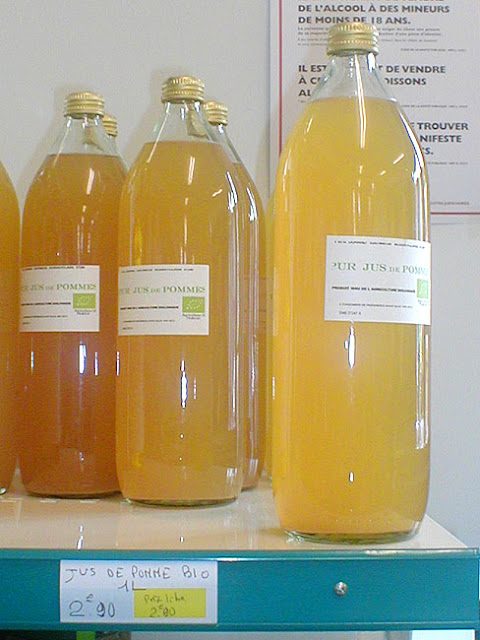
Organic pasturised apple juice, Indre et Loire, France. Photo by Loire Valley Time Travel.
Organic pasturised apple juice.

When people think of apples and France they normally bring to mind Brittany and Normandy. But these north-western provinces are principally growing cider apples, and not so much the sort you crunch into as a snack. The Loire Valley on the other hand has just the right climatic conditions for growing dessert and culinary apples and there are many commercial orchards here. Many apple orchards in the Loire Valley press, pasturise and bottle their own juice too, but there is no tradition of cider. The apples from the Loire Valley are eaten fresh, or cooked into tarts and purées.

Homegrown apples Reinette grise du Canada, Reine des reinettes, Granny Smith, Golden Delicious, Melrose. Indre et Loire, France. Photo by Loire Valley Time Travel.
Homegrown apples, from left Reinette grise du Canada, Reine des reinettes, Golden Delicious, Granny Smith, Melrose.

The supermarkets stock half a dozen widely popular varieties, but at the farmers markets there are dozens of varieties. The producer will happily tell you what the characteristics of each of the varieties are – sweet or sharp, crunchy or soft, juicy or dry. Each variety has a different use. Don’t be afraid to try new varieties – you will be in for a treat if you take a bite out of a Pilot, a Cybele, or a Chantcler, or have a spoonful of home cooked Reinette grise du Canada purée.

Apples and mushrooms foraged in the forest, Indre et Loire, France. Photo by Loire Valley Time Travel.
Apples and mushrooms foraged in the forest.

The old varieties of apples may not be so reliable commercially, but many people cultivate them in domestic gardens. An organisation called the Croqueurs de Pommes (‘the apple crunchers’) is on hand, with branches all over France, to educate the public about how to grow and graft apple trees. 
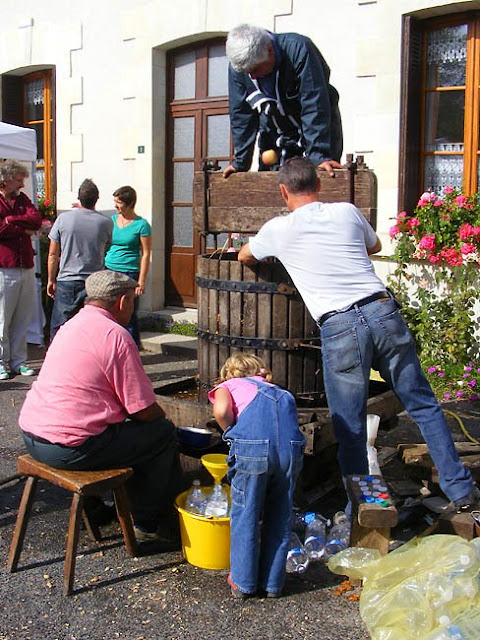
Pressing apples into juice at a village food fair, Indre et Loire, France. Photo by Loire Valley Time Travel.
Pressing apples into juice at a village food fair.

One reason there are so many apple orchards is because in the first half of the 20th century wine making was not profitable. At the end of the 19th century, winemakers were desperate to solve the killer fungal disease brought by the phylloxera root aphid. Within decades production was back up to pre-War levels, due to the introduction of phylloxera resistant root stock. However, consumption was slowly declining, there was an ongoing labour shortage, and the wine being produced was mostly not very good. Thousands of vines were grubbed up in the Touraine Loire Valley, with government incentives for winemakers to change their production. The apple orchards are a legacy of that farming transition. 

Homegrown apples Reine des reinettes left, Red Delicious right. Indre et Loire, France. Photo by Loire Valley Time Travel.
Homegrown apples. Reine des reinettes on the left, Red Delicious on the right.

Favourite Locally Grown Varieties: 

 The Reinette grise du Canada is a large, ugly, malformed apple with typical yellowy green russet skin with light brown scales all over. It is a variety that originated in England around 1800, under the name Golden Russet, then was introduced in Normandy to become much more popular in France than it is in England. It keeps and cooks well, and is even nice for eating raw, so long as you peel them. This apple is very fruity and aromatic, with a good balance of sugar and acidity. It fluffs up a bit when cooked but retains its shape.

Homemade tarte tatin. Photo by Loire Valley Time Travel.
Homemade Tarte Tatin.

Reine des Reinettes is a soft sweet apple when eaten fresh, an old local Touraine Loire Valley variety, yellow, streaked with red when it gets exposure to the sun. It is widely regarded as indeed the queen of French cooking apples, favoured by many big name chefs. They go soft and wrinkly quite quickly in storage, so are mostly cooked.
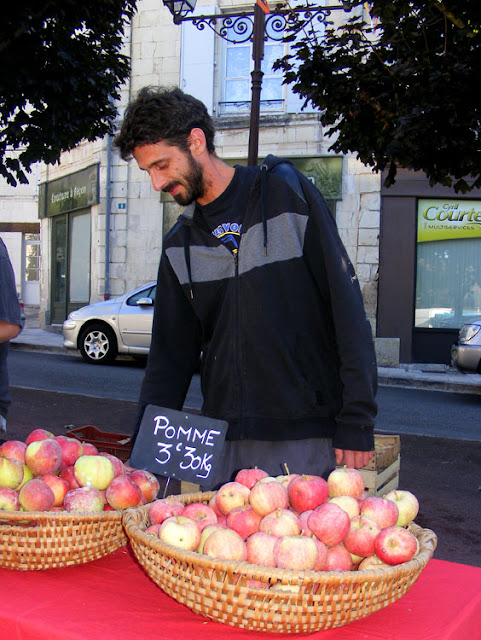
Organic apples at a market, Indre et Loire, France. Photo by Loire Valley Time Travel.
An organic orchardist at a farmers market, with an old apple variety that he has been unable to identify.

Golden Delicious, an American variety known simply as Goldens in France, is ubiquitious, and being sweet and crisp, by far the most popular apple here. After the Second World War men returning to their family farms in the Loire Valley were actively encouraged by the government agronomists to plant Golden Delicious orchards. The climate in the Loire Valley suits the variety extremely well, and it is highly productive here. Outside of France they are greeted with scorn and derision because of their pallid unappetising appearance and their tendancy to go disgustingly floury if they are picked too early and cold stored, as is normal for supermarket supply chains. Fortunately, a fresh mature Golden Delicious is a completely different creature to one purchased in the supermarket.

New season local apples come onto the market in September, and are good quality until March.

Because apples have been grown in the Loire Valley for millenia, naturalised trees can also be found in the forests. Usually the fruit on these ‘wild’ trees isn’t very good for eating raw, but they can be great for making apple jelly.

Apple purée is a pantry ingredient in French kitchens. Most people keep a jar of it on hand to make simple desserts. Every supermarket sells family sized jars of it.

Tarte Tatin: The best known Loire Valley recipe using apples is Tarte Tatin. This popular dessert is the benchmark for culinary apples in French minds. Apples that pulp and/or are highly acidic are not popular. In France the supply of sugar has historically been disrupted and unreliable, so French cooks prefer not to rely on adding much sugar to desserts. Therefore, naturally sweet apples are more popular. For tarte tatin you also need apples that retain their shape when cooked, so varieties such as Reine de Reinette and Reinette grise du Canada would be the choice for making this and many other traditional French apple desserts.

There seems to be no question that the Tatin sisters created the recipe in the 1880s and it became the signature dish of their hotel in Lamotte-Beuvron in the Sologne (the area between Blois and Orléans). They called the dessert Tarte Solognote. It seems to have been the famous Parisien restaurant Maxim's who dubbed it Tarte Tatin in the 1930s.

The original version seems to have been made in a cast iron Dutch oven, in the same way as one makes damper, by putting the pot in the coals and covering the deep sided lid with coals too. The sisters used the still popular old Tourangelle apple variety Reine des Reinettes , and the apples were not peeled (I peel mine). The tart is traditionally served warm, unaccompanied by custard, cream or icecream. The original recipe contains no spices or anything other than apples, flour, butter and sugar (and that is how I make it).

Traditionally the tart is an upside down shortcake, which is made by putting a layer of apple chunks on the base of a dish with plenty of butter and sugar to form caramel. Then a simple pastry is laid over the top, the ensemble baked then turned out so that the caramelly apple layer is uppermost for serving. (French people look away now…) To be honest, if you are nervous about turning the hot tart, there is no real need to do so. Just cut and flip each portion as you place it in the serving bowls, or leave with the pastry on top. It will taste the same either way. 


************************************************

For details of our private guided tours of chateaux, gardens, wineries, markets and more please visit the Loire Valley Time Travel website. We would be delighted to design a tour for you.

We are also on Instagram, so check us out to see a regularly updated selection of our very best photos.
 
*******************************************
 
UPDATE -- RESPONSES TO COMMENTS
Carolyn -- yes, we drive past that orchard often. It's owned and run by the Croqueurs des pommes, the association I mentioned in the blog post. They've tended to move their activities down our way more since their President lives in a village near to us.
Pré de la Forge -- I'm going on what the guy who planted our orchard told me the tree was.  
Jean -- I think French people use apple compote as a quick and easy dessert.
chm -- Simon has never mentioned apple jam, so I assume he didn't encounter it in Korea.

Friday, 3 April 2020

Anniversary of Our First Night in the House (2007)


It is the thirteenth anniversary of our first night in our house in Preuilly. We hadn't moved in at that point, but were still just coming over from London from time to time. It was like camping we had so few home comforts. This is a repost from 3 April 2007.

**************************************

This was a long standing planned trip, partly in order to try put a little pressure on M.Galland (the roofer) to start soon.

We had booked on SpeedFerries, leaving on their first sailing of the new season. On the Monday before we left we received an email saying that the start of service had to be delayed, so we had to make alternate arrangements. Luckily I was able to book a ticket with Norfolk Lines, which is a longer journey (2 hours to Dunkerque, which also adds the best part of an hour to the drive) so all was not lost. The amended booking meant that we had to leave home at 3.30am in order to make our 6.00am sailing from Dover, which meant that by the time we arrived in Preuilly we had been on the road for 13 hours including a diversion through Rouen, a town which appears to have me totally jinxed.

Our first port of call was M. Bertucelli to check on the plumbing works, which we were assured were complete. This caused us to rush to the house, as the thought of having our own toilet was very exciting.

Renovations in progress.  Indre et Loire, France. Photographed by Susan Walter. Tour the Loire Valley with a classic car and a private guide.

Arriving at the house, first port of call was to wonder at the new technology - a flushing WC. We flushed, and the cistern didn't fill up. I turned on the stopcock inside the house (which made no difference) so we moved outside to the external stopcock. This is a metre under a metal plate in the middle of our neighbour's driveway. I leaned into the hole to turn the water on... and my mobile phone and hankie dropped out of my pocket into 6 inches of muddy water. I don't know if it was the sacrifice of my phone that caused the water to flow (could have been turning the tap on) but we now have tapwater and a flushing WC. Excellent!!

The next move was to set up our kerosene heater (donated to us from the junk left by previous tenants of our house in London). This meant a trip to Yzeures to buy fuel and various foodstuffs. It's always a pleasure to wander around a hardware store after driving for 13 hours....

We had our first dinner together in the house, vegetable soup, followed by bacon and beans and pastries for dessert. We weren't exactly warm, but the heater took the edge of what was to be a cold night.

Eating our first meal in our French house in 2007.  Indre et Loire, France. Photographed by Susan Walter. Tour the Loire Valley with a classic car and a private guide.
It rained during the night, which meant our slumbers were accompanied by the sound of dripping water, but at least none of it entered the room we were sleeping in. We did decided, however, that we would erect our picnic tent/gazebo thing in the front room, and put the bed in there. This would provide us with a waterproof roof, and a lot more room so we could set up washing facilities. It also means that we can have our clothing in the same room we sleep in, making inter-room dashes in the cold unnecessary.

Bed set up inside in a tent while we renovate.  Indre et Loire, France. Photographed by Susan Walter. Tour the Loire Valley with a classic car and a private guide.
Friday was occupied with cleaning the front room, setting up the tent, moving the bed, putting a curtain over the space a door would normally occupy (and will, one day, occupy again). We also found time to visit M. Galland, the bank and the supermarket (and the hardware store). This set the pattern for the weekend - cleaning, visiting hardware stores, and plotting how we will proceed with the work.


The dump/recycling depot.  Indre et Loire, France. Photographed by Susan Walter. Tour the Loire Valley with a classic car and a private guide.The only real diversion came on Saturday, when we met the man from the dechetterie (the local dump, although it's more of a transfer station) whom our neighbours had organised to remove the piles of cuttings from our garden. He took a trailer of clippings to the tip, and we followed. He explained the system to us, and we trotted off to collect our own carload of stuff to junk. Most of it was "mixte", but we did have some glass, wood and cardboard which went in their respective skips, as did the old paintbrush cleaning mixture. As they say in the area; "Au pays de Descartes, je pense, donc je trie" (In the land of Descartes, I think, therefore I sort).

Cowslips
Cowslip Primula veris.  Indre et Loire, France. Photographed by Susan Walter. Tour the Loire Valley with a classic car and a private guide.
 We were amazed by how cold it was, considering how advanced spring seems to be. All the roadsides were covered in cowslips (coucou in French, the first of the wild primroses to appear) and the cherries and plums were blooming, as were the magnolias. Until recently, cowslips were big news in England, as modern farming techniques had destroyed much of their habitat. Thankfully they are on the way back in the UK, but we have never seen them in these numbers

On Sunday afternoon we rewarded ourselves with a drive in the country. as we drove on the road towards le Grand Pressigny (a trip we have done many times) I noticed, for the first time, the chateau at Etableau, a hamlet about 1.5 km from le Grand Pressigny. Why we have never noticed this before I can't say. It isn't as if it is small or anything....

Etableau.

Chateau d'Etableau.  Indre et Loire, France. Photographed by Susan Walter. Tour the Loire Valley with a classic car and a private guide.
Ruined keep of the chateau of Le Grand Pressigny.  Indre et Loire, France. Photographed by Susan Walter. Tour the Loire Valley with a classic car and a private guide. 
We also saw a different view of the chateau at le Grand Pressigny, which makes it look like a cutaway from a Richard Scarry book.

Although it sometimes feels like we aren't progressing with the house, it is coming on peu en peu and we are getting a lot better idea of what it is we want to do with it, which is a lot better than acting before you've decided!!

Simon

************************************************

For details of our private guided tours of chateaux, gardens, wineries, markets and more please visit the Loire Valley Time Travel website. We would be delighted to design a tour for you.

We are also on Instagram, so check us out to see a regularly updated selection of our very best photos. 

Sunday, 29 May 2016

The first time we saw our house

Ten years ago today we drove into Preuilly specifically to look at a couple of houses we had seen advertised on the internet.

The first was an interesting collection of three buildings, none of which had functioning bathrooms, and none of which you could reach from the others except via a courtyard shared with a fourth building. Far too confusing for us! (But not for someone else, who bought the collection, and has placed one of the houses back on the market).

The other was a building we were told by the estate agent was too small for us, so needless to say it was the biggest house we looked at. It is also the house we now live in.

I am not sure what was going on in our heads at the time: we both owned digital cameras, we almost instantly decided this was the house we wanted to buy, but we took only two photos of the exterior and none of the interior.


 We did take some more photos of Preuilly sur Claise (4 of them),
one of which is currently the header of the blog

We wrote about the whole life changing three day weekend in one blog post five months after the event.

Saturday, 28 May 2016

Our first proper pictures of Preuilly

After spending an evening at the Gerbe d'Or in Loches talking about the boulangerie (see yesterday's post) and deciding that the only option would be to demolish part of it to make a courtyard, we decided that we were being silly, and that there were sure to be other options.

We had decided we liked the feel of Preuilly, so the next day (a Sunday) we spent the morning in the Brenne, then drove to Preuilly to have lunch. We lunched at l'Image, the first of many pleasant meals we have had there over the years. It was Mother's Day, so we were lucky to get the last free table in the place.

Our first proper picture of Preuilly. 12h38, 28 May 2006

Our second proper picture of Preuilly. 12h39, 28 May 2006. If we had known
we would still be here ten years later we would have taken more photos

The meal was enough to convince us we really did like Preuilly, and to return on Monday check out other houses on the market.

You can read an almost 10 year old account of this buying trip here