Thursday, 13 August 2015

Catching the Train - to Spain

The last time this blog visited the panels at Tours Station we were talking about about St Jean de Luz. The town shown on this panel is not all that far away, but in a different country (and two different languages).

Fontarabie is in Spain and is more often called Hondarribia. Its a little port on the outskirts of Irun, the place just inside the Spanish border where you have to change trains because the railway gauge changes.

We're not sure how work on the 18 painted ceramic panels decorating the walls of Tours station is going, because we usually go to Saint Pierre des Corps (more parking, more trains, less traffic). The  purpose of the panels is to beautify the station concourse and entice travellers to the destinations portrayed. At present the panels are being conserved: each panel will cost €8000 to clean, conserve and reattach the tiles to the walls. The fundraising campaign started last year to raise some of this money. In order to publicise the fundraising, last year we started posting photos of the panels.

If you're wanting to visit Fontarabie/Hondarribia from Tours, this is how it's done.

Wednesday, 12 August 2015

Recycling in the Streets of Tours

Recently smart new recycling bins have been installed on footpaths all over Tours. Initially we thought they looked rather inadequate in size, but that was before we realised how they worked.

First a dumper truck with a hydraulic lifting arm pulls up by the bins. 
These are by the carpark at Saint Pierre des Corps station.
One day about a month ago we were sitting outside the pub in 'Place du Monstre' having breakfast and I got to watch open mouthed with amazement as the secret workings of these new bins were revealed. I was not the only one observing with a mixture of admiration and amusement. The bloke at the next table took out his phone and photographed the action. We all exchanged looks and exclamations.

Then a bin is hooked by the hydraulic arm. What you see on the surface is clearly just the tip of the iceberg (or recycling bin, as the case may be...)
Now that I have also managed to photograph the procedure in action, I felt it was time to share.

The bin is suspended over the truck and carefully lowered into the appropriate section of the trailer. These ones are in front of Saint Pierre des Corps station.
The bottom of the bin is released and the hydraulic arm swings up again.
Once the bins are placed back in their slots in the ground the whole area is hosed clean. These are at the corner of rue de la Rotisserie and Place Grand-Marché (aka Place du Monstre).
*****************************************
Milan: We have been away for a week visiting friends in Milan. Now we are back there will be trip report in the next few days, then a series of postings about what we did and saw. There will be lots of alps, with and without lakes, lots of pictures of saints but none of icecream (we were too busy eating it before it melted in the heat). We thought we might do a series called Monday in Milan (or maybe Lundi en Lombardy).

Tuesday, 11 August 2015

Underground Preuilly

Ever since we moved to Preuilly we've been hearing tales of the extensive system of tunnels under the town. Many of these stories are from perfectly credible sources -- professionals and people who have lived here all their lives. One of our neighbours has trouble growing fruit trees because their roots descend into a void under his garden. One of the Bâtiment de France architects told us he had been in the system that links the house of another neighbour to the chateau only a few days before he came to see our barn.

 The entrance to the caves under rue des Pavillons in Preuilly, with carefully vaulted walls and ceiling and sloping compacted dirt floor.
I've certainly been in several impressive medieval cellars under houses in Preuilly. Indeed, the very first house we looked at in Preuilly, and nearly bought, had a 12th century cellar. I've also been through the mushroom cultivation caves at Bourré many times, including going 'off piste' with Dorianne, their in-house guide, and down the subterranean refuge under the chateau of La Celle Guenand. But until recently I hadn't been underground in any of the galleries of caves that extend under multiple houses for a considerable distance in Preuilly.

 Not far from the entrance is a pile of rubbish. Once abandoned as places of work these caves were an easy repository of household junk and debris.
The local history association (Société Archaeologique de Preuilly) organised a nocturnal walk in mid-July, the highlight of which for me was going underneath rue des Pavillons into an abandoned limestone quarry. The tunnels extend under at least a dozen houses. The occupants of several of the houses above were on the walk and there were lots of jokes about just popping up into their kitchen for a cuppa and such like.

 Duck! 
These galleries were made by people who were generally shorter than us.
The French word cave (pronounced 'kahv') does not mean 'cave', by the way. Caves are man-made, usually (but not always) underground abandoned quarries, often repurposed for activities as varied as cultivating silkworms, mushrooms, endives, or making and storing wine. There is no good general purpose English equivalent of cave, but the word is often translated as 'cellar'. The French word for 'cave' is caverne.

The group on the nocturnal walk gather around to hear about the caves
A view down the cave. On the ceiling are black soot marks from the quarrymen's candles. In the background is a pile of rubble from a rockfall and ceiling collapse.
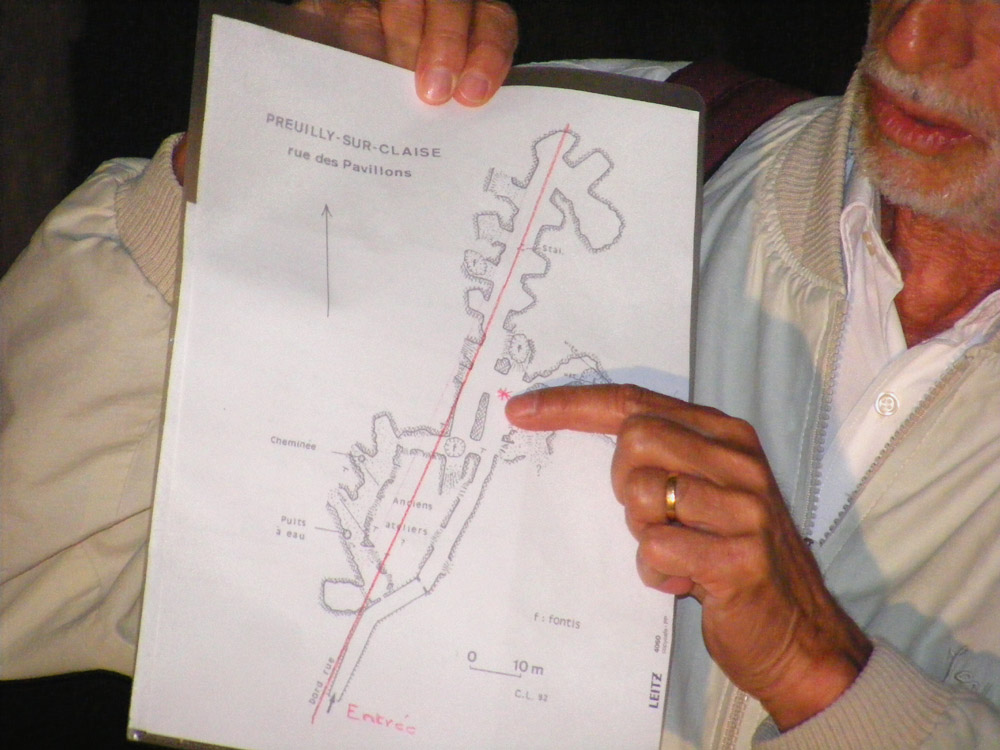
Jean-Claude holds up a map of the cave system and indicates 
we are standing at the red asterisk.
A view of some side galleries, with a rock fall. 
Some of the smaller side galleries are for neatly containing piles of quarrying rubble, but rockfalls can be identified by the way they spill out into the main tunnel.

Monday, 10 August 2015

Not So Enticing Korean Food

I wrote that there are some Korean foods I loved, but this is the other side of the coin: either foods I couldn't contemplate, or foods I just wasn't tempted enough by.

OK, so Sweet Buns (more a compliment than a foodstuff, I would have thought) don't sound too weird, but as even ordinary Korean bread was too sweet for my tastes, I just can't imagine how sweet Sweet Buns are.

Mmmmmmmmmm..... Health Porridge. Not really tempting, even if it has Nutrition Taster's Porridge on offer.

It's those grey items on the right hand end of the stall that put me off: have you ever contemplated what silk makers do after they have boiled the silk off the cocoons??

Sunday, 9 August 2015

Springvale Homestead

Springvale is the oldest cattle station in the Northern Territory, established in 1879. This is the old stone homestead. Alfred Giles drove 2000 cattle and 12 000 sheep 2750 km from Adelaide to stock the place. It took him 19 months to make the journey, and he crossed Australia from south to north in the process.

Saturday, 8 August 2015

Monsieur Parmentier versus the Deadly Nightshades

When potatoes and other New World members of the Solanaceae family (tomatoes, aubergines, chillies, peppers) were introduced to Europe they were treated with great suspicion. The intrepid explorers who brought them reported that the South American natives they encountered ate freely of these exotic plants.

Chillies growing in our potager a few years ago.
But French peasants weren't convinced. These plants were clearly related to Henbane, Deadly Nightshade and worst of all, Mandrake. No one in their right mind would eat these dangerous plants, associated with witchcraft and capable of killing or sending you mad. Due to a curious twist of evolution, many Old World Solanums are amongst the most poisonous of all plants, but many New World Solanums are safe, nutritious and delicious. It's true the New World species also contain some dubious compounds, but they are easily dealt with by simple everyday culinary techniques and pose no serious risk to consumers.

Potatoes harvested from our potager last year.
Tobacco, which of course is also a New World Solanum, is a different story, but in any case, was never a candidate on either side of the ocean as something you ingested.

Potatoes growing in our potager a few years ago.
Tomatoes and potatoes arrived in Europe in the early 16th century. Unfortunately, herbalists at the time referred to tomatoes as a type of mandrake, so people were well and truly put off eating them. They were restricted to being grown as decorative plants  for 200 years.

Tomatoes from our potager a few years ago.
In France growing potatoes was banned and they were believed to cause leprosy. They were eventually fed to pigs, but not declared edible for humans until 1772. Nevertheless, resistance to eating this nutritious foodstuff persisted in France, despite the fact that the Germans and the British by then ate tonnes of the things (resulting in a population explosion in Northern Europe due to improved diet).

Cherry tomatoes in the potager a few years ago.
Antoine-Auguste Parmentier, an agronomist who had been forced to eat potatoes whilst a prisoner of war in Prussia in the 1760s became an energetic promoter of the potato. His cause was aided by a series of poor harvests which meant that people had to eat potatoes or starve in the 1780s. By 1794 there was a cookbook aimed at ordinary people and instructing them how to prepare potatoes for the table. Finally, during the siege of the Paris Commune in 1795, potatoes were grown on every spare piece of land, including the Tuileries gardens, in an attempt to stave off famine. 

By the 19th century potatoes were so entrenched as a staple even in France that when the fungal disease blight broke out in Europe there was widespread famine (not just in Ireland). Nowadays we can enjoy several dishes which are a legacy of Monsieur Parmentier's enthusiasm for the potato: Hachis parmentier is similar to shepherd's pie; potage parmentier is leek and potato soup; pommes parmentier is diced fried potatoes. Yum.

Friday, 7 August 2015

The Rise and Fall of the Silk Industry in the Touraine

Once upon a time Tours was the centre of the silk industry in France. Wealthy folk from all over northern Europe would come to the city to stock up on fine cloth. The industry started in the late 15th century with Louis XI sponsoring the planting of white mulberry trees and encouraging housewives to earn a little extra cash by raising silkworms in the many abandoned limestone quarries along the Loire.

 19th century silk damask woven in Tours, on the walls in the chateau of Candé.
By the 17th century, a third of the population of the Touraine was involved in the silk industry -- raising the caterpillars, processing the raw silk, spinning, weaving both cloth and ribbon or braid, dyeing or selling cloth. But many of the weavers were Huguenot Protestants and when the Edict of Nantes was revoked in 1685 vast numbers fled, often to resume their careers in Spitalfields, London. This was a great blow to the industry, and the population of Tours. The city never regained its status as the centre of French silk manufacture. Nowadays there are just traces of all this activity left in the Touraine, with the final straw being outbreaks of disease in the silkworms in the 19th century. Only a single weaving workshop remains, at Saint Avertin, and they import the thread they weave. The last silk weaving factory in Tours, in rue Paul Bert, finally closed its doors about 10 years ago.

The caves of Chateau Gaudrelle, on the Quai de Loire, were used to raise silkworms in the 17th century, before they were used to make and store wine from the 19th century.
The industry ultimately lost its remaining economic importance within a generation in the  late 19th century. A fungus called Beauveria bassiana attacked the Domestic Silkworm Bombyx mori caterpillars, consuming their haemolymph fluids (ie blood) and leaving them covered in a snowy white shroud of spores. The disease became known in French as muscardine, because it looked like a sort of sugary spicy chewy candy of that name.

An unidentified caterpillar (not Bombyx mori) on the banks of the Loire which has been infected and killed by the fungus muscardine.
The cause of the disease was discovered by a remarkable Italian entomologist called Agostini Bassi, from Lodi, near Milan. His work, covering 20 years of experiment and observation, is the insightful precursor to Louis Pasteur's on the germ theory of disease. It was Bassi who was the first to realise that tiny living organisims can be pathogens, and Pasteur was greatly influenced by him and owes him much. Following his work on muscardine Bassi brilliantly speculated that measles, syphilis and the plague were all caused by micro-organisms. 

 A White Mulberry Morus alba leaf. Silkworms thrive on these.
Although Beauveria bassiana turns out to occur naturally in soil all over the world, and infects all sorts of caterpillars and other insects, the silkworm disease had only appeared in Italy in 1805 and by 1841 was in France. The parasitic fungus is capable of killing a caterpillar in a single day (and there have been interesting recent trials using it to infect malaria mosquitoes and bedbugs). In Italy Bassi's advice of using disinfectants and keeping the silkworm 'farms' clean as well as spacing the caterpillars out and destroying infected ones saved the industry. But in France, despite his 1835 paper on the subject being translated into French, by 1849 production was heavily affected in the Touraine. A generation after Bassi, the Tourangelle silkworms were again devasted by disease. Louis Pasteur was asked to investigate and discovered two more killer pathogens. He recommended much the same husbandry practices as Bassi, but by the 1870s the industry had effectively ceased in the Touraine.

 A silk weaving loom from the 1630s, saved by Maurice Dufresne from a factory in Tours and installed in his museum near Azay le Rideau.

This panel (below) in Souzay-Champigny says:  
Silkworms. (Sericulture: raising silkworms: 2500 years BC). A trader lived in this house in the 18th century. Thanks to sericulture he made a fortune in Denmark. The silkworm is the caterpillar of the Domesticated Silk Moth which encloses itself in a silk cocoon to prepare for its metamorphosis into a moth. The silkworm is extremely voracious and feeds exclusively on mulberry leaves.
How did silk come about? According to one legend, a Chinese princess called Xsi-Ling Shi would drink her tea in the Imperial Garden, and one day a cocoon fell into her cup. When she came to retrieve it she realised it was a never ending thread unravelling. Silk had been discovered!  
The trade in silk. It marks the birth of exchanges on a worldwide level with the civilisations of antiquity (Egypt, Greece, Rome). Later the Silk Route was opened by the Chinese from the 2nd century, retracing the route of Alexander the Great.

The next panel says:
Silkworms around Saumur.
It was only in the 12th century that the secret of silk manufacture arrived in southern Europe.
In the 15th and 16th century numerous mulberry trees were planted in the south of France and the Loire Valley and some magnaneries (buildings or cellars given over to the raising of silkworms) appeared. Here each individual would raise silkworms and it was generally women's work.
Silk formed a not inconsiderable sector of the economy even if that of Saumur was not particularly prized because the people didn't know how to spin well. Then a disease of the silkworms appeared in the second half of the 19th century causing the disappearance of the business. It was not until a century later, thanks to work by individuals, that there was a revival of interest in the silk industry of the area.
Silk on the walls of the chateau of Ussé, woven in Tours in the 18th century.
A young White Mulberry on the banks of the Loire near Berthenay, the naturalised descendent of those introduced for the silk industry centuries before.

Thursday, 6 August 2015

Rebranded Grocery Store

The other day I noticed that one of the little grocery stores in Preuilly has been rebranded. It used to be a Vival. Now it is an Epi-Service.

The new name is a play on words. The French word for grocery store is épicerie.

 The shop offers the following: groceries; regional products; pre-cut blocks of cheese (as opposed to whole cheeses); they take bank cards and make home deliveries.
Epi-Service is a chain of independent small supermarkets supplied by Degrenne Distribution, who also supply CocciMarket. They supply these corner stores and mini-supermarkets with fresh and frozen produce, dairy products, grocery lines, cured meats, drinks and household cleaning items under their brand Belle France. They are based in the north-west and we are about as far south as they come.


Wednesday, 5 August 2015

Yummy Korean Food

I wrote the other day about my birthday when I was in Korea ten years ago.

Because I was working for a month I had a good chance to sample may many foods, but not being one of those people who routinely photographs their food (there are better things to be doing with it, quite frankly) I don't have evidence of much of it. Photos I do have include:

School Dinner
Lunch was provided every day and usually consisted of soup, a rice dish, a meat dish, vegetables and desert. And kimchi - in fact, as much kimchi as you could eat. Some days were scrambled egg rather than meat, and other days the soup wasn't seaweed soup. Not often though. Strangely, for a country where all the foods seemed to consist of big robust and spicy flavours, school lunch seemed a bit lacking.

Ice cream
Goo-goo cones were my favorite. A peanut butter flavoured cornetto like ice cream. Ridiculously inexpensive and therefore a staple food for blokes on their own.

Snackage
Many kinds of snackage, including Jollypong. From memory a sweetened variety of puffed wheat, eaten like peanuts. I can't understand why anyone wouldn't want a pack of Jollypong.

After work a couple of beers and a bar-b-q dinner was the standard option, sometimes preceeded by a bowl of manduguk, a dumpling soup. Other dishes tried included a very (very) spicy black pudding stew, salted (and chillied) herring (I think), and lots of rice rolls. I also became a fan of many varieties of street food.

Street food


Tuesday, 4 August 2015

Mechanical Curiosities at the Domaine de Cande

A new exhibition has just opened at the chateau of Candé. As is often the case with Candé they have chosen to support an artist who works in mixed media, found objects and with a distinctly quirky and mechanical bent. The works are commissioned for the rooms they are placed in.

A little man pushes a broom around and around.
Antoine Birot says he can't decide if he is a handyman or a precision engineer. The works are fantasy machines, 'operated' by little gold mannekins. They are amusing and clever.

A 'windmill' drives an automatic pen which writes on brown paper tape.
The exhibition finishes on 15 October 2015.

 A little man rolls a geared disc.
Also new at Candé is the little restaurant they have opened in the Hunting Lodge. The menu has been created by local Michelin starred chef Olivier Arlot. A three course limited choice set menu is €18 and wine is €2 a glass. We haven't tried it yet, but are keen to do so. The restaurant is open from May to September, Wednesdays to Sundays.

For those of you who know the restaurant Les Charmes de Candé, situated at the entrance to the chateau (and not connected to the chateau), it has recently changed hands. The lovely blond ladies have gone and the new owner is a man who has changed the name to La Table de Candé. The style of food is unchanged and still an excellent value worker's lunch, but I'm sure the regular clientele will miss the flirtatious and buxom barmaid.