Thursday, 14 April 2016

The Real Life Tintin


At the Chatellerault classic car swap meet on the weekend the Chatellerault Motor Museum was displaying a 1926 Gillet-Herstal motorbike that had circumnavigated the globe.

 Gillet-Herstal motorbike, Belgian, 1926.

Its vital statistics were as follows:
  • Origin -- Belgian.
  • Motor -- single cylinder two stroke 350cc.
  • Carburetor -- AMAC.
  • Lubrication -- mixed and manual pump.
  • Transmission -- chain.
  • Gearbox -- two speed.
  • Brakes - drum front and rear.
  • Supplementary petrol tank with around 40 litres capacity.
Ridden by Robert Sexé, French motorcyclist, reporter and photographer, this particular motorbike achieved the first circumnavigation of the world by motorbike between June and December 1926, travelling more than 25 000 kilometres to cross Europe, Asia and North America. After this exploit Robert Sexé continued to ride the bike, up until the end of the 1960s, by which time it had several hundreds of thousands of kilometres on the clock.

 A cardboard cutout photo of Robert Sexé looking dashing on his motorbike.

According to legend, the famous cartoonist Hergé would be inspired by Robert Sexé to create the character of Tintin. The character of Milou (Snowy in the English language version) is named after another motorcyclist of the period, René Milhoux, who always wore white overalls. The chateau of Cheverny is the inspiration for Captain Haddock's residence Moulinsart (Marlinspike Hall in the English versions).

Wednesday, 13 April 2016

Loches Market


With 34 stalls per 1000 inhabitants, Loches market, in the heart of the town, is the second most important market in the Département d'Indre et Loire. For comparison, there are only 7 stalls per 1000 population in Tours. According to a recently published study reported in the paper recently, the market is growing year on year, unlike most of the markets in the Touraine.


Between the stalls, people meet one another. They discuss current events, the weather and pass on their news. Obviously, they do their shopping as well. Every Wednesday and Saturday the market in Loches attracts customers from the north of Indre to Cormery. Its success continues to grow, as evidenced by the annual survey of markets of Indre et Loire, which is published by the Observatory of the Economy and Territory of Touraine.


The report shows that the two weekly markets in Loches have the strongest growth in terms of numbers of vendors. Between 2005 and 2015 the total number of stalls per week has increased from 135 to 220. This positive growth means that the sud Lochois is the only area in the département where market sales figures are inceasing. Everywhere else in the département markets are shrinking at about the same rate and the report notes this with disquiet. But Loches is one of the few towns that is bucking the trend (Chinon is another example). In comparison, over the same 10 years, the markets in Tours have lost 400 vendors. Over that period the report estimates that vendors at Loches have increased by 63%.  The market manager, who was appointed in 2001, says he would say the increase is 'only' 50%.


At the moment Loches is the seventh largest market in Indre et Loire in terms of vendors. It is second, just behind Bourgueil, in terms of number of stalls per population. That's a sign of what an attractive proposition the market is for stallholders.


The south Touraine has seen growth overall of its markets of 11.5%, whereas the conurbation of Tours has seen a drop of 22.2% in the number of vendors. In Pays Indre et Cher (Monts, Esvres, Veigné, etc) the loss is 28.7%. The biggest market is that of Amboise, far in front of the main market in Tours.


We've written about Loches market a number of times before. In 'The Offal Butcher' and 'The Tarte Tatin Man' I wrote about specific stalls. In 'Local Green Asparagus!' I wrote about how pleased I was that a local asparagus producer now sells green asparagus at Loches market, when previously it had been more or less unobtainable (the local taste is for white asparagus). In 'Blessed are the Cheesemakers' I included a section on the various cheese stalls in Loches market. In 'The Last Market Day Before Christmas' I describe going to Loches market just before Christmas. In 'On the Road Again' Simon wrote about house hunting and the part Loches market played in our choice to live where we do.

Tuesday, 12 April 2016

Vendeur Premieres in Preuilly


Last year French film writer and director Sylvain Desclou brought a film crew (Fr. équipe du film) to Preuilly for the filming (Fr. tournage) of Vendeur ('Salesman') on location. We drove past them when they were filming in the cemetery. The decision to film in the area came about because the director's family comes from here and he spent childhood holidays here with his grandparents.

On Saturday night the finished film was premiered in the salle des fêtes (the town function rooms, which double as the cinema once a month).  We went with Niall and Antoinette and the room was packed by the time we arrived. Luckily we spotted a group of four seats in a row on the left hand side of the room and grabbed them quick.

Pantechnicons and coaches parked outside the mediatheque last February for filming in Preuilly.

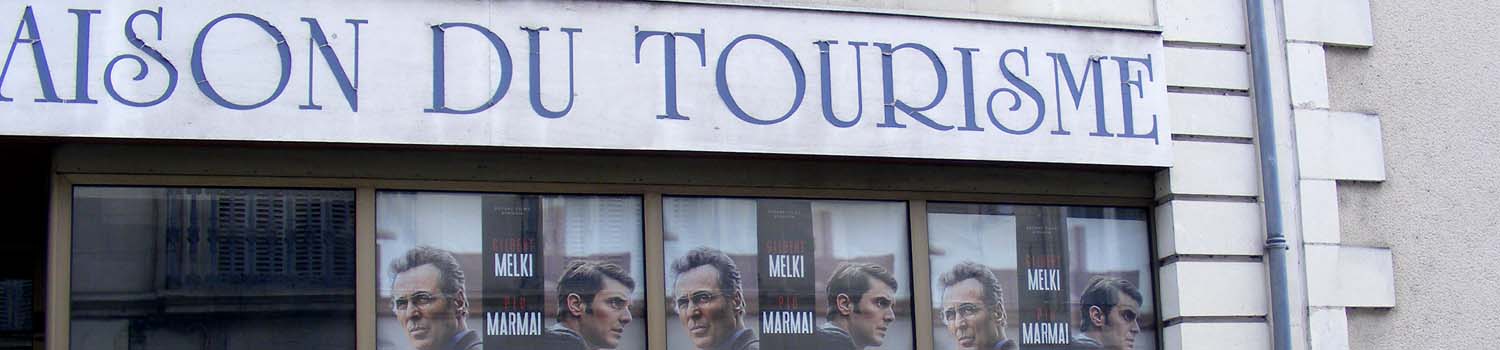
The film is about a salesman, Serge (Gilbert Melki), who is very good at his job, but has sacrificed his family and his health in the pursuit of his career. He works in a kitchen showroom, for Daniel (Pascal Elso) and describes himself as an itinerant (Fr. un bourlingueur). His son Gérald (Pio Marmai) is a chef who has just lost his restaurant. He comes to his father to ask for a job selling kitchens. At first he is hopeless at it, but with coaching from Dad, finally gets the hang of it -- rather too well. Serge realises his son is making the same mistakes he did and tries to warn him. He is also distinctly miffed that Gérald is starting to beat him in the monthly sales figures. Ultimately, after a health scare Serge deliberately sabotages Gérald, causing the break up of his son's marriage (Clémentine Poidatz plays his wife Karole) and the loss of his own job with Daniel. At the end of the film we see that Gérald has re-established himself as a chef, but Serge is unable to give up the buzz of selling and has moved to the south of France to sell swimming pools.

Quite early in the movie we started recognising places, such as the roundabouts at Chambray les Tours. A real frisson went through the audience only when the scenes became really local though. Serge drives along the road to Chaumussay in his classic black 1980s BMW and the murmur rippled through the assembled population -- 'Look, it's La Forge...' Later views over Preuilly were very recognisable and we identified the house used as Serge's father's. Our neighbour Gilles says he caught a glimpse of his own house and another neighbour's.

The  Q&A session: (left to right) Gilles Bertucelli, mayor of Preuilly; Sylvain Desclou, writer and director (with microphone); Clémentine Poidatz (Karole); Pascal Elso (Daniel).
Photo courtesy of Antoinette, who took this with her phone as none of us had thought to bring a camera.

After the film finished there was a question and answer session. The writer and director (Sylvain Desclou), two of the actors (Clémentine Poidatz and Pascal Elso), the casting director and a couple of the finance people sat on the edge of the stage and took questions from the floor.

Q: How long did filming take?
A: Eight days in a real kitchen showroom, three weeks around Tours and in the south Touraine, 38 days in all. The nightclub scenes were filmed in a real nightclub (Fr. boîte de nuit) in Saint Pierre des Corps. The main filming started in January of 2015 and was finished by the end of April. Then from May to November of that year a team of 50 people worked on the film making it ready for release.

Q: What was the budget?
A: 3 million euros. (There was a buzz at this information along the lines of 'goodness what a lot of money', but the director went on to explain that this is a tiny budget and has to cover a team of dozens of people for about a year, quite apart from all the actual filming.)

Q: How long will it take to break even?
A: No idea. That's a question for the distributors, and will depend on how long it stays in cinemas, how good the audience figures are and when it's released for television. It will premiere on Canal+ in two years time.

Q: There was a lot of drinking in the film. Are the drinks real?
A: No, they are syrups or teas. The cigarettes are real, but the lightest possible. The cocaine was real (joke).

Q: What research did you do about the life of a salesman?
A: The director talked to salesmen in a number of fields, not particularly kitchen showrooms. He wanted to focus on the sort of character whose skill is selling (it doesn't matter what) and will move from franchise to franchise to practise his trade, making money for himself and his boss. A whiteboard with the sales figures on it features prominantly in the film, and the director talked to a franchise manager so he could understand the figures. Gilbert Melki had worked as a saleman before he became an actor.

Q: At the end Gérald is shown as the proprietor of the Moulin Fleuri. Is that the real restaurant? (It's at Veigné and was where Edward and Mrs Simpson had their wedding breakfast.)
A: Yes.

Q: How do you cry on demand?
A: Pascal Elso admitted that he always had to cheat with fake tears, but that Clémentine Poidatz felt things quite intensely and cried very easily.

Q: What training did you do to become an actor, director, casting director...?
A: Pascal Elso responded that he had done a lot of theatre and had rather a fragmented training. Clémentine Poidatz said her background was fairly classic, beginning with chosing the right high school, then the Comédie Française. She said she didn't like doing theatre and preferred filming. The casting director had started as a stylist, and the director said he had done all sorts of things, most not related to film and had originally studied political science and economics.

Q: How was the music chosen? Why did the songs all have English lyrics? Why were there no songs with French lyrics, in particular, no chansons? Wasn't an opportunity to convey an extra nuance missed by having songs in a language the audience didn't understand?
A: Although it was fairly clear that the director had chosen the music, it was the actress Clémentine Poidatz who waded in and answered the question most fully. She countered that the songs were there to add atmosphere, a feeling and that the lyrics were not as important as the music (for a French person that is a difficult one to swallow...) The songs had clearly been carefully chosen, by someone with taste and a flair for matching song and action. They were all driving songs, a mixture of British and American and with an urgency of beat that no chanson would have been able to provide. Assuming that you understood English, the lyrics were remarkably appropriate too. (Simon was impressed to note that a song from incomparable John Martyn had made it onto the soundtrack).

Q: What will your next film be about?
A: It will be set in the world of politics (at which point the woman behind us went 'well that won't be set in Preuilly then...') and about a young woman from a humble background who becomes a lawyer and joins the team of a government minister.

During the Q&A session a man stood up and said he didn't have a question but rather a 'proclamation'. He referenced a joke from the film about fathers and it turned out he was the director's father. He wanted everyone to know how proud he was of his son. It was really touching and Clémentine Poidatz promptly shed a few tears.

The poster for the film, displayed in Preuilly's main street.

Once the questions had dried up everyone was invited to go downstairs for a drink. We didn't stay, but friends who did report that at the end of the night they were rewarded by seeing the producer drive off in the classic black 1980s BMW that Serge drives in the film.

We thoroughly enjoyed the evening and thought the film was well cast, well acted with some nice comedic touches (Serge ineptly stuffing a pillow into a pillowcase when he comes to stay with his father for example), good directing, shooting and cutting and a believable and interesting storyline. The film is released to the big wide world tomorrow. Here is the media kit (in French).


Monday, 11 April 2016

Sixteenth Century Saints 'n' Stuff


Mondays in Milan / Les lundis en Lombardie


This 16th century painting hangs in the Castello Sforzesco. I can tell it is the right hand section of a triptych, the central panel of which I believe is a Madonna and Child. I can also tell it is Saint Roch standing on the left and Saint Sebastian on the right. Saint Roch is wearing his trademark sun hat and carrying his staff (looking quite different from this amusingly graphic 20th century version I wrote about in January). Likewise, Saint Sebastian isn't looking too tortured. Unusually, he isn't depicted here as a human pincushion. Instead, he is shown delicately holding an arrow in his right hand. The three kneeling characters are probably members of the family which commissioned the triptych and donated it to some church. The two younger women are wearing plain but generously cut dresses. They are dressed fashionably but not very ornately, suggesting that their status is comfortable but not in the wealthiest or aristocratic circles. The older woman on the right is presumably an attendant, with her narrower set in sleeves, plain turban and apron.

I can tell all that just by looking at the painting. Unfortunately I can't tell you who the artist is or anything else about it. The museum label is blurry in the photo, and I can't remember anything else about it.

But it's a nice 16th century painting all the same.

UPDATE: With help from Simon I have now identified the painting as Saints Sebastian and Roch with Donors by Pseudo-Boltraffio. The delightfully named Pseudo-Boltraffio is a catchall covering painters from the Lombard School between 1500 and 1530, most of whom were students of Leonardo da Vinci. Their styles are so similar that in many cases the individual artist can no longer be identified.

Sunday, 10 April 2016

The First Time I Saw..

... Loches.

After our first foray into real estate buying in France, Susan had to take a rest by trekking across half of Australia with her family. This left me with an ambition to buy a house, but no way known was I doing it by myself.

Online, I had found two small houses for sale in Loché sur Indrois. They looked good on paper (as it were), and were within budget. I really wanted to see them: I had reached that stage where I was ready to leave London and start the next adventure, but that adventure didn't extend to talking to real estate agents on my own. I rang our friend Bryan and asked, if he wasn't doing anything, if he would like a trip to France. He was doing something, then suddenly he wasn't (meeting rescheduled), and suddenly we had a three day window in the middle of the week where we could go.

 The first photo we ever took of Loches.

Bryan was living in the Lake District at the time, so I booked a ticket on BMI Baby from Durham Tees Valley Airport for him, and myself a ticket from Heathrow, both timed to arrive at Paris Charles de Gaulle within 30 minutes of each other. I also booked a car. Driving around Paris in rush hour is not much fun, but we were amused by following a circus trailer carrying a crocodile.

We reached Amboise before deciding to call it a night. Seeing the chateau of Amboise for the first time, all lit up and glowing in the dark, was magic. Having breakfast in a cafe at the base of the chateau walls was no less magic.

After breakfast we drove to Loches, to stay in the (let's be kind here...) idiosyncratic Hotel George Sand. And that's the first time I saw Loches: 10 April 2006.

(For more details, the original trip report is here)

Saturday, 9 April 2016

Sometimes I Forget


Well - not forget exactly, but maybe fail to remember.

For some reason, there is nothing in my brain which causes me to remember that we own two Citroën Traction Avants, and that this isn't exactly typical for blokes from Australia. It only really strikes home when I see the cars together.

On Thursday we had a group of clients that required the two cars, and I have to say I think we looked epic on the road to Loches.


It's rare that both cars are in the same place: usually one is in the secret garage location in Saint Pierre des Corps, and one is at home. At the moment it is Célestine at home and Claudette awaiting the next client.

**************************************************

Chenonceau Tickets: We've ended up with an adult and a child ticket  for Chenonceau that we can't use. They are valid until 14 April. If you would like them, please get in touch (email addresses on our profiles on the right hand side bar). We will happily give them to you for free.

Friday, 8 April 2016

A Greenway to Replace the Railway?


A feasibility study to establish a greenway has been commissioned in the south Touraine. The Communauté des Communes (a group of local authorities) have obtained a provision for a 10 year renewable lease of a section of the old railway line between Port de Piles and Le Blanc, unused since 2005. They envisage creating a greenway and a company to design the project has been engaged.

The line at Le Grand Pressigny.

To begin the diagnostic phase local councillors met those doing the study at Chaumussay station. Councillors from Tournon-Saint-Pierre, Bossay, Preuilly, Boussay, Chaumussay, Grand-Pressigny, Abilly, and Descartes attended and saw the initial ideas for the project.

The line between Humeau and Chaumussay, running alongside the Claise River.

Positive elements, such as the proximity of picnic areas in Chaumussay and Bossay, were looked at, as well as problems to be solved, such as how to cross major roads. The greenway is going to ban the use of motorised vehicles of any sort. It remains for certain choices to be made once the diagnostic is done -- pedestrians or cyclists, and if applicable, what type of bicycles. Once the diagnostic study has been signed off a feasibility  study will examine the technical issues in the light of legislation, environmental constraints and landownership. A financial evaluation of the project will be done, which will look at both costs but equally, the positive economic benefits that could result.

The line at Humeau. They'll have to be quick if they want to preserve the railway signage in situ. 
The rusting metal kilometre sign in this photo has already disappeared.

During the visit several ideas were aired by the Councillors, such as the preservation of most of the existing infrastructure (bridges and tunnels) and railway signs. Setting up information panels with photos and history of the line were advocated. If this study deems the project feasible a tourism development phase will implement a series of measures to promote and operate the project. This could include creating a label for nearby accommodation, shops next to the greenway, signage and events relating to the various districts that the track passes through. The feasibility study group cited examples of similar projects that have succeeded and have expanded to double the length of their walking and cycling tracks in a linked network.

Chaumussay station.

I think it's a terrific idea. I've walked the line between Chaumussay and Preuilly and it is peaceful, attractive and once it's a walking track not a railway with sleepers, rails and bridges in dodgy condition, will be suitable for all levels of fitness. There are obviously possibilities for linking to the section through Le Blanc, with its impressive viaduct. I predict dog walkers and bird watchers will love it.

Back in 2012 Simon wrote about plans at that stage for the line in 'The End of the Line?'. The Nouvelle République reports on the current plans here.

Thursday, 7 April 2016

Pavement Pansy


I was amused to find this pansy having seeded itself in a crack in the gutter along the side of our house. It hasn't bothered growing more than a couple of leaves before sending up this large and pretty flower. It's currently on it's second flower, and there is another to come.


Wednesday, 6 April 2016

Métiers d'art

Last weekend was the Journées européennes des Métiers d'art, where local artisans open their doors to the general public and display their skills

In an uncommon fit of common sense, la Nouvelle Republique didn't assume we already knew what was happening, and listed the events nearby including one at the Musée Auto Vélo in Chatellerault, where M.Tessier would have the atelier open. A couple of years ago we visited Auto Classique Touraine for the Journées européennes des Métiers d'art (and didn't blog about it even though we took hundreds of photos) and I assumed it was the same people: I knew the name Tessier as a car restorer from somewhere.

 A 1948 Delahaye 135M, styled by Figoni et Falaschi.

Turns out that yes, I do know the name Tessier from somewhere, they are the garage on the roundabout at Veigné that seems to specialise in British sports cars (and the odd exhaust manifold bolt for Citroén Traction Avants), but this is a different M.Tessier, and a completely different enterprise to Auto Classique Touraine. This means that within 5km of each other we have two custom classic car coachwork builders, and a classic sports car restorer.

The car M.Tessier is rebuilding for the museum is a Delahaye 135M. The Delahaye was, like many top end cars, delivered as a rolling chassis to the coachbuilder of purchaser's choice, and a custom body built to the owner's tastes. This car is a 3.6litre straight 6, with a 4 speed electromagnetic pre-selector Cotal gear box. The body is mainly aluminium over an ash wood frame, and I would have one.

The gear selector is the mini switch to the left of the steering wheel.

The radiator cowl. Just like making a renaissance era armour breast-plate.

I love this kind of thing - people with amazing skills making beautiful things out of seemingly unpromising lumps of stuff. I also like the Museum at Chatellerault. It's in a great building and has some amazing cars and motorbikes, as well as an exhibit about the arms factory that previously occupied the building.

M. Tessier talking about his work

Eventually the car will look like this, which is a 1938 Delahaye 135M built by Auto Classique Touraine in 2010.

***************************************************

Au supermarché hier: Has anyone else noticed there seems to be a dark brown sugar crisis in France? I haven't been able to buy any for weeks, in any supermarket I've tried. I'm talking about the soft sugar that is called vergeoise brune in French and made from sugarbeet.

One type of product that seems to have burgeoned in French supermarkets since we first arrived is the range of spices available. The only problem is that much of the new range is not individual spices, but all sorts of blends -- for chicken, for curries, grills, various nationalities cuisine, couscous, and so on and so on. I was standing in front of the spice shelves in Auchan yesterday, not very hopefully scanning them for allspice (Fr. piment de la Jamaïque) and two young women came up beside me. They also scanned the shelves anxiously then one said to the other, in accented French, 'It's all blends! They don't have any on its own!' I didn't catch which particular spice they were seeking, but I was interested that their reaction was the same as mine. I don't want someone else's idea of what spice blend is good on chicken. I want the individual spices and to be able to mix to suit my personal tastes (and, generally unsuccessfully, second-guess what Simon will like). Susan.

********************************************************

Ticks: I was reminded yesterday that it is time to start checking for ticks every time you come back from a walk in the countryside. We don't have the problem here with ticks causing paralysis of pets like they can in Australia, but just like there and the US, ticks here can carry Lyme disease. And you really don't want to get that. Tick tweezers are easily available from your local vet or the pharmacy. Seek medical treatment within 48 hours if you have any concerns (the sooner the better). The classic sign is a 'bullseye' bite mark, but not everyone develops this. Susan.

********************************************

Film Showing: Last year a movie was shot partially in Preuilly. It is a comedy drama called Vendeur and is showing on Saturday 9 April, screening at 8.30 pm at the Salle des Fêtes. It's about a salesman, very good at his job, but everything else in his life is sacrificed for the sake of his career. When his son comes to him to ask for a job to fund starting a restaurant, he hesitates, then takes him on as a salesman. Against all expectations his son turns out to be talented. We are planning to go with friends to watch it. Susan.

Tuesday, 5 April 2016

Anglos Developing a Taste for Loire Wines


The local paper is reporting that sales of Loire Valley wines are up in Britain and the US. The producers association InterLoire regularly organises trade shows and commercial opportunities in both countries. Apparently the British love Vouvrays, the Americans are discovering Chinons.

 Chinon wines in the caves of Charles Joguet, near Marçay.

The US is now the most important export market in terms of value (27%) and the second in terms of volume (21%) for Loire Valley wines. Sales increased in 2015 by 12% in volume and 19% in terms of value.

 Serving sparkling Vouvray wine to a group of British visitors
at the caves of Chateau Gaudrelle.

Not all the Loire appellations are members of InterLoire. There are a couple who have withdrawn because they feel the organisation is not worth the price of membership. InterLoire has a newly appointed president and I suspect this positive newspaper article is at least partly an attempt to raise the profile and reputation under new management.

 Boxes of wine stacked on pallets ready for export at Chateau Gaudrelle.

Whites from Sancerre and Touraine have been strong sellers in the States for a while now. Vouvray has not been able to crack the market there, simply due to lack of sufficient volume of production. Chinon reds are gaining a significant foothold in America and consumers enjoy their fruitiness and their very attractive price.

Touraine wine box at Chateau de la Presle.

The UK is still the premier export market for the region's wines, with whites being the most popular here too. Here Vouvray has gained some market share, as sales of still wines have gone down slightly, but sparkling has increased.

Labels for bottles of Touraine white wines destined for the USA.

InterLoire will be in the US from 5 April to 3 May, at three days in New York, Los Angeles and Chicago that they have dubbed 'Spring to Loire'. They will presenting Loire Valley wines to importers, distributers, wine shops and sommeliers. They are also going to have a significant presence at Wine Week in London from 23 to 29 May, where they will have sales points in 125 bars, restaurants and wine shops.

Two American clients tasting Touraine whites at Domaine de la Chaise with Véronique Davault.

Sadly there is no interest at all in Australia that I am aware of in Loire wines.


********************************************************

Au jardin hier: The first orchid, an Early Spider, is out. The Glanville Fritillary caterpillars are getting bolder and foraging further afield and further apart. There was a Comma on the brambles.

**************************************************

A la cuisine hier: Spicy Lentil Soup for lunch, chicken stir-fry for dinner, with carrot, onion, broccoli rabe, red pepper, loads of spices, Dutch sweet pear pickle and soy sauce.

Monday, 4 April 2016

The Master of Trognano


Mondays in Milan / Les lundis en Lombardie


This Ascent up to Calvary dates from the final quarter of the 15th century and may be the work of the Master of Trognano. It hangs in the Castello Sforzesco in Milan. It is made of carved wood which has been painted and gilded.

Sunday, 3 April 2016

Fogg Dam


Fogg Dam is the remnant of project to grow rice on a massive scale on the Adelaide River flood plain, centred around the town of Humpty Doo in the north of Australia. The project, which dates from the 1950s, was a complete failure, mainly because hordes of Magpie Geese flocked to the area and ate the young rice plants. Nowadays the Dam is a much loved and well used wetland nature reserve. The following are some photos I took in 2006 showing some of the wetland habitats.

Rainforest.

Waterlilies. These are the Australian native species Nymphaea violacea.

Floating grasses. This floating mat is part of the succession process of the wetlands. Once the grasses establish on shallow water, Paperbark Melaleuca trees can germinate on the mat and eventually form wet woodland. Nowadays there is also a problem with invasive species forming or taking advantage of the floating mats and a couple of years ago the National Park acquired a floating weed muncher. It's a beast and apparently the local crocs cruise alongside waiting for one of the operators to fall off and provide lunch.


Paperbark swamp.

Swamp Mahogany Eucalyptus.

*****************************************************

A la cuisine hier: I made Anzac biscuits, an Australian classic.

********************************************************

Update: Chantal has sent me some additional information, so I have updated the post on the Forest of Montgoger.


Saturday, 2 April 2016

Wild Tulips at Chateau Gaudrelle


Last year Jim Budd wrote about having visited the Vouvray vineyards and being shown Wild Tulip Tulipa sylvestris (Fr. Tulipe des bois). Until then I had no idea the species occurred here so I made a note in my diary to check them out this year. I asked our friends at Chateau Gaudrelle if they had any in their parcels and luckily they do.


Armed with my map annotated with an 'x marks the spot' by Cyril, the cellar master, I set out on the Thursday  before Easter to see them. Aurore, the office manager, thought late March was a bit early for them and offered to send me an email when they'd been observed flowering, but Alexandre Monmousseau, the owner and winemaker, told me that he had seen the first flowers already. He also told me that once the predicted rain over Easter came through, the fragile tulip flowers would be toast. So, it was Thursday or never.

There is an abandoned tourist train just behind the tulip colony, for reasons that were not apparent.

The tulips turned out to be extremely easy to find, under a walnut tree by a track near Chateau Gaudrelle, as described. They have a seductive charm despite the fact that only about 10% of the population ever flowers each year. The flowers are delicate and graceful, and it was clear that all the Chateau Gaudrelle staff loved them and were proud to be their guardians. Charles, the commercial services manager, commented that it made him mad when he saw daytrippers in the vineyards making off with fistfuls of wildflowers like these tulips.

Tulips, with the vineyard in the background.

They used to be common along the Loire from Orleans to Nantes, but within a decade or two of widespread herbicide usage in the vineyards beginning in the 1970s, they had become very rare. Increased urbanisation in the 1960s also had an effect on the population in certain areas. Vineyards gained a reputation for being biodiversity wastelands, and the wine industry still accounts for 20% of agricultural pesticide use in France. Happily in the Touraine Loire Valley there are now a significant number of vineyards like Chateau Gaudrelle which are extremely careful about their pesticide use, applying products only when necessary and not by the calendar. They are also always looking for the most appropriate product for the job, and will spurn sprays altogether if something like pheromone capsules work just as well. Importantly they are no longer using copper based sprays to control fungal diseases.

It is unclear whether these tulips are native to the Loire Valley or whether they were introduced into gardens in the 16th century and are now a relict population of naturalised plants. My feeling is that the Loire is probably the northern limit of their natural range (like so many Mediterranean species). They can be found in Southern Europe and North Africa right through to Central Asia. They are also cultivated and bulbs are reasonably easy to obtain for the plantsman style gardener, although apparently you have to be a bit careful you are not sold a lookalike modern cultivar.


Despite their scientific name of sylvestris, they are not really a woodland plant. Where they are growing at Chateau Gaudrelle is very typical. They like dry chalky soil near isolated trees, and will also grow amongst the vines themselves. Colonies can be hundreds of plants, but most of them don't flower. The flowers themselves don't persist very long, and touching them or bad weather can make the petals drop.


They are also apparently scented, but I didn't realise this when I was photographing them and although I got quite close to them, the scent must be quite delicate, because I didn't notice it. None of them were open, as it was a dull day and around 5pm in the evening.

The tulips stretch all the way along the track to the corner.

Seeing these flowers and reading about their decline in my lifetime made me reflect on how impoverished and banalised our environment has become in the 21st century. These plants have a brief and what would once have been a glorious flowering period. Now they are tucked in to tiny pockets where they are out of the reach of intensive farming. The loss of this particular species wasn't even slow and insidious as has been the case with so many plants and insects. In under two decades Wild Tulips went from abundant and ubiquitous in the vineyards to being declared endangered. It's really shocking and disturbing. Nowadays there is an awareness and a pride in these disappearing species, but it seems unlikely we will ever get back to the days of clouds of butterflies and carpets of wild flowers. One reason is that the soil is still widely regarded as nothing more than a cheap growing medium. The matrix between time, labour, products, yield and net income requires more and more attention from the farmer and they have few incentives other than the cost of products and personal beliefs to farm in anything but the most pragmatic and compromised way. Another reason is that very few people now remember what it used to be like, and younger people have no idea that the natural world could possibly be as fecund and beautiful as the records suggest. We have an idea of nature and healthy ecologies that is already grossly degraded and limited.

Chateau Gaudrelle, no longer owned by the Monmousseau family,
but they still own the surrounding chenin blanc vines.

Why does this matter? It matters because soil all over the world is poisoned (in vineyards and many other places by copper and arsenic), losing fertility and/or disappearing. Everything we eat comes from or depends on the soil, and the health of our soil also impacts on how well we can manage the effects of extreme weather.


I was accompanied on my outing to see the tulips by Tim and Pauline of Aigronne Valley Wildlife. Their post about the tulips is here.

Many thanks to Chateau Gaudrelle for allowing me free access to their vine parcels and being so helpful when I expressed a wish to see the tulips. You can read more about what we've written about the Vouvray winery Chateau Gaudrelle here.

You can read more about the nature of the Touraine Loire Valley on our other blog, Loire Valley Nature

******************************************************

A la cuisine hier: Green Goddess Macaroni and Cheese, which was macaroni cheese with added chard. As you can see the steady supply of cheddar continues to be appreciated. Plus, I had half a litre of four day old raw milk that wasn't going to last it through the night to five days in consumable condition. Turning it into cheese sauce allowed me to feel righteous.

Dessert was the last of a rustic mirabelle tart (supermarket pastry, mirabelles from the freezer), with supermarket icecream.

Friday, 1 April 2016

A First World War Aviator


This plaque to aviator Lucien Prévost is in the church at Vendoeuvres in the Brenne.
He was killed 100 years ago today.

The French Armed Forces saw the potential of aviation very early and began training pilots in 1909. The Aéronautique Militaire formed in 1910 is generally considered to be the first Air Force in the world. By 1912 they had five squadrons and led the world in aircraft design. By the beginning of 1914 there were 132 planes and 21 squadrons, ready for their big test when war broke out in August. In 1916 most of the squadrons were based near Verdun and combat formation flying was introduced. Verdun was the first great battle in the air and the contribution of successive waves of French fighter squadrons over the skies of Verdun was critical to the hard won French victory.

Maréchal des logis Pilote Lucien Georges Victor Prévost was a non-commissioned pilot officer in the 27th Dragoon Regiment, attached to Number 2 Squadron of the fledgling French Air Force. He enlisted at Chateauroux. He was killed in aerial combat over Neuvilly-en-Argonne (Meuse).

He was awarded the Military Medal in September 1915 and the Croix de Guerre, and was mentioned in dispatches twice. He flew a Caudron and was based at Austricourt-sur-Aire (Meuse). According to his commanding officer he had 'demonstrated since the beginning of the campaign a remarkable endurance and courage. He had several bullets in his plane on April 28 [1915], having had a cell mounting broken by shrapnel. He nevertheless managed to set up and start shooting, all due to his coolness and skill'. In addition, he was a 'very skilled and very brave pilot, always seeking to fill the most difficult and dangerous missions'. On 22 September 1915 he 'was alone on board and despite a violent cannonade directed against him, was able to launch twenty shells at a train station and military buildings in enemy territory, accomplishing a raid of 450 kilometres into German territory'.

***************************************** 

It's time for another amazing Days on the Claise almost free offer:

We have become owners of a caravan (which can be seen here). Although I like the idea of a caravan we can't store it, and its not quite old enough to qualify for retro camping. At the moment we are paying to keep it stored, but that doesn't make sense. We're not sure how well it tows, so you may need a trailer, although industrial quantities of WD40 may make it towable if you're not going too far.

If you're looking for a garden office, drop us an email.


**************************************************

Hier au marché, j'ai acheté... Potatoes (Fr. pommes de terre), lettuce (Fr. salade), chard (Fr. blette), spinach (Fr. épinard), apples (Fr. pommes), carrots (Fr. carottes), coriander leaf (Fr. une botte de coriandre), onions (Fr. oignons), oranges (Fr. oranges), bananas (Fr. bananes), apple and blackcurrant juice (Fr. jus de pommes et cassis), tomato sauce (Fr. sauce tomate). Spent €32.